

"MY ENEMY'S ENEMY IS MY FRIEND"
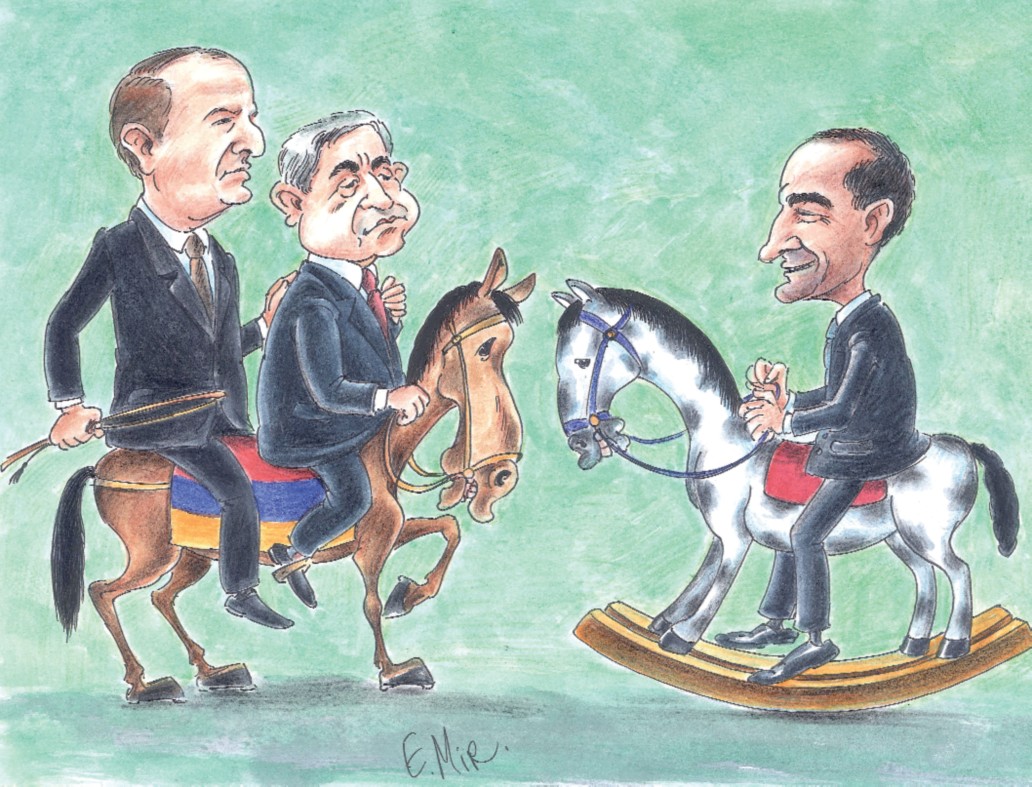
Serzh Sargsyan and Levon Ter-Petrosyan may join forces against Robert Kocharyan

Author: Nurani Baku
The Armenian remake of the "Arab spring" is being postponed, if not cancelled altogether. Not long ago most media carried reports about large opposition rallies in Yerevan, primarily those of the Armenian National Congress led by Armenia's first president, Levon Ter-Petrosyan. He had promised to take hundreds of thousands of his supporters to the streets to implement the "Egyptian scenario" in Armenia and would not accept anything other than resignation from the authorities. Then the situation changed dramatically. We recall that during one of the rallies Levon Ter-Petrosyan read out a rather lengthy list of demands. It looked like an ultimatum, while the first president chose a very harsh tone in which to talk to the third. But the demands appeared quite feasible, while the dialogue is no longer built on the principle of "resignation and early elections - we will not agree to anything less".
Unexpectedly for many, the Armenian authorities made obvious concessions. Under pressure from the opposition, Yerevan reopened the investigation into the tragic developments of 1 March 2008, when 10 people were killed in the streets of the capital during the dispersal of a rally organized by Ter-Petrosyan's supporters. Of course, contrary to the demands and hopes of the Armenian opposition, no specific charges have been levelled against Serzh Sargsyan and Robert Kocharyan yet, but, as a well-known Soviet politician used to say, "the process is under way".
Another remarkable event in the opinion of experts has been the freeing from custody of a number of Ter-Petrosyan's key supporters, including the editor of the opposition newspaper Haykakan Zhamanak, Nikol Pashinyan, who was imprisoned in the aftermath of 1 March 2008. Besides, opposition activists have received access to Freedom Square, also known as Theatre Square, in Yerevan.
Such concessions on the part of authorities under pressure from protesters are usually viewed as weakness, which is followed by a predictable desire "to finish them off". But instead, Levon Ter-Petrosyan suddenly stops the rallies and other activities, explaining that if there is chaos in Armenia, Azerbaijan may take advantage on the Karabakh front.
There is a sufficient number of theories explaining, with a varying degree of credibility, this turn of events. Of course, it is possible to maintain that commonsense has prevailed, that both sides have displayed a constructive approach, etc., but in reality such benevolence does not happen in Armenian politics very often. What is more likely is that there is unity against a "common enemy". And this enemy, to all appearances, is Armenia's second president, Robert Kocharyan.
Experts are saying that the possible political revival of Robert Kocharyan has been a talking point almost from the time Serzh Sargsyan took office. To a large extent, this is explained by the fact that after leaving the post of Armenian president at 54, Kocharyan did not outline his political future. Unlike Russia's example, he didn't take the office of the prime minister under a new president from his own team.
The talk that Robert Kocharyan intends to return to power, and clearly without a "gentlemen's agreement" with Serzh Sargsyan, has been floating around for some time. The reason behind this is that the second Armenian president has been giving political interviews, paying what looks like private visits to "leading capitals", most notably Moscow, where he is received by senior leaders… In addition, many are sure that Robert Kocharyan has a good chance of securing the support of at least a part of the protest electorate which is convinced that life was better in the time of his presidency.
Indeed, the presidency of Levon Ter-Petrosyan is remembered as the worst years of the post-Soviet turmoil and "energy blockade" of Armenia, which resulted in its aggressive policies against Azerbaijan. Following the ascent of Robert Kocharyan to power, there was a brief period of economic development. Thanks to the supplies of oil and oil products from Iran and the re-launch of the Metsamor nuclear plant, the problem of energy supplies was resolved, several new residential complexes were built in Yerevan, the media first talked about diamond-cutting as a hope of the Armenian economy and then about "Armenian Singapore", etc.
Experts, however, had been warning from the very beginning" that this brief period of "lively economic figures" should not be seen as an indicator of sustainable development. After isolating itself from the main economic locomotive of the region, Azerbaijan, Armenia could not resolve its economic problems even theoretically. The high crime rate of the country should not be forgotten either.
The process of a large-scale collapse of the Armenian economy started already under Serzh Sargsyan, and the global economic downturn played a part in that. Finally, as many experts believe, Serzh Sargsyan simply lacks the charisma, the character of a leader, authority and decision-making skill. Kocharyan is the most dangerous opponent for Sargsyan primarily because he is relying on the same "Karabakh clan" that has already survived a number of splits.
As a result, Serzh Sargsyan is effectively left with no option other than to look for allies on the principle that "the enemy of my enemy is my friend".
The question now arises as to how strong the alliance of Sargsyan and Ter-Petrosyan against Kocharyan can be.
And even a very superficial analysis of the situation leaves no doubt about this: a strong friendship between Serzh Sargsyan and Levon Ter-Petrosyan is unlikely. By getting too close to the authorities, Ter-Petrosyan runs the risk of losing his biggest trump card - the votes of the dissatisfied electorate. And these include not only those forced to join the opposition by the social disorder, but also those who are displeased with the clan distribution of influence in Armenia, mostly the natives of Yerevan. Especially since another opposition party, Heritage, will embrace them with open arms.
Also, Ter-Petrosyan is unlikely to settle for the release of Nikol Pashinyan from prison and the right to stage rallies in Theatre Square. He clearly wants more, at least after the "Robert Kocharyan problem" is out of the way.
However, Robert Kocharyan is unlikely to choose the tactic of "rallying", "Armenian Tahrir" and "flower revolution", something Ter-Petrosyan is placing his stakes on. His favourite style is conspiracy and intrigue in the corridors of power, the tactic of a "creeping coup" which helped Kocharyan estrange Levon Ter-Petrosyan from power in 1998, when he himself was prime minister. His key ally at the time was Serzh Sargsyan, and he knows very well how this should be done.
RECOMMEND:
 703
703

