

"NO WINNERS OR LOSERS..."
The US-Russian treaty boosted the Kremlin’s pride and gained political points for the White House
Author: Eldar PASAYEV Baku
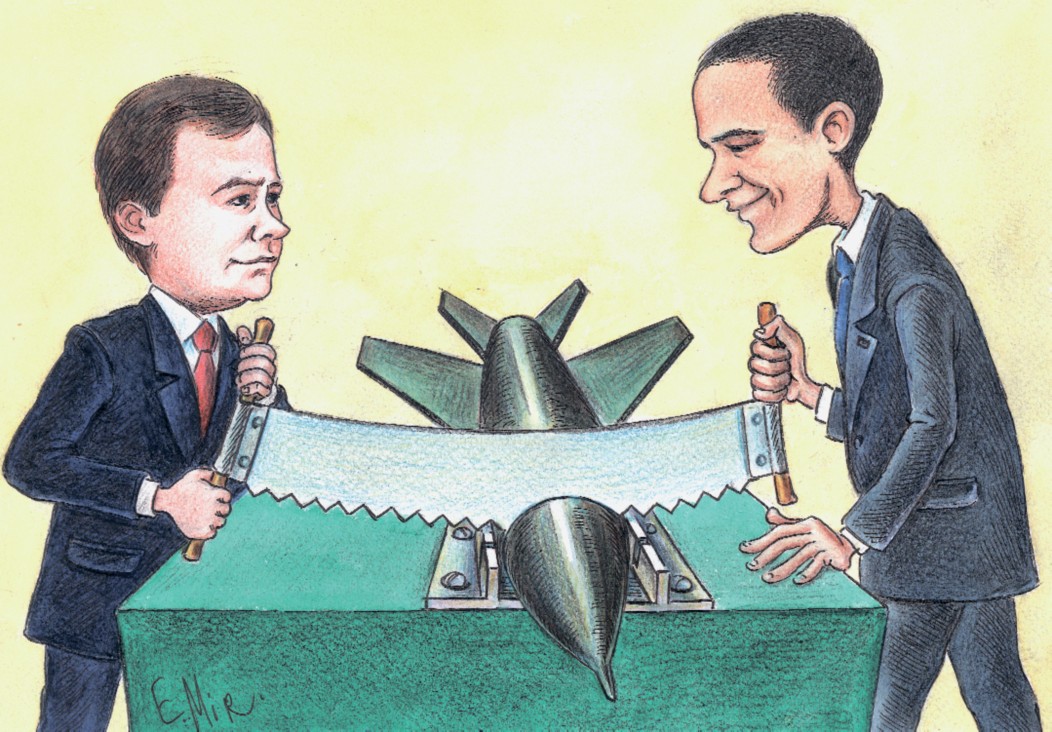
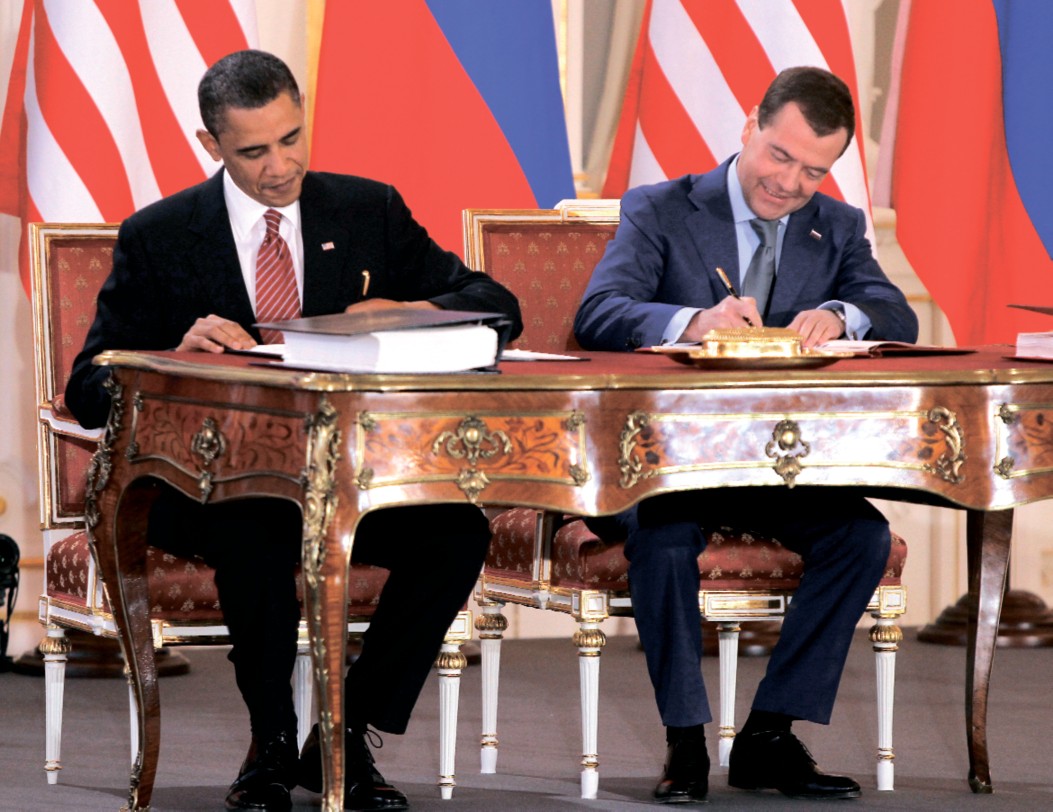
The signing of the new Russian-US Strategic Arms Reduction Treaty (START) on 8 April 2010 in Prague was the result of long and painstaking work. Suffice to mention that the previous agreement (signed in 1991) expired at the end of 2009, but Washington and Moscow finally managed to reconcile their positions only in mid-spring this year. To make this possible, a special commission had been set up, comprising representatives of more than 30 departments. In total, experts conducted 10 rounds of fully-fledged negotiations under the personal supervision of the Russian and American presidents.
700 - 800 - 1,550
According to the text of the new treaty, which consists of more than 160 pages, Russia and the United States need to reduce the number of deployed strategic delivery systems - intercontinental ballistic missiles, ballistic missiles on submarines and heavy strategic bombers - to 700 within seven years from signature. The total number of deployed and non-deployed warheads for each party shall not exceed 800 units. The maximum total number of warheads is 1,550 units on each side, which is 30 per cent fewer than was anticipated by the previous treaty.
Earlier, RIA Novosti quoted the Russian presidential aide Sergey Prikhodko as saying that the treaty now encompasses both used and decommissioned strategic systems. In addition, the new treaty provides for strict control of submarines converted to conventional weapons, and heavy bombers, which is intended to limit the return potential.
Further, each side can have limited non-nuclear strategic potential, which is not taken into account in the total number of carriers and is located in special areas under the control of the orbital grouping. Information exchange is planned once a year and the decision on what data will be included in the report will be taken by the reporting side. By the way, the treaty does not provide for continued monitoring of the key Russian company in the production of rocket technology in Votkinsk.
The new treaty is valid for 10 years. It is possible to extend the treaty by mutual agreement of the parties for a period not exceeding five years, unless it is replaced by a new treaty.
Meanwhile, before the signing of the treaty, The New York Times pointed to "snags" in the counting of warheads: under the treaty, the actual number of warheads which are equipped with ground-based and sea-based ballistic missiles will be taken into account, but each heavy bomber is equated to one warhead, although it could have many more on board. It also states that, for example, a B-52 bomber can carry 20 units of nuclear weapons at the same time - 14 cruise missiles, four B61-7 bombs and two B83 bombs". Thus, according to the Federation of American Scientists, "about 450 of the 2,100 operationally deployed US warheads and 860 of the 2,600 Russian warheads will not be taken into account, so in order to comply with the treaty, America has to cut 100 warheads and Russia - 190." At the same time, the White House says that "the bombers are not the most important element of arms control, because they are not designed for first strike."
The very text of the treaty states that "each of the parties restricts heavy bombers designed for testing to no more than 10 units."
Caveats
Now the document must be ratified by the Russian parliament and the US Congress. And the "battle" in Congress is clearly not going to be easy, because there are opponents of the treaty with Russia even in Obama's own entourage, not to mention the Republicans.
According to The Los Angeles Times, there are fears that Obama's political success could turn into a legal defeat. Therefore, as indicated by the authoritative American publication, the American president "has a choice of two options: he can ask two-thirds of the Senate to ratify the treaty in accordance with the second article of the Constitution, or ask a simple majority of both houses to approve the treaty in accordance with the first article."
"President Nixon chose the second path when discussing the initial treaty on weapons with the Soviet Union in 1972. Obama should follow Nixon's constitutional path. In this case, he will need the support of only 60 senators. Otherwise, he will have to get 67 votes, and he runs the risk of obstruction," says The Los Angeles Times.
Meanwhile, Moscow also has its own caveats to the treaty. On 6 April, Russian Foreign Minister Sergey Lavrov clearly named the conditions under which Russia could withdraw from the START Treaty. Thus, it will happen "if the quantitative and qualitative build-up of the potential of the US missile defence system has a significant impact on the effectiveness of Russian strategic nuclear forces."
Previously, Moscow did everything it could to ensure that the new START Treaty took into account the relationship between offensive weapons and strategic missile defence. The Kremlin, as you know, is sure that the deployment of US missile defence elements in Europe may not only serve as protection against possible attacks from "rogue states" such as North Korea and Iran, but also threaten Russia's national security.
However, the US also insisted and the new START treaty contains no limitations on missile defence, although, according to Lavrov, the document still maintains some relationship between START and ABM.
In any case, Barack Obama once again stressed at a joint press conference with Medvedev in Prague that "the US missile defence system will not threaten the strategic security of Russia".
"This discussion will be part of a broader debate about how to remove tactical nuclear weapons from the war theatre and reduce non-deployed missiles more drastically. There are a number of issues on which significant progress can be made," said the American president.
Venue for "resetting"
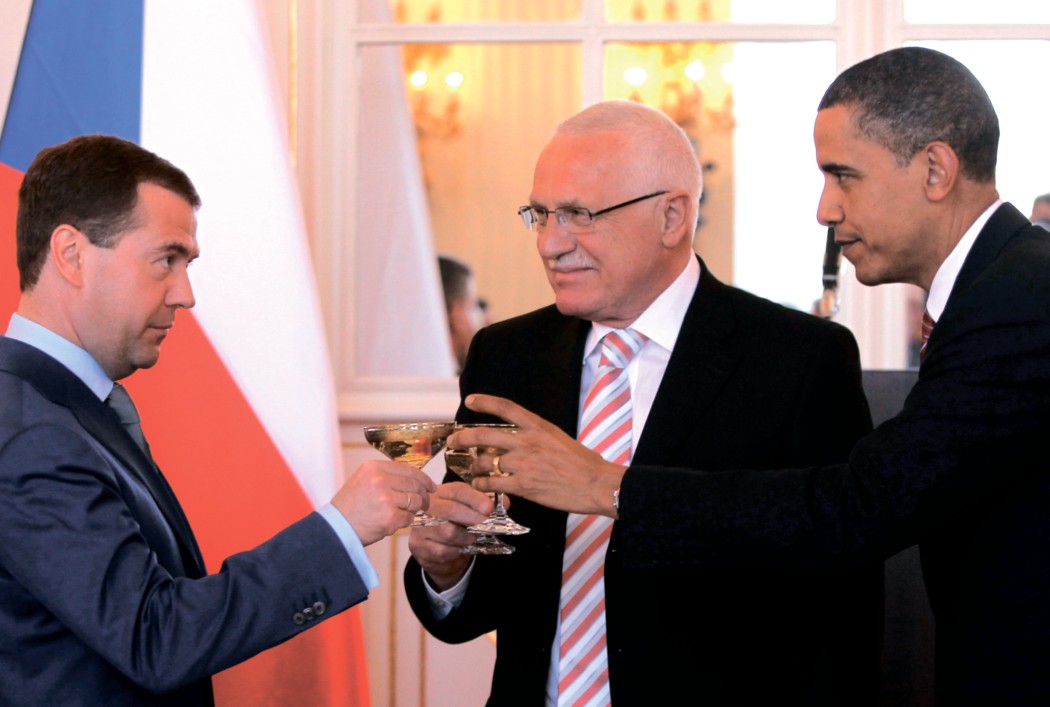
Incidentally, in this light, the very venue for the signing of the document is significant, because along with Warsaw, Prague was supposed to host US missile defence systems in Europe according to President George W. Bush's plan. Differences between the US and Russia on this issue erupted to such an extent at one time that the world's media were once again actively using that half-forgotten phrase "Cold War".
However, the new President Barack Obama gave up on his predecessor's plan and offered a different version of the American missile shield. As a result, the opposite happened, and Prague can be called the venue at which the famous "reset button" for US-Russian relations was finally pushed. At the same time, Obama and Medvedev agreed to continue discussions on missile defence, including information exchange and threat assessment.
Analyzing the treaty, experts indicate that it can be called a stage in US-Russian "resetting", first of all because by its presence, the document, so to speak, sustains Russian pride. The fact is that in the START Treaty, Russia and the US are nearly equal opponents, with the same geopolitical role. Moreover, these "rivals", recognizing their important role, have made a deal in order to set an example for the rest of the world. As stated by Dmitriy Medvedev, "Russia and the United States, in signing the treaty, have strengthened not only their own safety, but the safety of the entire world community." The main thing is that there are "no winners or losers", he said.
In this case, it is worth noting that Russia frees up money that previously went towards the maintenance of armaments (as well as by simplifying the verification mechanism), while Obama clearly gains points for his political image. Many US media called the treaty the first undisputed foreign policy success of the White House.
"The new START Treaty brings the world closer to a safe future without nuclear weapons, which represent the darkest days of the Cold War and the greatest threat of our time. We are taking another step forward, leaving the legacy of the 20th century in the past and building a safer future for our children," said the US president.
In addition, Obama assured the leaders of the post-socialist states of Central Europe of the progressive strengthening of Russian-American relations. The US president believes that this fact will have "a positive impact on the Central European region" and "significantly enhance its security."
One day before
In any case, the Obama administration achieved something more important - it strengthened its position in the eyes of the world community on the eve of an important battle in the UN Security Council over the imposition of new sanctions against Iran. It was once again demonstrated that the pace in the field of nuclear weapons is set by Russia and the US, and they had the final say by signing a new treaty on strategic offensive arms. Thus, Washington puts an additional argument into the hands of Moscow which is still in doubt, and it is now simply impossible not to say that Tehran must be influenced by decisive methods.
So, Obama pointed out again at the joint news conference with Medvedev in Prague that "the Iranian nuclear programme threatens to usher in a new arms race."
"We will work to ensure that the UN Security Council establishes strong sanctions against Iran, and we will not tolerate actions that go against the non-proliferation regime," said the US president in response to which his Russian counterpart, it seems, could do nothing but to note that "the UN Security Council could reconsider the issue of Iran, since Tehran has not responded to a number of constructive compromise proposals on its nuclear programme."
Moreover, the prevention of nuclear terrorism and the proliferation of nuclear weapons is the main purpose of a new nuclear strategy, which the White House administration proposed a few days before the signing of the treaty. According to the document, the role of weapons of mass destruction in the national security of the country is significantly reduced.
The US promises not to use nuclear weapons against non-nuclear countries, even if these countries attack the United States with biological or chemical weapons. Obama believes that such attacks can be perfectly well repelled without weapons of mass destruction - with the help of modern conventional weapons. However, the document spells out an exception for countries that fail to meet fully the requirements of the Treaty on the Non-Proliferation of Nuclear Weapons.
Thus, Barack Obama makes it clear: currently, the world community has the resumption of dialogue on nuclear disarmament on the agenda. Incidentally, in May New York will host a conference on the Treaty on the Non-Proliferation of Nuclear Weapons (NPT), which will bring together many politicians, scholars and public figures.
It is also worth noting that Obama expressed a hope in Prague that the signing of the START Treaty will give impetus to discussions with Moscow on reducing tactical weapons, including non-deployed ones. In particular, it has been repeatedly said that the US may withdraw tactical weapons - 200 atomic bombs - from Europe.
RECOMMEND:
 748
748

