

YEREVAN UNDER PRESSURE
The OSCE Minsk Group may have to hold talks in a completely different situation in late April
Author: NURANI Baku
Diplomatic activity surrounding the Nagornyy Karabakh conflict is increasing. The Karabakh issue was one of the main topics of talks between the Turkish prime minister and French President Nicolas Sarkozy during Recep Tayyip Erdogan's visit to Paris. The subject of Karabakh was the focus of Recep Tayyib Erdogan's message to President Barack Obama, according to the media. The message was delivered to Washington by Turkey's ambassador to the United States, Namik Tan. Finally, before the start of the "nuclear summit" in Washington, many informed sources stressed that Erdogan would raise the subject of Karabakh during his meeting with the US president. However, major events unfolded in the region itself.
In mid-March, Azerbaijani Foreign Minister Elmar Mammadyarov revealed details of an updated version of the Madrid principles for the Nagornyy Karabakh settlement: "According to the document, Armenia should first of all withdraw from 5 districts and 13 villages in the Lacin District. Then all borders and communications will be opened, a donor conference will be held, land and communications will be restored, programmes will begin to be implemented, the issue of international observers will be addressed, due to the importance of the security of internally displaced persons returning there, then the Armenian troops will withdraw from the Lacin and Kalbacar districts and all roads will open. After the return of the Azerbaijani community to Karabakh, conditions will be created to begin the process of determining the status of Nagornyy Karabakh at the final stage."
At the same time, the minister stressed that "Karabakh is Azerbaijan's land, and it would be wrong if any part of the republic's territory was not under its administrative control."
"Of course, we say that all questions must be determined within the territorial integrity of Azerbaijan. With respect to self-determination, this issue is part of international law. However, this does not mean that territorial integrity may be affected," Mammadyarov said.
"Let Armenia declare whether it accepts this option or not, so we know what to do next. We in the Foreign Ministry are also discussing various options and thinking about how to hold this year's discussions," said the Azerbaijani foreign minister.
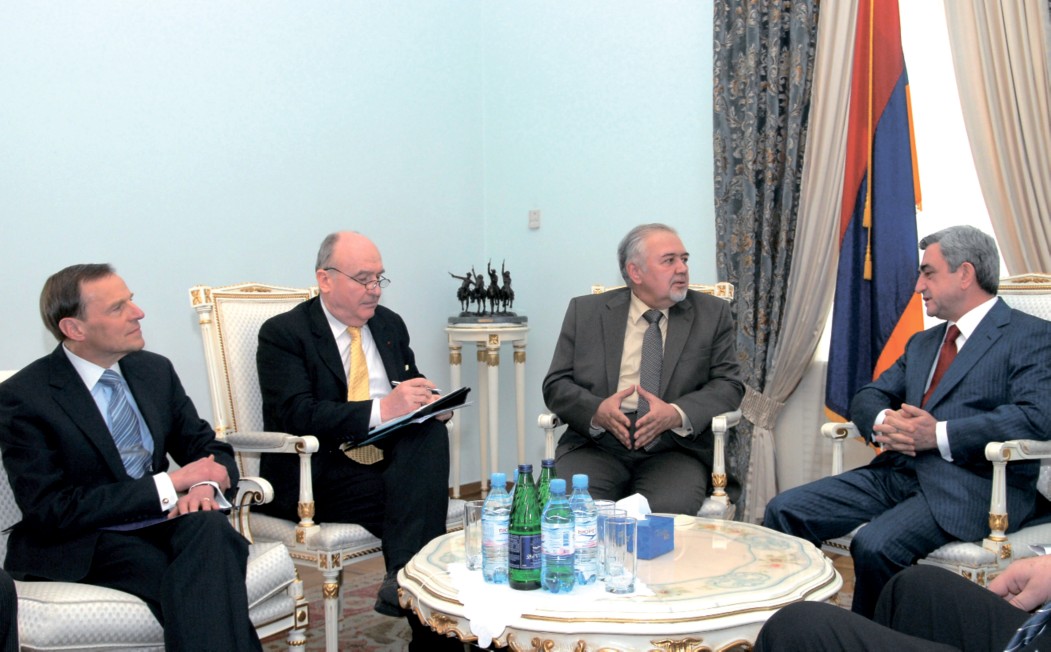
And then, a real "diplomatic fever" broke out in the region. First, there was NATO's Rose Roth workshop in Yerevan, where, according to the French co-chairman Bernard Fassier, Novosti-Armenia mis-quoted him. And then there was an official release by the co-chairs: "The OSCE Minsk Group co-chairs, Ambassadors Yuriy Merzlyakov, Bernard Fassier and Robert Bradtke, visited Yerevan and Nagornyy Karabakh from 26-29 March. On 27 March, they met with the de facto authorities to discuss the current state of negotiations. On 28 March, they met with President Serzh Sargsyan and Foreign Minister Edward Nalbandyan in Yerevan and discussed Armenian comments on the basic principles of the Nagornyy Karabakh conflict. In Armenia, the co-chairs also held a series of other meetings. As a result of these meetings and gatherings in Paris, the co-chairs welcome the parties' commitment to achieving a peaceful settlement of the conflict based on the Madrid principles."
And then the Minsk Group left the region, without visiting Baku. However, they promised to return: the Russian ambassador to Azerbaijan, Vladimir Dorokhin, quoted the Russian co-chair of the OSCE Minsk Group Yuriy Merzlyakov, as saying that the mediators would arrive in the region in late April. But what they will have "in the portfolio" is a question to which there is no official answer. Even after Mammadyarov revealed details of the Madrid principles, the Minsk Group continues to maintain confidentiality.
There was no clear and transparent Armenian reaction as to whether it accepts the Madrid principles or not. At the official level, Yerevan assured us that they accepted them as a basis for negotiations two years ago, but now the press says that Armenia does not accept four points. And we can assume that these points also include the withdrawal of troops, the return of Azerbaijani refugees and the status of Nagornyy Karabakh within the territorial integrity of Azerbaijan.
Meanwhile, before the prolonged and first "non-shuttle" visit to the region by the OSCE Minsk Group co-chairs, Armenian President Serzh Sargsyan suddenly proposed that Azerbaijan sign an agreement on non-use of force for the period of the negotiations. Baku did not officially respond to this initiative, but made it clear unofficially: on the negotiating table there are real proposals, and if Armenia is so committed to a peaceful settlement, then let them respond. But instead, Yerevan, while continuing its occupation of foreign lands, is still trying to get guarantees of security.
After the co-chairs' visit to the region, Armenian Foreign Minister Edward Nalbandyan proposed that the status of Karabakh should be determined first and then all remaining issues resolved, which, we should add, would enable Armenia to turn the occupied lands into an object of haggling over the infamous "status".
But all these "initiatives" taken together leave no doubt: Armenia is clearly trying to divert negotiations away from the Madrid principles, which the current Yerevan government is not willing to accept, but cannot reject either - the "political risk" is too high. And the hasty departure of the Minsk Group from the region proves this once again. The diplomats have also taken a break to decide how to proceed.
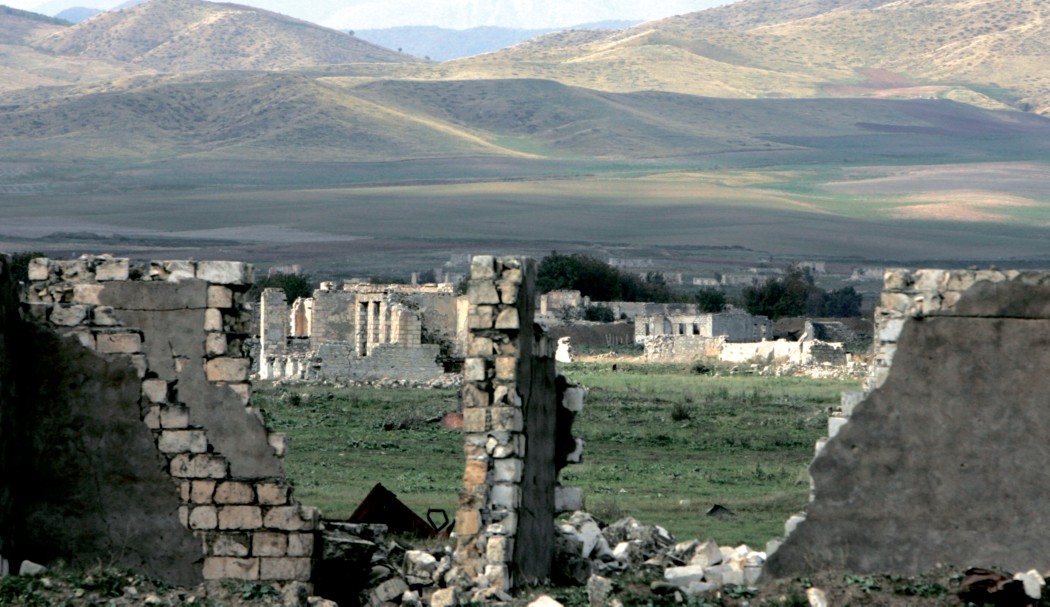
Frankly, this is not the first time that Armenia has blocked international initiatives on resolution of the conflict. But this time the old play features characters with new scenery and a completely different frame of mind in the "audience", because the world's attention to the Nagornyy Karabakh conflict has increased significantly. First of all, after the "five-day war" between Russia and Georgia, which left no doubt about the ease with which "frozen conflicts" can escalate into large-scale war and about the threat they pose to oil and gas communications in this case. And all that has happened in the region after the signing of the "road map" and the Zurich protocols between Turkey and Armenia leaves no doubt: the unresolved Karabakh conflict is not conducive to real progress in other areas.
Either way, it was after the departure of the OSCE Minsk Group from the region that it was announced to the surprise of many that Armenian President Serzh Sargsyan had been invited to the nuclear summit in Washington. This caused a quite unique reaction from the Armenian political establishment, especially the opposition: the President of Armenia will be persuaded, and quite insistently, to accept the Madrid principles.
"Despite their apparent importance, it is unnecessary to speak about Armenian-Turkish relations at the moment, because they depend solely on the resolution of the Nagornyy Karabakh problem or progress in this matter," Armenia's first president Levon Ter-Petrosyan told a rally in Yerevan. "According to the OSCE Minsk Group, progress means the surrender of five districts by the Armenian side," he said. In exchange, according to Ter-Petrosyan, Armenia gets only promises, if we exclude the de-blocking of some roads and the opening of the Armenian-Turkish border.
According to the first president of Armenia, the OSCE Minsk Group co-chairs have serious differences on the issue of Karabakh's status, about which he promised to talk in future statements. However, Ter-Petrosyan said, all the co-chairs are of the opinion that Armenia must withdraw from the territories, and Baku and Ankara's interest and support in this matter further aggravate Yerevan's situation.
According to Ter-Petrosyan, everything now depends on the position of the Armenian side: either the President of Armenia signs the Madrid principles, which will upset people, or does not sign them and upsets the international community. "In both cases, Serzh Sargsyan will lose power. If he signs them, he will be overthrown by internal forces, and if he does not, he will be overthrown by foreign forces which have a seriously compromising dossier on him: rigged elections, the events of 1 March 2008 etc. But I think he will choose the first option, and will soon, willy-nilly, hand over five districts to Azerbaijan. He is confident that in this case, the international community will guarantee his immunity - up to a Nobel Prize and political asylum."
Of course, we can and do not trust Levon Ter-Petrosyan's assessment. But there is no doubt that soon the President of Armenia may really come under very serious pressure. And the Minsk Group will probably have to conduct the talks in a completely different situation in late April.
RECOMMEND:
 670
670

