
CRIME WITHOUT PUNISHMENT
Another fact about the indifference of the international community to armenian terrorism
Author: Sahil ISGANDAR, a political scientist Baku
In February this year Armenian terrorists Kevork Miroshyan and Hovik Nobaryan were released from a Canadian jail. They were arrested 25 years ago over an explosion in front of the Turkish embassy and were sentenced to life imprisonment for terrorist activities. These terrorists, just like all their "colleagues", explained their crime by an attempt to draw global attention to the "Armenian genocide". Perhaps, there is no need to say that the end does not justify the means, especially when people are obsessed with a desire to avenge an offence which they have invented themselves. On the other hand, everyone knows that Armenian terrorist organizations are involved in numerous terrorist acts that are totally unrelated to the so-called "genocide."
It should be noted that when the Armenian terrorists were sentenced to life imprisonment in Canada, the "Armenian genocide" had not yet been recognized by Ottawa. Now it turns out that, recognizing the "Armenian genocide" at the level of Parliament (in 2002 and 2004.) and government (in 2006), Canada heeded the "voice of reason" and released the "fighters for justice". This formulation can be applied to all other countries that have shown touching concern for Armenian terrorists. Now let's talk about everything in order.
To begin with, I would like to cite a few facts to show that speculation about the cause-effect relationship between the "Armenian genocide" and Armenian terror is absolutely groundless. To see this, it is enough to refer to the book "The Age of Terrorism" by the British historian Walter Laqueur: "The Armenian revolutionaries (in the Ottoman Empire) of the 1880s and 1890s anticipated that their attacks on the Turks would lead to cruel vengeance, which in turn would radicalize the Armenian population and could lead to intervention by Western countries. Before 1914, Armenian terrorists contributed to the catastrophe that befell their people in eastern Turkey during the First World War." The British scholar's studies prove that Armenian terrorism is not a consequence of the ill treatment of the Armenians by the Ottoman Empire, but the direct cause of such treatment.
In its initial stage of formation, Armenian terrorism was also directed against many famous Armenians who refused to support this phenomenon. In December 1903, the banker Dzhamgarov was killed on the porch of an Armenian church in Moscow, because he did not keep his word to transfer 30,000 roubles to the Dashnaktsutyun party (the ideological mastermind of Armenian terrorism). In July 1907, the carpet trader Tavshanjian was shot in New York because he had declined to pay $10,000 for activities to overthrow the Turkish authorities in Armenian-populated regions. The murder was organized by Arzuyan (the head of the local branch of the Hnchak party) who was suspected of involvement in the killing of other Armenians in the United States who had also refused to make "donations" to the Armenian terrorist fund. In 1908, a writer and revolutionary Arpiar Arpiaryan, a prominent figure in the reorganized Hnchak party, was killed in Cairo. He had published information on the criminal activities of his compatriots. In 1920, M. Arutyunyan, V. Yesayan and A. Aramyants, whom Armenian terrorists had accused of collaborating with the Turkish authorities, were also killed in Istanbul (Constantinople).
Dashnaktsutyun is the author of the majority of terrorist attacks in the Caucasus at the beginning of the last century. Initially, the main efforts of this organization were aimed at the "liberation" of Armenians from Turkish control, and they were supported by the central authorities of Russia at that time in accordance with the country's foreign policy against Turkey. However, after the adoption of the law on the confiscation of the property of the Armenian Church in Russia in June 1903, which undermined the financial basis of the Armenian nationalist forces led by Dashnaktsutyun, the terrorists took a militant anti-Russia stance. By the decision of the Hnchak party, the first attempt was made in October 1903 on the life of the Russian army commander in the Caucasus, Prince Golitsyn, whom they considered responsible for the confiscation of the property of the Armenian Church. Golitsyn expected an attack and wore a coat of mail, so he was only wounded. In 1907, the 4th extraordinary congress of the Dashnaks decided to assassinate officials of the Russian Empire, beginning from P. Stolypin. In July of the same year, General Maksud-Alikhanov Avarskiy was killed in Aleksandropol. The wife of Lieutenant-General Glebov and their driver were killed along with him. The historian Gerard Libaridian (Director of the Zoryan Institute in Cambridge) admitted that from 1903 to 1906 alone, Armenian terrorists committed 105 murders. The absolutely inert reaction of the international community, especially the central authorities of tsarist Russia, to the atrocities of Armenian terrorists, as well as the selfish geopolitical interests of world powers prompted their activity. Impunity provoked further terrorist attacks. For example, in October 1919, the 9th congress of the Dashnaktsutyun party decided to destroy people considered as the main organizers of the "genocide of Armenians". A series of terrorist attacks was named Operation Nemesis. A list of 650 people was considered, and 41 people were selected for assassination. The ambassador of the Republic of Armenia to the United States, Armen Garo, was appointed head of the authority responsible for the operations. Thus, an official representing Armenia in the cradle of democracy became the leader of terrorist attacks.
In June 1921, Soghomon Teyleryan, an Armenian terrorist who had killed the former Interior Minister of the Ottoman Empire Talat Pasha in Berlin, was brought to justice in Germany. The German jury turned the process into a one-day farce and acquitted the Armenian terrorist. In October of the same year, a British military court considered the criminal case of Misak Torlakyan, the killer of the former interior minister of the Azerbaijan Democratic Republic (ADR), Behbud Xan Cavansir. Based on the conclusion of two Armenian and one Greek physician about the mental disorder of the terrorist, the tribunal exempted Torlakyan from responsibility. He was then deported to Greece.
In January 1973, 78-year-old Gurgen Yanikian (engineer-writer) acted as an Armenian terrorist in the American city of Santa Barbara, killing Turkish Consul General M. Baydar and Consul B. Demir in Los Angeles. Despite the court's decision on life imprisonment and tough protests from Ankara, Yanikian was released "for health reasons" in 1984.
He "explained" his actions by an attempt to attract world attention to the "Armenian genocide". Historical facts show that such figures, i.e. ideologists and organizers of Armenian terrorism, as well as its direct executors are abundant among Armenian "intellectuals". And they are not acting in the interests of the Armenian people.
Let's turn to the facts. Everyone will recall the active role of the writer Zori Balayan in inciting ethnic strife, and his statements about how much pleasure he received from participation in the Xocali massacre and from the sight of Azerbaijanis killed and their mutilated bodies. But it turns out that he feels the same animal instinct towards his own countrymen as well.
When the highest instances (sober-minded people) in Moscow warned him in the late 1980s "what are you doing, there are so many Armenians in Baku, and you are setting the two peoples against each other", he gave a cynical answer: "Let others think about them, they are not citizens of Armenia." But we should not think that, while speaking of citizens of Armenia, he was referring to representatives of all nationalities living in that country. It was only about the Armenians. Interpol excluded Balayan from the list of wanted persons, noting that the case had a predominantly political nature. Russia acted in the same way, stopping the search for Balayan on its territory. What is more, this representative of Armenian "intellectuals" lives in Russia for his own pleasure today, teaching his students the ideology of terrorism so that they are ready to stab Russia in the back at the right moment.
In January and November 1977, a series of terrorist acts was carried out in Moscow, which resulted in 6 people killed and 37 wounded. During its operations, the Soviet KGB arrested the perpetrators of these attacks A. Stepanyan, Z. Bagdasaryan and S. Zatikyan. The then first secretary of the Communist Party of Armenia, K. Demirchyan, and the chairman of the Armenian KGB, M. Yuzbashyan, did everything possible to impede the investigation and the arrest of these terrorists, trying to prove their innocence. But when their guilt was fully proved, the leadership of Soviet Armenia concealed this fact from the general public of the republic under a strange formulation: "In order not to cast a shadow on centuries-old Armenian-Russian friendship and not to compromise the Armenian people in the eyes of the Russians." Perhaps, it was this age-old "friendship" that inspired the Armenian terrorists to take such steps in Moscow.
When the three men were sentenced to death, many Soviet human rights activists headed by Academician A. Sakharov raised real hysteria and appealed to the then leader of the USSR, Leonid Brezhnev, with a letter in which they tried to prove the innocence of the Armenian terrorists. But the fair court decision was enforced. This was one of the rare cases when Armenian terrorists got what they deserved.
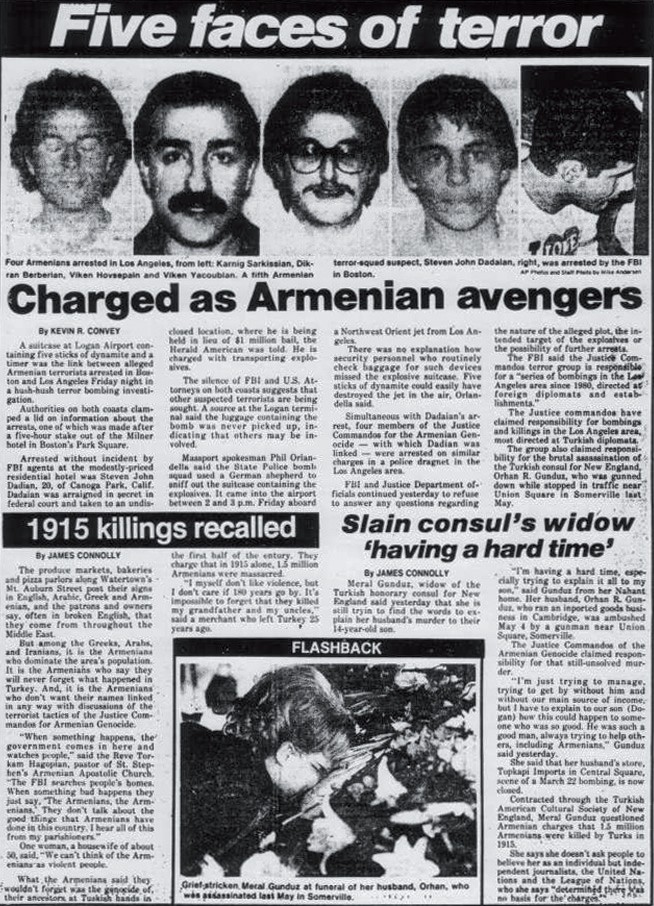
The activities of Armenian terrorists in France and reciprocal steps by local authorities draw particular attention. In September 1981, ASALA carried out Operation Van to seize the Turkish consulate in Paris. The operation was planned and organized by notorious M. Melkonian. Consul K. Inal and security official D. Ozen (who died in hospital from his wounds) were seriously wounded. Four Armenian terrorists took 56 hostages and held the consulate for 15 hours. It is striking that some of the French hostages sympathized with and helped the Armenian terrorists! When the terrorists' demand to release "Armenian, several Turkish and Kurdish political prisoners in Turkey" was rejected, they asked for "political prisoner status" and surrendered to the French authorities. Some of the French hostages suggested that they should wait until Turkey fulfils the demands of the Armenians. What a humane trial French justice organized in honour of the Armenian terrorists! Three of the terrorists were released in 1986, two of them then moved to Armenia. In 2001, Armenia marked the 20th anniversary of Operation Van. The French government entered into an agreement with the terrorists, and one of the conditions was lenient sentences for the participants in the attack on the Turkish consulate in exchange for ending ASALA operations on French territory. Most importantly, one of the leaders of ASALA Monte Melkonian was released. To the shame of French justice, on 25 October 1981, ASALA carried out 15 bombings in Paris. The compromising attitude cost France, and not only, dearly.
In mid-July 1983, ASALA commits another act of terror in Paris' Orly airport, in which 8 people were killed and 55 were wounded. Of the dead, only two were Turks, the rest were representatives of other nationalities (four Frenchmen, one Swede and one American). French justice proved to be weak once again. Only one of the organizers of this action - Varuzhan Karapetyan (Varoujan Garabedjian) was sentenced to life imprisonment in 1985. For the reasons best known to itself, France freed him in 2001. Armenia received the terrorist with high honours. The censure by Armenian rights campaigners drowned in the chorus of local "intellectuals" (S. Kaputikyan, G. Emin, P. Zeytuntsyan, Z. Balayan, etc.) who spoke out in defence of Karapetyan.
It should be noted that with the help of Echmiadzin, the special services of Armenia collected nearly a million signatures demanding the release of Karapetyan. Two of his accomplices were sentenced to 15 and 10 years in prison, as extenuating (?) circumstances were seen in their actions. Interestingly, M. Melkonian was re-arrested at the same time. But once again the French court played a game of humanism and sentenced him to 6 years' imprisonment, and three and a half years later, he was released. Does not it seem odd that he was released in the midst of the Nagornyy Karabakh conflict? In 1990, Melkonian appeared on the Karabakh front. Melkonian's group stood out for its specific atrocities against Azerbaijani hostages. In June 1993, units of the Azerbaijani army carried out a counter-terrorist operation and killed Melkonian. His grandiose funeral, which was organized by Armenians, was marked by the presence of the then president of Armenia, Levon Ter-Petrosyan. Armenia held grandiose ceremonies to mark the 50th birthday of Melkonian, who was called a national hero in this country. There is a school, street and museum named after Melkonian. In Armenia, there is a Melkonian Fund managed by the terrorist's wife Seda Melkonian. One of the sabotage centres of the Armenian Defence Ministry bears his name. It should be noted that Melkonian is not the only international terrorist who was sent by the Armenian authorities to crack down on Azerbaijani civilians in the area of the Nagornyy Karabakh conflict. Among them were such well-known terrorists as Vazgen Sislyan, Davidian, Hilbert Minasyan, etc. With the assistance of the Armenian diaspora, terrorists, weapons and finances from Iran, Lebanon, France, the United States, Russia and Greece were sent to the conflict zone through Armenia. Some terrorists (A. Mkrtchyan, V. Petrosyan, A. Mangasaryan, V. Harutuntyan and others) took refuge in Armenia despite the fact that different courts had sentenced them to death.
Most interestingly, a memorial plaque has been installed at the house where Melkonian lived in the French town of Clamart (near Paris). All this is happening against the backdrop of Armenian terrorism which has engulfed countries and regions: Europe, Middle East, Lebanon, Turkey, USA, France, Greece, Switzerland, Spain, Austria, Britain, Italy, Iran and Hungary, not to mention the occupied Azerbaijani territories. According to incomplete statistics, from 1973 to 2002, Armenian terrorist organizations committed 235 attacks, 70 murders, 41 assassination attempts and wounded 534 people in Western Europe alone.
Pay attention to the struggle with Armenian terrorists in the USSR and Russia. Despite the fact that the direct participation of three Armenian militants (E. Grigoryan, J. Azizbekyan and A. Oganov) was proven in the Sumqayit events in February 1988, the Soviet Prosecutor-General's Office classified investigative documents and saved the real instigators and perpetrators of these events from a just punishment. That is why the main organizer of the Sumqayit pogroms, E. Grigorian, was sentenced only to 12 years in prison, and soon he was released from prison with the help of his Armenian patrons. In early April 1991, Armenian terrorists killed a colonel of the Soviet Interior Ministry V. Blakhotin by mistake (instead of the former military commandant of the NKAR, General Safonov, whom they had sentenced to death). However, the Rostov Regional Court did not dare to punish the terrorists to the full extent of the Soviet law. After all, the country was governed by such an ardent defender and conductor of Armenian interests as Mikhail Gorbachev. Two of the terrorists were sentenced to 15, one to 12 years, and another one only to 4 years. One terrorist was released. It should be noted that these sentences were issued by the independent Russian Federation.
In autumn 1993, a counterintelligence officer of the Russian ZakVO, Soso Aroyan, was arrested as he tried to plant an explosive device on the Tbilisi-Baku train. In the course of operational activities in May 1994, the Russian FSK (now FSB) arrested a group of organizers of terrorist attacks in Moscow. The leader of the group was Lieutenant-Colonel Jaan Oganesyan, head of intelligence and sabotage operations on enemy territory at the Armenian State Administration of National Security. The second person was his subordinate, Lieutenant-Colonel Ashot Goloyan. The third detainee, Major Boris Simonyan, worked in the anti-terrorism office of the Russian FSK. The Chief Military Prosecutor's Office of Russia managed to collect evidence of their involvement in the explosion of a train in Azerbaijan and two attempts at explosions, one of which was committed on the territory of Russia. But the most interesting, if not tragicomic, thing was the finale of this epic. A Russian court acknowledged that their crimes fell under Article 213.3 (terrorism), but said that it was not possible to sentence the saboteurs under this article: "At the time of the crime, there was no article on terrorism in the Criminal Code. There was Article 68 (sabotage), but at the time of the trial, it had already been removed from the Criminal Code. Therefore, these individuals cannot be sentenced under that article." Thus, the Armenian terrorists were punished, but not for terrorism: Oganesyan was convicted under Article 86 of the Criminal Code (damage to railways and vehicles) and 218 (illegal possession of arms and ammunition) and was sentenced only to 6 years. Simonyan and Galoyan were also convicted under Article 218. The former was sentenced to 2 years' imprisonment, while Galoyan, who received slightly less, was released in the courtroom as he had already served his sentence. Just like in the well-known Russian proverb - "One law for the rich, one for the poor."
It is impossible to miss one more thing in this case. During the investigation it became clear that this group was financed by the Russian Technological and Intellectual Development Fund headed by V. Petrosyan. In mid-1992, the Ministry of Defence provided this organization with a loan (about $2 million) allegedly for housing troops. Very soon, the money disappeared. After the exposure of the Armenian terrorists who were financed by this structure, I think that all doubts disappeared.
In addition to these facts, Armenian terrorism is closely related to the affairs of the Sadval national movement, ethnic cleansing against Georgians in Abkhazia and attempts to destabilize the situation in Javakheti. Armenian terrorists from among citizens of Javakheti were implicated in the attempt on Shevardnadze (in his tenure as president of Georgia). In May 2005, an assassination attempt was made on the lives of US President George W. Bush and Georgian President Mikhail Saakashvili in Tbilisi. Already in July of the same year, the identity of the terrorist was established, and he was arrested. It turned out to be Vladimir Arutyunyan who killed an officer of the Georgian Interior Ministry's counterintelligence department during his arrest. A Georgian court sentenced him to life imprisonment. Now Arutyunyan is plotting an escape and occasionally causes physical injuries to himself, hoping to be handed over to a European country. Yes, you get used to good things quickly! What could be more desirable to Armenian terrorists than unprincipled decisions by judges in these countries? You can't think of a better gift for ASALA than such a spineless position that allows it to be based in France and Germany and feel at home in Europe.
For some reason, Armenian terrorists are taken care of precisely when world powers' intrigues in the South Caucasus reach a climax and the likelihood of military operations increases. It is unlikely that the political leadership of countries where Armenian terrorists are released from prison and allowed to avoid a just punishment does not know about this simple truth. During the formation of the first Armenian secret societies in the early 20th century, Russian diplomat F. Mayevskiy warned: "The main weapon of Armenian secret organizations, from the very beginning of their formation, was terror, terror in the form of unseen dangers that threaten anyone who dares to disagree, censure, condemn, or not to execute the decisions and demands of a certain organization."
RECOMMEND:
 736
736