

CRIME AGAINST HUMANITY
The internat вв ional community's recognition of the whole truth about the events of 18 years ago threatens to ruin the plans of the champions of armenian expansionism
Author: Natiq NAZIMOGLU Baku
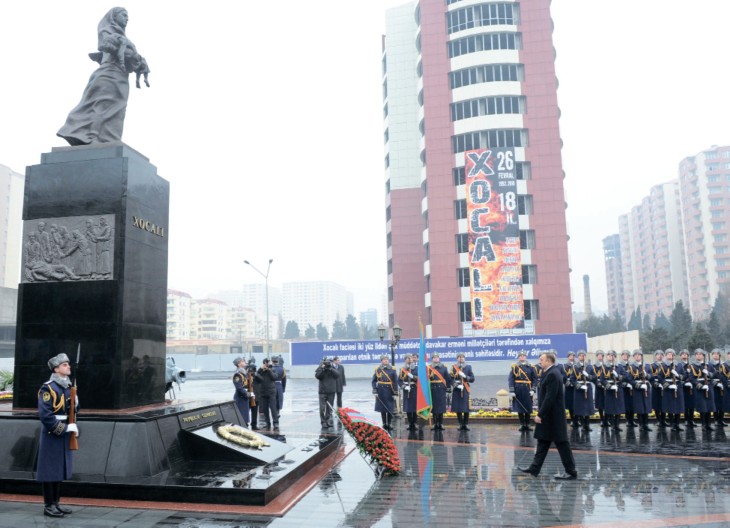
That cold February day has entered the history of Azerbaijan as a black date. Memories of it evoke a sense of immeasurable grief in people for their martyred countrymen. The pain of Xocali will never ease in our hearts!
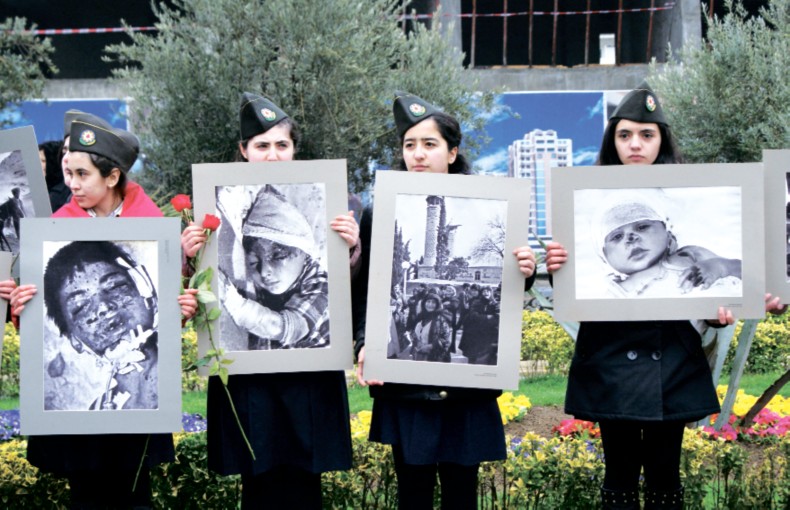
On the night of 25-26 February 1992, the Armenian armed forces, with the support of heavy military equipment and the personnel of the 366th infantry regiment of the former Soviet Union, razed the Karabakh town of Xocali to the ground. No mercy was shown for children, women, or old people...
According to official figures, 613 people were killed (including 106 women and 83 children), more than 1,275 were taken prisoner, 150 went missing and 487 were injured and permanently disabled. This tragedy is the most egregious crime that the Armenians ever committed during the Karabakh conflict, laying the foundation of the large-scale seizure of Azerbaijani lands in and around Nagornyy Karabakh. Taking the lives of hundreds of poor Xocali residents, the Armenian aggressors solved their important strategic task - to take control of Xocali airport and the corridor linking Asgaran and Xankandi.
The insidiousness of the Armenians was also that they destroyed Xocali at a time when Iran was brokering peace talks. On 25 February, Iranian Foreign Minister Ali Akbar Velayati was holding meetings with the leadership of Azerbaijan in Baku, and was going to fly to Karabakh and then to Armenia on 27 February. The conflicting parties had even agreed to cease fire from 27 February to 1 March in order to start a new round of negotiations. However, having decided that Baku's vigilance was lulled, the Armenian side intended to mark the three-day truce with an insidious campaign to exterminate the civilian population in an Azerbaijani town which they had not yet seized in Nagornyy Karabakh.
In fact, the then Azerbaijani authorities pandered to the plans of the butchers of our people, showing their own utter failure. Not only did they fail to organize the defence of Xocali and evacuate its inhabitants in a timely fashion, they also preferred to keep silent about the tragedy. However, although they proved their own helplessness and deprived themselves of the moral right to continue to decide the fate of Azerbaijan, the people learned the truth about Xocali. May the memory of TV journalist Cingiz Mustafayev live forever and many thanks to foreign journalists who showed in their reports from the site of the tragedy the true colours of the Armenian "self-defence forces" and the 366th Russian motorized infantry regiment! The picture of a field with mutilated bodies of Xocali residents shocked not only Azerbaijan.
"The Armenians attacked the Xocali region. The whole world witnessed mutilated corpses," said the French magazine La Croix-l'Evenement. The influential Paris newspaper Le Monde, talking about the tragedy of Xocali, wrote: "Foreign journalists saw women and three scalped children with nails driven into them among the dead. It is not 'Azerbaijani propaganda' - it is a fact and reality!" London's Sunday Times noted with horror: "Armenian soldiers annihilated hundreds of families." Britain's Frontline Television made the following verdict in its report: "The crime in Xocali cannot be justified in the eyes of the world community."
Some time later, Russia's Memorial Human Rights Centre stated that during the storming of Xocali, the actions of the Armenian armed forces against the civilians clearly contradicted the Geneva Convention, the Universal Declaration of Human Rights and the Declaration on the Protection of Women and Children in Emergency and Armed Conflict. "The massacre of the civilians in the free corridor zone and adjacent territory cannot be justified under any circumstances," the centre emphasized in its report.
Meanwhile, the tragedy in Xocali received a political and legal assessment at the state level only in Azerbaijan. On 24 February 1994, the Azerbaijani parliament adopted a special resolution "On the Xocali Genocide Day", which described the causes of the events in detail and named the culprits. However, Armenia's crimes against the Azerbaijani people have not been properly condemned by the international community. Most people in the world have yet to learn the truth about the evil committed by Armenian thugs in Xocali. More and more countries are demanding that the Xocali genocide be recognized as one of the most horrific tragedies ever experienced by mankind in the twentieth century.
For example, ahead of the 18th anniversary of the tragedy, the state secretary of the German parliament, former chairman of the PACE Monitoring Committee and president of the Society of German-Azerbaijani Relations, Eduard Lintner, filed an appeal entitled "The massacre and killing of the Azerbaijani population in Xocali and the fate of more than one million refugees in the Armenian-Azerbaijani war of 1992/93" with the Bundestag. The purpose of the petition is to inform the German and European public about the genocide of Azerbaijanis during the Armenian aggression in 1992 and the continuing occupation of Azerbaijani territories by the Armenian armed forces. The author of the document called on the Bundestag to unconditionally recognize the fact that the Armenian side committed a heinous crime against humanity in Xocali.
But, of course, the most important recent development in the context of international recognition of the Xocali tragedy is that the Parliamentary Assembly of the Organization of the Islamic Conference (OIC) adopted a resolution in the Ugandan capital, Kampala, in January, calling this tragedy "a crime against humanity" and "genocide implemented by the Armenian armed forces against the civilian Azerbaijani population." The resolution was put forward as part of the Justice for Xocali campaign, pioneered by the general coordinator of the OIC Youth Forum for intercultural dialogue, Leyla Aliyeva.
The resolution adopted in Kampala is, undoubtedly, an important step towards international recognition of the tragedy committed 18 years ago by the Armenian aggressors. It became the first international document to recognize the tragedy of Xocali as a "crime against humanity". Moreover, this document is also important due to the fact that it was adopted by the Parliamentary Assembly of the OIC which brings together a quarter of the world's parliaments and is the largest inter-parliamentary organization.
The adoption of such resolutions is the only part of Baku's policy, as well as the efforts of the Azerbaijani diaspora to inform the world community about the whole truth of the Karabakh conflict, in which the atrocities perpetrated by the Armenian side against Xocali civilians became the embodiment of the true intentions of Yerevan. Along with the State Committee for Diaspora Affairs, the Justice for Xocali campaign has been playing an important role in this direction in recent years. As part of this campaign, multiple actions have been held in many countries to mark the 18th anniversary of the Xocali genocide.
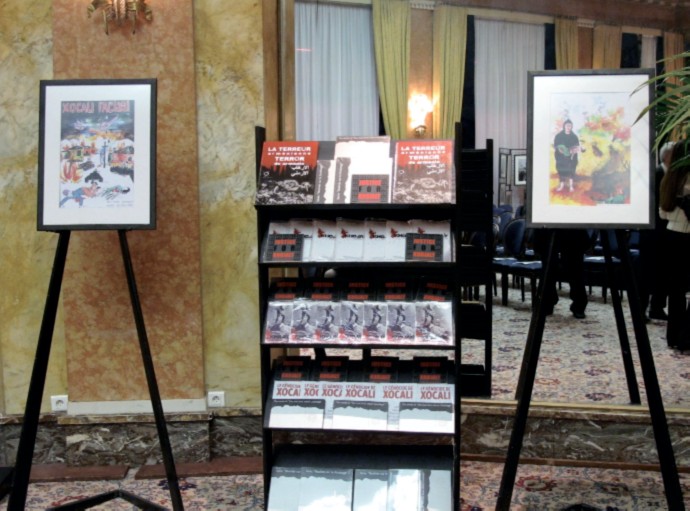
For example, the Permanent Mission of Azerbaijan to the Council of Europe, with the support of the Azerbaijani diaspora, organized a ceremony to commemorate the Xocali victims in the building of the Association of European Parliaments in Strasbourg. A special programme on the Xocali tragedy was broadcast by Radio Bienvenue Strasbourg FM 91.9. In addition, Azerbaijanis living in Strasbourg held a rally "MAIL", during which they sent out thousands of emails telling about the Xocali genocide in French, English and Turkish. These letters are addressed, primarily, to international organizations, in particular the Council of Europe and the European Union, as well as the parliaments and government agencies of France, Belgium, Switzerland, Canada, Sweden, the United States, Israel, Australia and various international media.
In days of remembrance for the victims of the Xocali genocide, marches and rallies were held in various European cities. Events in commemoration of the Xocali genocide were also organized in the United States, Canada, New Zealand, the United Arab Emirates, Turkey, Russia and Ukraine.
The Association of Azerbaijanis of France and the French-Azerbaijani Youth Association organized a march in the centre of Paris with support from the Irali public association. In London, 613 helium balloons with the names of the victims of the tragedy in Xocali were released in front of the British Parliament. On 26 February, a ship carrying the inscription "Justice for Xocali" cruised the Thames. A show of drawings "Xocali in the Eyes of Children", which are part of the exhibition of the Heydar Aliyev Foundation, was organized in Berlin.
A significant symbolic event connected Xocali to the Czech town of Lidice, which was virtually razed to the ground by German fascists during the Second World War. Due to the similarity of the two tragedies, events were held to commemorate the victims of the Xocali genocide in the Memorial Complex of Lidice in February 2007. The mayors of Xocali and Lidice have now signed a protocol on twinning the two towns. In addition, the authorities of the Czech town decided to name one of the streets of Lidice after Xocali.
Azerbaijan's efforts to secure the international recognition of the Xocali genocide cause great concern in Armenia. For those who have been trying for decades to persuade the world of the so-called "genocide of 1915", it is extremely undesirable that their own crimes, the most glaring of which was the massacre in Xocali, will be exposed. The international community's growing awareness of the whole truth about the events that happened 18 years ago threatens to ruin the plans of the champions of Armenian expansionism who are nurturing plans to harm their neighbours and seize their territories under the guise of a myth about the suffering of their own people.
At the same time, it should be clear that the best monument to the victims of the Xocali tragedy can only be the restoration of historical justice in the land of Azerbaijan, which was trampled upon by Armenian invaders. The latter should get out of the territories they have seized, and the Azerbaijani refugees, including the surviving residents of Xocali, should return to their homes.
We must not forget that in February 1992, the enemy, armed to the teeth and supported by significant military power from outside, hoped that Azerbaijan, which was not prepared to conduct a full-scale war and was disoriented by internal political strife, would not be able to withstand the blow, would surrender to the mercy of the organizers of the Xocali massacre and accept the loss of Karabakh. However, not only did Azerbaijan survive the imposed war, eventually it became the most powerful state in the South Caucasus. Armenia, which persists in its unwillingness to voluntarily withdraw from the occupied Azerbaijani lands, is doomed to defeat. Azerbaijan's patience has limits, and sooner or later the Armenian occupiers will have to answer for all the suffering they have caused to their neighbour, including the innocent inhabitants of the town of Xocali.
RECOMMEND:
 617
617

