

WHAT IS GOING ON IN THE NORTH CAUCASUS?
Situation in Russia’s south deteriorating
Author: Rasim MUSABAYOV, political analyst Baku
Information coming in from the cities and residential settlements of the North Caucasus is beginning to resemble a series of front-line reports. Hardly a day passes without attacks, killings and kidnappings.
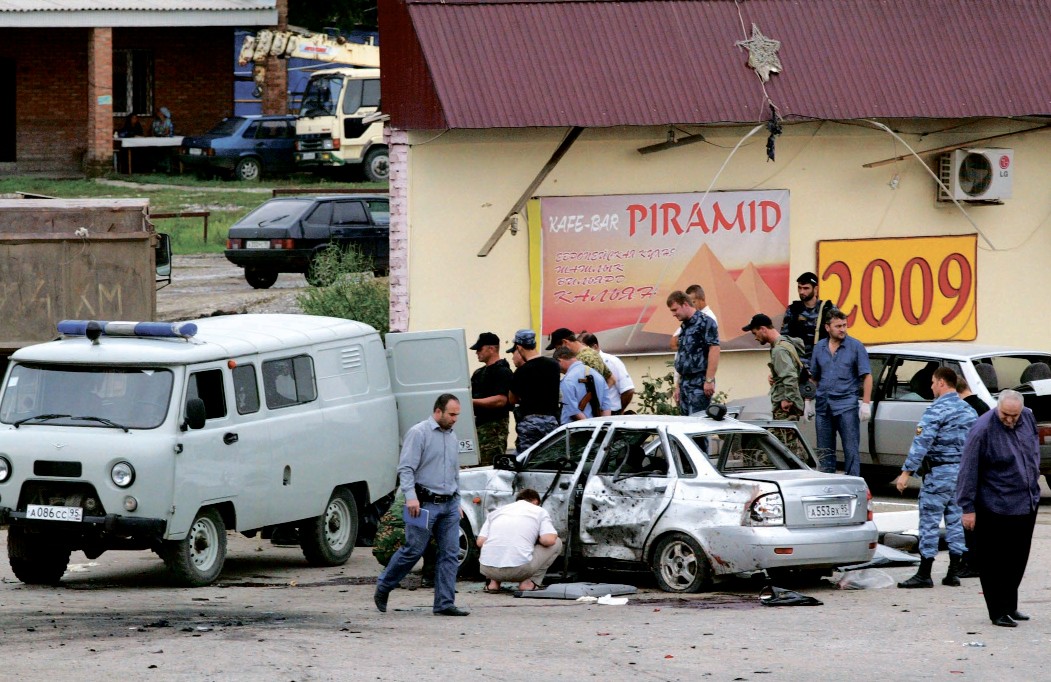
On 17 August, for example, a suicide bomber blew up a truck outside the internal affairs department in Nazran (Ingushetia). As a result, 21 people were killed and dozens wounded. On the same day, all the members of a five-person, Russian-speaking family were killed, while a day earlier rebels had wounded six policemen. A gas pipeline was blown up in the town of Khasavyurt in the early hours of 17 August and, on 18 August, an explosion rocked a market in Makhachkala, Dagestan.
A total of 128 attacks on police posts have been carried out this year, plus three acts of terror. Thirty-nine policemen, four secret service employees, 10 servicemen and 12 civilians have been killed. Fifty-eight armed attacks have been carried out in Ingushetia, in which 37 representatives of law-enforcement bodies were killed and 79 wounded.
It is not only ordinary citizens and servicemen who fall victim to such attacks, but also high-ranking officials, journalists and rights champions. Thus, the Minister of Internal Affairs of Dagestan, Adilgerey Magomedtagirov, was gunned down in May. In June, the Ingush president, Yunusbek Yevkurov, was severely wounded in an attempt on his life, while the Minister of Construction of this Russian republic, Ruslan Amerkhanov, was recently shot dead in his own office. Malik Akhmedilov, a journalist on the Dagestani newspaper Istina, was also killed. Rights activist Natalyan Estemirova was kidnapped and then atrociously killed in Chechnya, together with another rights champion, Zarema Sadulayeva, and her husband Alik Dzhabrailov. This sad list appears to be far from complete, as the situation in the North Caucasus continues to deteriorate.
It is no wonder that politicians, analysts, journalists and ordinary people are asking the question: what is going on in the North Caucasus? Are these the repercussions of activity by Islamic radicals and extremists, which has been stepped up around the world? Is it a response to Russian actions in Abkhazia and South Ossetia? Or perhaps they are the products of the pipeline war? Where will it all end?
There are many questions, but even the most outspoken and authoritative experts have no answers. It is clear that no matter who is behind the acts of terror, their number and professional execution, as well as the inability of local authorities to prevent them, are evidence of a permanent political crisis in the region.
"The Caucasus is boiling, not because of some mysterious external force, but due to internal contradictions. There are blood feuds, criminal showdowns and fights between representatives of local elites," says Sergey Markedonov, of the Russian Institute of Political and Military Analysis.
According to Aleksey Malo-shenko from the Moscow Carnegie Centre, this region looks increasingly like a neighbourhood living by its own laws, even though it officially reports to the metropolis. The activity of radical Islamists, according to him, "aims to create anarchy and reverse the modernization of traditional society". Maloshenko openly declares that there is no way out of the situation.
Meanwhile, Russian law-enforcement agencies and many leaders of the North Caucasus republics constantly promulgate the thesis that the North Caucasus underground is fed by a network of international religious extremists from abroad. Georgia and Azerbaijan are mentioned quite often as transit countries through which hostile activity is implemented. The unsubstantiated and malicious nature of such allegations, especially regarding friendly Azerbaijan, is so obvious that the Russian ambassador to Azerbaijan has had to state on record that Moscow has no claims against Azerbaijan in connection with the recent terrorist acts in Ingushetia and Dagestan. Russian President Dmitriy Medvedev put a full stop to the issue. During a field meeting of the Russian Security Council, held in Stavropol on 19 August, he said that external factors were certainly important "… but it is necessary, first of all, to look for reasons at home - unemployment, poverty and corruption in the law-enforcement bodies and the judiciary".
Moscow is trying to secure loyalty from North Caucasus elites with multi-billion rouble allowances, though the lion's share of funds is embezzled and not used for the intended purposes, while only a minute amount reaches ordinary citizens. In addition, a fierce fight is under way between different local clans for control over the cash flow from Moscow.
The personalization of political life and state management in the North Caucasus is assuming hypertrophic proportions. Institutes represent almost nothing, while everything is determined by the people leading them. A presidential election is due in Dagestan in 2010. The situation in the whole region depends on its outcome. A struggle is already under way between the present Dagestani leader, Mukhu Aliyev, and the so-called Northern Alliance, and many see this as the source of current tensions.
Ingushetia is unstable not least because the popular Ruslan Aushev has been estranged from power, while billionaire Mikhail Gutseriyev has been deprived of his business. At the same time, Moscow's henchmen have been unable to settle down and establish control. Things are made even worse by the ambitions of neighbouring Chechnya, where the idea of a unification of the Chechen and Ingush republics, which would effectively mean the assimilation of the Ingush people, is being promoted persistently, under the pretext of the unity of the Vaynakh people. In fact, Ingushetia does not have clear-cut borders: its boundary with North Ossetia is a source of conflict over who should control the district of Prigorodniy. There are disputed territories between Chechnya and Dagestan too. The establishment of administrative boundaries between districts controlled by different ethnicities is being actively debated in Dagestan itself.
Against this backdrop of incessant acts of terror in Dagestan and Ingushetia, the situation in Chechnya is relatively good. However, this has been achieved primarily by the extreme violence of Chechen leader Ramzan Kadyrov's personal guard, which do not always comply with Russian laws. Secondly, stability in Chechnya, built on the personal loyalty of Kadyrov's entourage to the country's leadership, is deceptive and fragile. It must also be said that the fight against terror in the region is led by another Chechen - the former "President of Ichkeria" (after Maskhadov), the so-called "amir (commander-in-chief) of the Caucasus mujahedin and Jihad leader" Doku Umarov. Most of his supporters, observing the traditions of Imam Shamil, are fighting for a single Islamic state in the North Caucasus.
The situation in the North Caucasus directly affects Georgia and Azerbaijan, as well as Armenia, Turkey and even Iran, albeit to a smaller extent. Abkhazia and South Ossetia were already directly integrated in the processes unfolding in the north, even before Moscow recognized their ostensible "independence". The local population is well armed and many people are ready to use force, including for criminal purposes and in clan showdowns. Explosions rocked Gagry and Sukhumi during a recent visit by Prime Minister Vladimir Putin. These arms were used by South Ossetian formations in Kokoyty to fire on Georgian villages in order to provoke fresh clashes between Georgia and Russia. This, however, can hardly please Moscow. Thousands of unregistered firearms, mines, grenades etc. from Abkhazia and South Ossetia are already "walking" in the North Caucasus and appear likely to continue to cause a lot of trouble for law-enforcers in the region.
Repeated attempts to transfer terrorist and extremist activity to the territory of Azerbaijan, especially to the Zaqatala-Balakan zone and Qusar District, have been decisively thwarted by our border troops, national security services and the MIA. The Azerbaijani government is apparently monitoring the situation on the other side of the Caucasus ridge carefully. Thus, when asked whether recent developments in the North Caucasus are affecting Azerbaijani border troops, the commander of the State Border Service, Lt-Gen Elcin Quliyev, said the processes taking place there are take into consideration in military training and preparedness. "The president and commander-in-chief, Ilham Aliyev, has issued all the necessary instructions in this regard and allocated sufficient material resources. I can say with confidence that our borders are securely protected," Quliyev said.
Meanwhile, in a situation in which Moscow requires an atmosphere of constructive cooperation and mutual support to preserve law and order and to prevent terrorist threats, some circles in Moscow are circulating absurd and provocative ideas via pro-Armenian media (the Regnum agency) about the possible stationing of an "Armenian base" for the collective rapid reaction forces in Dagestan. It is obvious that Armenia has neither the resources nor the strength to do this. The attempt to scare Baku in this way is likely to be in vain. Nor will it be possible to cast a shadow on mutually beneficial Azerbaijani-Russian cooperation.
But if we move on from unpleasant propaganda activity to practical problems, there is certainly something to think and be concerned about. Further aggravation of the situation in the North Caucasus may cause a number of problems for Azerbaijani-Russian economic projects. Important transport communications - railways, roads and pipelines - pass through unstable territory. The risks in the way of further growth in mutual trade and the transportation of oil through the Baku-Novorossiysk pipeline are increasing. Russia's plans to purchase Azerbaijani gas and transport it through the North Caucasus, together with plans pertaining to the North-South transport corridor, may be called into question. All this needs to be discussed and promptly dealt with.
RECOMMEND:
 692
692

