

NEW PARTNERSHIP MILESTONE
The launch of the Ighdir-Nakhchivan gas pipeline to meet the needs of the autonomous republic for natural gas in full.
Author: Nigar ABBASOVA
Ighdir, a city and province of the same name in eastern Türkiye, is a unique combination of ancient history, strategic location and agricultural potential. The region's strategic location, bordering three countries – Armenia, Azerbaijan (with Nakhchivan) and Iran – greatly increases its importance. Furthermore, Ighdir has played a pivotal role on the historical Silk Road since ancient times, as evidenced by numerous historical monuments.
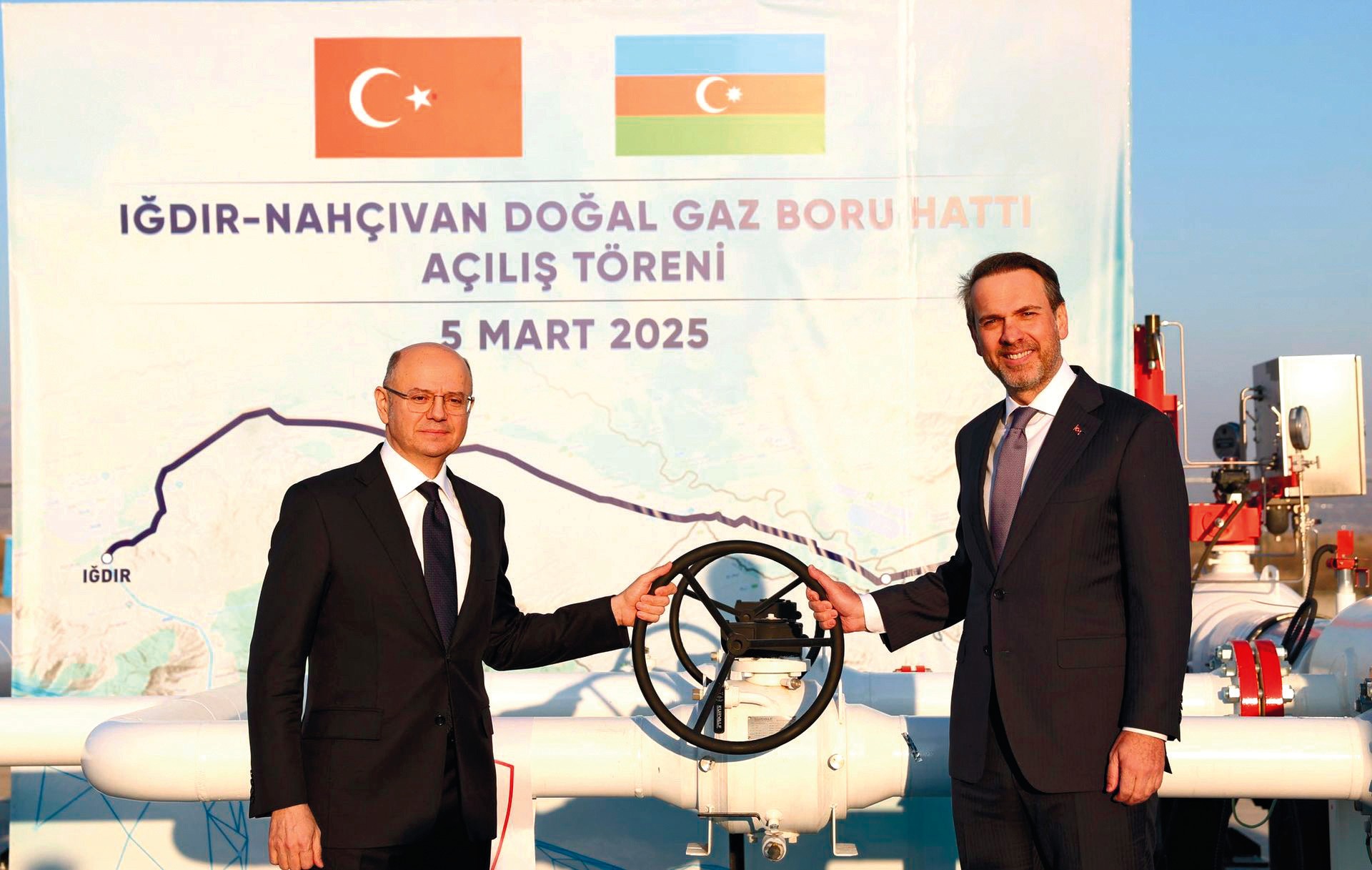
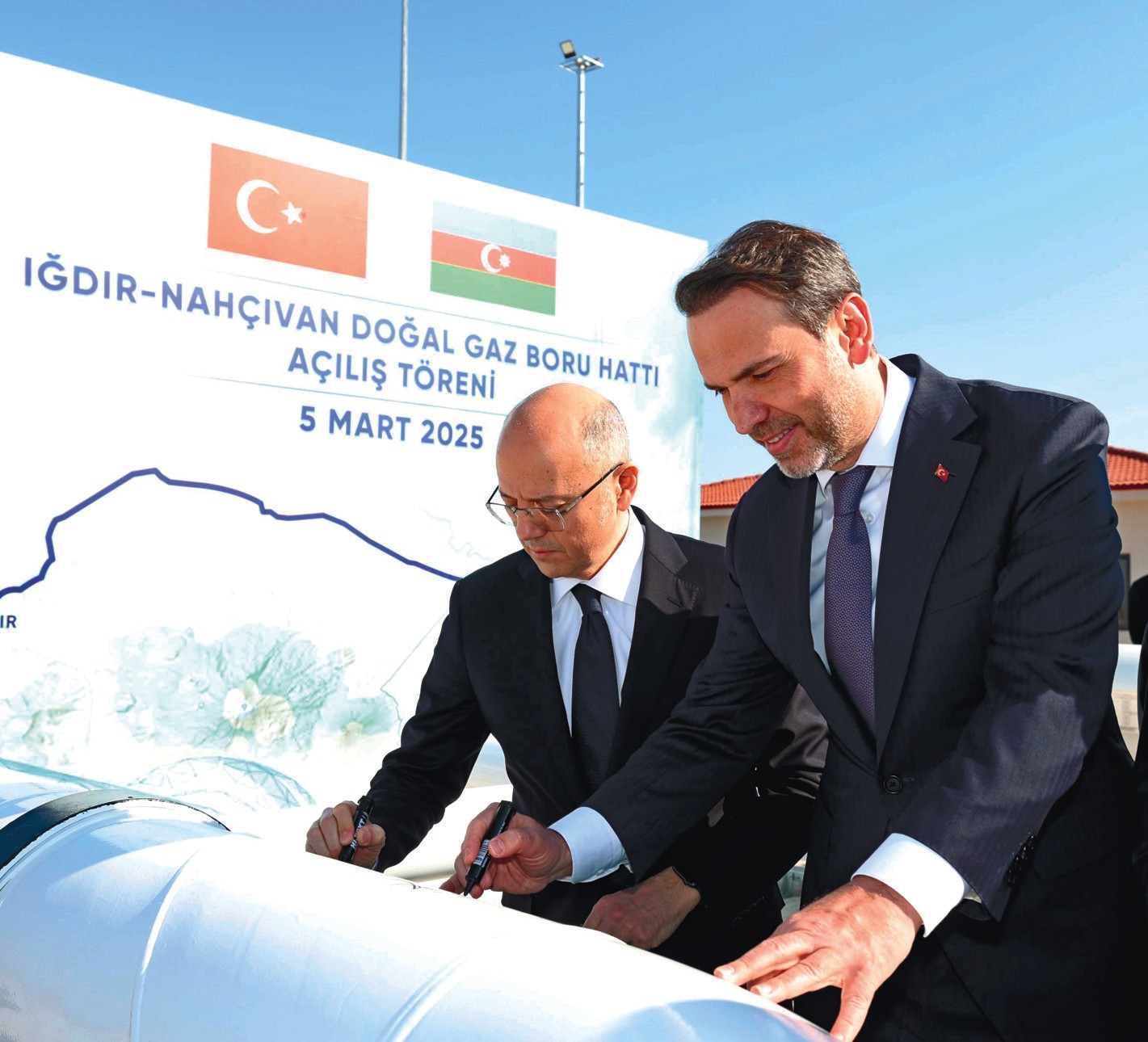
Today, Ighdir continues to play an important strategic role as a transport hub connecting Türkiye with the Caucasus and Iran. The launch of the Ighdir-Nakhchivan gas pipeline underscores the region's growing economic and energy significance, positioning it as a pivotal node for resource transportation. The pipeline's role in ensuring the region's energy security and fostering cooperation between Baku and Ankara is significant. The pipeline symbolises brotherhood. On 5 March, Presidents of Azerbaijan and Türkiye Ilham Aliyev and Recep Tayyip Erdogan participated in the ceremony marking the launch of the Ighdir-Nakhchivan pipeline, which aims to diversify gas supplies to the Nakhchivan Autonomous Republic (NAR).
Until recently, the only source of gas for Nakhchivan was Iran, which under the 2004 agreement supplied fuel on a swap basis. This agreement yielded 300-400 million cubic metres of gas per year: 1.2-1.3 million cubic metres were transferred to NAR on a daily basis from Iran, and then returned to Azerbaijan, in the amount of 1 million cubic metres.
Despite the stability of this process, the issue of diversification of NAR gas supply remained relevant. In any case, having two suppliers is always preferable to having one, especially since force majeure has never been cancelled. With the commissioning of the Ighdir-Nakhchivan pipeline, this issue can be considered closed.
The new pipeline, which starts in Ighdir and ends in Azerbaijan's Sadarak, will meet the needs of the Nakhchivan Autonomous Republic, which has a population of 500,000 and an annual demand for gas of 500 million cubic metres. This will reduce the region's dependence on imports from Iran.
It is important to note that this is the fourth pipeline project realised by joint efforts of Azerbaijan and Türkiye, and the first to connect the two countries via NAR.
Projects such as Baku-Tbilisi-Ceyhan, Baku-Tbilisi-Erzurum and TANAP have not only connected our countries, but also changed the energy map of Eurasia. Today, Azerbaijani gas transported through Türkiye ensures the energy security of many countries. Last year, Azerbaijani gas exports totalled 25 billion cubic metres, of which about half went to Türkiye and the rest to 11 other countries, 10 of them European. By acquiring our gas, these nations fortify their energy security," Azerbaijani President Ilham Aliyev stated in his address.
He also highlighted the efficiency of the construction work, which was completed in just over a year. The new pipeline will provide Nakhchivan with gas, transporting it from Azerbaijan via Türkiye in the form of swap deliveries (i. e. similar to transport to the NAR from Iran)."Today's ceremony once again clearly demonstrates Turkish-Azerbaijani unity, friendship and brotherhood. I am confident that about 500,000 of our compatriots living in Nakhchivan will mark this ceremony as a holiday today, in the beautiful month of Ramadan," Ilham Aliyev stressed.
The Azerbaijani leader also highlighted the pivotal role of R. T. Erdogan in fostering unity within the Turkic world: "Under his leadership, Türkiye has accomplished notable achievements, generating novel prospects for enhanced interaction among Turkic nations. Azerbaijan has always attached great importance to the unification of the Turkic world and has made every effort to ensure this unity, so that it is strong and relations are built on the basis of common interests and shared history."
Another symbol of brotherhood
The 16-inch pipeline, spanning from Turkish Ighdir to the Sadarak district of NAR, measures 97.5 km in length. The Azerbaijani segment of the pipeline is 17.5 km, while the Turkish section extends for 80 km. The project was realised by SOCAR Midstream Operations (a subsidiary of the State Oil Company of Azerbaijan) and Türkiye's BOTAS.
"I believe that today's ceremony will further strengthen Turkish-Azerbaijani brotherhood... I hope this project will benefit the entire region," Recep Tayyip Erdogan said, adding that the pipeline will complement the two countries' previous strategic initiatives in the energy sector and "become a symbol of the inseparability of the destinies of Türkiye and Nakhchivan."
The 80-kilometre gas pipeline, constructed by BOTAS, is designed to supply up to 2 million cubic metres of gas per day. This project, which will ensure the energy security of Nakhchivan for many years, will benefit our countries," the Turkish president emphasised.
He also noted that Türkiye and Azerbaijan are in favour of stability, cooperation and prosperity in the region: "Our countries are committed to peace, cooperation and shared development. Significant steps have been taken towards peace and regional development. We have demonstrated our sincerity in practice and are determined to continue joint projects aimed at peace and prosperity. We will continue this process by strengthening ties with Nakhchivan in the field of electricity," Erdogan announced.
The baton of announcements of future joint plans was picked up by Energy Ministers of Azerbaijan and Türkiye Parviz Shahbazov and Alparslan Bayraktar.
The Azerbaijani minister, referring to the new pipeline with a maximum capacity of 730 million cubic metres per year, mentioned the possibility of its expansion in the future (probably taking into account the growth of industry and population of the autonomous republic). In fact, even before the pipeline was commissioned, representatives of SOCAR Midstream Operations stated that its capacity could be increased to 5 million cubic metres daily (1.8 billion cubic metres annually) with a minor upgrade.
Most importantly, however, Mr. Shahbazov announced that the gas pipeline can also operate in reverse. This suggests that its status could be upgraded to export in the future, allowing Azeri or other Caspian gas to be transported to Türkiye and on to Europe. The possibility of reverse supplies makes the project not only an important element of Nakhchivan's energy security, but also potentially a key gas transit route in the region.
Even without considering reverse possibilities, the project can play an important role in diversifying the region's energy infrastructure, increasing stability and interconnectivity between neighbouring countries. This could lead to a more integrated energy market, to the benefit of both Nakhchivan and the wider South Caucasus.
Nakhchivan-Türkiye Energy Bridge
Minister of Energy and Natural Resources A. Bayraktar, who described the Ighdir-Nakhchivan project as another symbol of brotherhood between Türkiye and Azerbaijan, said that the next joint project of the two countries in the energy sector will be the creation of a power transmission line between Türkiye and NAR.
Although he did not go into details, it was clear that he was referring to the NAR (Azerbaijan)-Türkiye-Europe energy corridor. This project, which aims to export more than 1000 MW of energy from Nakhchivan to Türkiye and on to Europe, has already been declared a top priority by the Azerbaijani government. A feasibility study is currently underway, which will allow the scope of future works and the amount of financing required to be assessed.
It is known that NAR has been declared a "green" energy zone in Azerbaijan. Azerbaijan's Ministry of Energy is attracting foreign companies to build clean energy facilities in the Autonomous Republic: solar power plant projects in NAR have been announced by France's TotalEnergies and America's Nobel Energy (650 MW), Masdar (UAE, 150 MW) and Germany's Notus (70 MW). Other initiatives are also being explored.
The government plans to export electricity from the NAR to Türkiye and then to Europe, mainly from new solar plants.
In addition, this corridor could become another route for the transit of clean electricity from Central Asia through Azerbaijan. Work is currently underway to organise supplies from Kazakhstan and Uzbekistan to the European market through the Caspian-Black Sea-Europe energy corridor via an undersea power cable.
With the potential for this energy to eventually reach Europe, Turkmenistan, which is seeking to diversify its own energy supplies, has also begun to show interest in the project.
"Turkmenistan is ready to export electricity. A power plant with a capacity of 1,574 MW is currently under construction on the Turkmen sector of the Caspian coastline. I am confident that with the combined efforts of the countries through whose territories the power lines will pass, this project will be implemented in the near future and on the basis of mutual benefit," said the Chairman of the People's Council of the country, Gurbanguly Berdimuhamedov.
Thus, the launch of the Azerbaijan-Türkiye-Europe 'green' corridor will not only diversify the export opportunities of the Central Asian countries, but will also contribute to deepening the energy partnership between the Turkic states.
The projects undertaken by Azerbaijan and Türkiye, particularly in the energy and transport sectors, send a clear message to their common neighbour Armenia: It is more advantageous to cooperate and develop mutually beneficial relations than to delay peace, miss opportunities for development and remain isolated.
RECOMMEND:
 247
247

