

OPERATION "COOPERATION"
Baku Energy Week traditionally delivered new agreements and initiatives
Author: Nigar ABBASOVA
Azerbaijan steadfastly upholds its traditions as one of the region’s foremost organisers of major energy forums. The annual Caspian Oil & Gas international exhibition and conference stands as the most vivid testament to this legacy. Over three decades, this event has consistently drawn leading companies, experts, and policymakers, cementing its role as an indispensable platform for sharing expertise and debating the future of energy.
This year’s gathering formed part of Baku Energy Week (BEW), which united three pivotal events under one umbrella: the 30th anniversary Caspian Oil & Gas exhibition, the 13th Caspian International Energy and Green Energy Exhibition, and the 30th Baku Energy Forum.
For many attendees, the primary allure lies in uncovering the latest trends shaping the oil, gas, and energy sectors—from groundbreaking projects and international alliances to technological innovations. Yet, as ever, the true suspense revolves not around the exhibitions themselves but around the contracts inked behind the scenes—a tradition honoured once more this year.
A new chapter in cooperation
Were a hypothetical competition held among foreign companies for the title of Azerbaijan’s most prolific signatory of oil contracts, BP would indisputably claim the gold medal. For over 30 years, the British multinational has been deeply embedded in the country’s most strategically significant oil and gas extraction and export projects, maintaining an unbroken presence at Caspian Oil & Gas.
True to form, BP seized BEW 2025 to reinforce its foothold. Among its headline announcements are the approval of the investment plan for the next development phase of the Shah Deniz gas field, a project pivotal to sustaining output, as well as agreements to decarbonise production chains, including electrifying the Sangachal Terminal—one of the region’s largest energy hubs—and constructing the Shafag Solar Power Plant.
BP also secured rights to two new licence blocks for exploration and development, alongside preparations to onboard a partner for accelerated geological surveys on a third site.
"We take immense pride in BP’s three-decade partnership with Azerbaijan. The agreements signed this week underscore our conviction in the untapped opportunities here. As we execute our strategy to grow our upstream business, we are doubling down on key regions like Azerbaijan, leveraging our robust relationships with the government and partners," stated Gordon Birrell, BP’s Executive Vice President for Production and Operations.
The new old partner
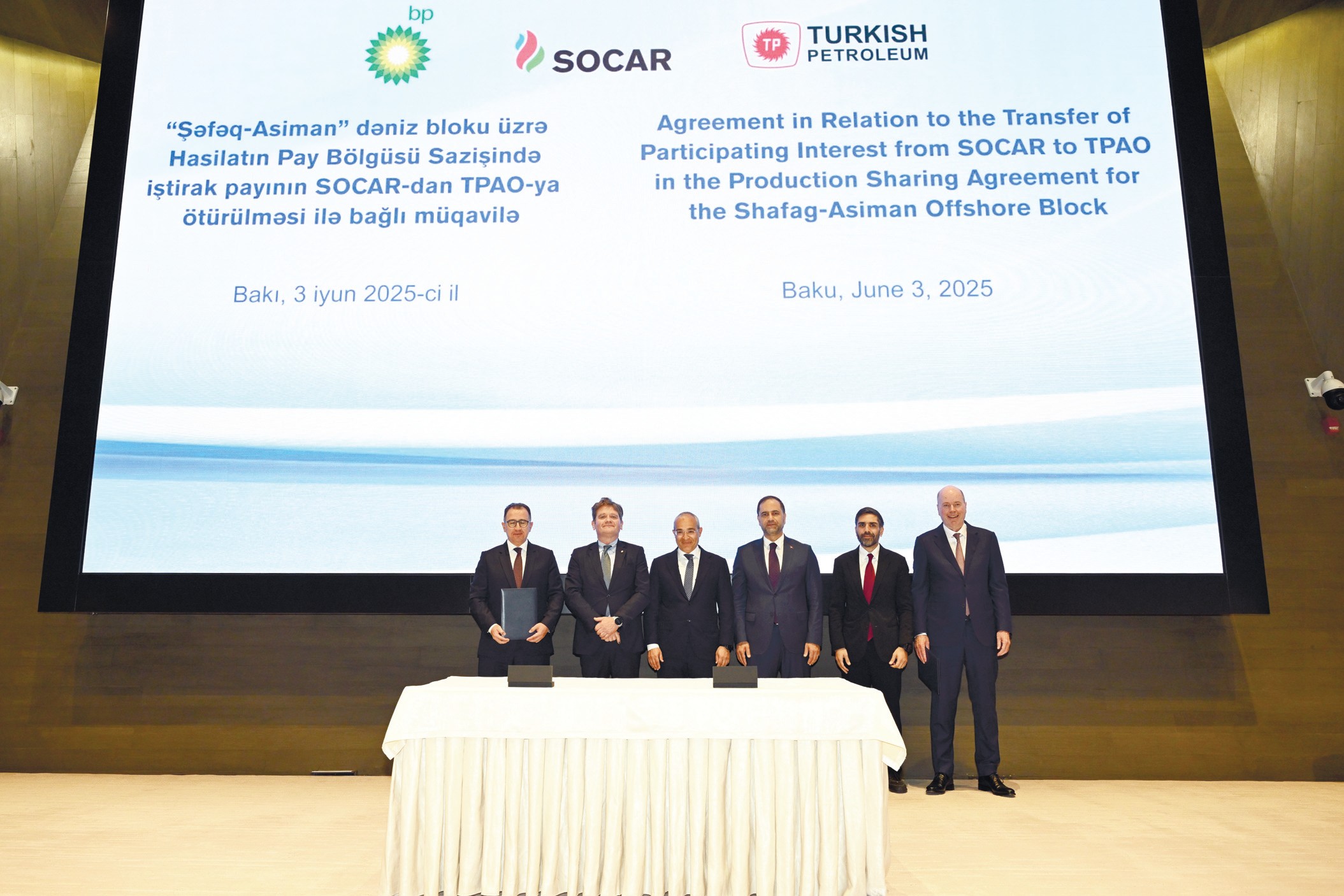
Among all the highlights of Baku Energy Week, the most intriguing was the entry of the Turkish company TPAO into the PSA-type contract for developing the promising Shafag-Asiman block in the Azerbaijani sector of the Caspian Sea. On June 3, TPAO signed several agreements with SOCAR and BP.
This deal is expected to close in the third quarter of 2025 and will accelerate further appraisal of the block to determine the best option for advancing the project. Upon completion, TPAO will hold a total 30 percent stake in the contract, acquiring 15 percent each from BP and SOCAR. Currently, BP and Azerbaijan’s State Oil Company each hold 50 percent stakes in the production sharing agreement, with BP remaining the operator during the exploration phase.
“TPAO’s entry into the Shafag-Asiman project is an important step that will not only strengthen Türkiye’s energy security but also significantly contribute to regional cooperation,” said Turkish Minister of Energy and Natural Resources Alparslan Bayraktar. He added that this partnership will elevate strategic energy cooperation between Türkiye and Azerbaijan to a qualitatively new level.
Notably, this deal itself marks progress in a project that since 2021 had been limited to analysing data from the first exploration well, SAX01.
The Shafag-Asiman structure was discovered in 1961. Three-dimensional seismic surveys have been conducted there. Reserves were estimated at 500 billion cubic meters of gas and 65 million tons of condensate.
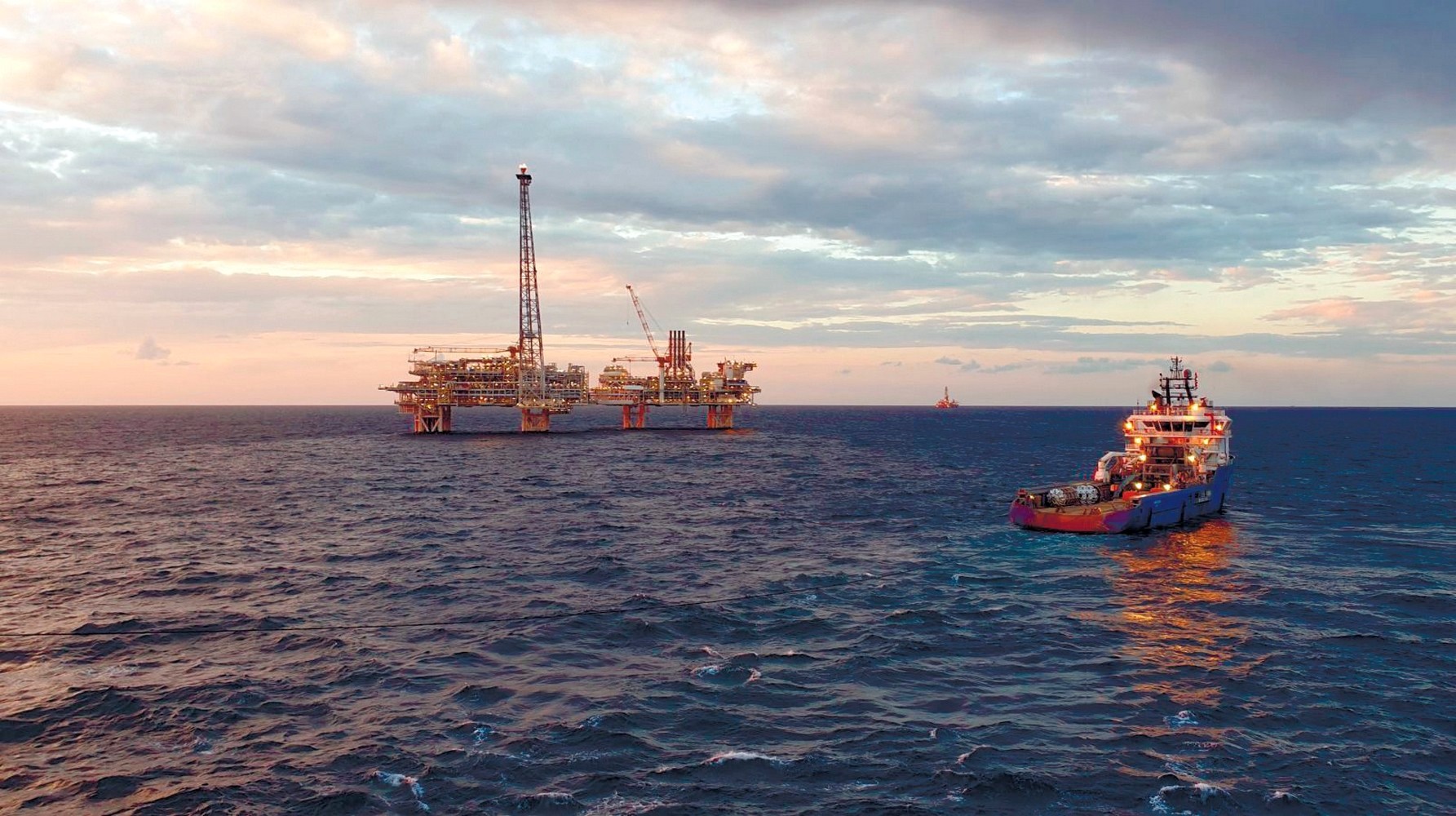
On January 11, 2020, drilling began on the exploration well SAX01 at a sea depth of 623 meters. By March 2021, BP and SOCAR announced that comprehensive studies at a depth of 7,200 meters had identified initial gas-condensate deposits, completing exploration drilling up to the productive Fasil formation (Pereryv suite). The companies did not rule out drilling an additional appraisal well branching from SAX01 to better define reserves.
Now BP plans new drilling operations at this promising structure, hoping to discover significant gas reserves.
“After analysing the data, we concluded that the productive formation might be larger than initially thought. Therefore, drilling a second well is necessary to confirm this. If our expectations are met, a development plan will be prepared, and gas production will begin,” said Gordon Birrell.
Drilling is planned to be conducted jointly with SOCAR and TPAO, partners with whom BP has worked successfully in the Caspian for over 30 years on the Azeri-Chirag-Gunashli and Shah Deniz developments.
“If it is confirmed that the formation is larger than expected, it will pave the way for commencing field development,” Birrell emphasised.
The inclusion of a new player like TPAO suggests that the structure holds substantial hydrocarbon potential that only requires further confirmation.
A new phase for Shah Deniz
Another significant event was shareholders’ approval of a final investment decision for constructing the Shah Deniz Compression (SDC) platform. Valued at $2.9 billion, SDC continues the previous two phases of field development aimed at accessing and extracting low-pressure gas reserves with maximum recovery.
Ultimately, this will enable production and export of approximately 50 billion cubic meters of additional gas and 25 million barrels of additional condensate. Construction is planned to begin in 2025 with commissioning targeted for 2029.
The project includes building an electrified SDC facility operating mostly unmanned, laying electric and fibre-optic cables, as well as subsea gas pipelines connecting platforms Alpha and Bravo. SDC will feature four compressors rated at 11 MW each.
SDC is designed to capture low-pressure gas from certain Shah Deniz reservoirs, compress it, and deliver it to the Sangachal terminal. Low-pressure gas will flow from Alpha and Bravo platforms; no drilling will be conducted from SDC itself.
Construction of supporting structures, topside modules, and subsea infrastructure components will take place in Azerbaijan. First low-pressure gas production from Alpha is scheduled for June–July 2029, followed by Bravo in April–May 2030.
The company is confident that this next phase will unlock additional resources, extend field life, and ensure continued stable gas supply to Europe.
Die-hard exploration
Another important deal during Baku Energy Week was BP’s acquisition from SOCAR of a 35 percent stake in developing the Garabagh oil field and prospective Ashrafi-Dan-Ulduzu-Aypara (ADUA) structures in Azerbaijan’s Caspian sector. SOCAR retains the remaining 65 percent in both projects but BP will serve as operator.
At ADUA, BP plans seismic surveys and exploration drilling. At Garabagh, BP aims to produce first oil by 2029.
“Garabagh is an oil discovery made several years ago. We expect first oil in 2029. This is quite a tight development schedule for such a large field,” noted Birrell. According to him, a new platform will likely be built in Azerbaijan for project implementation, integrated into existing Azeri-Chirag-Gunashli infrastructure.
“The concept involves constructing an unmanned (without permanent personnel) platform — lightweight, compact, with remotely operated technological equipment. Oil and gas will be transported into existing infrastructure,” Birrell explained.
Although initial focus is on oil production, BP does not rule out future gas development at Garabagh.
“At this stage our focus is on oil. However, gas resources have also been identified at Garabagh, and we will definitely consider development options in future,” company representatives added.
Azerbaijani onshore projects step into the spotlight
Perhaps one of the most unexpected outcomes of Baku Energy Week was signing documents paving the way for assessing hydrocarbon potential of Azerbaijan’s onshore fields. This involved three projects with MOL Group, ExxonMobil, and Gran Tierra Energy.
Hungarian MOL Group and SOCAR signed principal terms of a production sharing agreement for exploration, development, and production on the Shamakhy-Gobustan onshore block. Under agreements, MOL will receive a 65 percent stake and become project operator; SOCAR retains 35 percent. Final PSA conclusion depends on further negotiations and regulatory approval.
This agreement develops a memorandum of understanding signed in September 2024. MOL emphasises it reflects strengthening energy partnership between Azerbaijan and Hungary.
“Signing this agreement confirms our commitment to further cooperation and exploration in Azerbaijan. In our fifth anniversary year here, we are expanding collaboration based on shared vision and effective work,” said Chairman and CEO Zsolt Hernadi.
He also noted that this new project could contribute to Central Europe’s energy security: “I am confident that joint Shamakhy-Gobustan exploration will be an excellent addition to our international portfolio and an important solution for ensuring energy supplies to Central Europe. We will have flexible options to sell or ship produced oil within MOL’s core region contributing to energy security,” Hernadi added.
The second participant in onshore “expansion” was US-based ExxonMobil. The company signed a memorandum with SOCAR for joint study of unconventional hydrocarbon resources in Ganja-Yevlakh-Aghjabedi area.
“We are pleased to begin this partnership. The memorandum with SOCAR is an important first step toward further resource development in Azerbaijan, advancing energy innovation and strengthening reliable energy supplies. We aim to apply our expertise and advanced technologies to develop Azerbaijan’s unconventional onshore oil and gas resources,” company representatives said.
At this stage no exploration drilling is planned under the memorandum. “Azerbaijan has a rich history in hydrocarbon development and promising unconventional resource potential,” said ExxonMobil Vice President for Exploration and New Ventures John Ardill. “We look forward to applying our advanced technology and proven experience in this partnership.”
Gran Tierra Energy Inc., a Canadian company, also signed a memorandum with SOCAR providing for joint technical and economic studies assessing exploration, development, and production potential in the Guba-Caspian region. Gran Tierra will analyse existing geological, technical data as well as logistical and infrastructural potential.
Signing a full PSA will be possible after agreeing on geological exploration programs and key commercial terms.
Thus, these agreements show that leading global oil and gas players not only maintain Azerbaijan as a focal point but view it as a key hub for expanding and diversifying projects—opening new horizons in developing both offshore and onshore resources.
The growing interest by major international companies in onshore projects opens a new chapter in Azerbaijan’s energy cooperation. Until recently investor attention focused mainly on offshore projects; now major companies—from MOL to ExxonMobil—are ready to explore less studied onshore areas within Azerbaijan. This not only broadens investment geography but could play a crucial role in diversifying production and strengthening Azerbaijan’s energy ties with Europe and the US.
RECOMMEND:
 257
257

