

ALWAYS IN TOUCH
Broadband internet infrastructure transforms the Online Azerbaijan Programme to a new level of excellence

Author: Aghasaf NAJAFOV
Azerbaijan has recently taken decisive steps to accelerate digital development in the context of the 4th Industrial Revolution (4IR), with the clear goal of transforming society and the economy. We will achieve these goals by completing the construction of high-speed network infrastructure throughout the country.
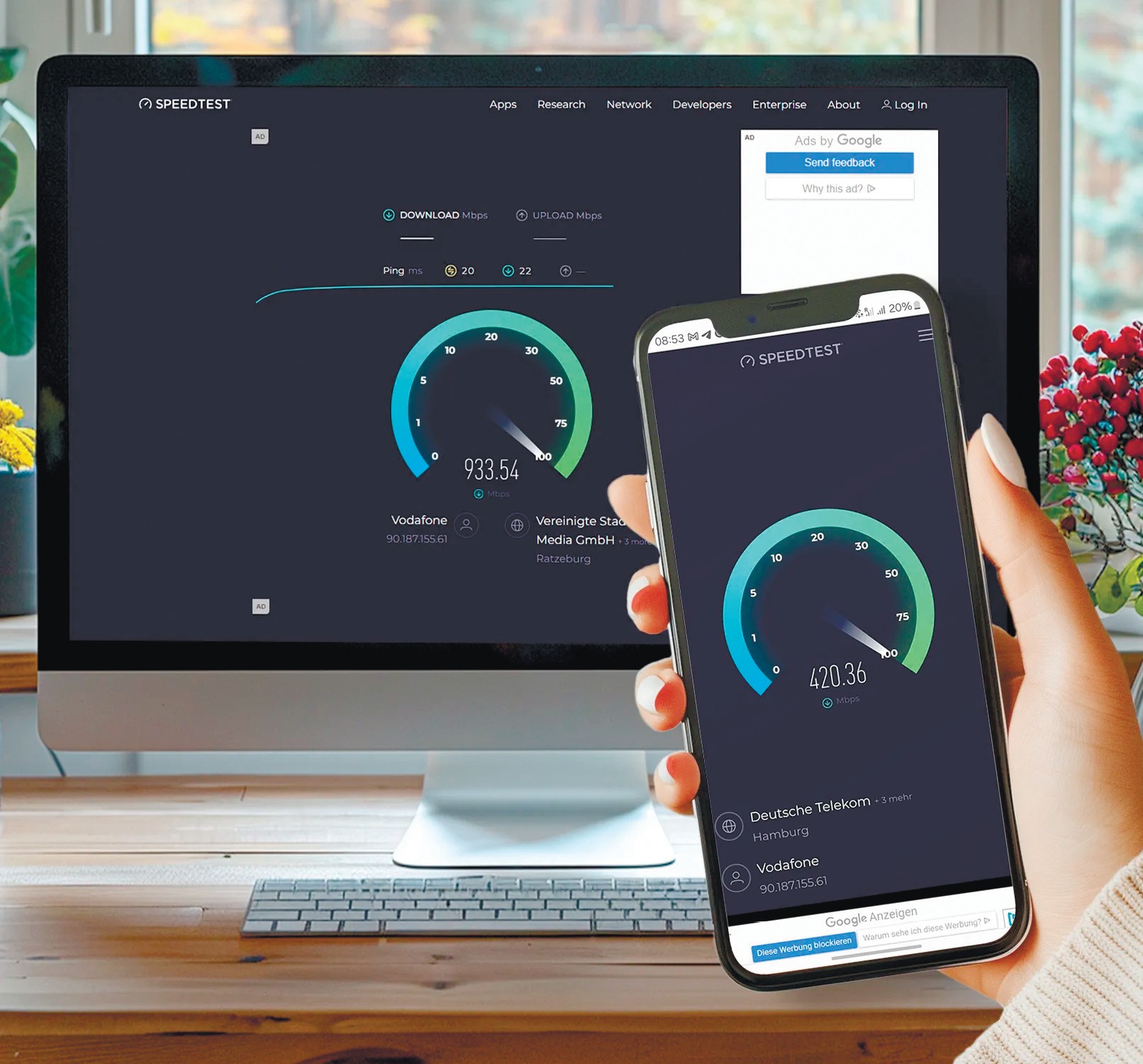
The Online Azerbaijan programme definitively states that the fibre-to-the-home project was successfully implemented by the end of 2024. This project entailed the direct installation of fibre optic cables to consumers' residences. The result? The average speed of fixed broadband Internet has doubled. Speedtest Global Index Service confirms that Azerbaijan is ranked 87th out of 153 countries worldwide for this indicator.
Aiming at full digitalisation
The state programme "Electronic Azerbaijan" was launched more than 20 years ago. An interactive information system for e-government was developed, and it currently provides over 500 e-services.
In January 2025, President Ilham Aliyev approved the "Concept of Digital Development of Azerbaijan", marking a logical continuation of the country's digital transformation efforts. The document sets out a number of recommendations for the further development of the e-government system and the digitalisation of state administration. The focus is on qualitative transformations, marking the transition from the present mechanisms of "e-government" to the subsequent phase of development: "digital government".
It is planned to completely abandon paper carriers and maximise the use of electronic signatures. The creation of an infrastructure for a state information "pool" is planned. This will enable the analysis of large volumes of data, the search for patterns, the building of forecast models, flexible management and optimal decision-making. It will also include the provision of proactive services. The digital government architecture will be organised in such a way that it can effectively manage the flow of information. The new concept is also designed to accelerate the transition to a digital society. The objective is to develop innovative technologies such as artificial intelligence and blockchain into the mechanisms of public administration, the commercial and civil sectors, as well as the planned mass introduction of systems such as Smart City, Internet of Things, Big Data, digital marketing, etc.
All of the above should also become the foundation for full digitalisation of production, expansion of startups and software business, and transfer of all business processes in accordance with the 4IR requirements.
Meanwhile, the Centre for Analysis and Coordination of the IV Industrial Revolution, operating under the auspices of the Ministry of Economy, established a special working group in December 2022. The development of a strategy for the digital economy until 2030 was launched. The document outlines 51 key initiatives, encompassing the areas of human capital development, the promotion of IT technologies, the modernisation of network infrastructure, and the digitalisation of tourism, transport and logistics, industry, agriculture, and food security. In addition, within the framework of the Industry 4.0 concept, it is planned to involve private companies in the implementation of about 34 projects, with another 15 initiatives planned in the public sector.
Doubled speed
Achieving these objectives is impossible without strengthening the foundation of the entire digital architecture – a qualitative improvement of the broadband network and IT infrastructure. This was prepared a considerable time ago. Just under ten years ago, the first large-scale projects to establish optical networks in the capital and regions of the country began. Broadband services have been available to residents of Baku, Sumgayit, Ganja, Khirdalan, Shirvan and Mingachevir for seven years. In this instance, high-speed networks based on optical technologies, including GPON (Gigabit-capable Passive Optical Networks), were successfully implemented, enabling speeds of 30 to 100 Mbps.
Inertia in the economy during the 2020-2021 pandemic has necessitated adjustments to the timing of these plans in peripheral regions. As recently as 3-4 years ago, less than a third of households in rural areas had access to broadband internet. Approximately 70% of villages were connected to the network using outdated ADSL technology. The average speed recorded was between 4-5 Mbit/s, which is considered low in the context of current requirements.
Due to the lagging regional network infrastructure, the acceleration of the Fiber to the Home programme (laying fibre optic cables directly to consumers' flats) has only been possible in the last few years. In order to overcome the lag, the Ministry of Digital Development and Transport of Azerbaijan (MDT) has supported a number of programmes to increase the effectiveness of partnerships between state-owned backbone operators and private ISPs. These programmes involve the involvement of private ISPs in the development of high-speed internet in the regions. The primary investors in broadband infrastructure were the state-owned operators Aztelekom and Baktelecom, which facilitated connectivity to all administrative centres and settlements nationwide.
Following the victory in the 44-day war and the liberation of all territories of Azerbaijan in September 2023, broadband optics were made available in Shusha, Khankendi, Khojaly and other administrative centres and settlements of Garabagh and East Zangezur.
Following the efforts of the MDGC structures in collaboration with private providers, Azerbaijan currently boasts a fixed broadband subscriber base of 2.2 million. Of these, 1.7 million, or 78 per cent, use GPON technology, with the help of which it is possible to achieve Internet speeds of 1 Gbit/s. At present, 2.9 million households in the country have access to broadband internet.
It is noteworthy that these achievements have been validated through objective assessments conducted by international experts and specialised global structures that evaluate Internet network speeds worldwide.
According to Stephen Bay, President and CEO of Ookla (the company that owns a service for measuring the speed of Internet connections), the average speed of fixed broadband Internet in Azerbaijan has doubled. Concurrently, access to the site has increased fourfold over the past four years, which is a significant achievement.
According to the latest Speedtest Global Index report for May 2025, Azerbaijan ranked 87th among 153 countries in terms of internet speed (79.25 Mbps). The average speed of fixed broadband internet in the country has doubled compared to the previous year, reaching 39.48 Mbps. During the reporting period, Baku ranked 115th among 196 cities worldwide in terms of average speed, and 84th among 148 cities worldwide in terms of mobile internet speed.
Yu Cao, Head of Huawei's Networking Department for the Middle East and Central Asia, stated that "Azerbaijan has built one of the best systems in the region for the introduction of fibre optic infrastructure using GPON technologies, which provided one hundred per cent coverage." He reports that the use of GPON technologies in the Online Azerbaijan project has reached 100 per cent nationwide, and today the broadband network in the regions supports farmers in agriculture, teachers in education, and a larger platform for such services in other areas. Yu Cao emphasised the importance of a symbiotic relationship between technical support and business growth, outlining that the subsequent phase will involve the expansion of services within the fibre segment.
Challenges and solutions
The progress made in the development of high-speed fibre-optic internet networks is to be commended. However, the long-standing issues affecting the local Internet market remain unresolved.
Private providers, especially in regional areas, have been found to experience delays in upgrading network equipment and increasing communication channel capacity, which can result in issues such as "compaction" of channels. This can lead to reduced speed, connection interruptions, and other technical failures.
Conversely, the introduction of optics in the country has led to an increased consumer demand for downloading "heavy" content, such as HD-quality video and online network games. This has a direct impact on the speed and quality of Internet connections. In this regard, it is imperative for consumers to utilise high-quality, high-speed equipment that reliably provides 100 Mbit/s. For instance, it is recommended to prioritise modem-routers that operate using the standard Wi-Fi 5 at 5GHz, and to utilise CAT6 cables.
Despite the widespread adoption of fibre optics, the effect of fibre optics is not uniform throughout the network. Optical signals are transmitted through base stations and network nodes that connect users to the backbone. In the centre of Baku and other cities, where state institutions, businesses and other key organisations are concentrated, there are more such nodes and stations. These are newer, located closer to each other, and providers first of all concentrate their main staff and new equipment here and start infrastructure modernisation from here. Consequently, the bandwidth capacity of intranet and inter-operator channels is higher in the centre, allowing optimisation of communication, minimisation of delays and signal interruptions between servers and equipment, and ensuring higher speed, stability and quality. In suburban areas, network nodes are less prevalent and situated at greater distances. Consequently, there is a possibility of a decline in quality for Internet users connected to busy base stations, particularly during peak hours.
Nail Mardanov, CEO at Information and Communication Technologies Agency, has called for internet speeds in Azerbaijan to be brought up to the level of those in developed countries. He made this call during a meeting with participants of the internet market. He emphasised that local operators and providers need to offer packages with internet speeds of more than 150-200 Mbps, for which the telecommunications infrastructure must support speeds of 1 Gbps and higher.
It is clear that the network market in Azerbaijan has achieved significant milestones. However, to ensure the continued growth and success of the market, Internet operators and backbone providers must focus on enhancing the technical capabilities of their equipment, thereby providing consumers with high-speed internet packages.
RECOMMEND:
 244
244

