
TURN TO THE SOUTH
Azerbaijan establishing new format of regional cooperation
Author: Nigar ABBASOVA
Azerbaijan continues to pursue a policy of expansion into international oil and gas markets. In this context, two events at the height of the summer season were of particular note: an agreement with Syria to supply natural gas to that country and the signing of a Production Sharing Agreement for the exploration, development and production of hydrocarbons from six investment blocks in the Ustyurt region of Uzbekistan.
Both documents testify not only to Baku's intention to strengthen its position as an energy player, but also to the country's increasing investment activity in strategic regions: the Middle East and Central Asia.
In response to any concerns regarding Azerbaijan's capacity to expand its gas supply and meet global demand, President Ilham Aliyev has provided a definitive response. He has assured that the country's resources are sufficient to not only fulfil existing commitments but also to increase exports.
More gas to flow
Azerbaijan is currently engaged in the international transportation of natural gas, with supply routes extending to 12 countries. At the same time, 10 of them are in Europe, of which 8 are members of the European Union. Azerbaijan is a global leader in pipeline supplies.
At Baku Energy Week, President Ilham Aliyev delivered a speech in which he outlined the country's plans to increase natural gas production by 8 billion cubic metres per year by 2030.
During his address to the Global Media Forum in Khankendi, Ilham Aliyev provided responses to questions from the participants. "Therefore, if we export 25 billion cubic metres per year, our exports will be approximately 33 billion cubic metres. The question that arises is where these 8 billion cubic metres should be allocated. As I have previously mentioned, I have already discussed this issue in the context of the capacity of the existing pipeline system and interconnectors (in Europe, R+). Without expanding the pipeline system, it will be difficult to even plan how to increase it."
The head of state observed that at present, approximately 50% of Azerbaijani gas exported to Europe is equivalent to around 13 billion cubic metres per year. Furthermore, the export system of the Southern Gas Pipeline (SGP) is operating at full capacity (10 billion cubic metres per year). The issue of expanding its capacity has not been addressed to any significant extent, to put it mildly, except for the expansion of the European component of the Trans Adriatic Pipeline by another 1.2 billion cubic metres by January 2026.
"Today, the Southern Gas Corridor is operating at full capacity. In order to reach new destinations, we use interconnectors, but the main pipeline is fully loaded," Aliyev emphasised.
One of the main obstacles to further growth is the reluctance of European financial institutions to invest in projects related to fossil fuels. The President noted that the European Investment Bank has ceased providing such support, and the EBRD has significantly reduced its involvement.
"There is no doubt that, for a variety of reasons, there will continue to be a need for Azerbaijani gas in Europe. It will grow," Aliyev said. "Europe needs more gas from Azerbaijan, and we are ready to deliver. In 2021, the volume of supplies was 8 billion cubic metres, and today it is 13 billion. This represents half of all our exports. However, to increase production, additional financing will be required."
In this regard, Baku anticipates a more pragmatic approach from European institutions regarding the green agenda, in order to provide the necessary support for the expansion of gas infrastructure.
"Given the current volume of 8 billion cubic metres, it is essential to identify suitable markets for these products. We are currently exploring a range of options to achieve this. We have received proposals from several members of the European Union, including both recipients of our gas and those who do not yet receive it. We are evaluating these proposals in terms of market availability and, naturally, commercial terms," the Azerbaijani leader said.
While Europe continues to deliberate on the expansion of the SGC, which is of significant importance to itself, Azerbaijan is proactively developing alternative routes and partnerships. This is in addition to the country's ongoing efforts to enhance its energy independence through a flexible foreign economic policy. The country has already taken concrete steps to expand exports, albeit in a different direction. Our destination is the Middle East.
Syria is next in line
Azerbaijan's strategic entry into the Middle East oil sector commenced last year with the announcement of a deal between SOCAR and the Abu Dhabi Oil Company (ADNOC). The agreement involved the acquisition of a 3 per cent stake in the SARB, Umm Lulu, Bin Nasher and Al Bateel offshore concession project. The transaction value was $285 million.
The project's current daily production is 255,000 barrels of oil. By the conclusion of the contract, it is anticipated that the production volume will reach 2 billion barrels. However, through the execution of supplementary projects, this figure can be elevated to 2.7 billion.
The primary geological oil reserves at the SARB field are estimated at 257bn barrels, and at Umm Lulu at 3.8bn barrels.
In 2025, State Oil Company consolidated its position in the Middle East region by acquiring a 10% stake in the Tamar gas field development project, the largest offshore gas field in Israel. The company also issued a licence with BP for the exploration of gas reserves in Zone I (the Israeli shelf).
The next country to be considered is Syria. For the first time, the world learned of Azerbaijan's readiness to assist the new authorities of the country with natural gas, as conveyed by Turkish President Recep Tayyip Erdogan.
During a meeting with Ilham Aliyev, he informed me of his willingness to provide any support to Syria in the matter of natural gas. Ilham Aliyev's approach is of great significance. The most pressing issue facing Syria today is the lack of gas, which is essential for the country's energy supply. Erdogan stated that Syria currently has issues with its energy supply.
He emphasised that Türkiye is also trying to help Syria in this matter within its capabilities.
Ten days after the aforementioned statement, Syria's interim president, Ahmed al-Sharaa, made an unannounced visit to Baku, which resulted in the signing of a Memorandum of Understanding with SOCAR. While the specifics of the document remain undisclosed by both parties, the Syrian SANA news agency reported that it encompassed provisions for cooperation and coordination in the energy sector, the supply of natural gas to Syria via Türkiye, and oil exploration.
According to Turkish media reports, work on the implementation of this memorandum is proceeding as scheduled. Azerbaijani gas will be supplied to Syria through Türkiye via the Kilis-Aleppo pipeline. On the Turkish side, the pipeline has been extended from the city of Kilis to the Syrian border. "Botas, in collaboration with SOCAR, is conducting final tests and inspections prior to the scheduled launch of natural gas supply on 1 August," the publications noted.
The first phase is expected to supply 1.2 billion cubic metres of gas per year, which will be used to generate electricity at plants in Aleppo and Homs, key regions in terms of rebuilding the country's industrial and utility sectors.
Furthermore, the collaboration between Botas and SOCAR entails investments in oil and natural gas exploration, production, and petrochemicals in north-eastern Syria. Technical support will also be provided to modernise Syria's worn-out energy infrastructure.
For Baku, such a deal represents much more than a humanitarian action; it will significantly strengthen the country's position in the region and reinforce its role as a reliable supplier of energy resources. Azerbaijan's involvement in supplying energy to Syria can be regarded as a component of its "soft power" strategy, particularly in light of the fact that there had been virtually no economic collaboration between the two countries until recently. Baku now has the opportunity to demonstrate political flexibility and to establish a new format for regional interaction.
From a logistical perspective, Azeri gas supplies to Syria strengthen Türkiye's role as a transit hub and create a precedent for expanding the Southern Gas Corridor southwards. For the Republic of Azerbaijan, this represents an additional export route, enabling it to diversify its market presence irrespective of broader European economic developments.
Production Sharing Agreement in Uzbekistan
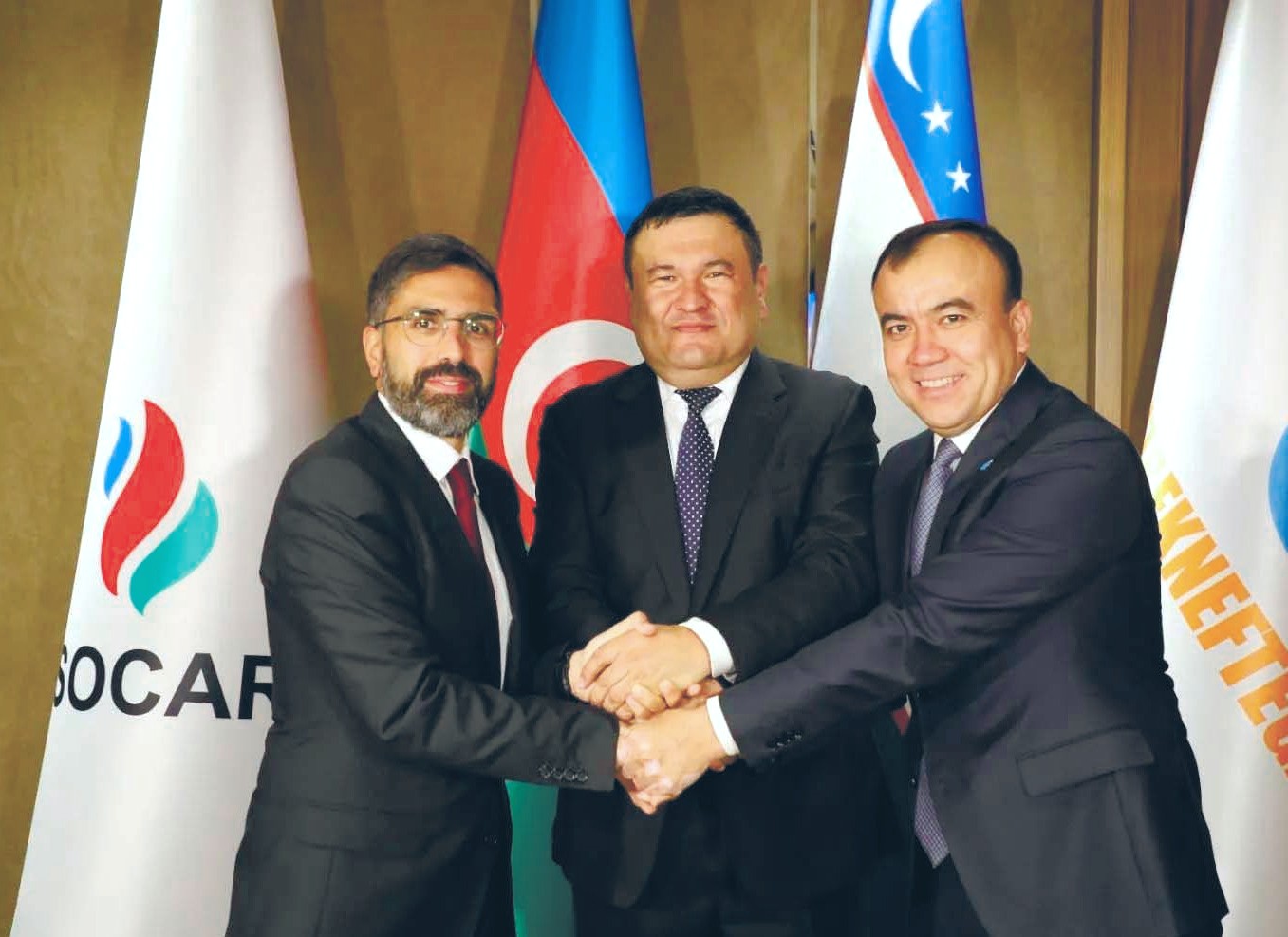
At the same time, Azerbaijan is increasing its presence in Central Asia. On 24 July, the Uzbek Ministry of Energy, SOCAR and Uzbekneftegaz signed a Production Sharing Agreement, paving the way for geological exploration and subsequent production of hydrocarbons in the investment blocks of the Ustyurt oil and gas-bearing region of Boyterak, Terengkuduk, Birgori, Kharoi, Karakalpok and Kulboy.
At the outset, promising areas will be identified. A 3D seismic survey is planned to be carried out over an area of at least 1,000 square kilometres. Based on the results of the survey, geological exploration work will begin on a single well. In the event of the discovery of hydrocarbon fields of industrial significance, the relevant parties will proceed to the stage of their development and subsequent production.
During this period, SOCAR will assume the role of operator. As outlined in the document, the company plans to complete prospecting and exploration works, as well as drilling at least one exploration well, within a five-year period.
The agreement was a significant milestone in the expansion of the energy partnership between Uzbekistan and Azerbaijan, paving the way for long-term collaboration in the exploration and development of hydrocarbon resources.
This project will open up new opportunities for hydrocarbon exploration and production in the promising Ustyurt region, and will also promote the introduction of advanced technologies and international standards in Uzbekistan's energy sector. SOCAR's extensive experience and collaborative efforts will ensure that cooperation becomes a key factor in achieving sustainable economic growth and enhanced energy security in the region.
RECOMMEND:
 298
298