

GAS DIPLOMACY
Azerbaijan declares gas deliveries to Syria a springboard for future projects
Author: Nigar ABBASOVA
Kilis is a small Turkish town in south-eastern Türkiye, the administrative centre of the eponymous province on the border with Syria. For centuries, the region has been a crossroads of civilisations. The region has also been home to the Hittites and Romans, as evidenced by historical remains. During the Byzantine and Crusader periods, fortifications were constructed, and in the Ottoman era, Kilis developed into a significant trading hub between Anatolia and Syria.
During the Syrian civil war, Kilis provided a unique example of humanitarianism. The number of Syrian refugees there exceeded the number of local residents, for which in 2016 the UN awarded the town a special prize.
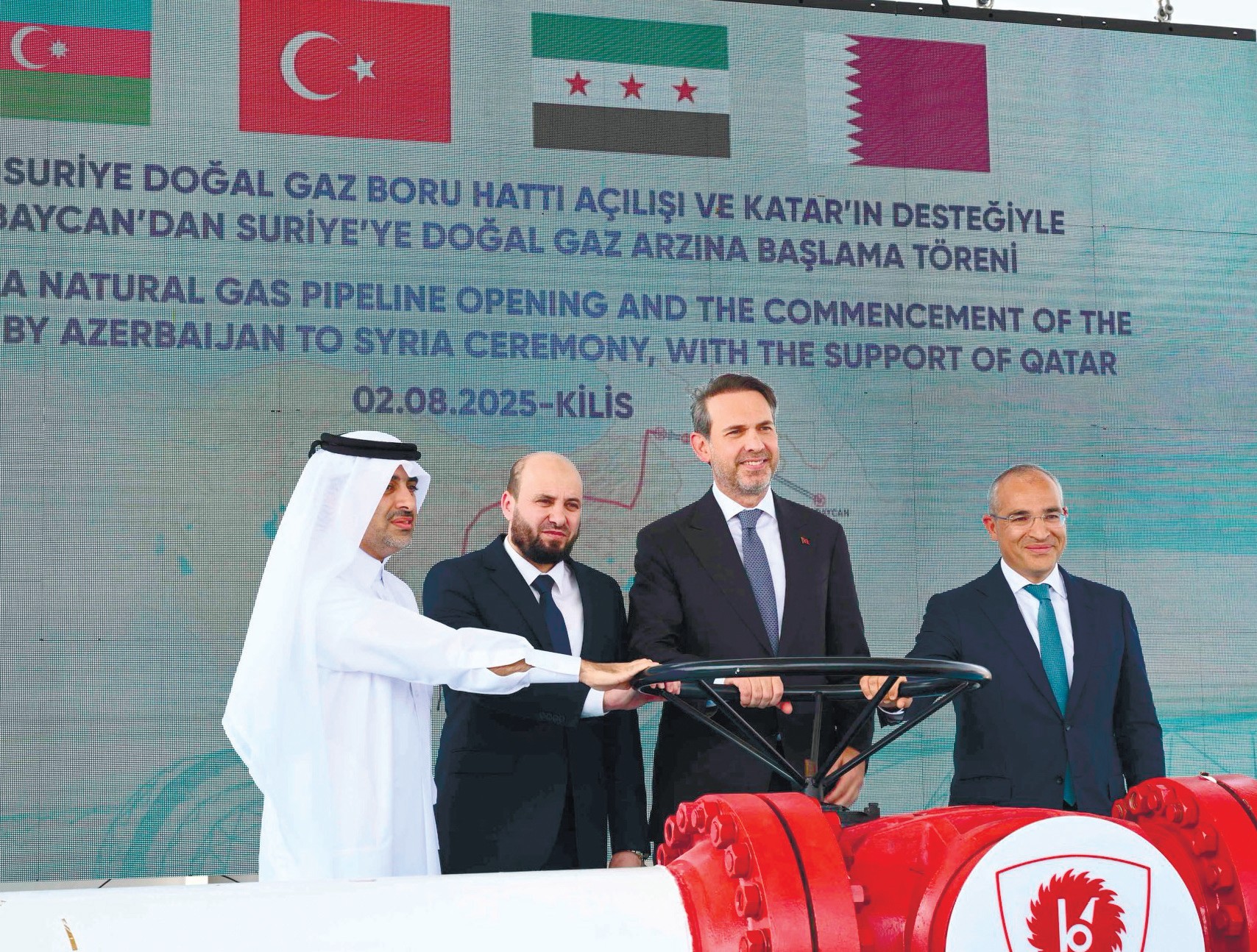
Today, Kilis is once again in the global news spotlight. On 2 August 2025, Azerbaijani natural gas supplies to Syria commenced in this location, thereby endowing the town with new strategic significance and situating it at the nexus of Middle Eastern energy policy.
South Caucasus–Middle East energy bridge
The inauguration ceremony for the Kilis-Aleppo pipeline and the commencement of Azerbaijani gas deliveries to Syria was held in the village of Yavuzlu. The event was attended by the Azerbaijani economy minister, the energy ministers of Turkey and Syria, and the president of the Qatar Development Fund.
During his meeting with Azerbaijani journalists, President Ilham Aliyev highlighted the significance of the event, emphasising that Azerbaijan has taken a significant step in expanding the geography of gas transportation.
"Today, Azerbaijan supplies natural gas to ten NATO countries, meaning ten US allies. Azerbaijan's pipeline gas deliveries are available in fourteen countries worldwide, positioning it as a major player in the global gas industry. Azerbaijan is a key supplier of natural gas to ten NATO and ten EU member states. We are pleased to announce that we have recently commenced gas supply to Syria. We have already established a presence in the Middle East region and will be expanding our geographical reach into Europe and the Middle East. However, this is only one part of our future agenda," President Ilham Aliyev emphasised.
The technical specifications of the project stipulate that Syria will initially receive 3.4 million cubic metres of gas per day through the Yavuzlu metering station, with a subsequent increase to 6 million. On an annual basis, this will amount to between 1.2 and 2 billion cubic metres of gas.
The "blue fuel" is already being supplied to power stations in Aleppo and Homs. When operating at full delivery capacity, this will allow the generation of 1.2–1.3 GW of electricity, which will increase the electricity supply duration to up to 10 hours per day for 5 million households.
Azerbaijan's economy minister Mikail Jabbarov made a statement at the ceremony, highlighting the significance of gas exports to Syria via Türkiye in the country's energy export history. He underscored that this development paves the way for the establishment of a new "energy bridge" between the South Caucasus and the Middle East.
The minister also highlighted that the event underscores Azerbaijan's role as a reliable and strategically significant energy supplier. The project will make a significant contribution to expanding Azerbaijan's gas delivery geography in new directions.
Syria's energy minister, Mohammed Al-Bashir, expressed his gratitude to Azerbaijan and Turkey for their support in improving the welfare of the people of Syria and in the restoration of the country following years of war.
Furthermore, Alparslan Bayraktar, the Turkish energy minister, clarified that the project is being implemented on a commercial basis. "Natural gas from Azerbaijan is exported to Syria. This is not gratuitous aid. Azerbaijan has assumed the commitment to deliver gas and sells it to Syria. Turkey is responsible for the delivery and transportation of this gas, and for providing the necessary logistics. In addition, the Qatar Development Fund is providing financing for this project. This is also a commercial activity."
The head of the Qatar Development Fund, Fahad Hamad Al-Sulaiti, confirmed that Qatar's participation aims to support sustainable energy supply and Syria's recovery: "This initiative is intended to be a long-term commitment to sustainable development and progress in Syria."
Future plans
The export of Azerbaijani gas to Syria is a significant development, marking an unprecedented and successful cooperation model among a producing country, a transit country, a consumer and a financial partner. The project is designed to create conditions for long-term regional integration, to stimulate international investment, and to strengthen energy security and stability in the South Caucasus and the Middle East.
This initiative represents a significant investment and development, extending beyond the scope of an energy project. This represents a significant step towards establishing a novel model of collaboration that will be mutually beneficial to all parties involved.
Azerbaijan is thus strengthening its position as a strategic energy supplier on the international stage, expanding export corridors to Europe and the Middle East, and enhancing its investment appeal and political influence.
Turkey is consolidating its status as a key transit hub between the South Caucasus, the Middle East and Europe, increasing its influence in the region's energy and geopolitical space, and raising the significance of its infrastructure on the international arena.
The stabilisation of Syria's energy sector will provide the country with a reliable and predictable energy source, thereby facilitating economic recovery, infrastructure and social services restoration. This, in turn, will strengthen internal and regional stability, while also raising international partners' confidence in cooperation opportunities.
Qatar has demonstrated an active role in financing strategic projects and humanitarian initiatives, strengthening its position in the region's energy and investment sectors, and fostering the development of sustainable international economic and political ties.
The region is set to benefit from a single initiative that will provide it with energy and, at the same time, create the conditions for long-term stability and integration. "This is not the last project, but the first one. We will have other joint projects in the future," said Mohammed Al-Bashir.
SOCAR has also announced its intention to significantly expand its presence in Middle Eastern energy markets. Mr Jabbarov, who also serves as Chair of SOCAR's Supervisory Board, did not disclose the countries that may potentially import Azerbaijani gas in the region.
"However, I can confidently note that demand for Azerbaijani gas in the eastern market and across the Middle Eastern region is substantial. The potential to supply gas to these markets on competitive terms has already been confirmed by the current export project to Syria. Turkish partners have demonstrated a high level of cooperation, which opens prospects for further expansion of SOCAR's activities in the region," Jabbarov emphasised.
In Azerbaijan, he also said that they believe that gas transport to Syria will become not only the beginning of energy cooperation but also a platform for future large-scale regional projects.
"We are confident that this partnership will stimulate mutual economic development and create a firm basis for strengthening regional energy security, as well as implementing joint investment and strategic infrastructure projects," Jabbarov noted.
It is also noteworthy that in April 2025, reports emerged from Middle Eastern media outlets that Syria's new authorities had offered Azerbaijan a role in the development of oil and gas fields in the country's north-eastern region. This area is currently under the control of the Syrian Democratic Forces, who are supported by the United States.
The first step towards developing energy cooperation between Baku and Damascus has already been taken. In light of SOCAR's growing interest in the upstream sector (exploration and production), particularly in foreign markets, and in the context of the restoration of Syria's oil industry, this project presents a range of promising opportunities and establishes the foundation for long-term, mutually beneficial cooperation between the two countries.
RECOMMEND:
 242
242

