

INSURANCE UNION
Turkic states strengthen economic partnership via financial instruments
Author: Nurlana BÖYÜKAGHAGHIZY
Economic cooperation among Turkic countries is expanding to encompass a growing number of sectors and industries, with a focus on mutually beneficial projects and initiatives. In principle, this provides a valuable foundation for the economic development of member states within this broad community. Furthermore, it offers a practical solution to mitigate the adverse effects of geopolitical and other external shocks on domestic markets.
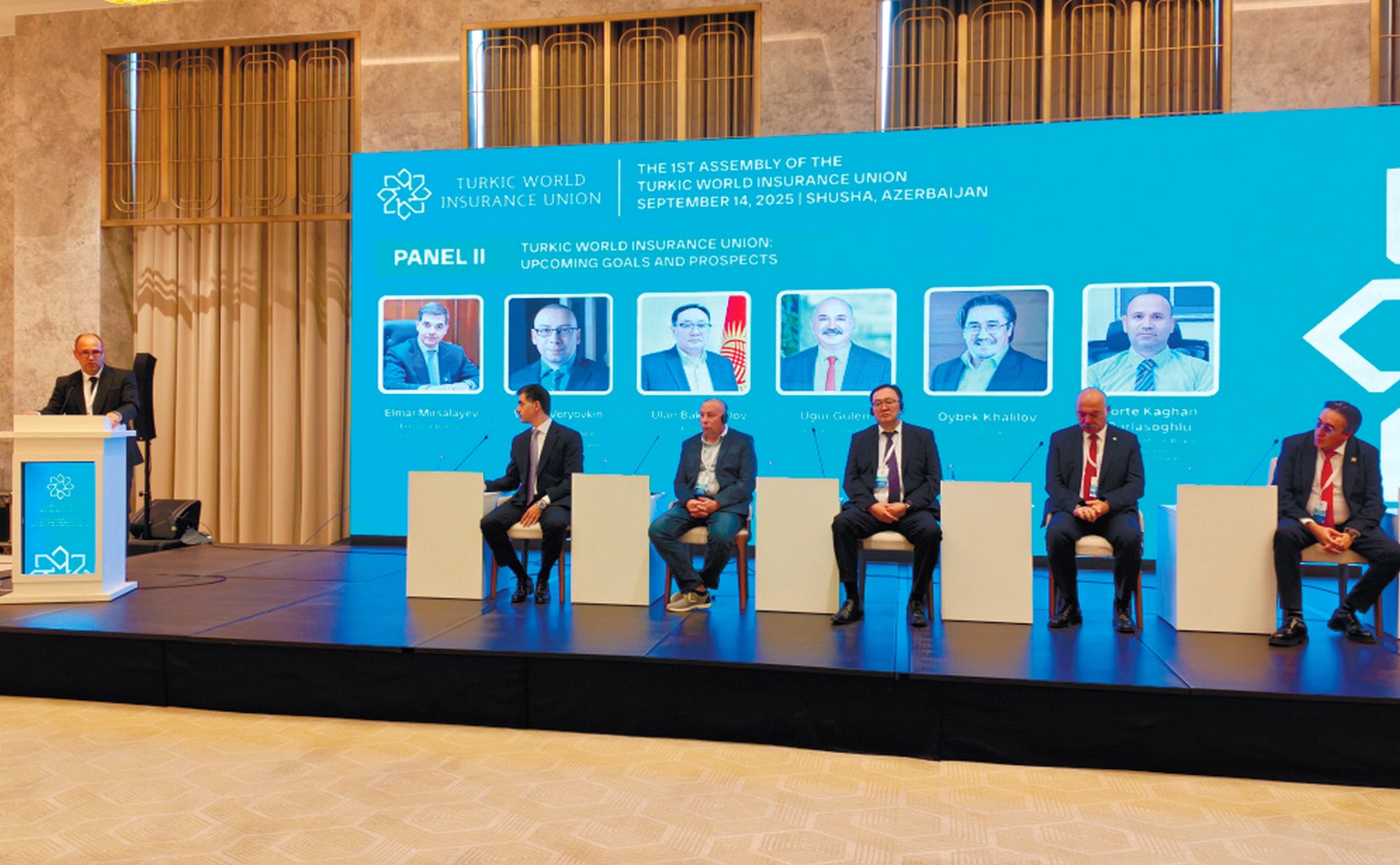
One area in which this cooperation is gradually moving towards practical initiatives is insurance. The first assembly of the Union of Insurance Organisations of the Turkic World (UIOTW) was held, initiated by the Association of Insurers of Azerbaijan, with strategic support from the Central Bank of Azerbaijan (CBA) and participation of the Organisation of Turkic States (OTS). The event took place in Shusha, the former cultural capital of the Turkic world.
At the summit, a joint "Document of Proclamation" was signed by insurers from several countries, and the UIOTW logo and flag were presented.
Integration mechanisms
The economic potential of the Turkic states is growing rapidly, and with it the opportunities for joint projects in specific economic sectors are expanding. As outlined in the address to assembly participants by OTS Secretary‑General Kubanychbek Omuraliev, in 2024 the community's combined GDP exceeded $2.1 trillion, while trade turnover reached $1.1 trillion, and intra‑community trade amounted to $85 billion. "A few years ago, the share of internal trade in total turnover was 3%, and now this figure has reached 7%. This growth paves the way for future integration," the address states.
OTS representative Farid Mammadov emphasised that financial integration among Turkic states would be strengthened by mechanisms created within the organisation, such as the Turkic Investment Fund, the Union of Chambers of Commerce, the Agreement on Partnership in the Digital Economy, and the draft Agreement on Free Trade in Services and Investments.
In terms of the insurance sector specifically, the situation is also promising.
Last year, insurance markets in OTS countries demonstrated robust growth dynamics: Azerbaijan — 10.7%, Kazakhstan — 41.38%, Kyrgyzstan — 71.32%, Türkiye — 72.5%, Uzbekistan — 21.22%.
Meanwhile, Elmar Mirsalaev, executive director of the Association of Insurers of Azerbaijan, stated that the expected average annual growth rate of insurance markets in OTS member and observer countries through 2030 is projected at 44–51%. This positive outlook is founded on strategies for facilitating knowledge exchange between markets, with a particular emphasis on the systematic development of personnel and information exchange, along with the establishment of reinsurance relationships, including the creation of a joint reinsurance pool.
Please note that the initial three observer countries, as announced at the assembly, will be the insurance associations of Hungary, Turkmenistan and the Turkish Republic of Northern Cyprus.
As Davud Mentesh, chairman of Türkiye's Agency for Supervision and Regulation of Insurance and Private Pensions, said, the reinsurance market may become strained in future, especially with increasing catastrophic risks: "Therefore, the creation of alternative products is important. The increase in natural disasters due to climate change has a negative effect on the reinsurance market, causing prices to change and volumes to shrink. This forces countries to seek alternative products and markets," he added.
Meanwhile, Ugur Gulen, head of the Union of Insurers of Türkiye, reported that his country is ready to share experience with other Turkic states, including Azerbaijan, in the areas of earthquake insurance and agricultural insurance.
Priority instruments
Azerbaijan has already accepted this offer and is studying Turkey's experience in creating seismic maps and risk models. "In line with the model that has already been successfully implemented in Turkey, a bespoke variant has been developed for Azerbaijan." The product is currently undergoing testing. The model will facilitate the assessment of the economic and material consequences of potential earthquakes in Azerbaijan, thereby enabling a more accurate risk assessment for both the state and insurance companies," stated CBA Director General Vusal Gurbanov.
He also announced that an initial draft law on mandatory insurance of immovable property has been prepared, with the primary objective being to alleviate the fiscal burden on the state created by catastrophic risks. "The implementation of this system will transfer catastrophic risks to insurance companies and the sector as a whole. This also includes regularly occurring social risks, including risks arising from fires and explosions," he clarified.
The CBA director general asserts that the regulator has identified risk-oriented regulation and supervision, as well as transparency of communications, as priority instruments for building the resilience of the country's insurance sector.
Furthermore, a key objective is to enhance the accessibility of insurance services, a field in which digitalisation holds particular significance. It is important to note that no other country has witnessed the simultaneous development of technology and legislation in this area. Given the rapid pace of technological advancement, this approach is essential for staying competitive.
Despite the challenges and gaps that currently exist, the insurance sector in Azerbaijan is developing steadily, a development which distinguishes it from other OTS countries. Its assets have grown by 12% over the past year, reaching a value of over 2.1 billion manats. Profitability indicators have also shown signs of improvement. In the first half of the current year, the sector's total profit exceeded 80 million manats. The return on assets was 7%, and the return on equity was 25%. Market participants acknowledge that recent reforms and active adoption of innovative solutions and new products have given the market a stimulus.
Thus, the development of an insurance union of Turkic countries opens new prospects for deepening financial integration and increasing the resilience of national economies. Coordinated efforts in this sphere will help not only to share risks but also to create competitive mechanisms to counter global challenges.
RECOMMEND:
 201
201

