

A UNIQUE ROUTE
The Zangezur Corridor: Transforming the Region into a Key East-West Energy and Trade Hub
Author: Nigar ABBASOVA
This year has marked a new stage in the development of energy cooperation between Azerbaijan and Türkiye. In April, the Igdir-Nakhchivan gas pipeline was commissioned; in June, the Turkish company TPAO joined the project to develop the prospective Caspian structure Shafag-Asiman; and in August, with the financial participation of Qatar, Baku and Ankara began joint efforts to supply Azerbaijani gas to Syria.
Another shared success was the commencement of construction on the Kars-Igdir-Nakhchivan railway, which is viewed as a key element of the Zangezur Corridor and an important part of the regional transport network. The project holds significance not only for transport but also for energy, as it includes plans to develop infrastructure for transporting energy resources along this route. This enhances the corridor's strategic value for both the region and the global economy as a whole.
The prospects for cooperation between Azerbaijan and Türkiye in the energy sphere, as well as the further development of the Zangezur energy corridor, were the main topics of discussion at the IV Azerbaijan-Türkiye Energy Council, held in Türkiye on September 3-4.
Priority: The Zangezur Corridor
In their speeches at the council meeting, the energy ministers of Azerbaijan and Türkiye outlined the priorities for energy cooperation between Baku and Ankara. It emerged that the foremost among these is the creation of infrastructure for the export of "green" energy from Azerbaijan to Türkiye and onward to Europe.
"Developing renewable energy and strengthening our partnership with Azerbaijan on electricity transmission infrastructure is a shared responsibility we owe to future generations," stated Turkish Minister Alparslan Bayraktar.
Türkiye places special importance on the construction of a line that will connect Türkiye and the Nakhchivan region of Azerbaijan, which will guarantee the security of electricity supplies to the Nakhchivan Autonomous Republic, taking the electricity trade between the two countries into a new phase.
According to Mr. Bayraktar, the "Green Electricity Transmission and Trade" project, being implemented by the two countries, is a "vivid symbol of cooperation". This refers to the creation of the Zangezur energy corridor which, combined with its transport component, will transform the region into a primary hub for energy and trade links between East and West. "The Zangezur Corridor, in addition to being an unimpeded route connecting the main part of Azerbaijan with Nakhchivan, will strengthen relations with Türkiye and other Turkic states in the energy and communication spheres, turning our countries into one of the main centres of the Middle Corridor for energy, transport, and transit," said Azerbaijan's Minister of Energy, Parviz Shahbazov.
Regarding the energy dimension of the Zangezur Corridor, the plan involves creating a unique route to supply not only clean energy but also hydrocarbons from the Caspian region and Central Asia to world markets via Nakhchivan to Türkiye.
In the first phase, it is planned to export 1,000 MW of electricity, to be generated directly in Nakhchivan, to Türkiye and Europe.
In Mr. Shahbazov's view, the preparatory processes for this project must be expedited. "Accelerating these processes is becoming particularly relevant given the new realities. Effective electricity connections between Nakhchivan and Türkiye remain one of the key issues awaiting resolution. This will enable the supply of 'green' energy not only from various regions of Azerbaijan and the Caspian Sea but also from Kazakhstan and Uzbekistan through the 'Jabrayil' energy hub, across Armenian territory to Nakhchivan, and then on to Türkiye and Europe," he noted.
It is noteworthy that Armenia is already mentioned among the transit participating countries, something that was difficult to imagine just five years ago. The inclusion of this country among the potential participants in the regional energy infrastructure is evidently a result of the agreements reached in Washington between the leaders of Azerbaijan, Armenia, and the US, and serves as clear confirmation of Baku's commitment to sustainable peace.
It is no secret that the large-scale projects realised by Azerbaijan in cooperation with Türkiye and Georgia have brought significant dividends to all three countries. Beyond the economic benefits, they have become a source of pride and a stimulus for new initiatives. Armenia should take note of this and realise that exorbitant ambitions will yield no dividends, only complete isolation.
The creation of the Zangezur energy corridor promises its participants substantial economic and reputational advantages and will strengthen their positions on the international stage. At the same time, the project will become a factor for regional integration and will increase the strategic importance of the South Caucasus on the world's energy map.
Caspian Union
When discussing the energy cooperation between Azerbaijan and Türkiye, the gas component cannot be overlooked; its reinforcement has been declared one of the priorities for interaction between Baku and Ankara.
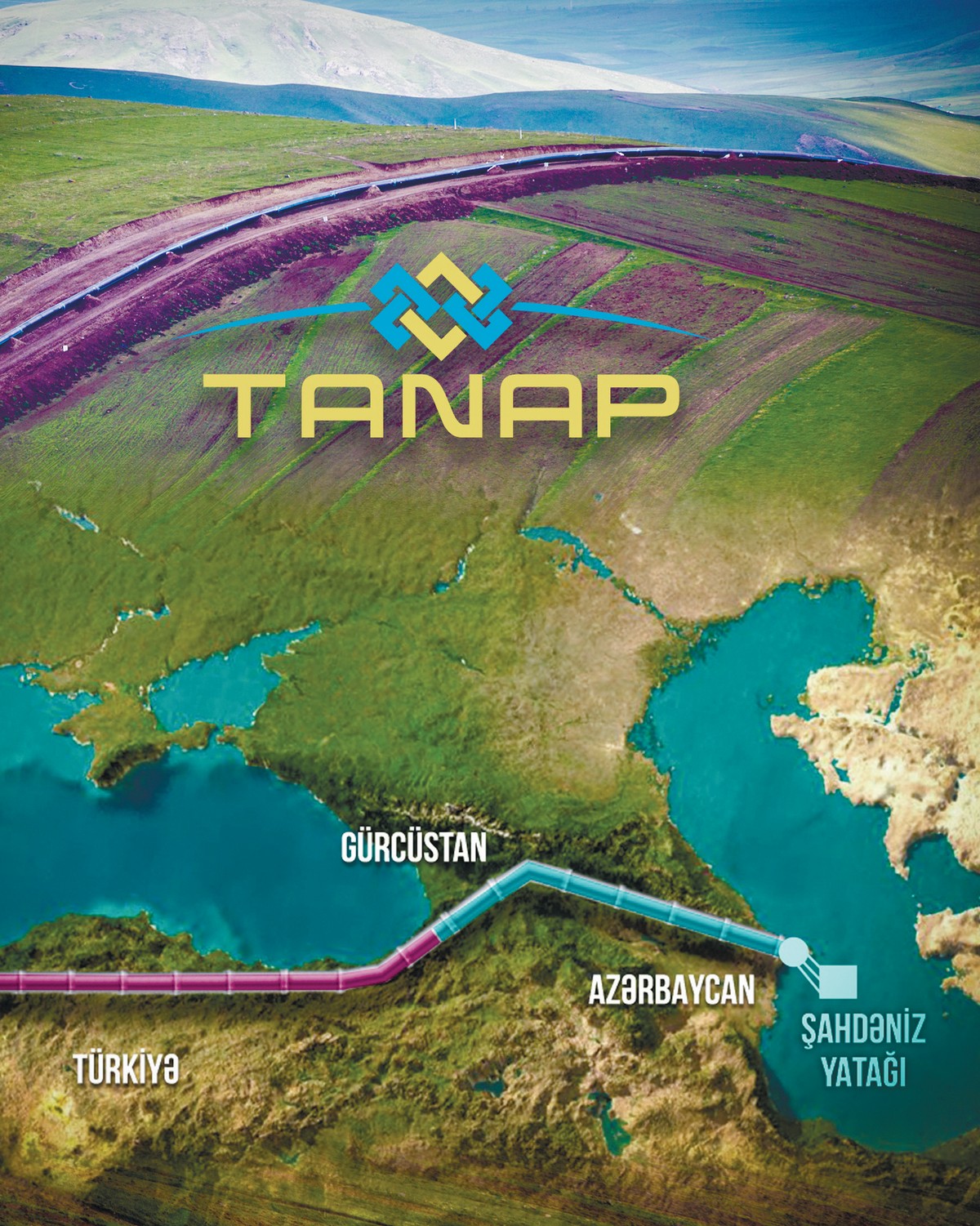
To date, more than 120 billion cubic metres of natural gas have been transported from Azerbaijan to Türkiye, with 35 billion of that volume flowing through the Trans-Anatolian Natural Gas Pipeline (TANAP). Furthermore, over 50 billion cubic metres of natural gas have been supplied to Europe via TANAP. In the first eight months of this year, 6.6 billion cubic metres of gas were exported to Türkiye, and 8.3 billion cubic metres were transported through Türkiye to European countries.
Currently, the geography of Azerbaijan's gas supplies covers 14 countries and is expanding not only into Europe but also into the Middle East.
Meanwhile, Türkiye anticipates that the export of Turkmen gas through Azerbaijan and Türkiye will become one of the most significant steps in the development of cooperation between Baku and Ankara.
"The investments required for Azerbaijan to supply gas in larger volumes, and the development of our cooperation on the export of Turkmen gas through Azerbaijan and Türkiye for the benefit of all parties, will be among the most important steps we will jointly take in the coming years," stated Turkish Vice President Cevdet Yılmaz.
In addition to this, it appears that Ankara has high hopes for expanding cooperation with Baku in the oil and gas production sector of the Caspian. Mr. Bayraktar's statement to this effect was somewhat unexpected, though it fits well within the framework of Türkiye's regional energy strategy, which seeks to diversify its energy sources, strengthen its role in oil and gas transit, and simultaneously expand its influence in the Caspian and Mediterranean regions.
"Our cooperation, which began with the development of the Azeri-Chirag-Gunashli block of fields and the Shah Deniz field, has reached a new level with the signing of the agreement on the Shafag-Asiman field this year. Strengthening cooperation on the 'Garabagh', D230, and 'Dostlug' fields (in the Azerbaijani sector of the Caspian) is also among our main goals," the minister said.
It should be recalled that Türkiye is not yet participating in the latter-mentioned projects. Nevertheless, such statements from a high-ranking official are unlikely to be made merely to show interest—rather, they are a signal of a possible expansion of cooperation. It will be interesting to see how and when the relevant agreements will be signed, as their realisation could become a crucial step in strengthening the roles of Ankara and Baku in the regional energy architecture.
All three projects have good potential for successful implementation, but the 'Dostlug' field, which Azerbaijan plans to develop jointly with Turkmenistan, is attracting particular attention. So far, plans have only advanced to the memorandum stage; however, the involvement of Turkish capital could give the project new impetus, considering Türkiye's special relationships with both Azerbaijan and Turkmenistan.
Expanding cooperation in the gas and oil sectors in the Caspian will enhance the energy independence of Baku and Ankara, increase their export revenues, and strengthen their influence in the region, creating new strategic opportunities for both countries.
REGIONAL NEWS
Azerbaijan and the US discuss a new phase of energy cooperation
During a meeting between the head of the ministry, Parviz Shahbazov, and Brendan Hanrahan, a senior official from the US State Department's Bureau of European and Eurasian Affairs, the priorities for a new phase of energy cooperation between Azerbaijan and the US were discussed.
According to a Report citing the Ministry of Energy, negotiations were held on priority areas of cooperation, such as expanding investment in the energy sector and regional infrastructure. The activities of the Strategic Working Group, established to develop the Charter on Strategic Partnership between Azerbaijan and the US, were also discussed.
The meeting participants underscored Washington's role in the implementation of strategically important energy security projects for our country and noted the importance of cooperation with the US in ensuring the stability of Europe's energy supply.
The current state and prospects for expanding cooperation with ExxonMobil, a long-term partner of our country in the oil and gas sector, were also reviewed.
Furthermore, the parties assessed opportunities for cooperation in the fields of hydrocarbons and renewable energy sources, particularly on "green" energy corridor projects that will link Azerbaijan with Türkiye and Europe via Nakhchivan, Armenia, the Black Sea, and Georgia, as well as establishing an Azerbaijan-Central Asia energy connection across the Caspian Sea. American companies and investors were invited to participate in potential projects.
RECOMMEND:
 187
187