

GREEN ZONE
Azerbaijan confidently turns renewable energy into a new strategic resource
Author: Ilaha MAMMADLI
Azerbaijan has long moved beyond the classic image of a hydrocarbon-exporting country. Today, it is shaping a new agenda—the 'green' transition, which focuses on developing solar, wind, and promising hydrogen projects. This process is not only about reducing emissions or meeting international climate goals; it is about strategically positioning the country on the map of Eurasia as an energy bridge between Europe, Central Asia, and Türkiye.
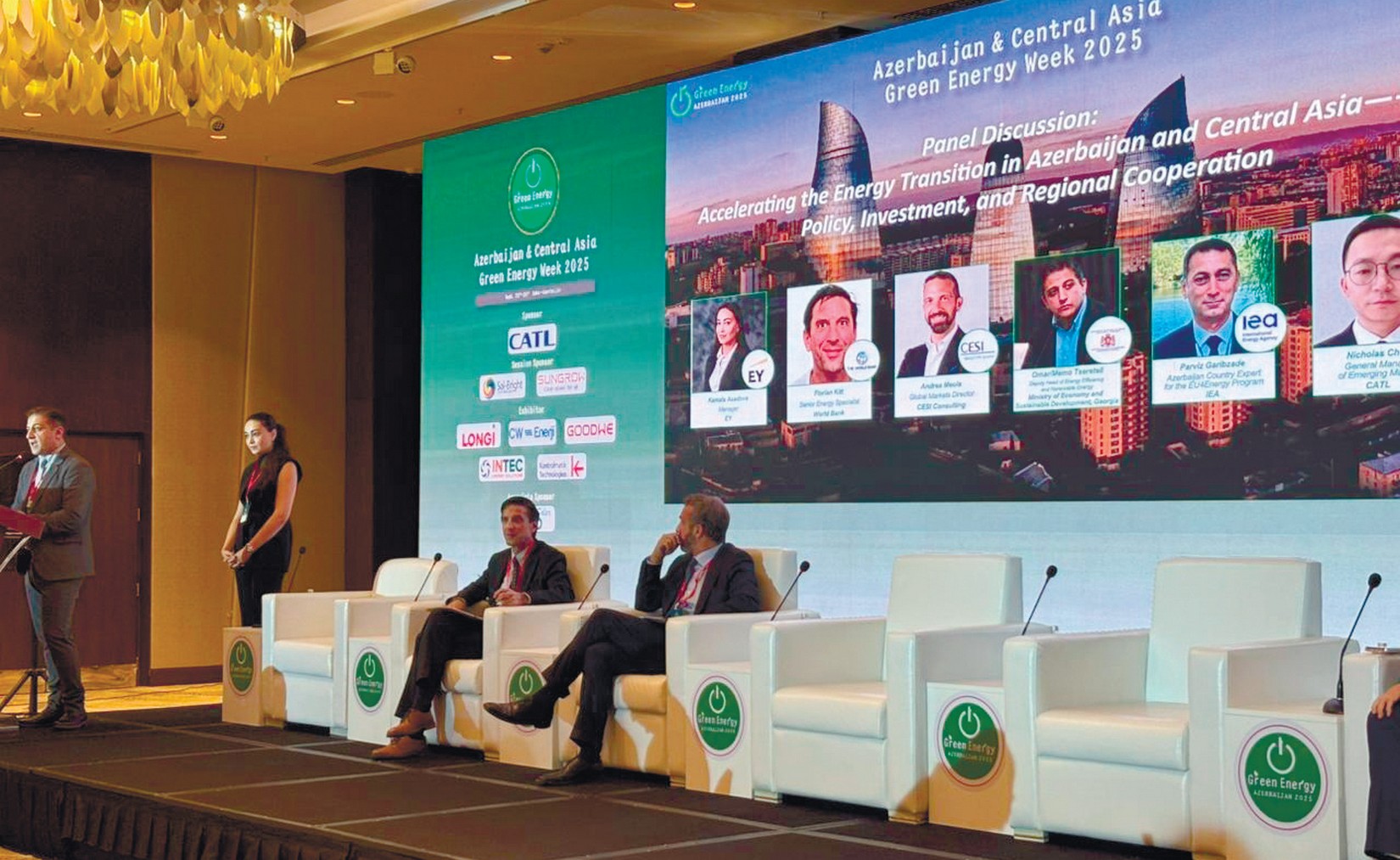
During 'Green Energy Week-2025' in Baku, leading international and national experts noted that the country exemplifies a systematic approach to implementing large-scale 'green' projects, integrating new technologies, and creating conditions for investments.
Problems of the 'Green' Agenda
"Perhaps one of the most pressing issues for Azerbaijan's 'green' agenda is the development of local competencies. As Elchin Targuluyev, a specialist in solar and wind energy at SOCAR Green, stated in his speech at Green Energy Week-2025, without its own EPC companies (EPC, Engineering, Procurement, Construction) and contractors, a large portion of investments will 'leak' abroad: "If everything is imported, then funds will leave the country, even if investments are formally made in Azerbaijan. Therefore, it is necessary to develop local competencies: create EPC companies, attract equipment manufacturers, and support their development."
In essence, this is about creating a new industrial base where Azerbaijani specialists can not only maintain facilities but also compete on the international market. Simultaneously, SOCAR Green emphasises engaging local communities: this includes employment, new economic opportunities, and dialogue with residents of areas where stations are built. Such an approach reduces risks and fosters a positive attitude towards the projects.
According to other experts, the development of 'green' energy in Azerbaijan is accompanied by challenges today. One of the main ones is the grid infrastructure. Rasim Aliyev, Head of the Wind Energy Department at Azerishig OJSC, draws attention to the transition to predictive maintenance based on SCADA data (Supervisory Control and Data Acquisition system). This will allow for identifying faults before they occur and increase efficiency. In the country, he says, preventive and corrective maintenance methods are currently mainly used, which do not provide sufficient return.
Chingiz Orujov, Chief Business Development Specialist for Renewable Energy at TotalEnergies in Azerbaijan, highlighted the difficulties with permits in the renewable energy sector, especially for offshore wind energy, biogas, and geothermal energy. "The creation of a 'single window' system could be an excellent solution," he believes.
No less important is the personnel issue: as noted by ACWA Power and CESI Consulting, in Central Asia and the South Caucasus, there is a shortage of experienced specialists. Therefore, large companies are already planning training programmes and attracting experts.
And finally, the environmental factor. The development of offshore wind energy in the Caspian Sea opens huge potential but requires consideration of the marine ecosystem. Here, experts emphasise the importance of balancing capacity growth with biodiversity conservation.
From local projects to regional hubs
Azerbaijan is confidently moving from pilot initiatives to large-scale programmes, turning renewable energy into a new strategic resource.
Already, 'green' energy zones are being created within the country. For instance, negotiations are underway for the construction of two solar power plants with a capacity of 530 MW in the Nakhchivan Autonomous Republic with the prospect of exporting electricity to Türkiye. As noted by Rena Humbatova, Deputy Director of the State Agency for Renewable Energy, agreements with companies A-Z Czech Engineering and Nobel Energy have already been signed.
By 2027, eight large solar and wind stations with a total capacity of over 1.7 GW are planned to be commissioned in Azerbaijan. The next step will be the development of the 'Socio-Economic Development Strategy for 2027-2030', where 'green' growth will be among the five key priorities.
Elchin Targuluyev spoke about Azerbaijan's transition to the second and third phases of renewable energy development: "The first stage can be called pilot: we were mastering new technologies, learning from mistakes, and forming a legislative base. Now the country is moving to the second phase—technological maturity. This means enhanced project control and mandatory implementation of energy storage systems."
This is why by 2027, the first energy storage system with a capacity of 250 MW will appear in Azerbaijan, becoming part of the national grid. Subsequently, responsibility for integrating storage systems will gradually shift to investors.
According to Targuluyev, after 2032, the country will be able to enter the third stage—export-oriented, implementing projects on a gigawatt scale. By 2040, it is planned to increase the export of 'green' energy to 4 GW, which is comparable to the largest international programmes in this sphere.
It is important to note that Azerbaijan's 'green' energy is not developing in isolation. Major international companies—ACWA Power, Masdar, TotalEnergies, Sungrow—are actively working in the country, each with its own strategy.
Thus, ACWA Power has presented a three-stage roadmap, including the optimisation of wind farms using artificial intelligence, the launch of hybrid projects (wind + solar + storage), and preparation for offshore stations. The company is also betting on the development of local supply chains, including the production in Azerbaijan of key components—blades, towers, and bearings.
These initiatives are already moving the country beyond a 'market for sales'. Azerbaijan is becoming a regional production platform and a future hub for 'green' energy.
The key to scaling up energy lies beyond national borders. The most ambitious project is the energy cable along the bottom of the Black Sea, which should connect the South Caucasus with Europe.
According to Vyacheslav Gordiyenko, Investment Specialist at IFC, this project has colossal strategic significance, but its implementation will require complex coordination and multilateral support. The World Bank (WB) is already conducting necessary research.
Moreover, not only South Caucasus countries but also Central Asia should be involved in the process. Such an approach will create conditions for the emergence of local production capacities and make projects commercially viable.
View of IFIs
The development of renewable energy requires not only technologies and engineering solutions but also significant financial resources. Here, the main role belongs to international financial institutions—IFC, the European Bank for Reconstruction and Development (EBRD), and the World Bank—which are becoming not just creditors but full partners in Azerbaijan's energy transition.
It is worth noting that the Asian Development Bank and the Asian Infrastructure Investment Bank are also actively participating in this process. Their attention to Azerbaijan's energy sector is not accidental. Both institutions view the country as an important link in forming a sustainable energy system for Eurasia and support projects for grid modernisation, the implementation of energy storage systems, and the development of 'green' infrastructure.
According to Gordiyenko, the country is already forming an impressive portfolio—over 1.7 GW of projects by 2027. However, the future success depends not so much on the capacity of the stations themselves but on the resilience of the grid infrastructure and the predictability of revenues.
"It is important to have a reliable electricity buyer. The contract duration should match the loan repayment period—this significantly increases investor interest," notes Gordiyenko.
The topic is continued by another IFC expert on sustainable financing, Leyla Huseynli, emphasising that the country is already moving beyond classic renewable energy projects: "We see growing interest in projects in the format of public-private partnership, including in the sphere of 'green' hydrogen. Not only the region but the whole world could benefit from this." An important direction, she asserts, is becoming 'green' certificates and the implementation of energy-efficient solutions that simultaneously reduce carbon emissions, lower long-term costs, and increase the overall efficiency of the economy. But there is a more pragmatic aspect: in the country, about 90% of buildings depend on gas supply, and the difference between domestic gas tariffs and its export price is quite tangible.
"If domestic consumption is reduced and gas is freed up for export, the state will receive additional revenues that can be directed towards further 'greening' the economy. Such an approach could be a turning point not only for Azerbaijan but on a global scale," believes Huseynli.
The World Bank, in turn, focuses on systemic changes in Azerbaijan's energy sector. Florian Kitt, Senior Energy Specialist at the World Bank Group, noted that the country is moving correctly by building reforms in the sphere of generation, transmission, and distribution of electricity. "This is a necessary condition for further connection to European markets. The government is demonstrating a new vision: a move away from oil and gas dependence, which accounts for over 80% of the economy, and a transition to using other resources available to Azerbaijan. This, firstly, is wind—both onshore and offshore, and, secondly, solar energy. In both directions, we are already observing quite rapid changes: the country has solar power stations in operation, there is a wind farm that supplies energy to the grid. And the government is expanding its vision, considering how to replace main export commodities, i.e., transition from exporting traditional energy sources to exporting renewables," he emphasised.
This transformation, according to the expert, is becoming not just an internal priority but also part of a broader regional strategy.
The World Bank fully supports this process, conducting active negotiations not only with Azerbaijan but also with its neighbours—Georgia and Türkiye. The goal of these discussions is obvious: to find optimal ways for South Caucasus countries to access European energy markets and turn the region into an important bridge between the 'green' energy of Asia and the demand of Europe.
Kitt also pointed to prospects that remain in the shadows: geothermal resources. Azerbaijan, he believes, can use hot underground waters both for the needs of agriculture and recreational zones, and for generating electricity. "This is a natural continuation of the experience accumulated in the oil and gas sphere," added the expert.
The first such project, as announced by SOCAR Green, is planned to be commissioned by 2030.
An active player in Azerbaijan's 'green' energy market remains the European Bank for Reconstruction and Development. Its goal is to support the country's ambitious plan to increase the share of renewable energy sources to at least 30% by 2030. As reported by Sandro Museridze, Chief Energy Specialist at the bank, in recent years alone, the EBRD has financed projects with a total capacity of 1.2 GW. Among them are cooperation with Masdar (230 MW) and ACWA Power (240 MW), as well as two other facilities of comparable scale. "These are the first large utility projects in the Caucasus. It is important that along with capacities, we are also forming local competencies. At the construction site of the Khizi-Absheron wind farm, 850 people are employed, of which 70% are citizens of Azerbaijan. These are new jobs and new skills," he noted.
The participation of the EBRD, according to Museridze, increases the confidence of other international creditors in the Azerbaijani market, which has already yielded several successful examples of joint investments. Particular attention is paid to developing a reliable electricity network and conducting transparent auctions. In 2024, with the support of the EBRD, the first competition for the construction of solar power stations with a capacity of 400 MW was held in the country—an important signal of the long-term role of renewables in national energy.
The EBRD also emphasises the use of saved gas for hydrogen production. "Just two renewable energy projects allow for the freeing up of approximately 300 thousand cubic metres of gas per year. These resources can be directed towards new industries, including hydrogen energy," said Museridze.
All of the above confirms that in Azerbaijan's energy transition, technology and policy go hand in hand with international capital.
Unlike many countries in the region, Azerbaijan is betting on the localisation of production, attracting international investments, integration into regional networks, and the introduction of the latest technologies. Such a combination—national competencies, global partners, and regional cooperation—turns the country into one of the most promising participants in the energy transition in Eurasia.
RECOMMEND:
 187
187