

TAP: THE FIRST FIVE YEARS
Building a resilient and flexible energy system in Europe
Author: Nigar ABBASOVA
The year 2020 became a turning point for Azerbaijan not only in political but also in energy terms. Gas supplies through the Trans Adriatic Pipeline (TAP)—the final segment of the Southern Gas Corridor (SGC)—effectively redrew Europe’s energy map.
The launch of energy exports to the Old Continent cemented Azerbaijan’s status as a reliable and long-term partner of the European Union. It is particularly noteworthy that this strategic milestone was reached in a year of profound global turbulence, marked by the COVID-19 pandemic, a sharp economic downturn and major disruptions to international supply chains. Despite these challenges, the SGC was commissioned on time, demonstrating the resilience of the Azerbaijani–European energy partnership and its capacity to withstand unprecedented global crises.
Path to expansion
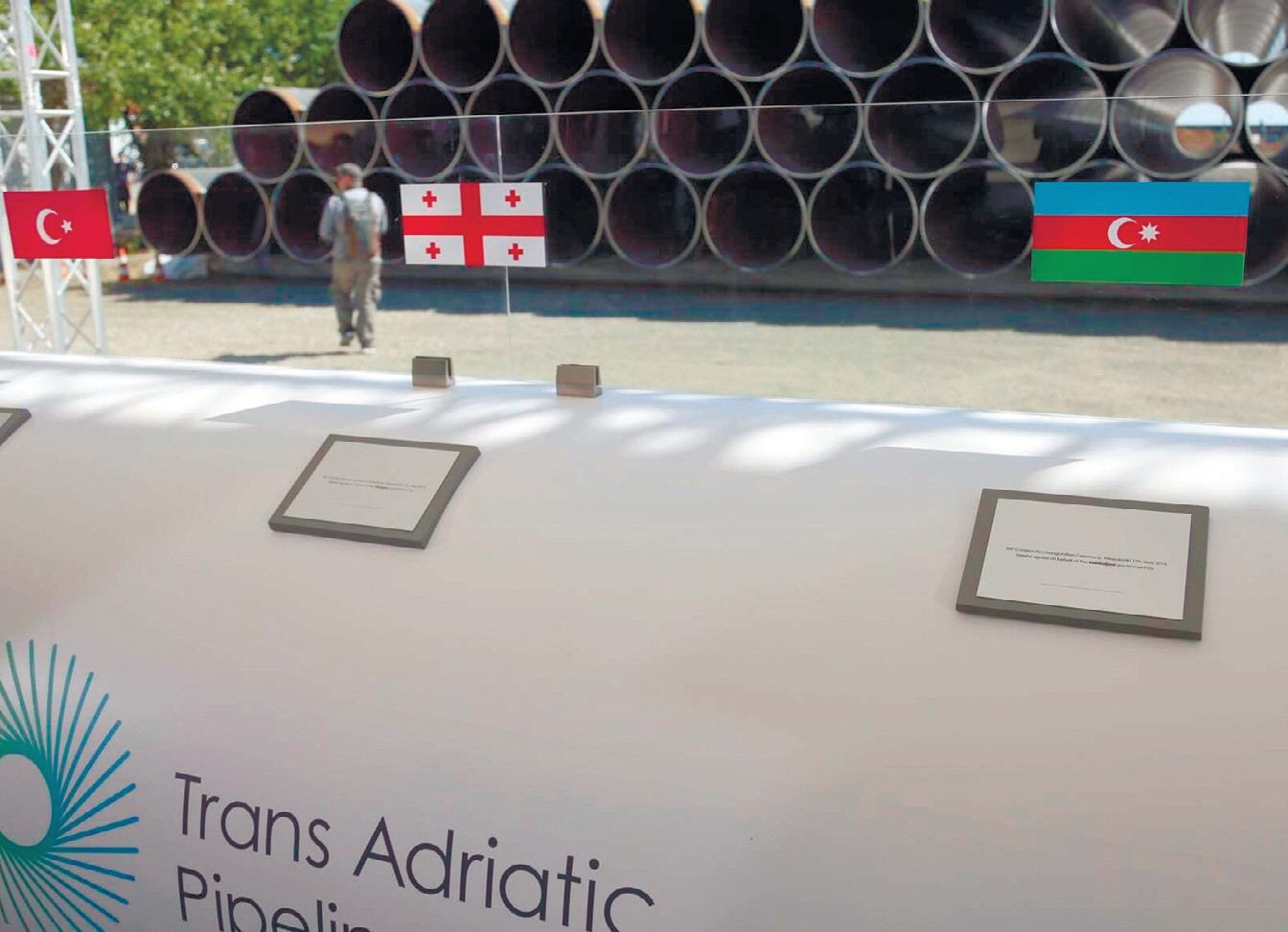
This landmark phase was preceded by the start of commercial operation of the Trans Adriatic Pipeline on November 15, 2020. By December 31, the first volumes of Azerbaijani gas had already reached the European market, opening a new chapter in Europe’s energy history. Since its launch, TAP has not only integrated into the pan-European gas transportation system but has become one of its key pillars. The 878-kilometre pipeline, with an annual capacity of 10 billion cubic metres, runs through Greece, Albania, the Adriatic Sea and Italy, forming a strategic link between the Caspian and Europe.
Five years on, TAP AG, the project operator, sums up an impressive outcome. During this period, more than 52 billion cubic metres of Azerbaijani gas were supplied to Europe—a figure that not only confirms the project’s efficiency and resilience but also underscores its growing role in strengthening the continent’s energy security. Throughout its first five years, TAP has demonstrated impeccable reliability, operating without interruption and meeting the highest safety, environmental and operational standards in all transit countries.
“The first five years of operation reflect the dedication and high professionalism of our teams and contractors, as well as the consistent support of our shareholders. I take pride in the progress we have made and am confident that TAP will continue to play a strategic role in ensuring Europe’s energy security and energy transition in the coming decades,” stated TAP Managing Director Luca Schieppati.
Today the pipeline is approaching a new milestone. From January 2026, TAP will shift to an expanded mode of operation, allowing an additional 1.2 billion cubic metres of gas to be transported annually—not only to Italy but, for the first time, to Albania, further strengthening the role of the Southern Gas Corridor in Europe’s energy-security architecture and its diversification of supplies.
It is notable that discussions on the pipeline’s potential expansion began almost immediately after its launch. The infrastructure quickly proved its stability and efficiency, making the issue of capacity increase a natural step in the project’s development.
Events in Ukraine gave these discussions renewed momentum: once military operations began there, the European gas market changed rapidly, and the EU’s course toward accelerating the phase-out of Russian gas further heightened interest in stable alternative routes, including TAP. A real outcome of these deliberations was the signing on July 18, 2022 of the Memorandum of Understanding on a strategic energy partnership between Azerbaijan and the European Commission, which formalised plans to double the capacity of the Southern Gas Corridor to at least 20 billion cubic metres per year by 2027.
The document created a political framework for moving towards practical steps. Although the first expansion stage of TAP foresees a relatively modest increase—1.2 billion cubic metres per year—it served as an important signal confirming the commitment of both sides to advancing capacity growth. This stage essentially forms the basis for future decisions on a larger-scale expansion of the pipeline. The expansion process began after a market test in 2021, which confirmed commitments to increase TAP’s capacity by 1.2 billion cubic metres per year from January 1, 2026. Of these additional volumes, 1 billion cubic metres will be destined for Italy and 200 million for Albania. The stage is financed through TAP AG’s own funds and is estimated at approximately €132 million. The project includes installing an additional compressor unit and upgrading equipment at the Kipoi station in Greece.
TAP AG’s announcement of the completion of construction works ensures that additional volumes will be transported precisely on schedule. “The expansion works, launched in January 2024, were completed ahead of schedule, within budget, safely and without interrupting ongoing gas transportation, demonstrating the high quality of planning and the resilience of operations,” the operator noted.
Next stage
In parallel with completing the first stage, TAP AG continues to assess possibilities for further increasing the pipeline’s capacity. According to Balkan media reports, one of the options under consideration is expanding the TAP metering station in Bilisht, in south-eastern Albania near the Greek border. In a document submitted to Albanian authorities, TAP AG stated that modernisation of the station had been envisaged in the original TAP design on Albanian territory. The pipeline operator is now conducting technical tests to determine whether this stage is necessary.
The original project (dating from 2013) envisaged the potential scaling of the ACSO2 station in Bilisht into a full-fledged compressor station with five units of 15 MW each. Today the pipeline operates at 10 billion cubic metres, although its design capacity is 20 billion. Reaching this level will require station upgrades.
The updated plan foresees switching to electric compressor units, which will require constructing a high-voltage substation and a transmission line. Electrification will increase capacity, reduce emissions and ensure alignment with the EU’s climate objectives.
In October 2025, TAP AG moved to the binding phase of the market test, accepting applications from gas companies for booking additional capacities.
Energy traders, suppliers and operators book capacity on the basis of real contractual arrangements: TAP AG commits to transporting the declared volume, while customers commit to paying for the service.
Schieppati also noted that almost five years after its launch, TAP infrastructure is used by 46 registered clients. “In the medium- and long-term perspective, our strategy is to enhance TAP’s resilience and adaptability through innovation, the development of new market products and support for the energy transition,” he said.
“As Europe moves towards a low-carbon future, I am confident that TAP will retain its important role in building a resilient and flexible energy system,” added Murad Heydarov, Chairman of the Board of Directors of TAP.
Emirati interest
Another factor underscoring the growing strategic significance of the Southern Gas Corridor is the deepening partnership between Azerbaijan and the United Arab Emirates in the gas sector. On November 4, on the sidelines of the ADIPEC energy exhibition, XRG—the international investment division of Abu Dhabi’s national oil company ADNOC—and Azerbaijan’s Ministry of Economy signed a non-binding agreement on the basic terms of a potential acquisition by the Emirati company of a stake in Canub Qaz Dehlizi JSC (CQD, the Southern Gas Corridor), the managing company of the SGC project.
The agreement followed a memorandum of understanding signed on September 16, 2025 during a meeting between President of Azerbaijan Ilham Aliyev and UAE President Sheikh Mohammed bin Zayed Al Nahyan.
According to XRG, the planned transaction would expand the company’s presence in the Caspian region and boost its involvement in the delivery of Azerbaijani gas to Europe. A potential acquisition of a stake in CQD aligns with XRG’s strategy of increasing its portfolio in regional gas infrastructure and strengthens cooperation with SOCAR—beyond their partnership in developing the Absheron field (30%) and participation in Turkmenistan’s Block I project (38%). As the company notes, investments in the SGC, which transports gas resources from Azerbaijan’s sector of the Caspian Sea to the European market, contribute to the EU’s energy security and support XRG’s regional strategy.
Entry of the Emirati company into CQD’s capital means attracting additional investment into key assets and, likely, further expansion of SGC infrastructure. The transaction itself may seem unexpected—after all, the Southern Gas Corridor stretches to Europe rather than the Middle East. Yet XRG evidently sees value in stable European gas infrastructure and is ready to invest in assets over which European actors often deliberate for years.
Moreover, CQD’s assets are operational, commercially successful projects secured by long-term gas-supply contracts, ensuring guaranteed revenue and low risks. For SOCAR, the deal opens access to long-term capital for developing gas-transport infrastructure and brings genuine diversification of investment sources, especially given the cautious stance of European financial institutions. In the final analysis, the transaction strengthens the positions of both companies and elevates Azerbaijani-Emirati energy cooperation to a new level.
RECOMMEND:
 192
192

