

WIND-POWERED PROGRESS
Azerbaijan's new energy model based on renewables, grids, and exports
Author: Aghasaf NAJAFOV
Azerbaijan is steadily increasing the number of generation facilities in the renewable energy sector, modernising substations where battery energy storage systems (BESS) are being introduced, and creating new energy corridors to access global electricity markets. Experts estimate that the country's exploitable total economic potential for renewable energy stands at 27 GW.
Significant progress achieved
The development of green energy in Azerbaijan has become a vital asset in attracting foreign direct investment. A modern legislative framework has been established, along with fiscal and other incentives for investors.
Azerbaijan has established partnerships with specialised companies from the Persian Gulf, China, Türkiye, and European countries through a most-favoured-nation regime, with these investments focusing on renewable generation capacities. Furthermore, it is involved in international initiatives to develop infrastructure for electricity exports.
The majority of domestic renewable energy projects are funded by foreign investments. According to the Ministry of Finance, by 2027 the investment volume in ten solar and wind power plants will exceed $2.7 billion, which will add an additional 2 GW of capacity to the national energy system.
A map of solar and wind power plants has been approved, including on land and at sea, and on liberated territories. According to the latest plans, by 2030 the national energy system will integrate 6,000 MW of solar, wind, and hydro energy, rising to 8,000 MW by 2032," President Ilham Aliyev said in an interview with local television channels.
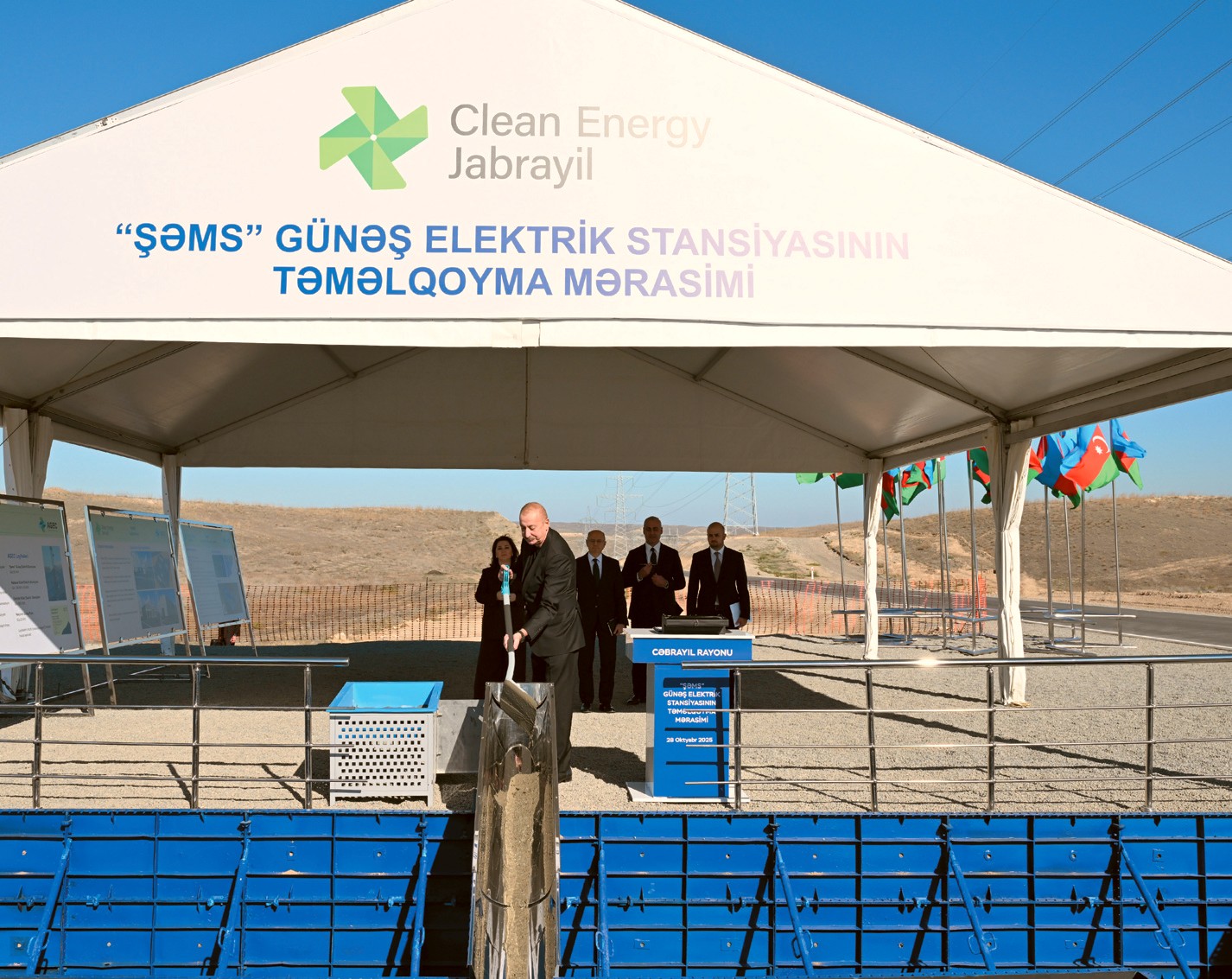
These plans have attracted global attention from the energy sector, including from Masdar, a leading investor from the United Arab Emirates. In October 2023, Masdar commissioned the country's first solar power plant, with a capacity of 230 MW. In the Jabrayil district, BP has initiated construction of a third large solar plant, Shafag (240 MW). It is evident that Chinese and Turkish companies have also expressed considerable interest in this sector.
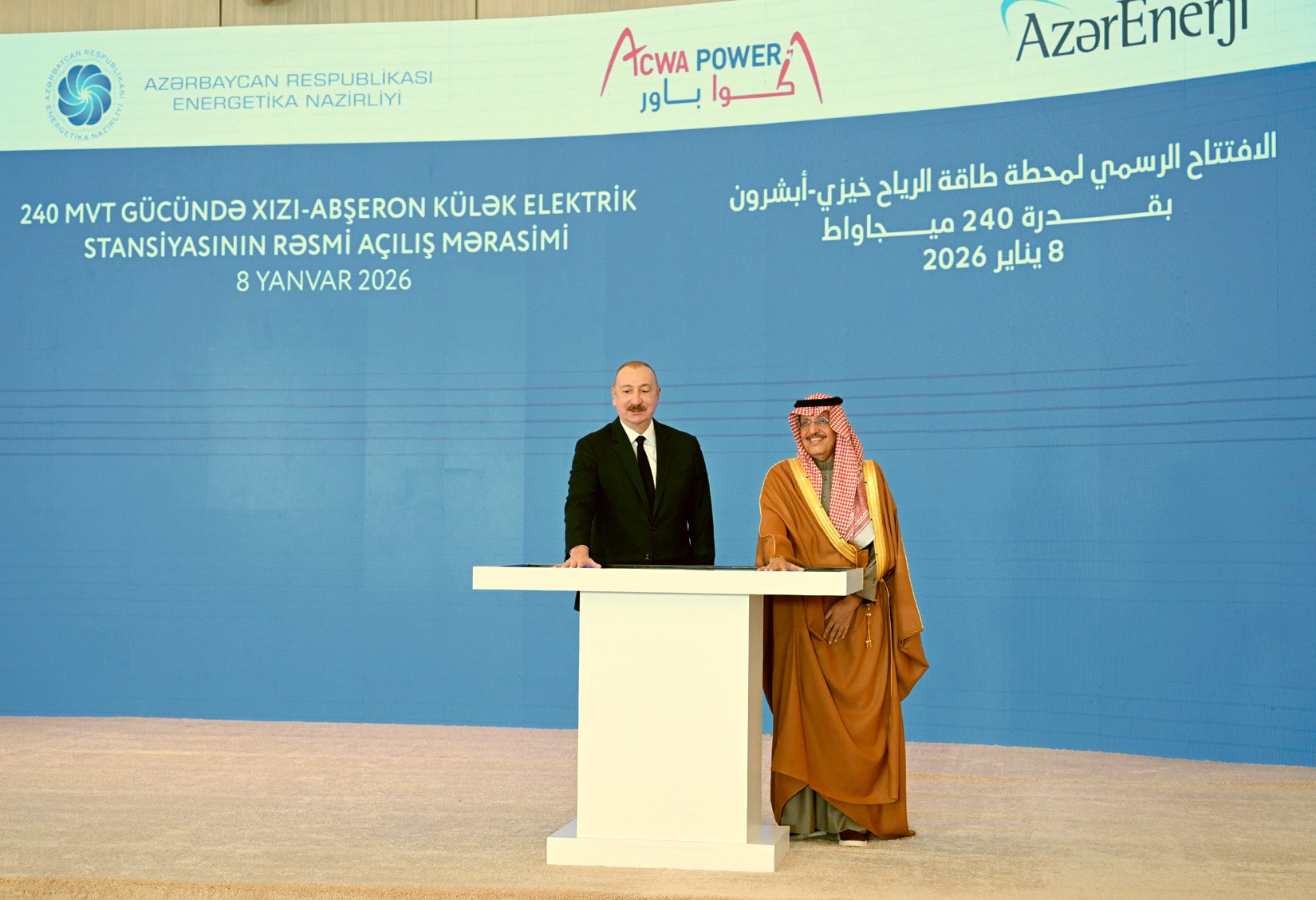
Another key partner in green energy is Saudi Arabia’s ACWA Power: on January 8, 2026, it commissioned the Khizi-Absheron wind power station (240 MW), investing $340 million. The project’s general contractor was China’s PowerChina Huadong Engineering Corp Ltd, with financing supported by the European Bank for Reconstruction and Development and the OPEC Fund. The wind farm comprises 37 turbines of 6.5 MW each: 12 turbines are located in Pirekeshkul village of Absheron district and the remaining 25 in Sitalchay village of Khizi district. After reaching design capacity, the station will annually generate about 1 billion kWh of electricity, saving up to 220 million cubic metres of gas and preventing over 400 thousand tonnes of carbon dioxide emissions. The project follows a build-own-operate model.
“…ACWA Power, being one of the world’s leading companies in this field, is interested in implementing new projects in cooperation with Azerbaijani organisations,” President Ilham Aliyev said during the inauguration ceremony at the Gülüstan Palace in Baku.
Future projects
Agreements and memoranda signed by Azerbaijan's ministries of energy and economy with companies from Saudi Arabia and the UAE demonstrate the dynamic growth of partnerships in green energy. Specifically, we are collaborating with ACWA Power to explore opportunities in wind and solar generation, green hydrogen production, seawater desalination, and manufacturing and subsequent export of green fertilisers (primarily urea) under the "Low-carbon/green fertilisers" project.
In June of last year, Masdar initiated the construction of three renewable generation facilities, with an investment value close to $1 billion and a total capacity of 1,000 MW: in Bank settlement in Neftchala (315 MW), Bilasuvar (445 MW), and Absheron-Garadagh (240 MW). It is estimated that these power plants will generate an average of over 2.3 billion kWh per year. This will result in annual savings of 496 million cubic metres of natural gas and the prevention of over 943 thousand tonnes of emissions.
The joint portfolio of Masdar and SOCAR projects also includes long-term initiatives in offshore wind power with a total capacity of 2 GW, production of green hydrogen and ammonia, as well as synthetic methane. It is also worth noting that Masdar is cooperating with CJSC Azerbaijan Railways on decarbonising rolling stock and freight logistics means.
Alongside Persian Gulf countries, China is a leading partner in the renewable energy sector. "Several Chinese companies have signed agreements with Azerbaijan to implement five new energy projects, including photovoltaic power plants and wind energy with a total installed capacity of 1,570 MW," Chinese Ambassador Lu Mei reported late last year. Chinese investors have been active participants in the contracting sector, contributing their expertise and equipment to the construction of solar plants in Fuzuli and the Khizi-Absheron wind farm. Sichuan Sunsync Photovoltaic Technology plans to provide technology transfer and co-finance a solar panel manufacturing enterprise in Alat SEZ with export potential.
Renewable energy development is also progressing rapidly in the Garabagh and East Zangezur economic regions, which account for approximately one-third of Azerbaijan's total renewable energy potential. To unlock this potential, experts from the Ministry of Energy, with support from the Japanese energy company TEPSCO, have prepared and are implementing a conceptual document to transform liberated territories into a green energy zone.
"Over the past five years, we have constructed approximately 40 small hydroelectric power plants in Garabagh and East Zangezur using state funds, with a combined capacity exceeding 300 MW. A map of potential hydroelectric stations on liberated territories has also been drawn up; in this region, we plan to build small hydropower plants with a total capacity of around 500, possibly even 600 MW. In Jabrayil district, three solar power plants are under construction with a combined capacity of 340 MW," said Ilham Aliyev.
In Garabagh, the installation of over 7,000 LED lighting devices has been completed with the aim of increasing energy efficiency. Many of these devices operate on solar energy.
The Nakhchivan Autonomous Republic also has significant renewable potential, estimated at 5 GW. In the coming years, wind and solar capacities totalling 1,500 MW will be commissioned there, with plans to supply at least 1,000 MW of electricity to Türkiye and Europe. To this end, there is a programme of modernisation and construction of substations, transmission lines and control centres in Garabagh and Nakhchivan. These are designed to export at least 2 GW of green energy.
Reception and distribution
As wind, solar and hydropower generation shares increase, the need to integrate these dynamically growing renewable capacities into the unified electricity system operated by JSC Azerenerji also increases.
Azerbaijan's President has announced that the country's current main task is to expand its ability to receive energy resources. In order to accept this volume, it is necessary to strengthen the energy system. "Therefore, it is essential that we implement an energy grid that is sufficiently robust to receive and transmit not only 8, but also future amounts of up to 20, 30, or even 40 GW."
The modern energy grid mechanism is a centralised system of transmission lines, substations and transformers delivering electricity from generation sites (thermal and green power plants) to consumers, ensuring reliable and efficient distribution. This includes the creation of "smart" grids using digital technologies for real-time data collection, which provide greater efficiency, reliability and cost-effectiveness when integrating renewables.
This is of particular importance given the inherently unstable output of renewables, which is subject to changing wind strength, variations in cloud cover and sunlight, diurnal variations, and seasonal water flows, among other factors. In contrast, the domestic power system primarily relies on large gas-fired stations, whose capacity is not influenced by weather or climate variability.
Integration of renewables into the energy grid necessitates the modernisation of substations through the introduction of new equipment that automatically synchronises and adjusts external reference voltage by level, frequency and phase.
This is the first time that an energy storage system based on batteries is being created domestically, with an initial project capacity of 250 MW. Azerenerji is financing the project independently at the 500-kilovolt Absheron substation site. Similar measures have been implemented at the central country's Aghdash 220-kilovolt substation. The total planned capacity of BESS systems is expected to be 250 MW, with an energy capacity of 500 MWh.
Azerbaijan is also preparing to attract foreign partners for energy storage development. Approximately one year ago, ACWA Power entered into an executive contract for the creation of a battery storage system with a capacity of 200 MW. In November of last year, during COP29, the Baku International Sea Trade Port and Malaysian company Tiza Green Energy launched construction of a 5.4 MW solar photovoltaic installation integrated with a battery energy storage system (BESS). Potential partners for the deployment of BESS systems include Chinese companies China Southern Power Grid International Corp Ltd and PowerChina Huadong Engineering Corporation Limited. The development of battery systems is also planned as part of World Bank and Ministry of Energy projects. These projects are integrating renewables into the unified transmission grid.
Finally, international cooperation remains crucial for building cross-border energy cables to export electricity generated by green capacities to Türkiye and onwards to European countries and possibly the Middle East. "This will allow us to export clean energy; as you are aware, we have a Black Sea cable project whose feasibility study is ready. We have also reached an agreement with Kazakhstan and Uzbekistan on laying a cable across the Caspian Sea floor; work on its feasibility study is underway," President Ilham Aliyev stated.
It is therefore evident that the combination of ongoing and planned renewable projects, along with the development of energy storage and the modernisation of the energy grid, will form a fundamentally new electricity architecture in Azerbaijan. This architecture will be capable of handling tens of gigawatts of green capacity. This will reduce the carbon footprint and release substantial volumes of natural gas, while also laying a solid foundation for transforming the country into a major regional hub for clean electricity exports.
RECOMMEND:
 178
178