

SPRING CLEAN AT BAKU BAY
The Cabinet of Ministers kick-starts an eco-renaissance for the Caspian: from Soviet legacy to a 'green' future
Author: Sabira ALAKBAR
The problem of the Caspian Sea's ecological health, and in particular that of Baku Bay, has long ceased to be a question of local improvement, transforming into a strategic challenge for Azerbaijan. At a recent Cabinet meeting chaired by Ali Asadov, an ambitious full stop was put to the issue: a Comprehensive Action Plan for 2025–2030 was adopted. This document is designed not merely to bring order to the coastline, but to conduct a large-scale surgical operation to remove the 'metastases' of an industrial past that have accumulated for decades in the Azerbaijani sector of the sea.
A hostage to its status
The history of attempts to clean the bay dates back to the mid-20th century, but this work took on a truly systematic character only in recent decades. Baku Bay has historically been a hostage to its status: in the early 1900s, the local port ranked first in the world for oil transportation, with dozens of tankers leaving its waters daily. The price of such success proved high—decades of intensive use turned the seabed of the gulf into a graveyard of sunken ships and industrial scrap.
The first serious studies of the seabed's ecological state began after 1996, and large-scale works to extract structures unfolded between 2007 and 2009. In just those three years, over 30,000 tonnes of metal waste and around 40 vessels with names that became part of the region's maritime history—Dalgha, Moskva, Yagub Kazymov—were raised from the Caspian seabed. Later, by the end of 2011, through the joint efforts of SOCAR, the Ministry of Emergency Situations, and the Caspian Sea Shipping Company, the total number of raised vessels exceeded 60.
The burden of the Soviet past in numbers
The main obstacle on the path to a clean aquatic area remains the heavy legacy of the Soviet era. Worn-out trestles, piers, and mothballed wells, once symbols of industrial triumph, have today become monuments to corrosion. Prime Minister Ali Asadov emphasised that under the influence of hydrometeorological factors, these structures have reached a critical state. Statistics from past years indicate the scale of the problem: a cadastre of 90 wells requiring immediate conservation was once compiled. And although the majority of these were later liquidated, new challenges appear each year due to sea level fluctuations.
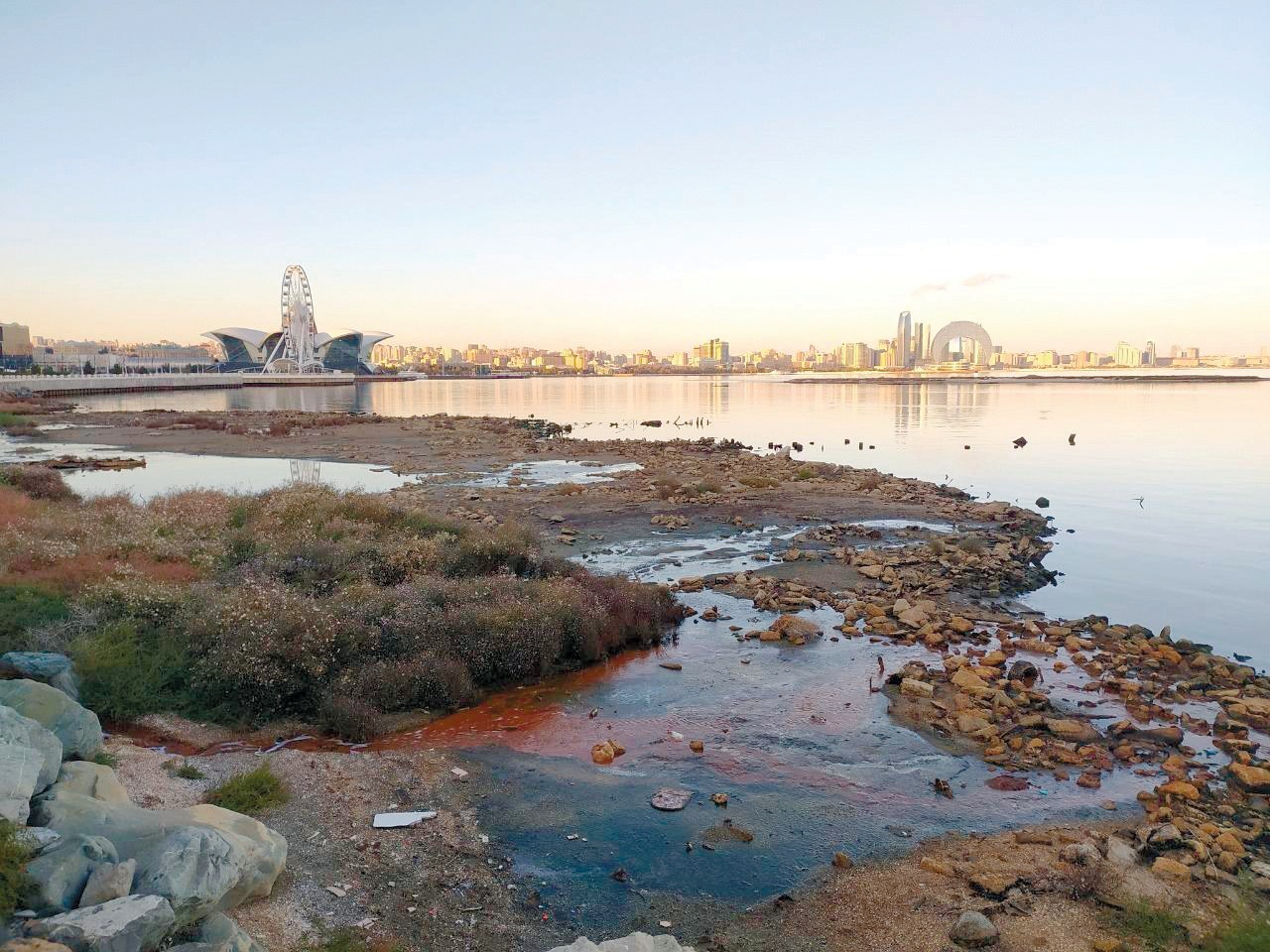
Special attention in the new programme is paid to Baku Bay—the heart of the capital. The Seaside Boulevard has faced a new reality: the cyclical retreat of the sea has exposed old structures hidden for decades under a thick layer of water. If in the 19th century the Caspian Sea level was rising, swallowing even such historical monuments as the Sabayil Castle, the current drop in level is exposing less romantic objects—reinforcing bars, remnants of old piers, and oil sludge. The plan of measures envisages urgent steps to clean the coastal zone of this 'iron scrap', eliminate oil slicks, and, critically, prevent the discharge of wastewater, which for many years was the bay's main scourge.
Digitalisation and partnership: Vision 2030
An innovative approach in implementing the new plan will be the transition from fragmented works to digital management. Instead of point-by-point reaction, the government is initiating the creation of an interactive mapping scheme of the Caspian. This will allow for the real-time visualisation of all problem points—from 'leaking' wells to submerged barges—and the establishment of clear work priorities.
It is also important that the state plans to share responsibility with business and attract international expertise. The active involvement of private capital through public-private partnership mechanisms is anticipated, which will accelerate works previously hindered by limited budgetary funding.
The scale of the upcoming works, articulated by the heads of the Ministry of Emergency Situations, the Ministry of Ecology, and SOCAR, is impressive. In the next five years, the Caspian awaits not just a 'spring clean', but a deep rehabilitation. The cleansing of polluted soils in coastal zones and the raising of semi-submerged vessels will become the foundation upon which Baku's renewed image will be built. The implementation of this plan is not only a technical task but also a manifesto of responsibility, confirming that the country's economic achievements must go hand in hand with the protection of its chief natural treasure.
RECOMMEND:
 162
162

