

DIGITAL LIGHTHOUSE
State Oil Company of Azerbaijan (SOCAR) considers the introduction of advanced technologies as a key strategy for expanding exports
Author: Aghasaf NAJAFOV
Azerbaijan's industrial development has traditionally been centred on the petrochemical sector, which possesses strong export potential. Alongside the largest polymer and methanol plants located in the Sumgayit Chemical Industrial Park (SCIP), the flagship of the national industry, SOCAR Carbamide, has been operating for more than seven years. This facility produces ammonia and urea fertilisers from natural gas, with products that have a high level of added value. The largest plant in the Caspian region, which is primarily oriented towards external markets and owned by the State Oil Company of Azerbaijan, was awarded the Digital Lighthouse Award at the World Economic Forum (WEF) in Davos and was admitted to the prestigious Global Lighthouse Network.
Non-oil priorities
In accordance with the National Priorities for Socio-Economic Development: Azerbaijan 2030, adopted several years ago, is a strategic plan that is guiding the country's economic transition. The primary objective of the plan is to diversify the economy by shifting focus from predominantly raw-material exports. The strategy aims to foster the development of non-oil industry and the supply of high-value-added products to external markets. One of the most promising areas identified within this strategy is the development of the petrochemical industry. Over recent decades, numerous new enterprises have been launched within the SCIP for the production of polymer, household and construction chemicals, as well as facilities for recycling secondary raw materials, including through the use of "green" and waste-free technologies.
The national chemical industry is led by the SOCAR Methanol plant, as well as SOCAR Polymer, a State Oil Company enterprise commissioned in early 2019. SOCAR Polymer is a leading producer and exporter of polypropylene, high-density polyethylene and other polymer raw materials and semi-finished products. It is worth noting that the stability of SOCAR Polymer's operations in foreign markets is largely linked to the fact that the plant supplies SOCAR's largest petrochemical facilities in the region, located in Türkiye. These include the Petkim Petrokimya Holding petrochemical complex in Izmir, as well as the STAR refinery. The country's petrochemical complex is performing well, as evidenced by its export dynamics, which exceed the overall indicators of non-commodity external supplies by almost threefold. For comparison, while the total value of non-oil exports from Azerbaijan in January–September of last year amounted to $2.6 billion, representing an increase of 7.7%, over the same period the value of exported petrochemical products rose by 22%.
Speaking in September last year at the BELEXPO exhibition centre in Minsk, Azerbaijani Prime Minister Ali Asadov emphasised that plants in Türkiye owned by SOCAR subsidiaries had received the prestigious WEF award as some of the most advanced digitalised industrial facilities in the world. It should be recalled that in 2020 the Petkim plant received this award, followed by the STAR refinery in 2021. Last year, SOCAR Carbamide, located in Azerbaijan, was also included in the list of nominees for the Davos-based award.
Digital efficiency
The achieved successes are linked to the consistent implementation of modern technologies and industrial transformation within the framework of the state "Industry 4.0 Readiness Programme". To this end, the State Oil Company invested in advanced methods aimed at improving production efficiency, process safety, occupational health and environmental management, achieving substantial progress in these areas.
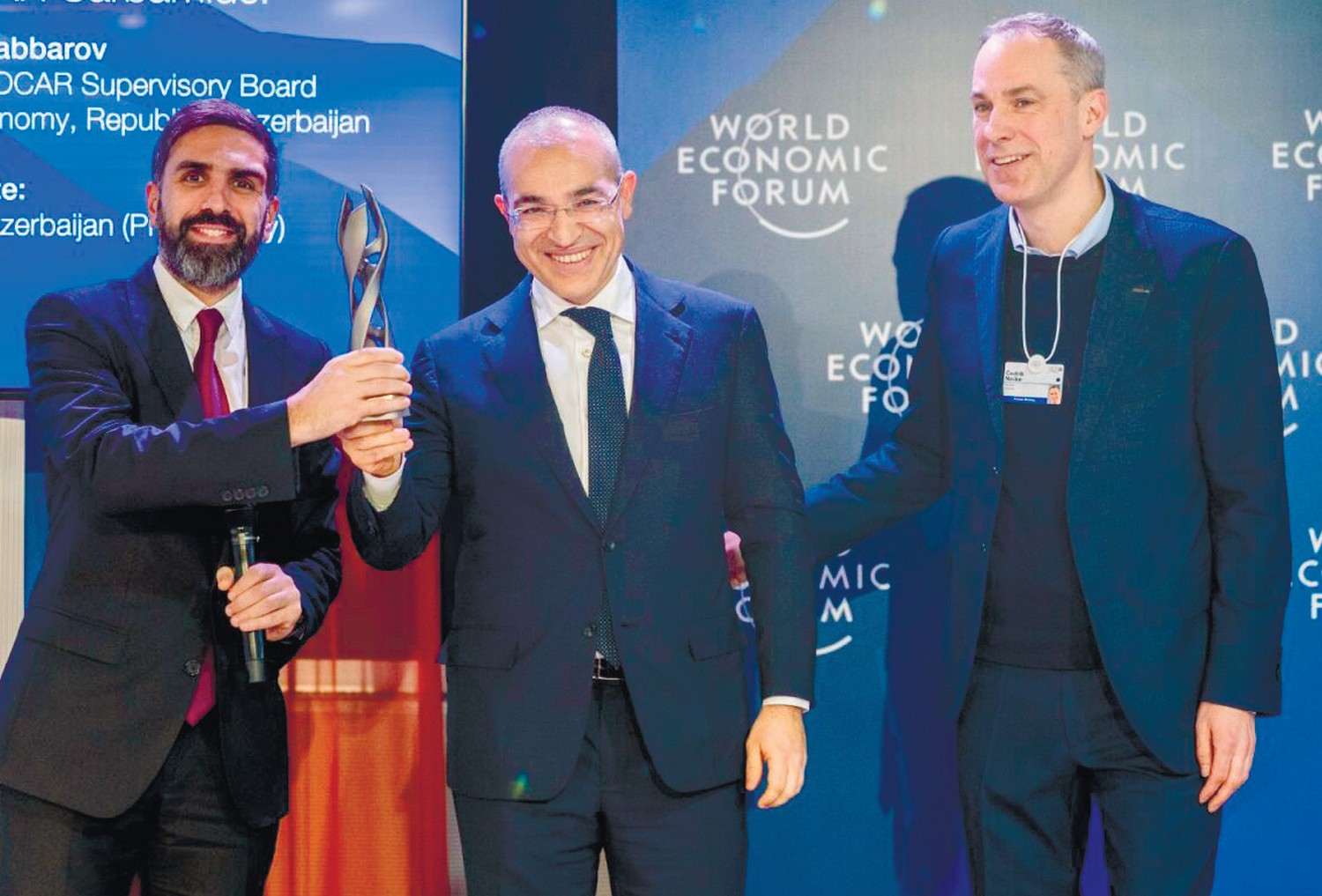
It is therefore unsurprising that the prestigious international award was also presented to another flagship national enterprise producing nitrogen fertilisers: the award was handed to SOCAR Supervisory Board Chairman and Azerbaijan’s Minister of Economy, Mikayil Jabbarov, on the sidelines of the WEF in Davos on January 20. "SOCAR Carbamide is the first operating plant in Azerbaijan to receive this award, and SOCAR is the only energy company in the world to have been honoured with three Digital Lighthouse Awards. This achievement is the result of systematic transformation, innovation and effective digitalisation efforts, as well as the highly efficient integration of Industry 4.0 technologies into operational processes," said Jabbarov.
At the SOCAR Carbamide plant, the management of complex chemical production processes is based on advanced automation and artificial intelligence (AI) models, with a total of 42 AI-based digital solutions implemented at the facility. Thanks to the Industry 4.0 model, carbon emissions have been reduced by 19%, production waste by 72%, and unplanned downtime by 82%. "Admission to the Global Lighthouse Network and the receipt of the Digital Lighthouse Award confirm the success of SOCAR’s transformation programme—demonstrating how digital technologies, advanced automation and workforce development can deliver tangible improvements in productivity and environmental safety," SOCAR President Rovshan Najaf said while speaking at WEF 2026.
As SOCAR Chief Digital Officer Murad Abdullayev noted on the sidelines of the Davos forum, by implementing its digital transformation strategy, SOCAR has received the international award for the third time among 210–250 companies worldwide. This marks the first time that a urea plant from the South Caucasus and Central Asia has received such recognition. He emphasised that alongside technological improvements, the plant has increased production efficiency, ensured a transition to environmentally friendly energy sources and enhanced employees’ use of advanced technologies.
Export-oriented strategy
During a media tour of the Sumgayit Chemical Industrial Park, SOCAR Downstream Management LLC Director General Emil Alkhasli outlined the factors that enabled SOCAR Carbamide to be included in the prestigious Digital Lighthouse Network. "For SOCAR, the implementation of Industry 4.0 standards is not merely a trend but a solution designed to ensure safety, increase digitalisation levels, improve product quality and enhance economic performance," he emphasised. "The awarding of the WEF prize to SOCAR Carbamide is the result of implementing a series of solutions that meet the requirements of digitalisation, artificial intelligence and Industry 4.0 elements, leading to increased efficiency and production capacity, as well as reduced unplanned downtime."
The project implemented during 2023–2024, through the introduction of core foundations and subsequent analytical solutions, increased the plant’s production capacity by 21% and reduced costs. Natural gas consumption used to produce each tonne of urea declined by more than 24%.
An equally important advantage of SOCAR Carbamide’s inclusion in the Global Lighthouse Network is the recognition of Azerbaijan’s achievements in developing Industry 4.0. Among other aspects, this step demonstrates that the country is implementing environmental, social and governance (ESG) reporting principles. This means that work is being carried out in Azerbaijan’s chemical industry to reduce toxic waste, develop waste-free recycling and sorting technologies, and maximise digitalisation of production processes to enhance workplace safety. These are not merely issues of prestige or external reporting: enterprises that implement and comply with ESG standards gain easier access to concessional loans from international banks, while export procedures—including international standardisation and certification processes—are also simplified.
These developments are particularly important for SOCAR Carbamide, commissioned slightly more than six years ago and one of the most export-oriented enterprises in Azerbaijan’s petrochemical sector. Urea export dynamics have grown rapidly in recent years. According to the Centre for Analysis of Economic Reforms and Communication, in January–November 2025 urea exports totalled $163.4 million, representing a 44.9% increase compared with the same period of 2024.
The carbamide plant consists of three industrial sections—ammonia production, urea production and urea granulation. Its daily production capacity stands at 1,200 tonnes of ammonia and 2,000 tonnes of urea, and taking into account the growing market demand for fertilisers, production volumes have been brought close to the plant’s design capacity. "SOCAR Carbamide fully meets domestic fertiliser demand—around 12% of total production—and has also become an important exporter in this field. We export fertilisers to Ukraine, Romania, Bulgaria, Türkiye and Canada, and, provided there are no logistical difficulties, we also plan to establish supplies to the US," stated plant director Kutay Durna during the media tour, emphasising that the facility is capable of supplying 650 thousand tonnes annually.
It should be noted that the global nitrogen fertiliser market has experienced several sharp rises and declines over the past three to four years due to complex geopolitical and economic processes. The situation stabilised in 2025, when prices for nitrogen fertilisers increased amid sustained demand. In January 2026, the global fertiliser market experienced another growth surge, with urea prices rising due to active purchases by Asian countries and limited supply. The primary demand is generated by India and Australia, which are actively attracting volumes from the Middle East and regions east of the Suez Canal. As a result, the European market has come under pressure, while prices in Southeast Asia are already approaching $415 per tonne of granular urea. In response to the price surge, the European Commission is considering the temporary abolition of import duties on fertilisers. All of this opens a window of opportunity for Azerbaijan as well.
The new fertiliser market environment demonstrates that digitalisation, improved energy efficiency and ESG approaches are no longer simply trends but essential conditions for accessing the global industrial value chain. SOCAR Carbamide has already integrated into this paradigm, strengthening its role in expanding non-commodity exports and enhancing the country’s industrial profile. As a result, the petrochemical sector is becoming one of the key pillars of Azerbaijan’s long-term industrial strategy.
RECOMMEND:
 160
160

