

THE END OF AN ERA
Georgia after Patriarch Ilia II
Author: Namig H. ALIYEV
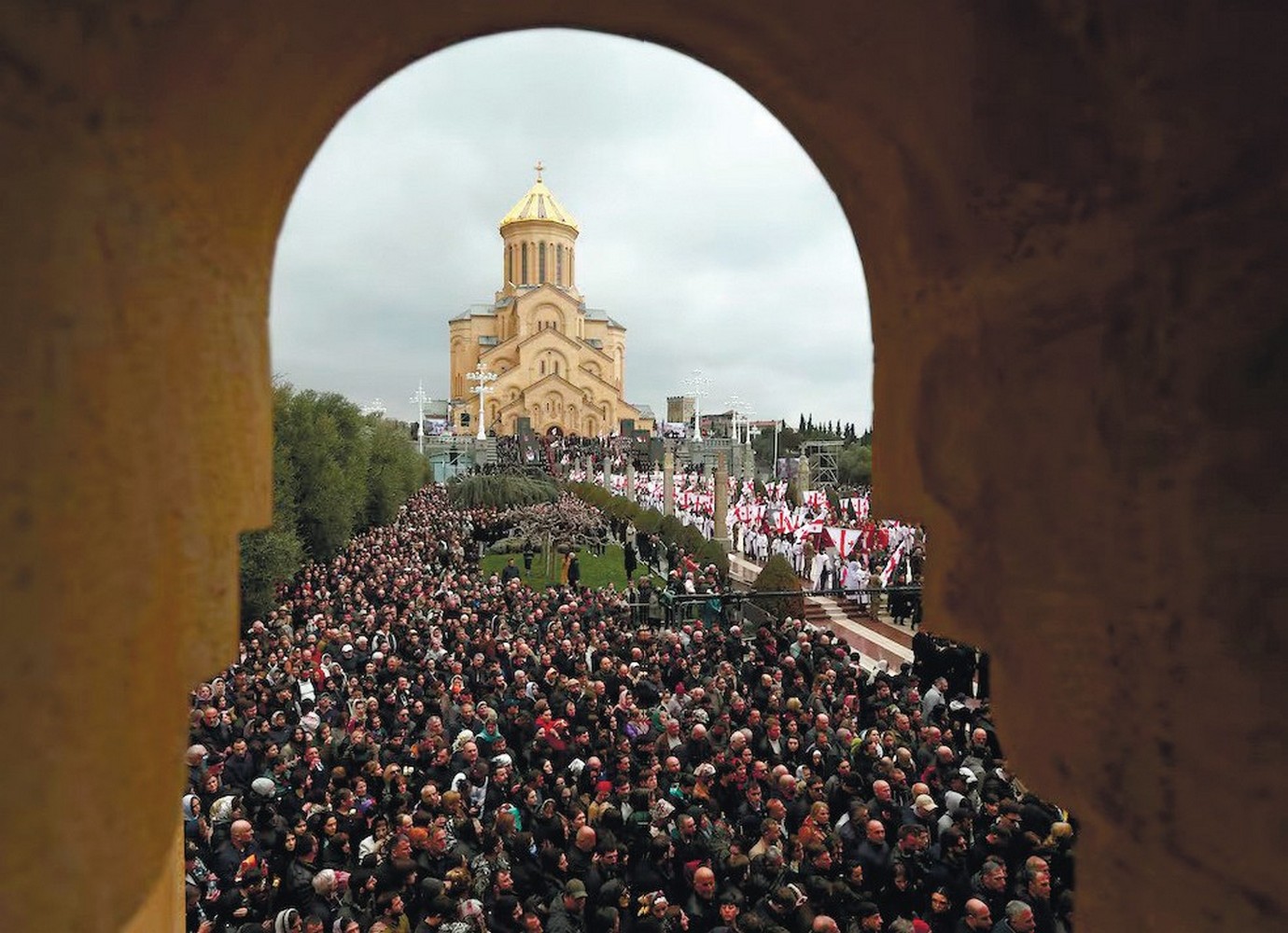
The death of Ilia II has become not merely the loss of a spiritual leader—it has marked the end of an entire era in the history of Georgia. Public attention and the country’s media have focused on his many years of service, as well as on the profound charitable, cultural, and spiritual legacy he leaves behind. For more than four decades, he remained a moral compass for the nation, a symbol of stability and unity during periods of crisis and transformation. The Patriarch’s passing inevitably opens a new and more uncertain chapter for both the Church and the state.
A shepherd in an era of upheavals
Ilia II became head of the Georgian Orthodox Church in 1977—a period when religious life was under strict control by the Soviet system. His ministry became an example of gradual yet persistent spiritual revival.
Following the collapse of the USSR, it was the Church that, to a significant extent, prevented society from sliding into complete disintegration. Against the backdrop of wars, economic collapse, and political instability in the 1990s, the figure of the Patriarch was perceived as a source of moral legitimacy.
He achieved what few religious leaders manage: he transformed the Church into one of the most authoritative institutions in the country while maintaining a distance from direct political struggle.
Today, two distinctive features characterise state–confessional relations in Georgia. First, Georgia ranks among the most religious Orthodox countries in Europe. Second, it is perhaps the only modern Orthodox country in which an agreement with the Orthodox Church is enshrined at the state (constitutional) level.
Authority beyond time
For five decades, Ilia II remained, without doubt, the most respected individual in the country. His word was perceived not as the position of one side, but as a voice above politics. This phenomenon is explained not only by his personal qualities, but also by the strategy he adopted: a refusal to engage in direct political confrontation, an emphasis on national unity, and a careful balance between tradition and modernity. He became a symbol of the “soft power” of Georgian identity—a fusion of faith, culture, and statehood.
It is symbolic that the Patriarch’s authority extended far beyond Georgia. The well-known director Robert Sturua recalls: "We were on tour in Buenos Aires when I was informed that the Archbishop of Buenos Aires urgently wished to meet me. Somewhat bewildered, I was taken to see him. He greeted me and handed me an icon, saying: 'In your country there is a living saint—please present this to him with great reverence and affection.' Several years later, that Argentine—Jorge Mario Bergoglio—became the first non-European Pope and entered history under the name Francis."
The Church as a pillar of the state: internally and externally
In post-Soviet Georgia, under the Patriarch’s leadership, the Church assumed a unique position. It not only preserved its influence but strengthened it, becoming a key public institution.
At the same time, Ilia II avoided turning the Church into an instrument of power. His caution enabled him to maintain trust both among believers and within the more secular segments of society.
Patriarch Ilia II played a key role in preserving and protecting Georgia’s cultural and spiritual heritage. He regarded cultural monuments and religious shrines not merely as material objects, but as the foundation of national identity and the spiritual consciousness of the Georgian people. Within the framework of his mission, the Patriarch initiated and supported projects aimed at restoring churches, safeguarding them from external claims, preserving icons and historical monuments, and actively engaged with international partners to strengthen the protection of religious heritage.
The Muslim community of Georgia consistently maintained an active dialogue with the Patriarch as the country’s principal Orthodox spiritual leader. Representatives of the Muslim community frequently noted his friendly, tolerant, and diplomatic approach, which significantly contributed to the peaceful coexistence of different confessions.
According to the Marneuli City Hall, in connection with the declared mourning following the passing of the Catholicos-Patriarch of All Georgia Ilia II, all festive events dedicated to Novruz and Ramadan Bayram were cancelled (according to the 2014 census, approximately 83.2% of Marneuli’s population are Muslims).
The Patriarch paid particular attention to relations with neighbouring states and was consistently attentive and respectful in his dealings with different confessions. From the recollections of Professor Mariam Tsatsanashvili, an academician of the Gelati Academy of Sciences under the Patriarchate: "The Patriarch’s moral authority repeatedly became the target of various provocations. In 2009, as a result of cyber interference in the English-language version of the Patriarchate’s official website, the text of His Holiness’s address was distorted. At the initiative of the then Ambassador of Azerbaijan, Namig Aliyev, we immediately visited the Patriarch. The conversation lasted for an hour. A subsequent review of the Georgian-language version of the website confirmed that the text contained no such statements. It was ultimately established that the website had been hacked, with the aim of inciting interreligious confrontation and destabilising the situation in the Caucasus region. Thanks to the professional actions of the Ambassador, the consequences of this provocation were swiftly neutralised."
The Patriarch’s passing and a possible shift in balance
The death of the Catholicos-Patriarch of All Georgia Ilia II may lead to a transformation of the entire system of Church–society relations in the country. The principal consequence is the disappearance of a figure capable of acting as an arbiter and a symbol of consensus. Unlike many other institutions, his authority was not institutional—it was deeply personal. In practice, this may mean that the level of trust in the Church could decline, internal contradictions may become more visible, and the influence of various groups within the clergy may increase.
What theoretical scenarios might unfold? The scenario of continuity is the most moderate option, предполагающий the election of a figure oriented towards maintaining Ilia II’s course. In this case, the Church will retain its current stabilising role, and no abrupt changes are likely.
In the event of a conservative turn, a more rigid, traditionalist leader may come to power. This could, on the one hand, strengthen the Church’s influence in public life, and on the other, lead to a stricter stance on social issues and increased tension with the liberal segment of society.
The most complex scenario may prove to be internal fragmentation—an intensification of internal conflicts. The absence of a figure of Ilia II’s stature could lead to competition among Church factions, a decline in institutional authority, and the politicisation of the Church agenda.
The election of a successor
The above brings to the forefront the issue of preserving continuity. Everything will depend on the personal factor.
The procedure for electing a new Catholicos-Patriarch is formally regulated: the election will take place two weeks after the 40th day following the Patriarch’s death. The new head of the Church is elected from among the members of the Holy Synod of the Georgian Orthodox Church, which consists of 39 members.
According to established rules, a candidate must meet a number of criteria: be between 40 and 70 years of age (28 of the 39 meet this requirement), belong to the Georgian Orthodox Church, hold Georgian citizenship, and possess theological education.
In addition to the 39 members of the Synod, the procedure also involves two representatives from each diocese and four members of the Gelati Academy of Sciences. They have the right to present character references for candidates; however, only members of the Holy Synod take part in the voting. It should be noted that, in practice, elections always reflect the balance of influence within the Church elite.
According to available information, the most influential metropolitans are traditionally considered among the potential candidates. In expert circles, three hierarchs are most frequently mentioned: 1) Shio Mujiri—the locum tenens of the Patriarchal Throne—Metropolitan of Senaki and Chkhorotsku (born 1969), a figure who has already played a key role in recent years; 2) David (Sarsania)—a representative of the more moderate wing; 3) Iakob (Iakobashvili)—one of the most public and influential hierarchs. The list of potential candidates may expand as the situation develops. However, it is important to understand that in such cases the issue concerns not only individuals, but also the direction of the Church’s future development.
Available information suggests that the first candidate has the greatest chances, as he embodies continuity of the traditional course and stability for Georgia.
The era and its legacy
With the passing of Ilia II, Georgia loses not merely a spiritual leader. It bids farewell to an era in which there existed a moral centre capable of uniting society. This is not only a religious event; it is a factor capable of influencing domestic political stability, social cohesion, and the balance between tradition and modernisation.
For many years, the Georgian Church has performed the role of an informal stabiliser. The weakening of this function may affect the entire system.
The principal legacy of Ilia II is not only restored churches and revived traditions. It is a model of relations between the Church, society, and the state, based on trust and a careful balance.
And it is precisely on the nature of the newly elected Patriarch that much will depend—whether the Church will remain a pillar of society or become yet another arena of struggle.
The central question is whether this model will endure without its creator.
RECOMMEND:
 151
151

