

DAMAGED REPUTATION
When a humanitarian mandate serves as a cover and when silence is complicity
Author: NURANI
The peace process between Azerbaijan and Armenia is gradually becoming a model of successful diplomacy. Armenian aggression has been halted, previously seized territories have been liberated, and Azerbaijan's territorial integrity and state sovereignty within its internationally recognised borders have been restored. Baku and Yerevan are successfully advancing the peace process. A peace treaty has been initialled during negotiations in Washington, and Azerbaijan has opened cargo transit across its territory for Armenia.
August 2025 did not follow January 1988 immediately. Azerbaijan reserves the right to remember a war that lasted nearly three decades. Furthermore, it reserves the right to political, diplomatic, and legal assessments of the activities of individuals, states, and international organisations—even those that believe they have long since claimed a monopoly on white robes and angelic wings. A classic example is the International Red Cross; more precisely, the International Committee of the Red Cross (ICRC).
On the surface, it is the world’s oldest humanitarian non-governmental organisation, with more than a century of history. It is the only one whose employees officially enjoy diplomatic immunity. The Red Cross assisted prisoners of war during the Second World War, and today its staff work in numerous "hotspots" on exclusively humanitarian missions. That, however, is the promotional brochure. In reality—to put it mildly—it is a different story.
In fact, the Red Cross faces serious grievances in many countries. We shall not list them all, but instead recall how ICRC staff conducted themselves in Azerbaijan and the attitude the leadership of this "world’s oldest humanitarian organisation" displayed towards our country.
Red cross and international law
The ICRC representative office in Azerbaijan was established in the early 1990s following the restoration of independence. By that time, the Azerbaijan Red Crescent Society (ARCS) had already been active in our country for several decades. Yet, for some reason, the ICRC considered working through the ARCS beneath its international dignity. Nevertheless, during those same 1990s, an ICRC office appeared in occupied Garabagh, and it was subordinate to the organisation’s Yerevan office rather than the Baku representation.
The International Red Cross frequently operates in hotspots, including occupied territories and the so-called grey zones. In doing so, however, its internal hierarchy must respect the principle of territorial integrity. In most cases, this is ostensibly observed. Yet an exception was made for Azerbaijan. The ICRC office in Khankendi was placed under the authority of the Yerevan office. Naturally, Baku expressed its dissatisfaction, but Geneva refused to change its stance, claiming such subordination was necessary for the "humanitarian mission".
Azerbaijan raised the issue that the "humanitarian mission" and the office in Khankendi were no longer necessary shortly after the conclusion of the 44-day Patriotic War. Following the signing of the Trilateral Statement in November 2020, President Ilham Aliyev explicitly stated that the Garabagh conflict was over. However, Geneva only reacted in May, and with a rather curious interpretation: that in 2025, when Russian peacekeepers leave the region as per the agreements, a "humanitarian mission" might be needed once again. Meanwhile, the office was never transferred to the Baku representation’s jurisdiction, despite the fact that Azerbaijan never obstructed humanitarian activities. This status quo persisted until September 2023, when anti-terrorist measures resulted in the defeat of the Armenian armed forces units remaining in Garabagh. The occupying junta in Khankendi announced its dissolution, and Russian peacekeepers left the region ahead of schedule. Alongside them, the majority of Garabagh residents of Armenian ethnicity moved to Armenia, unwilling to live in territories where Azerbaijan’s sovereignty had been restored. Only then did the ICRC finally close its office in Khankendi.
Espionage, smuggling and more
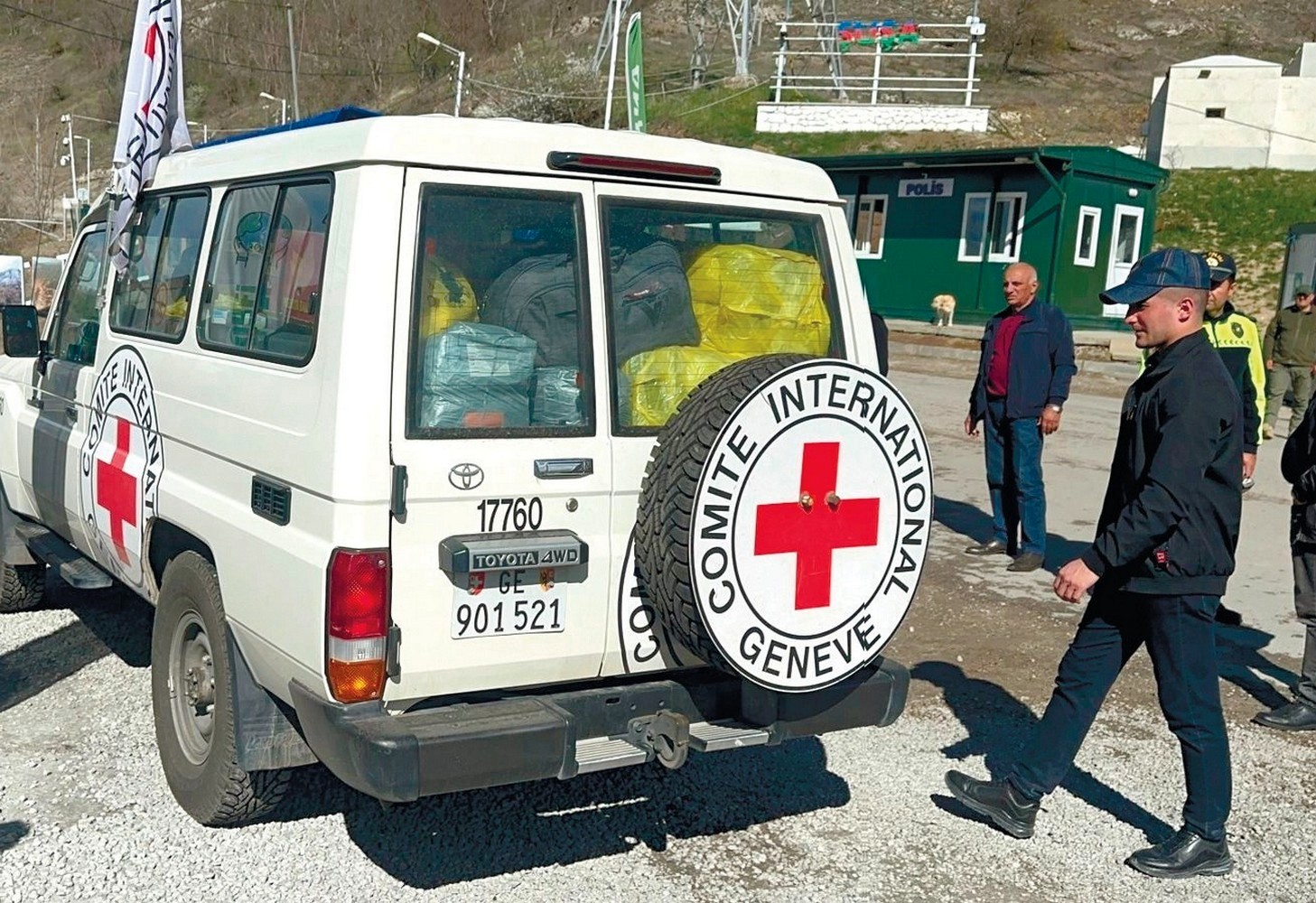
In April 2023, a significant event occurred in Garabagh. Azerbaijan established a border checkpoint on the Lachin road. The country's border was now fully controlled, without any "windows" or "loopholes". The ICRC immediately undertook another "humanitarian mission"—transporting residents from the area of responsibility of the Russian peacekeeping contingent to Armenia and back.
Following repeated rumours and photographic evidence on social media suggesting that commercial goods were being transported under the guise of "humanitarian cargo", ICRC drivers were caught smuggling in June 2023. They were transporting mobile phone parts, consignments of cigarettes, and even petrol into the peacekeepers' zone of responsibility. The ICRC attempted to distance itself, claiming these were not their employees but rather "casually hired drivers" and "randomly rented vehicles", for which they bore no responsibility.
However, this is far from the most serious transgression on the ICRC's "service record". On the eve of and during the 44-day war, several ICRC employees were caught spying. They photographed military installations and attempted to obtain other "sensitive" information, which subsequently ended up in the possession of the Armenian intelligence services. These individuals were, of course, deported from the country. Yet, the ICRC conducted no internal investigation. Furthermore, during the Azerbaijani Armed Forces' offensive in the Fuzuli direction, the ICRC claimed that "critically wounded Armenian servicemen" were surrounded and required urgent evacuation. Yet, among those for whom the ICRC showed such concern, there was not a single—we emphasise, not one—critically wounded soldier. The request was actually an attempt to extract combat-ready soldiers from encirclement.
Towards the end of the war, more evidence of the organisation's "humanitarian" activities emerged. After the liberation of Shusha, Azerbaijan blocked the Lachin road, which the ICRC demanded be opened immediately. Their justification was that 180 foreign journalists were in Khankendi and needed urgent evacuation, requiring a pause and a "humanitarian corridor". However, from the very beginning of the hostilities, it had been officially stated that journalists in the combat zone must be accredited through the established procedure. If this was not done, Baku could not be held responsible for their safety.
Khankendi is a small city; it does not even have 180 streets. Was there really a "foreign correspondent" standing at every single intersection? The idea is absurd. Who, then, were they actually trying to pull out of Khankendi? It is no secret that "humanitarian pauses" allow a retreating side to use the respite to regroup their forces. Why should the Red Cross involve itself in this—an organisation that only compromises its reputation through such deeds? Is this a reorientation of its core credo?
How the ICRC "looked the other way"
One of the most ignoble chapters of the ICRC's work in Azerbaijan remains the issue of prisoners and hostages during the First Garabagh War. At that time, the country received virtually no assistance from this international organisation, despite its claim to exclusive status.
A few years ago, a screenshot was published on social media of a letter written on February 10, 1994, by Lachin Ahmed oghlu Novruzov, who was held in Armenian captivity: "Hello, Father, Mother. I am Lachin Novruzov in the village of Edilli in Armenia... Please, get me out of here! I beg you. Mother, this is Lachin writing. Whatever happens, get me out of here! I want to live!" This letter bears the stamp of the International Red Cross. ICRC staff delivered the letter to Lachin’s family. He never returned home; he was killed in captivity.
In theory, if a prisoner of war comes to the attention of the Red Cross, it means the Geneva Conventions and at least some rules of conduct must be observed. In practice, the ICRC simply "forgot" about the murder of Lachin Novruzov: no person, no problem.
Lachin Novruzov was within the Red Cross’s field of vision; ICRC staff had met with him, yet he was subsequently killed. The organisation did not demand an investigation or attempt to clarify the circumstances of his death. This was not an isolated incident. We are talking about dozens of people who were alive but never returned home. They "disappeared" back in the 1990s. Not once—not a single time—did ICRC staff even attempt to publicly express concern or initiate an investigation. The ICRC remained shamefully silent.
They remained silent even when an entire group of Azerbaijani prisoners was killed—according to the Armenian side's official version—"while attempting to escape". Notably, eight of them had head wounds—a clear sign of execution.
In 2006, the region was visited by Leo Platvoet, the PACE rapporteur on prisoners and missing persons. His 2007 report stated that, "according to the authorities, 4,604 people are listed as missing in Azerbaijan. The ICRC, by contrast, had registered 3,247 missing persons as of June 2006."
Platvoet released the following data: "The Azerbaijani list includes 783 people who, according to the authorities, may be alive and held as prisoners or hostages in Armenia or in the Nagorno-Garabagh region." In his report, he says he "was struck by reports received from the families of the missing, as well as from the authorities and administration, that some of the missing might be alive and held in official or unofficial captivity." As Platvoet noted, he "heard about secret detention camps, gold mines, and chemical plants where prisoners were kept and forced to work. There were reports of missing persons being held as slaves in private households, women forced into prostitution, and organ trafficking. There were also reports of hostage-taking, ransom demands, and organized exchanges."
Later, information emerged about the notorious General Manvel Grigoryan—the same man in whose garage boxes of canned meat, army underwear, an ambulance, and even a funeral wreath were found. He recounted bringing "hundreds of prisoners" back from the war and keeping a fifteen-year-old Azerbaijani boy as a slave in his home. He claimed he had handed the boy over to the ICRC, but there is no evidence of this. The Red Cross remained silent once again. Despite living in Yerevan, their staff could not have failed to hear or know about this. Undoubtedly, the ICRC also knew the locations of mass graves of Azerbaijani prisoners of war and civilian hostages. However, they were in no hurry to share such information with Azerbaijan. After all, this is not just information; it is a confirmation of war crimes. The ICRC did everything it could to protect the reputation of the Armenian aggressors.
Today, of course, much has changed. The war is over. The fate of the missing will be clarified—with or without the ICRC's involvement. But there is no doubt: Azerbaijan had every reason to demand the closure of the ICRC office not only in Khankendi but also in Baku. Unless such "imbalances" in the ICRC's activities are properly addressed, they will be repeated in various "hotspots" around the world. In such a case, no appeals to a century-long reputation will be of any use.
RECOMMEND:
 145
145