

BRINGING BACK THE CASPIAN
Baku sends alarming signals as the world’s locked water-body is running dry

Author: Sabira ALAKBAR
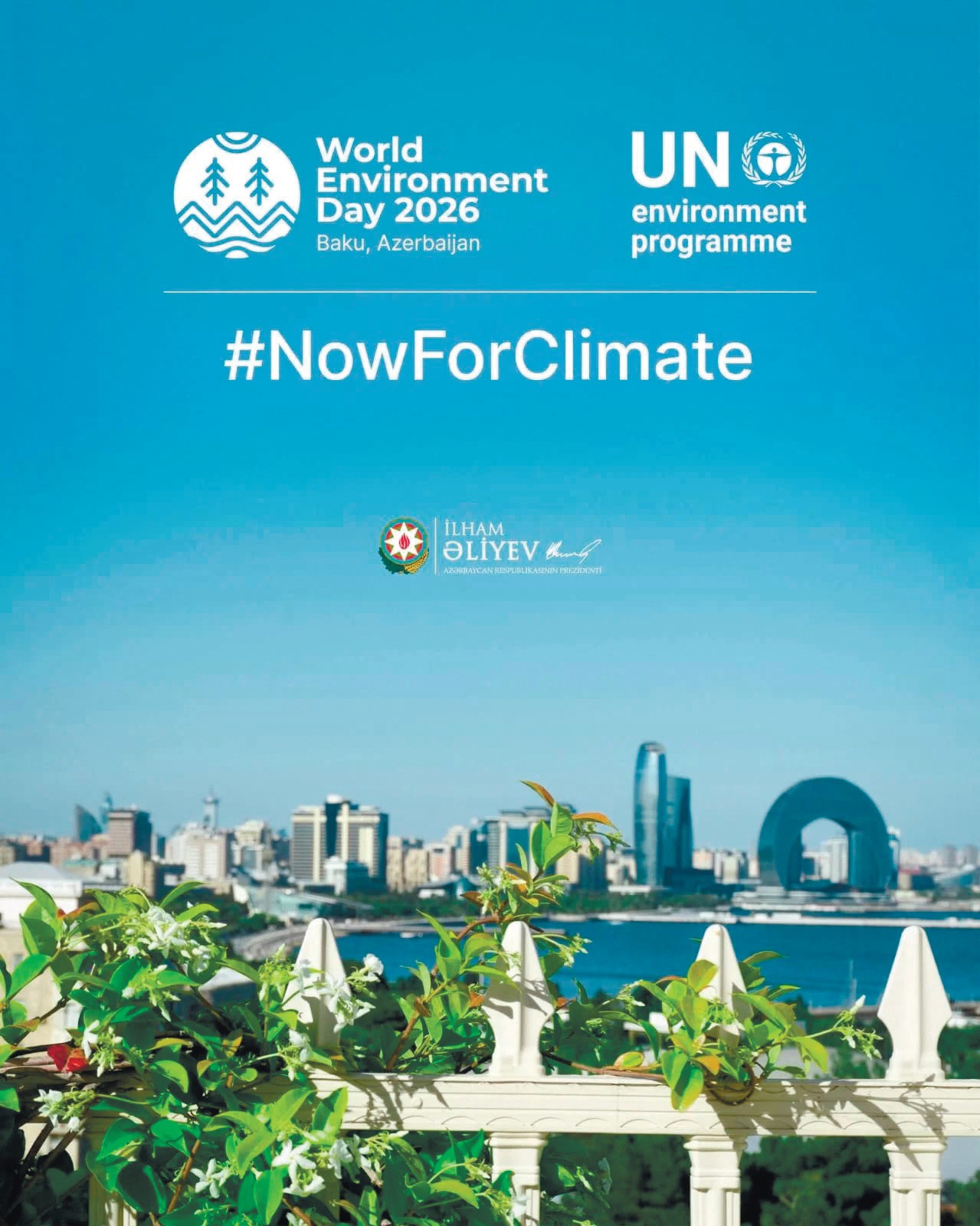
In 2026, Azerbaijan assumed the role of global leader in discussions on the future of our planet. Baku has been selected as the official global venue for hosting major international events to commemorate World Environment Day, which is celebrated annually on 5 June. The campaign, which is being held under the auspices of the United Nations Environment Programme, aims to unite humanity's efforts in the face of an unprecedented environmental crisis. The campaign has a resonant slogan: #NowForClimate.
In his official message, UN Secretary-General António Guterres openly warned the international community that the Earth is sending increasingly alarming signals. The past eleven years have been the hottest on record since records began. At the same time, the planet is on the verge of surpassing the critical warming threshold of one and a half degrees. Extreme heatwaves are already causing around half a million deaths per year, forcing major cities to work together on various projects to adapt to heat of fifty degrees.
In the context of this global issue, the issue of the Caspian Sea's rapid shallowing was discussed in Baku not only as a local concern, but also as one of the central challenges of the current climate agenda.
Chronicles of receding waters
During his address to participants at the Baku events, the President of Azerbaijan, Ilham Aliyev, stated that the shortage of water resources is a serious concern for the entire region. He asserts that the Caspian Sea's water level is rapidly declining towards its lowest point in the past two centuries, a development that unequivocally underscores the impending environmental crisis.
For our country, this challenge is of particular significance, as it was in Baku in 1830 that the eminent Russian academician Emil Lenz pioneered the first systematic instrumental measurements of the Caspian Sea level in history. Azerbaijan's rich scientific heritage is under threat from changes to the landscape, which are clearly visible along the country's coastline, particularly in the vicinity of the city of Sumgayit. Ongoing coastal erosion has caused the shoreline to shift by tens of metres, exposing vast sandy areas and previously submerged territories.
The relevant authorities in the Caspian states have confirmed that, throughout the history of observations, the Caspian Sea has undergone several pronounced cycles. According to official data from Kazakhstan's Ministry of Ecology, between 1940 and 1977 the sea lost approximately 4 centimetres per year. Over the past 37 years, the total drop has been just under 1.5 metres, although the ministry's official reports give a rounded figure of 1.2 metres. From 1978 to 1995, the water level rose at a remarkable rate of up to 30 cm per year. However, from 1996 to the present day, the Caspian Sea has once again begun to rapidly lose depth. Environmentalists have stated that the water level has been falling by an average of 8 centimetres per year over the last 30 years, with a total drop of 1.83 metres recorded since the late 1990s. According to UN experts, this process is set to continue for at least another fifty years.
The physics of the crisis
To understand the movement of water, it is necessary to examine the annual water balance of the body of water in question, which is currently deeply negative. The average annual evaporation from the Caspian Sea's surface is approximately 369 cubic kilometres, whereas the total river inflow is 266 cubic kilometres, and atmospheric precipitation contributes a further 72 cubic kilometres. Consequently, the Caspian Sea experiences an annual loss of approximately 31 cubic kilometres of water.
It is evident that global warming is the primary catalyst for this process. Since 1976, the global average annual temperature has risen by 0.20°C, whilst in the Caspian region this figure has jumped by as much as 0.53°C, triggering extreme evaporation. Renowned Azerbaijani climate expert Rovshan Abbasov also attributes the shallowing to a sharp reduction in river inflows, particularly from the Volga, due to decreased rainfall in the areas through which they flow and growing human water consumption.
The Russian expedition 'New Delta-2026' documented the extent of the geographical restructuring in the northern Caspian Sea in April 2026. It noted a twofold increase in the area of Temiz Banka Island. However, Azerbaijan did not merely observe the processes in the north; it launched its own large-scale research programme, focusing on the central and southern waters of the sea.
Azerbaijan's Ministry of Ecology and Natural Resources, through its specialised Directorate for Comprehensive Caspian Environmental Monitoring, conducts regular research expeditions along the country's entire coastline. The shelf area of the Absheron Peninsula, as well as the coastal waters of Baku and Sumgayit, are of particular interest. Azerbaijani scientists are carrying out detailed hydrophysical measurements to model complex marine currents. The investigation is concerned with ascertaining the impact of variations in wind, fluctuations in river flow and thermohaline factors – that is, the redistribution of water temperature and salinity amid record-breaking warming – on the dynamics of water masses off our coasts. These are the physical parameters of seawater temperature and salinity, which together determine its density. In the field of oceanography and hydrology, these factors play a fundamental role, as it is precisely the difference in water density that causes vast bodies of water to move. Concurrently, rigorous monitoring of human impact is conducted, encompassing chemical and microbiological analyses of water samples. This approach facilitates the prompt identification and elimination of sources of marine pollution.
On the brink of a biological catastrophe
The receding water is having a detrimental effect on the Caspian's highly complex ecosystem. Faig Mutallimov, Senior Advisor to the Office of the Representative of the President of Azerbaijan on Climate Issues, rightly points out that for millions of people, the Caspian is the foundation of their identity, traditions and way of life, and that protecting it is our shared duty. The economic consequences for ports and coastal settlements are further compounded by the threat of extinction facing the region's unique fauna. The Caspian Sea is home to 90% of the planet's remaining sturgeon population. However, these fish are struggling to find their way to their spawning grounds due to the shallowing of the deltas.
During the scientific and political discussion 'The Caspian Sea at a Crossroads', held in Baku, Russian researcher Elena Ostrovskaya confirmed that a further drop in water levels is inevitable in the coming years. British scientist Simon Goodman presented a mathematical model that suggests a worrying scenario: if sea levels were to fall by a further five metres, seven out of the 15 ecologically significant zones in the Caspian would lose more than half their area. Should the decline reach 10 metres, the unique ecoregions of the northern and central Caspian will be lost permanently. Meanwhile, Robb Butler, a representative of the World Health Organisation, noted that there are as yet no systematic assessments of the impact of changing water quality on human health in the region.
In response to these challenges, Azerbaijani scientists have focused on monitoring biodiversity in 2026. Domestic biologists are focusing on the status of valuable and endemic fish species, including the Caspian and white salmon, khramulya (Varicorhinus, or chiselmouth), shamaika (Alburnus mento, or lake bleak), bystranka (Alburnoides bipunctatus, or spirlin) and garasol (Capoeta capoeta, or Caspian scraper). A separate strategic priority is the continuous monitoring of the Caspian seal, which is the only mammal in the body of water. Azerbaijani specialists are conducting detailed studies into how the retreat of the sea is altering the animals’ usual rookeries and migration routes, in an effort to address the very shortage of scientific data highlighted by Elnur Safarov, an expert from the IDEA Public Association. He drew the participants’ attention to the fact that the Caspian littoral states lack a unified, comprehensive and detailed scientific basis for developing sound long-term models for the Caspian Sea’s conservation.
Bonn and leadership in regional strategy
Azerbaijan has effectively communicated to the global audience that the Caspian Sea can only be safeguarded through collaborative endeavours. Baku has taken the initiative to promote integration and has established special bilateral expert working groups with the three Caspian states – Russia, Kazakhstan and Turkmenistan. These platforms are already facilitating the end-to-end exchange of hydrological data, the conduct of joint monitoring and the development of unified adaptation measures on the ground.
Furthermore, on the initiative of Leyla Aliyeva, head of the IDEA Public Association, a high-level panel discussion on the future of inland water bodies took place in Bonn, Germany, as part of the UN Climate Change Conference. Alongside IDEA, this prestigious event was organised by the United Nations Environment Programme, the United Nations Framework Convention on Climate Change and the Azerbaijani Presidency of COP29.
The Secretariat of the Tehran Convention, which has provided the primary legal foundation for regional cooperation since 2003, has developed a new framework action plan that outlines the directions for interstate cooperation in times of crisis. Joint regional efforts are already yielding the first tangible results. While Azerbaijan is establishing a common diplomatic and policy framework, Kazakhstan is mobilising significant domestic resources to physically replenish the water body. The country is now proactively managing floodwaters and river flows, directing them into the Caspian Sea via an extensive network of canals. This approach prevents water seepage into the soil and ensures the efficient use of water resources.
Nurzhan Nurzhigitov, Kazakhstan's Minister of Water Resources and Irrigation, has announced that the effective redistribution of flood-water over the past two and a half years has resulted in the channelling of more than 35 billion cubic metres of water into the Caspian Sea.
Integrating practical measures on the ground with strategic initiatives at the international level is the only way to stabilise the ecosystem. As Rauf Hajiyev, Deputy Minister of Environment of Azerbaijan, rightly emphasised, the Caspian Sea is an indivisible asset of the entire region. Only an equal dialogue, underpinned by rigorous scientific calculations and actual water inflows, will enable us to safeguard the future of this unique body of water.
RECOMMEND:
 91
91

