

A SECOND LIFE FOR ACG
The largest oil block in Azerbaijan’s Caspian sector transformed into gas and technology project
Author: Nurlana GULIYEVA
Almost three decades after the commencement of commercial oil production, the Azeri-Chirag-Guneshli (ACG) field block is once again the focus of attention in the global energy sector.
On this occasion, the reason is not the launch of yet another oil platform. Instead, BP has announced the start of production of associated natural gas at ACG. This development marks a significant milestone in the history of a project widely regarded as the foundation of Azerbaijan's oil and gas sector. On initial observation, this appears to be the launch of an additional gas source for both domestic and export markets.
However, the significance of this event is much broader. Key issues addressed include the long-term utilisation of the Caspian's resource base, Europe's energy security, the introduction of digital technologies in the oil and gas industry, and improving the efficiency of existing infrastructure.
Gas beneath the oil
For decades, the ACG block was viewed primarily as a giant oil field. This field has been central to the greatest successes of Azerbaijan's oil strategy, its multi-billion export revenues and the development of the country's modern energy infrastructure. Meanwhile, the block's geological potential has proved to be considerably greater.
According to BP, the first well for producing free gas, drilled from the Western Chirag platform, marks 'an important step towards unlocking the potential of large deep-gas reserves in the ACG'. These reservoirs are located considerably below the main oil-bearing horizons.
"Alongside initial production, this well is providing important data on the reservoir and flow characteristics, which will assist in assessing gas reserves for future plans for full-scale development," according to a statement from the project operator.
The initial results proved highly encouraging: the well confirmed the presence of gas reserves in the Qirmaki Upper Sand (QUS) reservoir and identified high-pressure gas deposits in the deeper strata of the Qirmaki Lower Sand (QLS) reservoir. Commercial production has now commenced from the latter.
According to the company's preliminary estimates, "recoverable reserves of free natural gas at the ACG are estimated at approximately 4 trillion cubic feet, with the potential to increase to 6 trillion cubic feet". However, just a few hours after the official announcement, representatives of BP made an important clarification.
Gordon Birrell, the company's Vice-President for Production and Operations, clarified that this pertains exclusively to the gas potential of the Guneshli structure.
"We have not yet carried out any calculations for the Azeri zone; we do not have any data. Yesterday (1 June), we initiated the production of free natural gas from the lower reservoir. Over the next few weeks, we will begin production from the upper reservoir, and the gas will be routed to the Western Chirag platform, from there to the Sangachal Terminal and on to the market. However, it is too early to say who the buyer of this gas will be; negotiations must take place first," said Birrell.
Incidentally, the first well is viewed not only as a production facility, but also as a tool for studying the field. It provides "important data on the reservoir and flow, which helps in assessing gas reserves for future plans for full-scale development".
In summary, the company is commencing a new phase of geological exploration of the ACG. Should similar gas horizons be confirmed on the 'Azeri' structure, the scale of the project could significantly exceed current estimates.
Infrastructure economics
A key feature of the new project is that there is no requirement for large-scale construction of new infrastructure. As previously stated, in contrast to the majority of the world's significant gas fields, which necessitate the development of new platforms, pipelines and processing facilities, the ACG deepwater gas is incorporated into the existing production infrastructure.
The gas is produced via the existing Western Chirag platform, then transported to the Sangachal Terminal, after which it can be fed into the existing export network. Essentially, the company is making use of infrastructure that has been developed over decades and has required multi-billion-dollar investments.
From an economic perspective, this is one of the most efficient models for developing resources. Capital costs are significantly lower, start-up times are shorter, and profitability is higher compared with implementing a completely new project.
This new gas resource is particularly significant in light of the growing demand for Azerbaijani gas in Europe. In the wake of the recent energy crisis, the European Union has been proactively diversifying its supply sources, with the Southern Gas Corridor emerging as a pivotal route for gas from the Caspian region.
For this reason, Joe Christofoli, BP's regional president for Azerbaijan, Georgia and Turkey, described the launch of the project as a historic event. He stated that the field "will now play a leading role in the regional industry, occupying a unique position as an integrated oil and gas field".
Another discovery proved to be of great interest: while drilling a gas well at the very bottom, specialists discovered a thin oil rim between the gas and the water.
It was noted by Gordon Birrell that the presence of oil in deep-seated formations could not be discounted. "During the drilling process, it was evident that there was an oil ring present between the water and gas layers. We had that information. We had anticipated the possibility of encountering an oil ring. However, to be certain, we conducted a thorough investigation by drilling the well. The well is currently being drilled directly into the oil ring, and oil production is scheduled to commence from this location. This will allow us to assess the potential of the oil ring and determine its overall size. "We anticipate that this well will commence production in September, which will provide us with further information about the recently discovered oil ring, allowing us to determine its volume," he stated.
New projects have the potential to extend the economic life of SOCAR's assets. Many mature fields around the world are facing a natural decline in production. However, the discovery of new reservoirs makes it possible to significantly extend the effective operating life of existing assets.
Digital exploration
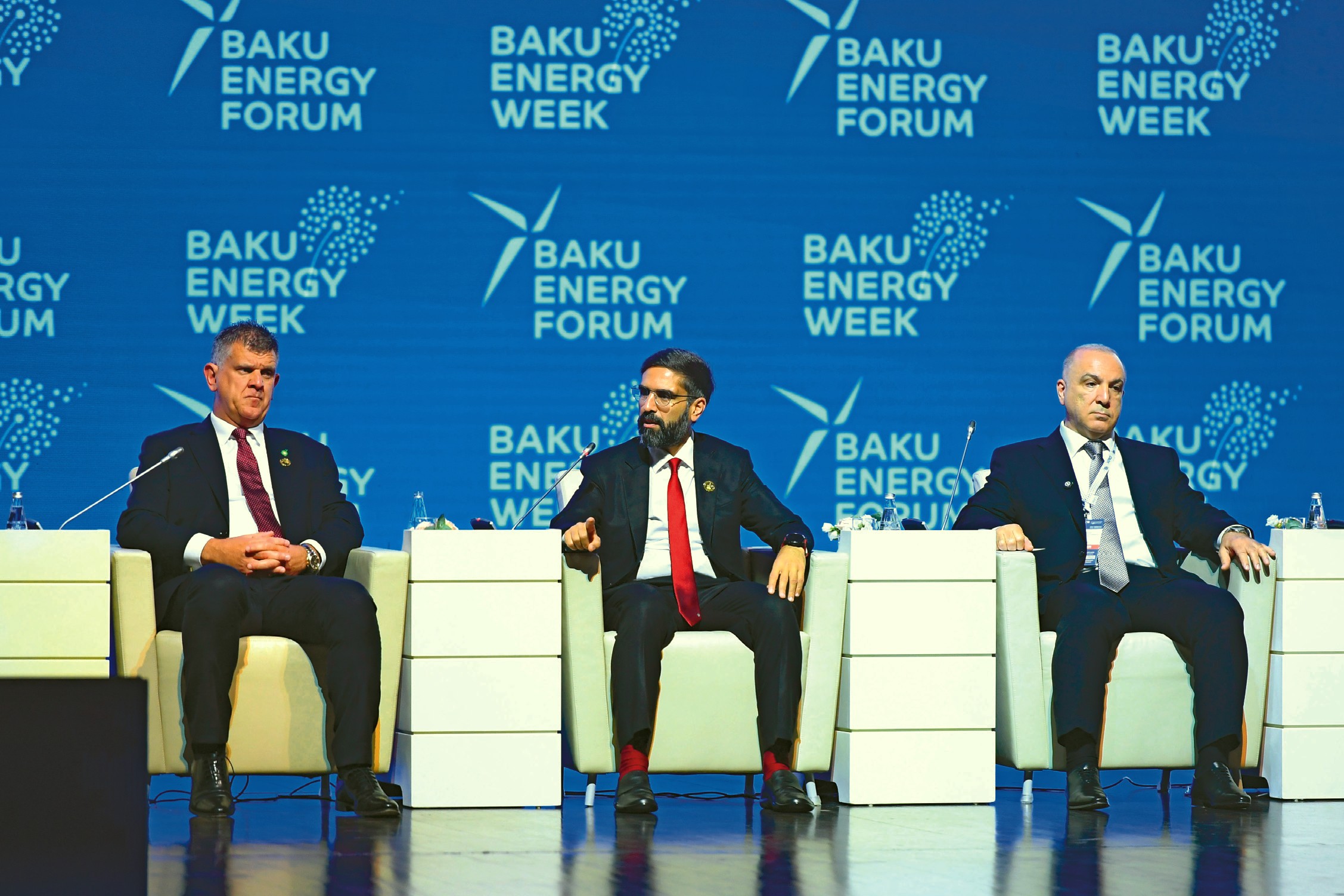
Rovshan Najaf, President of the State Oil Company of Azerbaijan (SOCAR), stated during a panel discussion at Baku Energy Week that production at the ACG could prove to be more stable than current forecasts suggest.
"If these factors are taken into account, the decline in production at the ACG may be less than 3 per cent and may even remain stable. The company is also assessing the potential for increasing production at the field. Ultimately, even fields that have been in operation for many years can enter a new phase of development thanks to modern technologies, the right approach, effective partnerships and government support," said Najaf.
In this regard, an equally important transformation at the ACG is linked to the use of digital technologies and artificial intelligence.
For the first time, BP has provided journalists with such in-depth information regarding the process of applying AI to oil and gas production in the Caspian Sea. Furthermore, this is not related to corporate automation or market analytics.
The company uses artificial intelligence to process four-dimensional seismic data. As part of a five-year research programme, specialists are tracking the movement of oil, gas and water within the reservoir, and then analysing vast amounts of data using machine learning algorithms.
The primary objective is to enhance the oil recovery factor. Given that this field has been in production for almost 30 years, this is of fundamental importance.
In essence, artificial intelligence is playing a pivotal role in addressing a critical question in established domains: the precise location of remaining oil reserves. Following data processing, the system facilitates the identification of the most promising areas for drilling new wells and enables more accurate predictions of reservoir behaviour. This approach is intended to reduce exploration costs and improve the return on investment.
Concurrently, the company is implementing a further strategic project in collaboration with SOCAR. Dan Sparks, BP's Vice President for Geology and Development, has confirmed that the parties involved are collaborating to establish a consolidated database of offshore seismic data for the Azerbaijani sector of the Caspian Sea.
Sparks has confirmed that work is underway to consolidate the existing offshore seismic data into a single, comprehensive database. He also observed that "the Caspian Basin surpasses even the Gulf of Mexico in terms of hydrocarbon reserve density".
This assessment is of particular importance in the context of future exploration work. Despite decades of production, the Caspian Sea still contains a significant number of under-explored structures. The creation of a unified digital database will accelerate the search for new resources and improve the efficiency of exploration.
It is noteworthy that the world's leading oil and gas companies are progressively transitioning from conventional field development models to a data-driven approach. In this sense, the Azeri-Chirag-Guneshli region is becoming not only a source of oil and gas, but also a platform for the implementation of next-generation technologies.
It is evident that the Azeri-Chirag-Guneshli region is undergoing a gradual transformation into a high-tech, integrated oil and gas complex. This development is poised to generate value for numerous decades. For Azerbaijan, this means not only additional export revenues and the strengthening of Europe's energy security, but also an opportunity to demonstrate how mature fields can be given a new lease of life through technology, data and innovation.
RECOMMEND:
 83
83

