

TIME OF PRAGMATISM
Azerbaijan and the new architecture of Eurasia’s energy security
Author: Nurlana BÖYÜKAGHAGIZY
This year's Baku Energy Week took place amid profound changes in the global energy market. Europe continues to explore sustainable supply sources, with countries revising their approaches to the energy transition. The rapid advancement of digital technologies and artificial intelligence is creating new challenges for energy systems.
In this context, Azerbaijan is increasingly establishing itself as a reliable hydrocarbon supplier and a key player in shaping new energy routes.
A return to realism
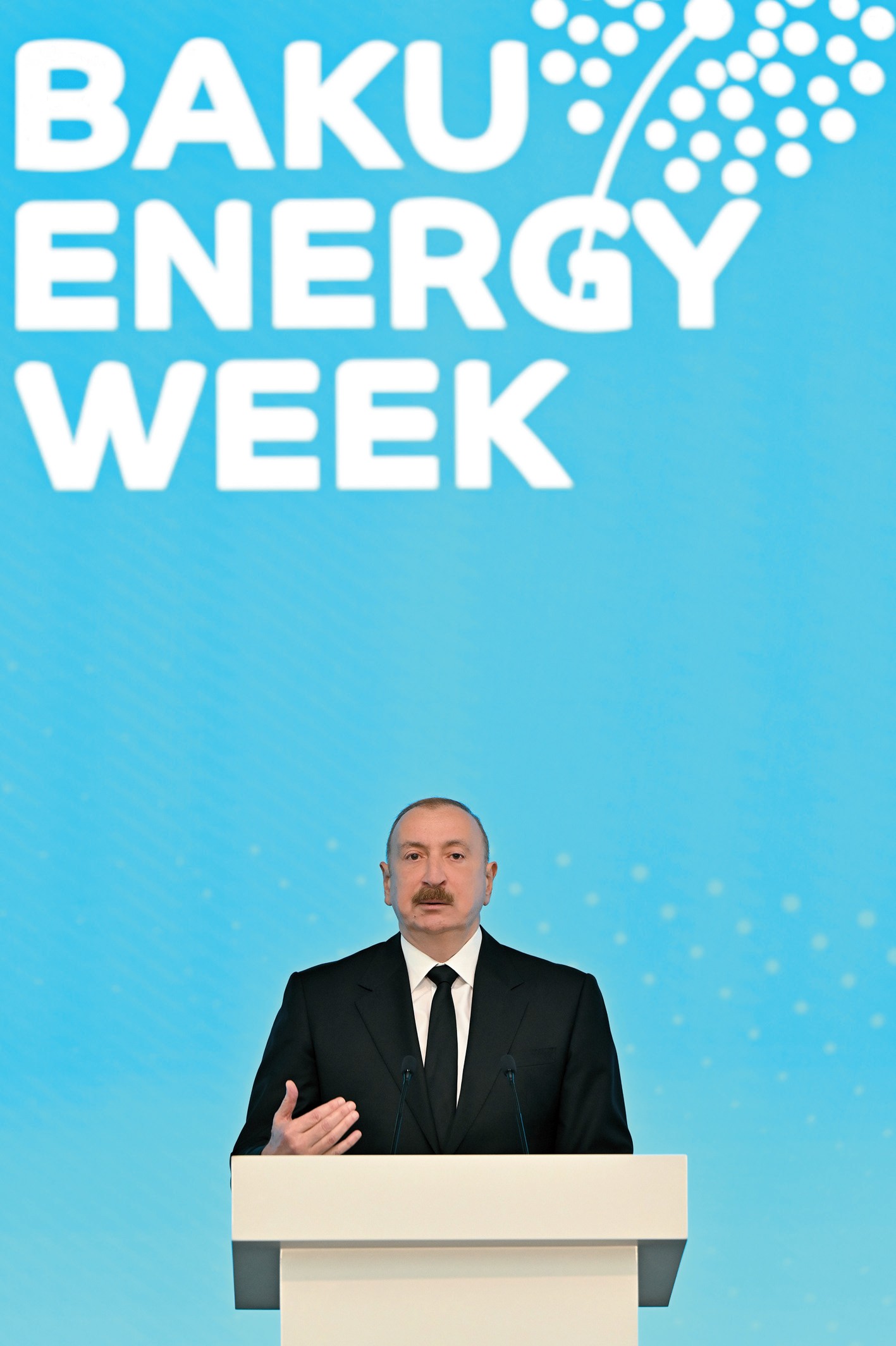
At the opening of Baku Energy Week, President Ilham Aliyev delivered a speech on a topic of significant debate in global energy circles: the balance between climate agendas and energy security.
The head of state has expressed gratitude for President Trump's role in stabilising the energy situation. He observed that for a considerable period, the oil and gas sector had been subject to considerable political and social pressure. Meanwhile, the global economy remained dependent on traditional energy sources, with the real needs of industry and populations often being sidelined.
This is why participants noted the president's assertion that "the world cannot exist without fossil fuels." This statement reflects a growing trend in international energy policy. In the wake of recent energy crises, many countries have come to recognise that abandoning traditional sources without reliable alternatives can have serious consequences.
Azerbaijan recognises the importance of balancing the development of its oil and gas sector with its commitment to climate goals. As Ilham Aliyev emphasised, "In the current climate, we must be very pragmatic and rely on realism. We need to plan our future with regard to energy security while also investing in renewable energy."
This theme was further elaborated by Azerbaijan's Minister of Energy, Parviz Shahbazov, at the 31st Baku Energy Forum. Recent years have demonstrated that the possession of resources alone does not guarantee energy security. The minister has stated that energy policy worldwide must be balanced, pragmatic and oriented towards both current market needs and ensuring future energy security. Mr Shahbazov emphasised that a modern energy system demands not only resources but also a reliable supply chain, stable partnerships, and long-term commitments. The core of most countries' energy strategies today, including that of Azerbaijan, is the diversification of routes, suppliers and technologies.
One of the issues that was discussed at length in the forum was the lack of investment in global energy. SOCAR President Rovshan Najaf has expressed concerns that this could become a significant challenge. "As in oil and gas, investments in energy projects do not yield short-term results; therefore, a gap between supply and demand may emerge in the future," he explained.
In recent years, there has been a notable shift in investment towards renewable energy projects, while funding for traditional sectors has frequently been postponed or reduced. However, global demand for oil and gas remains high and is even rising in some regions.
New technologies have the potential to mitigate some of the increasing pressure on energy systems. SOCAR's chief executive is convinced that artificial intelligence (AI) will have a significant role to play here. "In particular, AI technologies are expected to help both companies and households use energy more efficiently," Rovshan Najaf said.
From reliable supplier to systemic partner
Despite the implementation of state-of-the-art technologies, it remains imperative to enhance production volumes and expand export capacity. The forum identified the further development of Azerbaijan's export potential as a central issue.
Ilham Aliyev restated the significance of the Southern Gas Corridor (SGC), which has become increasingly important for Europe in recent years. "It is challenging to envision the current state of Europe's energy market without the SGC," the president stated, emphasising that presently, 16 countries are receiving Azerbaijani gas through this vital corridor.
Parviz Shahbazov provided a reminder that Azerbaijan is responsible for 8.1% of the European Union's pipeline gas imports. According to the minister, exports of Azerbaijani gas to Europe reached 16.7 billion cubic metres in 2025 and the first four months of 2026. Additional volumes were delivered to Türkiye, Georgia, and Syria.
SOCAR's president noted that partners regard Azerbaijan as one of the most stable energy sources in the region. Rovshan Najaf emphasised that the company's core philosophy is to ensure reliable supplies, and that this approach has not changed and will not change.
In light of current market conditions, there are plans to expand production and exports. SOCAR's head confirmed that Azerbaijan is negotiating with international partners to increase system throughput and boost deliveries to European markets. Such projects require long-term purchase guarantees and European consumers' participation in infrastructure financing.
Absheron: a next-generation project
A notable event at the forum was the signing of a new 15-year agreement between SOCAR, Türkiye's BOTAŞ, France's TotalEnergies and ADNOC from the United Arab Emirates. This agreement stipulates that, from 2029, Türkiye will receive 33 billion cubic metres of natural gas from the Absheron field. This deal not only guarantees future supply volumes but also confirms international partners' strong confidence in Azerbaijan's long-term gas sector prospects.
Concurrently, the project is entering a new development phase. Emmanuel de Guyabon, head of TotalEnergies in Azerbaijan, reported that phase two of field development has already reached practical implementation. "Production at the field is stable and has exceeded forecasts. These results have provided all the necessary data and confidence to move forward with phase two," he said. During this phase, three additional production wells will be drilled, with each well having the capacity to produce 40 thousand barrels of oil equivalent per day. Approximately 70% of the output will be natural gas, with the remaining 30% being condensate.
The forum saw a particular focus on technological solutions. "The first industrial application of this technology will take place in Azerbaijan as part of the Absheron project. We are proud of this," de Guyabon said while describing an innovative underwater pipeline cleaning system. The project will therefore generate additional gas volumes in addition to serving as a platform for the introduction of world-class technological innovations.
Following the completion of phase two, production at Absheron is expected to increase from the current 1.5 billion to a minimum of 4.5 billion cubic metres per year. SOCAR is aiming to accelerate project timelines, with securing first gas remaining a top priority for Azerbaijan. SOCAR Vice-President Babek Huseynov emphasised the importance of implementing these projects in a manner that ensures their viability and economic profitability. He stressed the necessity of simplicity, speed and strict financial discipline in their execution.
This approach reflects an overall trend evident in nearly all Baku Energy Week presentations: success depends not only on resource volumes but also on speed to market, technological sophistication, and ability to provide competitive supply costs.
From Garabagh to Umid
Another promising project is the Garabagh field. While a final investment decision is pending, industry experts are already lauding this as a fresh approach to Caspian resource development. Joe Christofoli, regional president of BP for Azerbaijan, Georgia and Türkiye, confirmed that engineering work is ongoing, with an investment decision expected by mid-next year.
The project is distinguished by its substantial reserves and innovative concept. If implemented, it would be among the first Caspian fields to be developed using existing infrastructure. He stated that this signifies a significant milestone in the integration of existing Caspian production and transportation infrastructure into new field development. This approach has been shown to reduce project commissioning times and required investment volume.
This model is of particular significance to Azerbaijan. Decades of development in the Caspian shelf have established a distinctive production and transport infrastructure that is now supporting current operations and facilitating the initiation of new projects. However, the sector's future depends not only on the exploration of new fields, but also on the modernisation of existing assets.
One such example is the further development of the Bahar and Gum-Deniz fields. Following the implementation of operational measures, the Bahar Energy Operating Company has reported a 50% increase in gas production at Bahar. SLB, a global leader in the field of oilfield services, was commissioned to assess the potential of the field. SLB Senior Vice-President Gökhan Yarim made a notable contribution to the forum by proposing that Bahar be regarded as a next-generation project. He confirmed that the Bahar project is currently in the design phase, but will be constructed as a fully digital asset. He added that the latest seismic exploration tools and AI technologies are already being used in field evaluation. "We employed AI to recognise several different productive layers," noted SLB's representative.
For Azerbaijan's future gas balance, Umid is of equal importance. This is the first large gas-condensate deposit to be discovered since the country gained independence.
Elkhan Bashirov, CEO of Umid-Babek Operating Company, reported at the forum that efforts are underway to develop a concept for increasing production volumes further. He emphasised the importance of Umid to Azerbaijan's strategic gas assets, pointing out that work is currently ongoing on a complex high-pressure well on the field's southern flank.
Bashirov also commented that such wells have never been drilled before, and that this is the first technically challenging project in SOCAR's history. Today, Umid's gas and condensate reserves are estimated at around 200 billion cubic metres and 40 million tonnes respectively, making it one of the country's most promising gas sources.
Azerbaijan's commitment to increasing production and enhancing resource efficiency is evident. The country's strategic approach to international cooperation, evidenced by Baku Energy Week, demonstrates a commitment to adopting digital technologies and exploring innovative partnerships. Azerbaijan's position as one of Eurasia's key energy centres is being strengthened by a combination of a large resource base, modern infrastructure and consistent investment policy.
Regional News
Agreements worth $7.5 billion signed during Baku Energy Week
At Baku Energy Week and the 1st Azerbaijan-US Economic Dialogue, the Ministry of Economy of the Republic of Azerbaijan and the State Oil Company of the Republic of Azerbaijan (SOCAR) signed several important agreements and memoranda with leading companies and organisations from countries including the United States of America, Turkey, Serbia, San Marino and France. The agreements covered the economy, energy, investment and digital technology sectors, with a total financial value of $7.5 billion.
Below is the list of the signed documents:
- A framework agreement has been reached between Azerbaijan and the US, with the aim of ensuring a reliable supply during the extraction and processing of critical minerals and rare earth elements.
- The project document between SOCAR and Serbia's Electric Power Industry (EPS) on the main terms of a joint venture shareholder agreement for the construction of a gas-fired power plant in Niš, Serbia.
- A memorandum of understanding between SOCAR and Shell. This document sets out the basic principles for potential cooperation across various energy sectors.
- An agreement between SOCAR and AASS for the sale of gas to San Marino, with sales due to commence in October of this year.
- A memorandum of understanding between SOCAR and US company Comstock Resources. This memorandum explores potential cooperation and investment opportunities on existing and new gas fields, as well as related infrastructure projects.
- A memorandum of understanding between SOCAR and JP Morgan to expand long-term cooperation in financing strategic projects and to enhance SOCAR's access to long-term capital.
- An agreement between SOCAR and Chevron for the joint execution of technical studies. The objective of the studies is to assess the oil and gas prospects in the Central Caspian Basin sector of Azerbaijan.
- An agreement between SOCAR and Apollo Global Management to provide investment for the TANAP project. A separate MoU was agreed to expand energy financing cooperation.
- The protocol from the 1st Azerbaijan-US Economic Dialogue.
RECOMMEND:
 80
80

