
BOSNIA: ELECTIONS WITHOUT CHANGE
The victory of ruling parties heightens European concerns about the country’s unity and the prospects of European integration
Author: Natig NAZIMOGHLU
The recent elections held on 4 October in Bosnia and Herzegovina, in which members of the Presidency, the central parliament and two regional parliaments, as well as the President of the Republika Srpska, were elected, have proven to be a significant test of the state's resilience. The voting process unfolded largely as anticipated, yet the nation's territorial integrity remains compromised.
Almost the same people in power, but…
The results of the elections in Bosnia and Herzegovina show a clear victory for candidates from the ruling parties. The Bosniak (Muslim) and Serb forces have maintained their positions in the highest state body, the Presidency. In the race for the Croat seat, Darijana Filipović—a representative of the Croatian Democratic Union of Bosnia and Herzegovina—emerged victorious. She took up the position previously held by centre-left politician Želko Komšić as a member of the Presidency. In the case of the Bosniaks, the incumbent member of the Presidency, the Social Democrat Denis Bečirović, was re-elected. Meanwhile, the Serbs once again expressed their preference for Želko Cvijanović, the candidate representing the Union of Independent Social Democrats.
In the context of Cvijanović's re-election to the Presidency, Savo Minić's victory in the Republika Srpska presidential election is also significant. The Republika Srpska is one of two autonomous entities of Bosnia and Herzegovina. Following the recent presidential election, Minic has succeeded his party colleague, Sinisa Karan, as head of the Republika Srpska.
Previously Prime Minister of the entity, Minic has beaten the opposition candidate, Branko Blanusha, in the race.
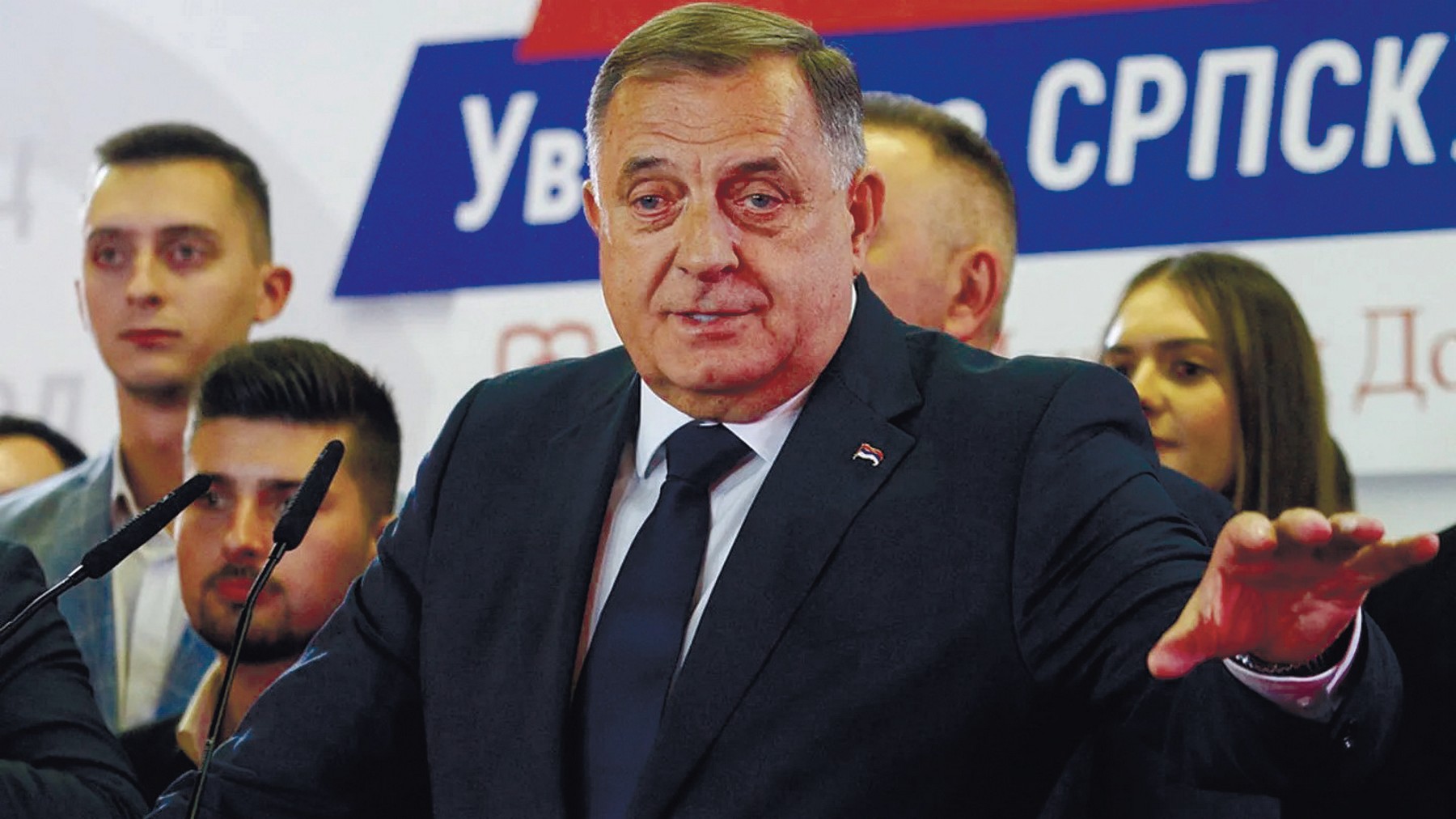
Cvijanović and Minić, like Karan before them, are regarded as protégés of Milorad Dodik, the former President of the Republika Srpska. He is the founder and long-standing leader of the Alliance of Independent Social Democrats. In 2025, Dodik was removed from the leadership of the entity for failing to implement the rulings of the Constitutional Court of Bosnia and Herzegovina and international agreements. For a period of six years, he is prohibited from holding public office; however, this does not prevent Dodik—who remains the leader of the ruling party—from controlling virtually all levers of power and personnel decisions in the Republika Srpska.
And following the results of the current elections, he has consolidated his de facto leadership within the entity by retaining his positions in the Bosnian Presidency, the success of his candidate, who was elected President of the Republika Srpska, the victory of the independent Social Democrats in the elections to its parliament—the National Assembly—as well as in the lower house of the Parliament of Bosnia and Herzegovina—the House of Representatives of the Parliamentary Assembly.
Thus, despite legal and political constraints, Dodik remains the most influential Serb politician throughout Bosnia and Herzegovina and within one of its entities—the Republika Srpska. What consequences does Dodik and his political movement retaining their position as the leading Serb power centre have for the country?
Will the Dayton system survive?
The elections on 4 October should be regarded as another test. The Dayton system was established in 1995, following the agreements that brought the Bosnian War to an end. This system is now under review. The system was agreed upon with the aim of resolving the disputes between the warring parties: The religious affiliations of the Bosnian Muslim, Orthodox Serbian and Catholic Croatian communities. This has resulted in the establishment of a unique presidential system, in which the duties of head of state are performed simultaneously by representatives of the Bosnian Muslims, Croats and Serbs, who hold the three seats on the Presidency of Bosnia and Herzegovina. This is despite the fact that the state consists of two autonomous entities: the Bosniak-Croat Federation of Bosnia and Herzegovina and the Republika Srpska.
However, the ethnic division, which permeates the electoral legislation, acts as a factor that constantly keeps the territorial unity of Bosnia and Herzegovina in limbo. This aspect is a contributing factor to ongoing debates regarding the durability and effectiveness of the Dayton system. While it achieved its objective of ending the war, it has yet to establish the foundations for a unified Bosnian society.
Despite the Dayton system having been in place for almost 30 years, Bosnia and Herzegovina remains, in essence, a divided society — a society without shared strategic goals, ideology or historical memory. The wounds of war run so deep that each side of the conflict continues to regard itself as a victim of the other.
The bloody past continues to impact the minds of Bosniaks, Croats and Serbs. This was clearly evident in the reaction to the death of General Ratko Mladić. The former commander of the Bosnian Serb Army, who had been convicted by the International Criminal Tribunal for the former Yugoslavia of war crimes, including the genocide of Bosnian Muslims in Srebrenica and the siege of Sarajevo, died on 27 August in a prison hospital in The Hague. Serbia and the Republika Srpska are mourning Radic as a national hero. However, Bosnian Muslims and Croats perceive this as an insult to the memory of the victims and their families.
Significant differences in the assessment of historical events and figures are, to a large extent, fuelling separatist sentiments in Bosnia and Herzegovina. The results of the 4 October elections served only to confirm their legitimacy, a fact that poses a significant threat not only to the state, but also to the very foundations of the Dayton system that has hitherto been in place.
Europe against the ‘influence of Washington and Moscow’
The issue of separatism is intrinsically linked to the policies of the Republika Srpska. The re-election of Cvijanović to the Presidency of Bosnia and Herzegovina suggests that the leadership of the Serb entity will, as previously, effectively block the development of a common state strategy. Dodik's party, Dodik himself and his supporters frequently voice the idea of the Republika Srpska seceding and withdrawing from Bosnia and Herzegovina. Furthermore, separatist sentiments are not confined to the Serbs.
Recently, there has been an increase in the number of calls for secession from the Bosniak-Croat Entity that are coming from the Croat part of the Federation of Bosnia and Herzegovina. The concept of establishing a distinct Croat entity within Bosnia and Herzegovina is also endorsed by Filipović, who was elected to the Presidency.
Furthermore, driven by a shared separatist interest, tactical alliances between Croats and Dodik's party are sometimes even observed. It is also important to note that the most pressing external factor for this country is also contributing to the intensification of separatist tendencies in Bosnia and Herzegovina. Specifically, neighbouring Serbia and Croatia, which often act in a manner that is not aligned with the values of their Serbian and Croatian compatriots, respectively—the residents of Bosnia and Herzegovina.
Another key factor that undermines Bosnian unity is the nature of the country's foreign policy orientation. Bosniaks and Croats are in favour of a Euro-Atlantic path for Bosnia and Herzegovina, namely accession to the European Union and the North Atlantic Treaty Organisation. This is also reflected in the statements made by the winners of the elections to the Presidency—Bečirović and Filipović. In the case of the latter, her direct links to the ruling political force in Croatia – an EU and NATO member state – also play a role. The Croatian Democratic Community, active in Bosnia and Herzegovina, enjoys every possible support from the centre-right party of the same name in Croatia, including with regard to Euro-Atlantic aspirations.
But the pro-Western course is supported no less by Bosnian Muslims. Hence the condemnation by both components of the Bosniak-Croat Federation of Russian aggression against Ukraine, as well as their support for Western sanctions against the Russian Federation.
The Serbs hold a completely opposite position. Modic, Cvijanović, Minic—indeed, practically the entire political elite of the Republika Srpska, much like the majority of politicians in Serbia itself—advocate close ties with Russia. This, one might say, is a traditional component of Serbian political culture, and it is also fully evident in the concrete actions of the Serbian entity within Bosnia and Herzegovina.
Thus, at the end of September, a few days before the Bosnian elections, Dodik and Minic met in Moscow with Russian President Vladimir Putin. The media interpreted this meeting as a sort of Kremlin-backed presentation of Minic as Modic’s successor and as the voice of the pro-Russian sentiments of the Bosnian Serbs.
That said, the leadership of the Serbian Entity is also quite pleased with its growing rapprochement with the administration of US President Donald Trump. The White House occupant appears to be impressed by the battle that Dodik and his associates are waging against the ‘evil of the Brussels bureaucracy’. Trump lifted US sanctions against Dodik, and following the 4 October election, the patriarch of Bosnian Serb politics expressed his gratitude for the United States’ support of the representatives of his party who secured victory.
It is hardly surprising that European political circles are gripped by scepticism regarding the latest triumph of Modic’s party. A triumph which, in essence, dashes the hopes of those in Bosnia and Herzegovina who favour a pro-Western course. At least until the next elections.
The Süddeutsche Zeitung, a leading German newspaper, has reported that in Bosnia and Herzegovina, a country that is in urgent need of reform, there is now an acknowledgement that, for the foreseeable future, the status quo will prevail. In this regard, the newspaper expresses the hope "that the people of Bosnia and Herzegovina will receive a signal for change, and that the European Union will provide more tangible support in countering the influence of Washington and Moscow". Furthermore, "we would also like to see a political class in power that is prepared to push for reform of the Dayton system and a new constitution, which would make it more difficult to block political decisions and reduce the role of ethnicity in the allocation of government posts".
The opinion of the Ljubljana-based newspaper Dnevnik is also noteworthy: "Bosnian politicians have once again been given a mandate to preserve the status quo and continue to languish in the EU's antechamber." Furthermore, in the aftermath of the elections, the formation of a sufficiently stable government remains uncertain, with the overarching objective being the establishment of a functional state that embodies a genuine European perspective.
Such assessments highlight the strategic importance of Bosnia and Herzegovina in European geopolitics. The country is widely regarded as the 'weakest link' in the Balkans. Despite the region having been stable for nearly a third of a century following the bloody regional war, the country is still teetering on a fine line between stability and collapse. At the same time, one long-standing hope remains as relevant as ever for Bosnia and Herzegovina: that there will never be another war. This, in fact, is what gives rise to the 'Bosnian phenomenon': this state continues to exist, despite what would seem to be intractable contradictions and problems. This is a significant historical achievement in its own right.
RECOMMEND:
 50