
IN ALLIANCE WITH EUROPE
Azerbaijan, Georgia and Moldova defend the honour of Eastern Partnership
Author: Fuad HUSEYNZADA Baku
The Eastern Partnership summit in Vilnius, which has caused such a hullabaloo over the past several months, has drawn to a close. The outcome of the European Union summit of member states and partner countries, on one hand, was a real disappointment for the European leaders, but on the other hand, it confirmed the predictions of the pragmatists: not all Eastern Partnership participants turned out to be independent in their conduct and ready to act in accordance with the previously made statements regarding their readiness to move towards European integration.
Progress despite obstacles
The third Eastern Partnership summit wrapped up with a final declaration, which stated progress in the programme made in the last two years and set goals for the future. The document welcomes the initialing of the association agreements with Georgia and Moldova, as well as the agreement on simplifying visa rules with Azerbaijan. It also noted that the EU is ready to launch negotiations with Azerbaijan on setting up a comprehensive free trade zone, which is part of the Association Agreement. However, this requires the country's accession to the World Trade Organisation (WTO).
Those signing the declaration expressed their regret that an Association Agreement was not signed with Ukraine during the summit, which had been supposed to be the main achievement. Nonetheless, the EU is leaving the door open for Ukraine.
Participants of the summit in the Lithuanian capital outlined their goals for the coming years up until 2015. These include further deepening of cooperation between the EU and partner countries, further steps towards strengthening democracy and respect for human rights, other key reforms such as advancing towards a visa-free regime between the EU and partner countries, expanding opportunities for integrated efforts in business and in transport network.
The sides will seek to sign the Association Agreements in 2014 with the participants which initialed them at the summit as well as to subsequently create comprehensive free trade zones. Moreover, the greatest effort possible will be made by 2015 for further implementation of multilateral projects of strategic importance, including those in the energy sector. People-to-people contacts and academic cooperation will be further stepped up as well.
The next Eastern Partnership summit will be held in 2015 in the Latvian capital Riga where participants will evaluate the implementation of the goals outlined in the mentioned declaration and the signed agreements.
Ukraine crisis
Other documents were also signed as a result of the summit, and we will go back to this topic later on; for the time being, let's refer to the main development which significantly disappointed the European leaders and was reflected in the declaration: Ukraine, which approved the Association Agreement as early as in March 2012, refrained from its much-expected signing in Vilnius. Instead, Ukrainian President Viktor Yanukovych called on the European Union to develop an economic assistance programme jointly with Kyiv that would allow the Ukrainian authorities to make preparations for the signing of the Association Agreement with the EU.
It is noteworthy that a few days prior to the Eastern Partnership summit the Ukrainian government decided to suspend the preparations for the signing of the Association Agreement, citing the need for settling issues regarding its economic and trade relations with Russia. This decision was a "cold shower" for Brussels, because the signing of the Association Agreement with Ukraine was considered to be one of the focal points on the agenda of the Vilnius meeting.
The leaders of the EU and major European countries deemed Kyiv's decision as a result of pressure and even blackmail on the part of Russia. The Ukrainian government's move stirred up the pro-Western forces in the entire Ukraine, with mass protests still ongoing in Kyiv and other cities of the country, while their organisers declared a "bloody war" on President Yanukovych (an expression used by Arseniy Yatsenyuk, one of the opposition leaders).
So, what evoked curiosity till the very end is whether or not the Ukrainian president would cope with the pressure of his European counterparts. The EU representatives expressed hope until the last moment that Kyiv would actually change its mind, assuring others that the document is still "on the table" and ready for signing "as soon as Ukraine wants to do so".
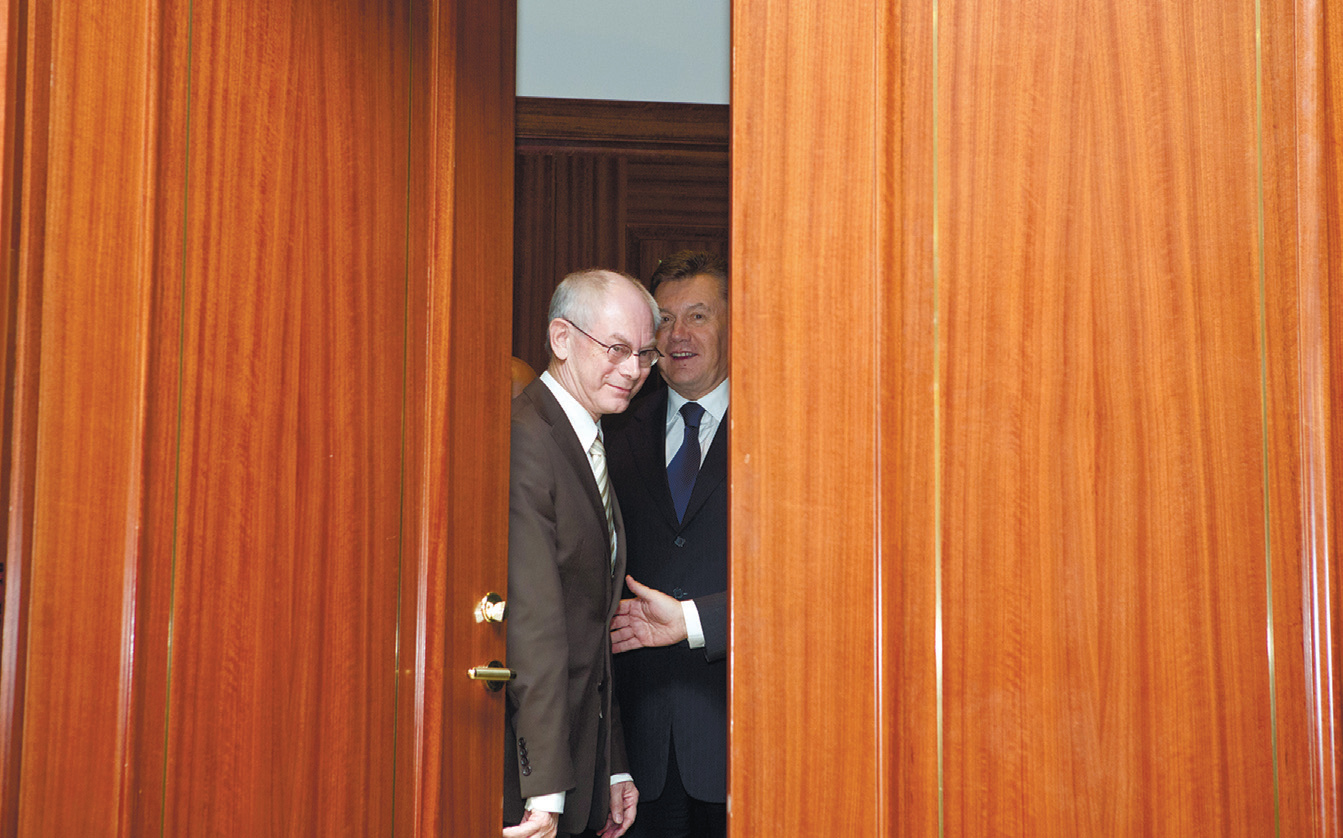
Since the moment President Yanukovych arrived at the summit the European leaders had tried to convince him to alter his decision. On the eve of the high-level meeting the Ukrainian President was approached by European Commission President Jose Manuel Barroso, as well as Dalia Grybauskaite, President of Lithuania, which will hold the presidency of the Council of European Union in the second half of
2013, and German Chancellor Angela Merkel.
One of the members of the European delegation admitted later that the EU was ready to sign the Association Agreement with Ukraine even without Kyiv's fulfilling the demand regarding the jailed former Prime Minister Yulia Tymoshenko's treatment abroad, which was expressed earlier.
However, Russia's arguments evidently turned out to be weightier for Kyiv than the persuasion of Brussels. As a result, the Lithuanian president stated that "the Ukrainian leadership is choosing a path that leads nowhere". According to Grybauskaite, by rejecting the Association Agreement, Ukraine is taking a step back, slowing down its progress.
EU Commissioner for Enlargement Stefan Fule evaluated the actions of the EU's changeful ally in an even more straightforward way.
"Ukraine's turning down the association (agreement) puts the country's future at risk," Fule said.
The Ukrainian government, which was seeking to appease its European counterparts and anticipating outcry from the numerous Ukrainian supporters of European integration upon its return home, sought a way out. President Yanukovych tried to assure the EU leadership that Ukraine is not backing down from European integration as its strategic course. During the summit the Ukrainian leader said Kyiv and Brussels should develop a programme of economic assistance that would allow the Ukrainian authorities to make preparations for the signing of the Association Agreement with the EU.
"Today we are in need of our European partners' decisive steps toward Ukraine in the issue of developing and implementing a programme of financial and economic assistance with the use of all available mechanisms and resources of both international institutions and EU member states," the Ukrainian president was quoted by his press service as saying.
The term "economic assistance" used by the Ukrainian government implies a hefty amount of funds. Prime Minister Mykola Azarov said earlier that Ukraine needs 160-170bn euros over 10 years just to bring its technical regulations into compliance with EU standards as part of enforcing the clauses of the Association Agreement. Azarov said that nonetheless, the EU has only pledged that over a period of seven years it would allocate approximately 1bn euros, while the International Monetary Fund is ready to disburse a loan worth about 4bn dollars -- the amount Ukraine owes to the IMF.
"We don't need such handouts in exchange of essentially ruining our economy. 1bn euros is nothing. You can say, it's like helping a beggar on a church-porch," the Ukrainian prime minister said.
In reality, these statements were deemed by the Europeans as nothing but attempts to lay the burden of responsibility for derailing the signing of the Association Agreement on the EU. French President Francois Hollande cited the unacceptability of Ukraine's seeking a certain amount for the signing of this agreement.
"The European Union does not pay for cooperation," President Hollande said harshly while commenting on his Ukrainian counterpart's request for assistance.
Lithuanian President Dalia Grybauskaite echoed the statement, saying that Ukraine follows the path of Belarus, turning down modernisation in exchange for Russian loans.
No matter how strange it may sound, after the summit Mykola Azarov said with satisfaction that President Yanukovych had explained to the European leaders in Vilnius Kyiv's problems regarding the association with the EU, and the Ukrainian government witnessed understanding of these problems and the willingness to provide assistance. But this statement looks rather as an attempt to make a good face during a bad game. Officially, Kyiv and Brussels agreed to continue working to coordinate the text of the Association Agreement with a possible prospect of its signing in the future. However, even these prospects are hard to believe, given Yanukovych's statement about Kyiv's being interested in signing a strategic partnership agreement with Russia.
In any case, under the new circumstances Ukraine is unlikely to get any concessions from the EU, therefore, by the time of signing the above-mentioned agreement Kyiv will have to fulfill the outstanding tasks, in particular, uprooting the practice of selective justice, i.e. resolving the situation regarding the criminal prosecution of the opposition leader Yulia Tymoshenko.
According to the results of the Vilnius summit, one may assume that even if Ukraine's rapprochement with the EU in the near future is possible, this could happen only under a new leadership of the country, including the president and a new composition of parliament. At least, that is how European Parliament President Martin Schulz sees the solution of this issue.
Evidently, President Yanukovych has lost the confidence of Brussels, and the latter is not withholding its opinion that the Association Agreement could be inked only with new authorities in Ukraine. The Ukrainian opposition concurs with this opinion.
It is worth mentioning that the next presidential election in Ukraine is scheduled for 2015.
All these twists and turns regarding Ukraine nearly overshadowed the significance of other member states' steps toward European integration. Certainly, this is not about Belarus, which has not been slanted toward the West anyway; not to mention Armenia, whose leader crossed out the prospects of his country's European integration. In a statement that was made about three months ago and was unexpected for Brussels, the Armenian leader expressed Yerevan's intention to back down from its rapprochement with the EU and to accede to the Customs Union (the Armenian opposition even suggests that 3 September, the day President Serzh Sargsyan made the statement, be included in the list of the most tragic developments in the "much-suffering history of the Armenian people").
Summit rescuers
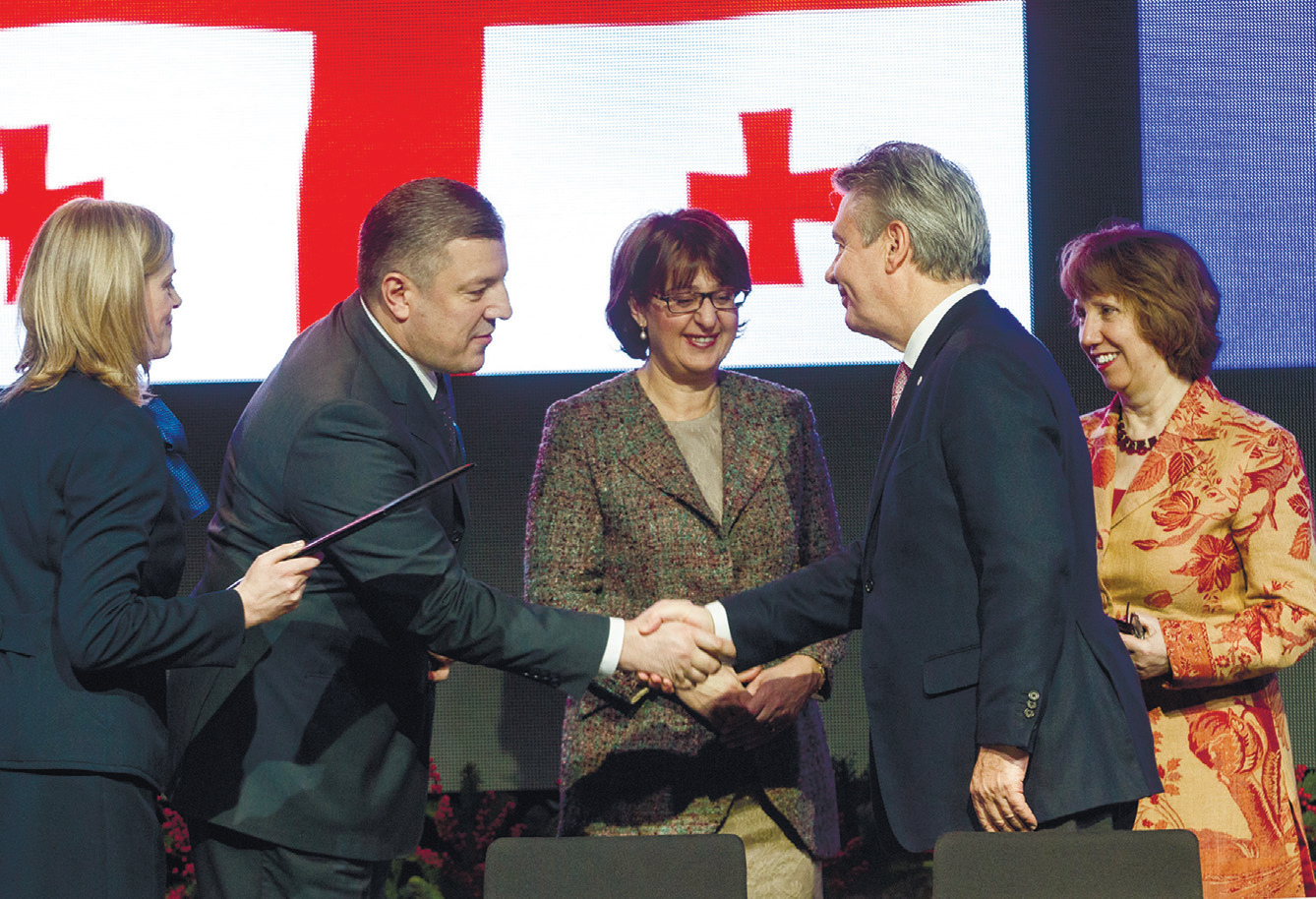
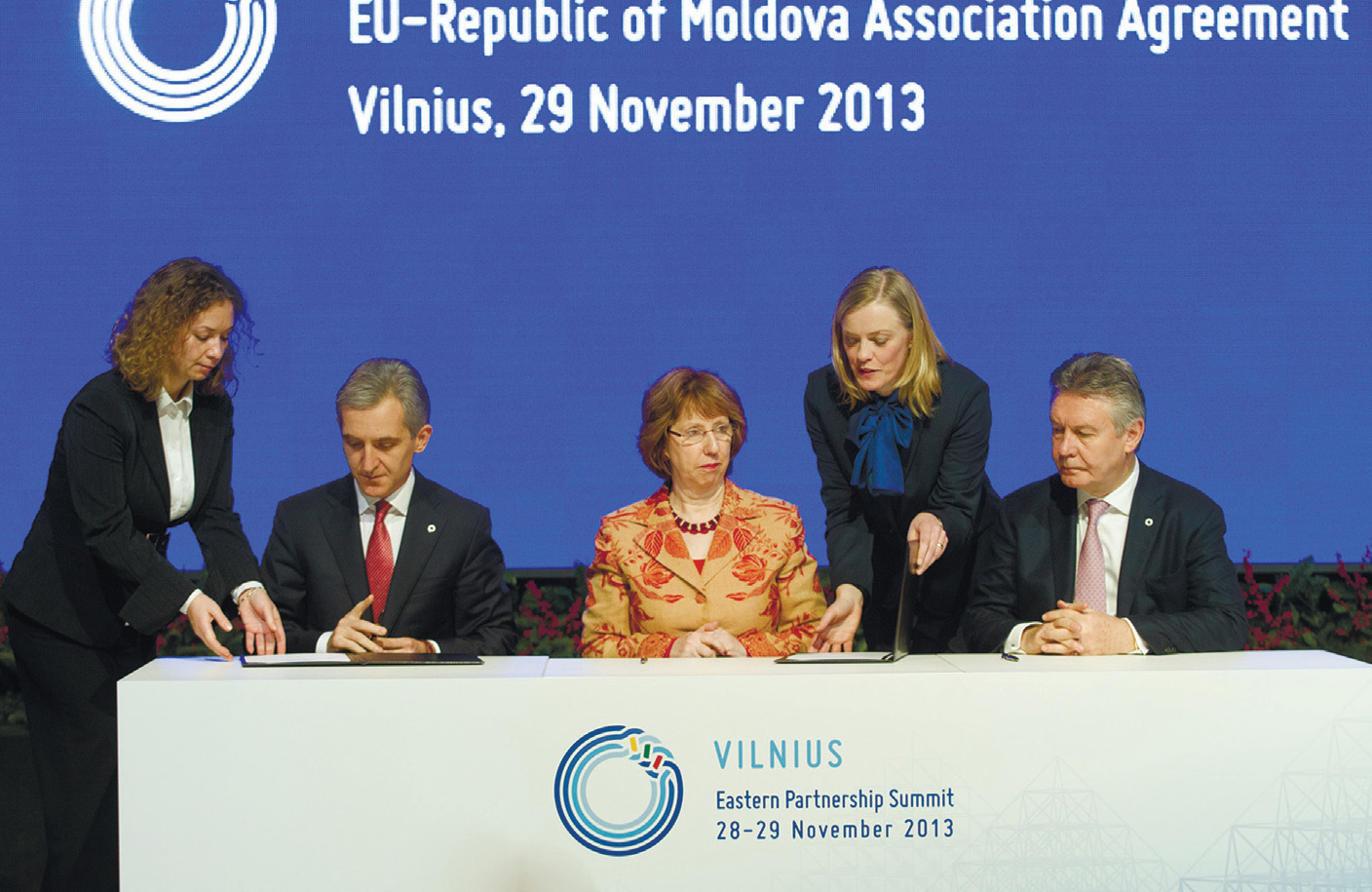
It is noteworthy that the signing of the above-mentioned declaration was preceded by the signing of documents without which the summit could be actually considered a failed event. Moldova and Georgia initialed their Association Agreements with the EU (the agreement with Georgia was signed in a Georgian pompous manner, with the song "Suliko" and the "Shalakho" dance tune playing, along with the EU anthem). European Council President Herman Van Rompuy and European Commission President Jose Manuel Barroso said at the summit afterwards that the EU expects to sign the documents as early as possible next year. During the Vilnius event Georgia also signed an agreement on its contribution to the EU operations on crisis management.
Moreover, an agreement on easing the visa regulations between the EU and Azerbaijan was signed in Vilnius. The significance of this document should not be underestimated. It is for a reason that EU officials and even NATO Secretary-General Anders Fogh Rasmussen solemnly congratulated Azerbaijan, Georgia and Moldova on their success in Vilnius, making it clear that these very countries helped the organisers of the Eastern Partnership summit not to lose face.
As for Azerbaijan's attitude toward the Association Agreement, Baku informed its European allies long before the Vilnius summit that the country would not sign an agreement on associate membership at the summit.
"We want to prepare a document that corresponds more adequately to the level of our relations and cooperation with the European Union," the deputy head of Azerbaijan's Presidential Administration, Novruz Mammadov, said, noting at the same time that Baku has offered the EU to sign a partnership agreement which would "reflect the level of bilateral cooperation and provide for mutual respect and equality of the parties".
It is evident that at this stage Azerbaijan prefers to develop its relations with the EU in the spheres it deems as close and understandable, notably, in the energy sector, especially after the Sah Daniz [Shah Deniz] Consortium passed a decision to select Trans Adriatic Pipeline (TAP) as a route for supplying Azerbaijani gas to European markets.
Azerbaijan is actually the only Eastern Partnership participant which is guided by the "for the sake" principle, not "contrary to", in its relationship with the EU. Baku is not using this cooperation in defiance of anyone, but is trying to reap mutual benefit, in accordance with its national interests. Perhaps, when it comes to its collaboration with the EU, Azerbaijan's plans initially were not as far-reaching as those of some of the other Eastern Partnership members. However, Baku has never undertaken any commitments which it would be unable to fulfill.
The accusations against Russia repeatedly made in Vilnius over its essentially de-personalising the Eastern Partnership summit, piling unprecedented pressure upon some of its participants, do not stand up to any criticism. Moscow's conduct was anticipated as it would be na?ve to expect it to indifferently watch outside players intruding into the sphere of the traditional Russian interests. Another point is that the Vilnius summit became a kind of a litmus paper that showed which of the Eastern Partnership participants are capable of coping with any outside pressure, are genuinely sovereign and independent states in terms of their demeanour and are entitled to long-term and mutually beneficial cooperation with the EU.
NOTE
Who can benefit from a simplified visa regime with the EU?
The European Union will reduce the fee for a Schengen visa for the citizens of Azerbaijan from 60 to 35 euros, according to the agreement on easing the visa regulations signed by Azerbaijan and the EU at the summit of the Eastern Partnership countries' leaders in Vilnius, Deputy Foreign Minister Mahmud Mammadquliyev told Trend news agency.
"Moreover, the fee will be waived for a separate category of Azerbaijani citizens -- this concerns the citizens who go to EU countries for education purposes, for treatment or to visit their relatives. The agreement also envisages introduction of a visa-free regime for the holders of diplomatic passports," Mammadquliyev said.
According to him, the agreement will allow reducing the number of documents required to obtain a visa. Specific timeframes for the issuance of a visa will be determined as well.
Mammadquliyev said these changes will go into effect presumably in the summer or the early fall of 2014.
In order for the agreement to go into effect, it is necessary to sign a re-admission agreement, which is expected to happen in the first quarter of next year.
"Afterwards, ratification procedures will begin in the Milli Maclis (parliament) and the European Parliament. After that both documents will simultaneously go into effect," the deputy minister said.
Moreover, it is necessary to sign bilateral agreements with those countries that are part of the Schengen Area but are not EU member states (Norway, Switzerland, Iceland and Liechtenstein).
According to an EU report, it will be possible to obtain faster and cheaper a short-term visa that enables its holder to stay in EU countries for no more than 90 days over a 180-day period.
For some categories of citizens, the procedure of issuing multiple-entry long-term visas (for a period of one to five years) will be simplified.
The agreement also envisions cancelling the visa fee for certain categories of citizens, including members of official delegations, children under the age of 12, retired persons, scientists and students.
RECOMMEND:
 937
937