

SUN, FIRE, WATER
In Abseron district, there are a number of unique historical and natural monuments
Author: Zarifa BABAYEVA Baku
Abseron means "salt water" in Persian (?). "Ab" is water and "shoran" is salt. Indeed, if you dig a little deeper in search of water, artesian water in Abseron villages is almost always salty. There is something symbolic about it. Sea, sand and dry climate. Figs and grapes ("ar saani", "qara saani", "Sakina xanim", "saray sarigilasi") sweet like honey grow here, while watermelons, melons and tomatoes grow in Saray. And it seems that even Abseron plants are accustomed to the rigour of salt water, they grow here without any problems. There are wonderful beaches here. And the area is different from others for its skilled carpet-weavers, artists, etc. Although the district has the same name as the Abseron Peninsula, the territory of the district (1,546 sq. km) does not coincide with the territory of the peninsula and is significantly more to the west and mostly inside the country.
Actually, everything is symbolic in Abseron. The climatic and natural nuances of the area have left their mark on the history and culture of these dry, but very beautiful places. In the towns and villages in the district, there are historical monuments, mosques, reservoirs and quarries of the 14th-17th centuries. In Xirdalan, there is the Masadi Imambaxis Bath and the Haci Hasan pond of 1904; in Novxani - the 17th century Shah Sultan Huseyn Mosque; in Masazir - the 15th century Xan Bagi mausoleum; in Mammadli - Yanar Dag - an 18th century pond and White Mosque; in Hokmali - the 19th century Alimurad Bath; in Fatmayi - the 17th century Haci Heybat Mosque; etc. The village of Qobu is unique in that it appeared 700 years ago and is famous for its carpet-weaving like Hokmali.
But this is not the only thing that makes Abseron District famous. These places are also rich in the names of prominent historical and political figures of Azerbaijan. Vali Axundov, M. E. Rasulzada, Qara Qarayev, Mehdi Huseynzada, Mikayil Alakbarov and Aliaga Vahid were born here.
Currently in Abseron District, along with ancient historical monuments, there are four modern parks, two museums, four cultural centres, twenty medical institutions, an urban health centre, one high school, two technical lyceums, one college, thirty-six schools, twenty-three kindergartens and a children's sports-youth school.
As an independent district, Abseron was founded in January 1963 in order to ensure the functioning of enterprises and institutions, collective and state farms, poultry and agricultural industries, as well as construction and drainage organizations, research institutes and laboratories with highly qualified management in the administrative territory of Baku and Sumqayit, serving to meet the needs of the two industrial centres for agricultural produce. The district has one city (Xirdalan), eight towns (Ceyranbatan, Saray, Mehdiabad, Digah, Qobu, Guzdak, Hokmali, Lower Guzdak) and six villages (Masazir, Fatmayi, Mammadli, Goradil, Pirkuskul and Novxani). In the 1930's and 1940's, the city of Xirdalan was transferred to Binaqadi District, in the first half of the 1950's - to Mastaga District and in the 1950's and 1960's - to Binaqadi District again, and on 4 January 1963, according to the decree of the Presidium of the Supreme Soviet of the Azerbaijan SSR, it became the centre of Abseron District. In 1936, Xirdalan was a suburban settlement and on the basis of the 2 October 2006 law of the president of the Azerbaijan Republic № 149-III, Xirdalan was given the status of a city.
The city is located on the coast of the Caspian Sea, 10 km north-west of Baku.
The place name Xirdalan has several interpretations. Some scientists link the name of the city to numerous sowing areas (in Azerbaijani "xirlar") that once existed on this site. Other scientists have a different opinion. In their version, the word "xir" in the place name should be read only as "xur" (many Azerbaijanis still call this place Xurdalan), which has at least two meanings in Farsi - unusual, unprecedented or fire, flame, sunlight. If this is true, the ancient inhabitants of the area can be attributed to fire worshippers. There is also a theory that the first A is missing from the word "Xirdalan" i.e. Xirdalan is a form of the word "Axirdalan", which is not uncommon in Turkic languages. "Axirdalan" (Ax?r dalan in Azerbaijani) means "the last dead end (turn)." This name is due to the fact that Xirdalan is the last staging post on the way to Baku.
As for information about other administrative units of Abseron District, among those that are known, the following place names draw attention: Novxani, Goradil, Digah, Qobu, Mammadli, Fatmayi, Hokmali, Guzdak and Corat. Their translation from ancient languages sometimes conveys the true meaning and name of a particular locality. You can get to know a lot of facts from them. Many districts received their names from the tribes that inhabited these places in antiquity.
Novxani. "Nou" means new in Persian and "khana" means a house. That is to say a new home. Actually, the history of the Abseron dachas goes 500 years back and the oldest dachas in the area are those in Novxani. Based on this, we can say that the history of the village of Novxani is also ancient despite the fact that some sources attribute it to the Middle Ages. According to sources, about 500 years ago, there was the village of Siyan near the present village of Novxani. The word "siyan" means "to burn". This word is a deformed form of the word "soot", "smoke", i.e. "igniting soot". As a result of the rise in the sea level, this village (according to some sources, as a result of a strong earthquake) sank, and the population moved to Asagibas. The new homes built in the village were called "new homes" - "nov khani" in Persian, and later the village was named Novxani. In the courtyards of the houses located in the old part of the village, you can see wells and barns for storing vegetables. In Novxani carpets were woven and embroidery was sewn from gilded lace almost in every house. One of the unique characteristics of the local population was the fact that they never fenced gardens or locked houses here. Although many of the customs have not survived, some of them are still used. For example, on return from the country, they prepare "yurd halvasi". In the village, they give preference to flour and meat dishes. Fish dishes are few, because people used to bring the desired fish from fisheries, but now it is difficult to find those species of fish.
The village is the birthplace of people like Mammad Amin Rasulzada, Mirzabala Mammadzada, Seyid Huseyn, Umgulsum and Oktay Sadiqzada, Kamil Balakisiyev, Ruhulla Qafil, Habib Balasadiq oglu, Azim Azimzada, Lotfi Zadeh, Mehdi Huseynzada, Suleyman Rustam, etc. Due to the elimination of state saffron, almond and pistachio farms, they are grown in separate courtyards. In Novxani, there is the Shah Sultan Huseyn Mosque (17th century).
Qoradil. The name of this village has three options. 1. It means "a cemetery" in Farsi; 2. The root of the place name "Ger" is closely connected with the Goranboy tribe; 3. "Geran" was a Mongol-Turkic word and meant a camp, army or warring party.
Digah. In Persian, it means "di" - village, "gah" - a place i.e. a rustic place.
Qobu. In Azerbaijan, there are a lot of places connected with the place name Qobu. For example, the village of Qobu in Abseron, the village of Qobustu in Agdam, Qobuqiraq in Xacmaz, Qobudilaqarda in Fizuli and Qobustan District itself. This place name has several meanings - a lowland place, a small hole, moorland, a small lake, etc. No doubt, the name of the Baku village of Qobu comes from some natural features. By the way, a very important ecological facility will appear in Qobu very soon. According to the president's order, a new zoo with unique and rare species of flora and fauna will be built in the village of Qobu. The new zoo, which will occupy an area of 230 ha, will house not only rare and endangered species of local flora and fauna, but eventually rare mammals and birds from other continents such as Australia.
Mammadli. Studies have shown that the name of the village is related to the person who founded the village. Unfortunately, so far it has been impossible to find out more about him.
Fatmayi. A certain Vali xan founded the village, which he named after his wife Fatma - hence the name of this place.
Hokmali. The place name literally means "hokm" - an order, while "Ali" is the name of a person, i.e. a village built on Ali's order.
Saray. The village's name literally means the shah's or khan's palace, house or tall building that attracts attention with its grandeur. "Sar" means "height" in Farsi. There is another version that is associated with the Mongolian tribe Saray.
Guzdak. The name of the village presumably comes from the Turkic tribe Guz. Over time, Tats began to live in Guzdak. Guzdak means "lambs" in their language.
Corat. The village's name is taken from the Mongolian tribe Corat.
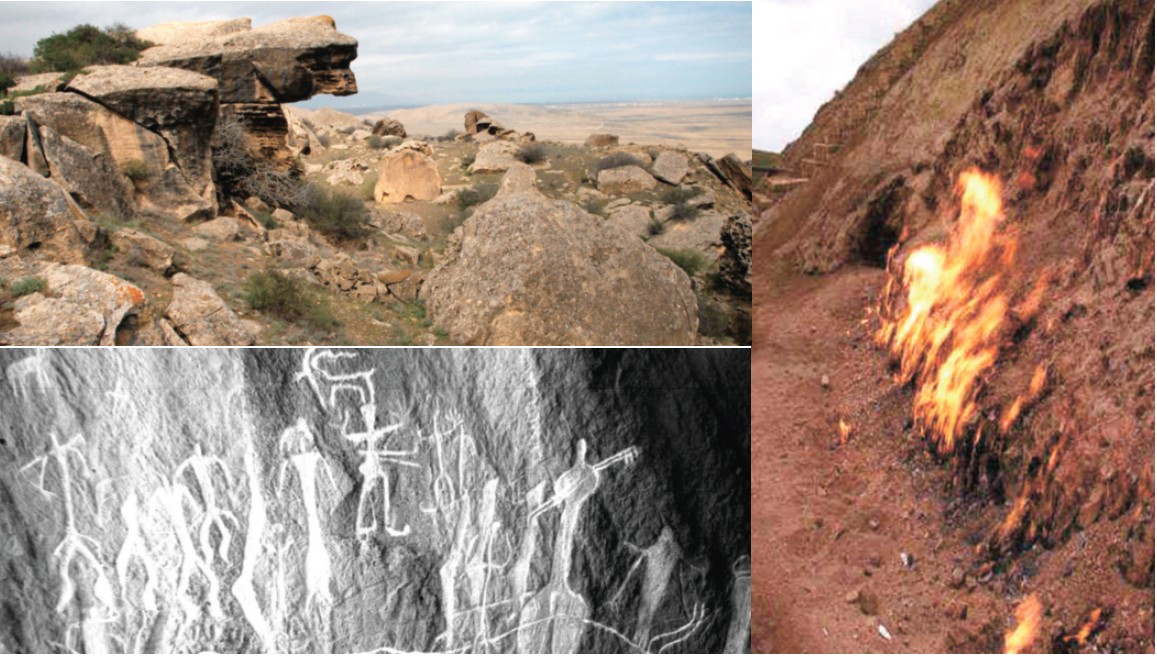
As for the iconic natural monuments of Abseron District, the most interesting one is Yanar Dag. It is located about 20 kilometres from Baku near villages of Digah and Mammadli. Yanar Dag is gas flares burning for centuries and this unique natural phenomenon can be found only in Azerbaijan - the Land of Fire. When you look at this natural wonder from a distance, it seems like a huge hoard buried under a mountain, and its luminosity radiates out from under the ground! Many legends are connected with this mountain. Yanar Dag means Fire Mountain (yanar dag), because a whole mountain has been "burning" for thousands of years here because of natural gas escaping from the ground. Near Yanar Dag, there is a source of mineral water which escapes together with natural gas and gives the effect of "hot water".
From its foot, the hill seems to be strewn with red tulips - tongues of fire. Initially, it is strange to see those lights escaping not from a familiar gas burner, but from under the ground, without any need, by themselves (just like everything in nature - that's how rivers flow, trees grow and birds sing). And then comes a feeling of admiration for the independence of the fire that escapes from the depths "just like that". It may be blown out, but no, it is done by the vehement northern wind of Baku - "Xazri", but after a while the fire flares up again - it is enough for a pebble carried by the wind to hit a rock or stone and produce a spark.
Mountain "burns" even in the rain (in the rain, the fire becomes bright blue), in the snow and in strong winds, because fuel gas escapes from its depth - ethane and propane. Gas comes from the thin porous layers of sandstone. In ancient times, there were many such places where fire naturally erupted from the ground in Abseron. According to the Azerbaijani culture expert Togrul Cuvarli, oil and gas lied so shallow that in some places, they spilled out in the form of flame. Literally until the middle of the 19th century, there were places in Abseron where the ground began to burn from a lit wick like a torch.
The height of the mountain is 116 metres. Interestingly, at the top there is a cave which locals call "Wolf's Nest". They say that a pack of wolves had lived here for a long time, but archeologists found pictures on the walls and suggest that this place was one of the first settlements of ancient people in Azerbaijan.
Travellers who visited Abseron often described mysterious lights in their travel notes. For example, here is how the famous 17th century Turkish traveller Evliya Celebi describes what he saw in his "Book of Travels": "In the Baku nahia (region), there are some areas that are not suitable for farming (so-called "shuras"). If a man or a horse set foot here and hesitate, they burn their feet. Passing caravans dig a hole in the ground and quickly put copper dishes (with food) in it, and the food in them instantly cooks with the heat of the earth. God's wisdom is amazing!"
But here is what A. P. Bogolyubov saw and recorded in his "Notes of the Artist-Sailor" (1861-1862): "Returning home in Baku in the evening or at night, I saw a wonderful picture on the way. It was quiet. A shepherd drove his flock together, made holes in the sand and lit natural gas, which served as a fence, lighting and protection for the sheep with its eight tall pillars."
In ancient times, fire worshippers from all over the world, especially from India and Iran, gathered in Baku. Yanar Dag is still the focus of both local residents and tourists from Russia, Germany, Japan, Korea and Norway. It is also visited by Buddhists, who believe in the sanctity of the mountain and meditate at its foot.
In 2007, Yanar Dag was placed under state protection, and its territory was declared a state historical-cultural and natural reserve. In recent years, archaeological research has been conducted here. In particular, employees of the Institute of Archaeology and Ethnography of the National Academy of Sciences of Azerbaijan found two barrows - ancient burial sites - on the mountain. Currently, the excavations are continuing. Many tourists come from all over the world to look at this natural wonder.
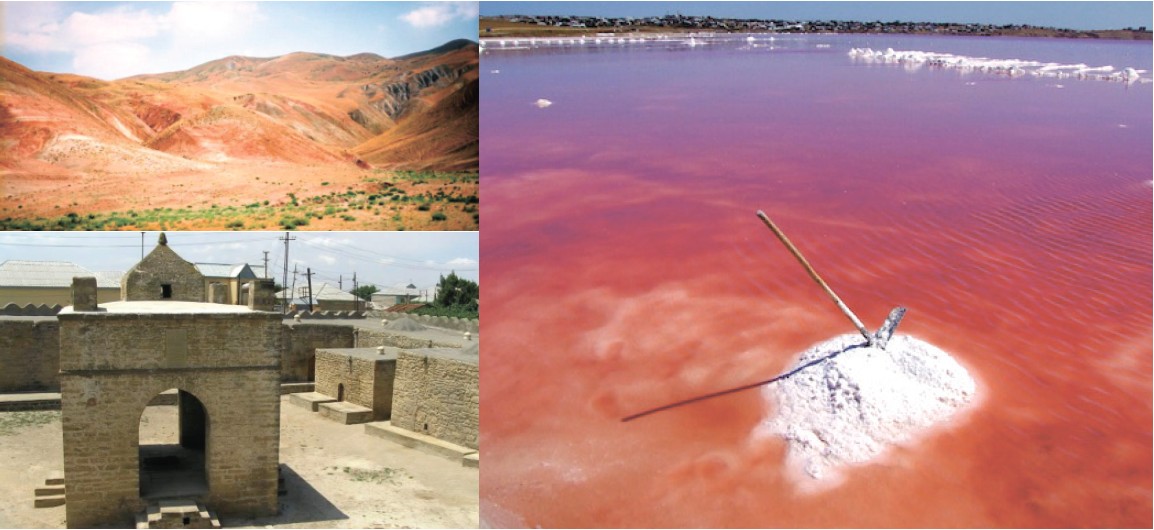
No less interesting is another unique natural phenomenon - the Masazir salt lake with an area of 10 sq. km. It contains salt in layers and in the form of brine in the water. The reserves of the raw material in it are about 1.735 million tons, which is more than enough for 25-30 years even with the full use of the capacity of the plant that was established here for salt production.
RECOMMEND:
 790
790