

CINGIZ ABASSOV'S GOOD FORTUNE
"One must feel strongly to make others feel strongly"(Nicolo Paganini)
Author: Natali ALEKSANDROVA Baku
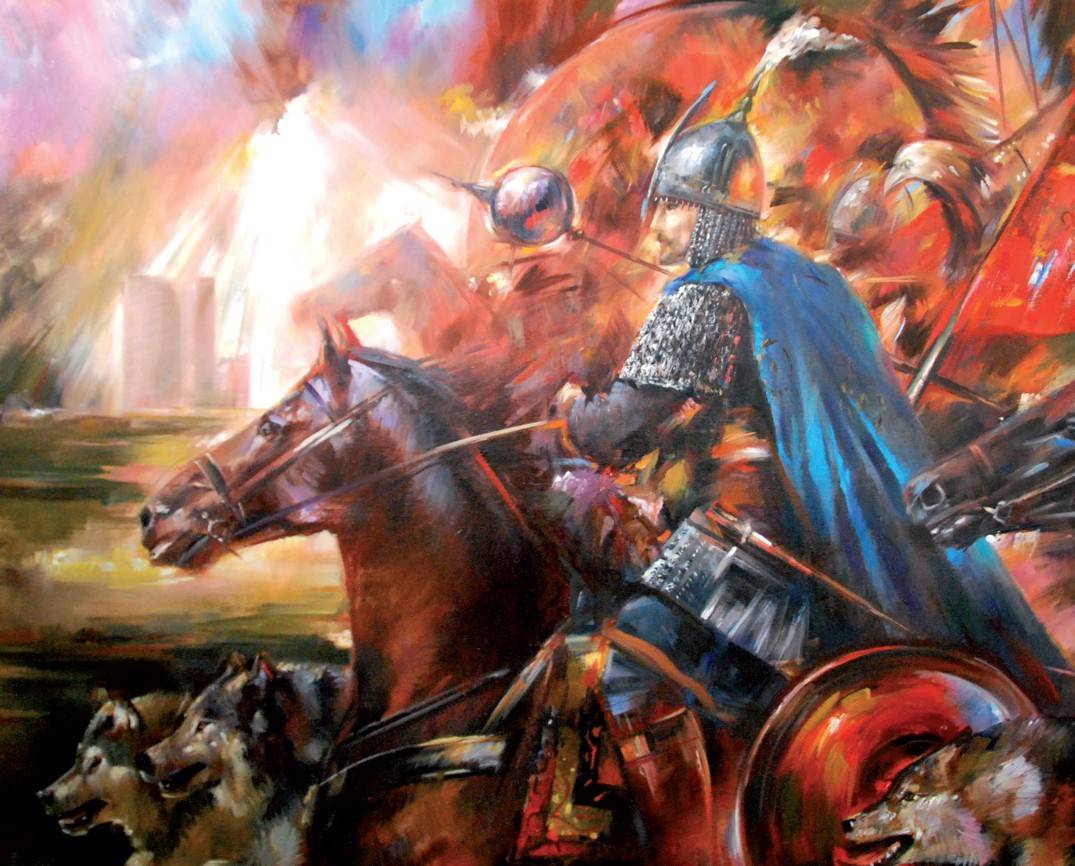
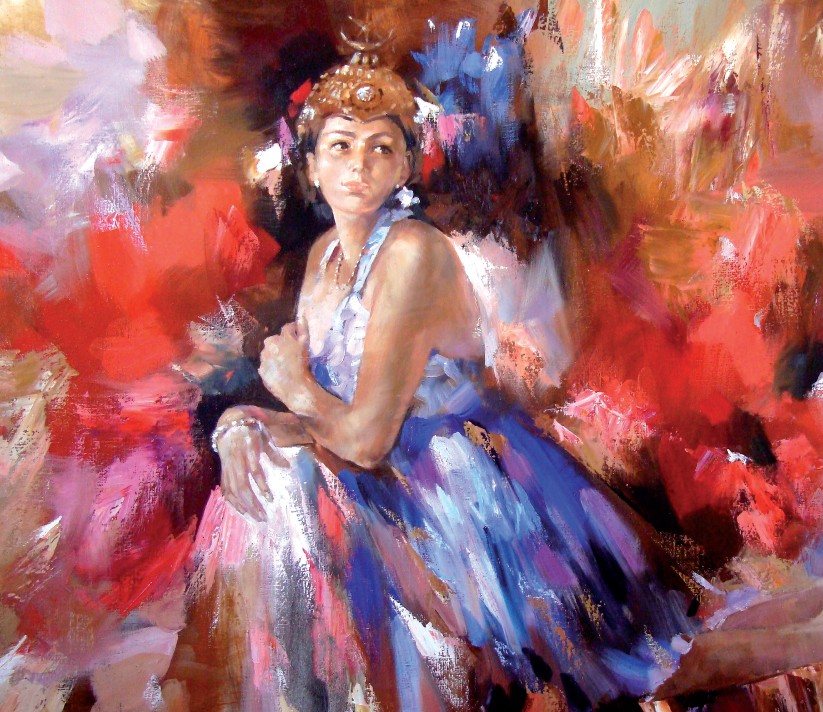
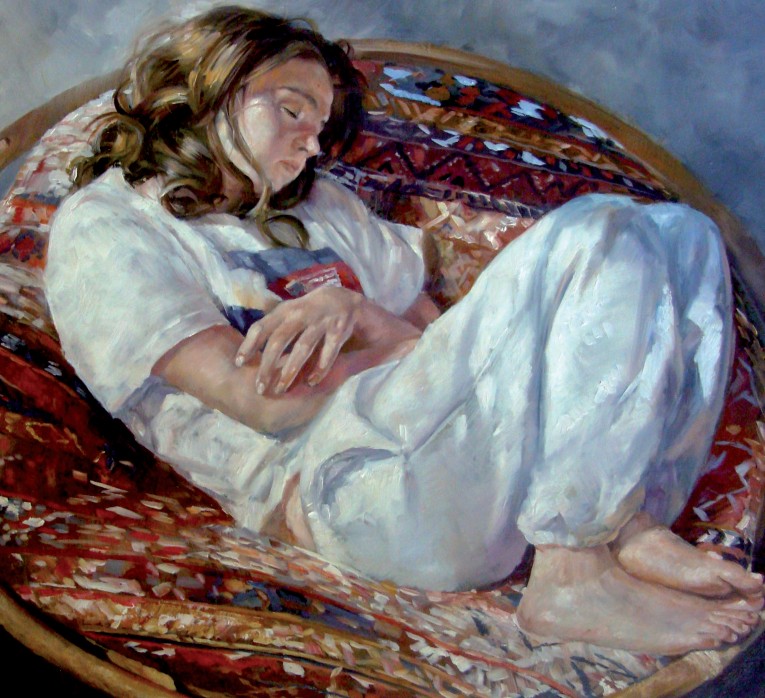
Before meeting Cingiz Abassov, I knew only the dry facts taken from the ''omniscient'' internet: ''Born-grew up-works''. But I had seen his paintings. Even their virtual versions struck one with energy and a certain...mysticism.
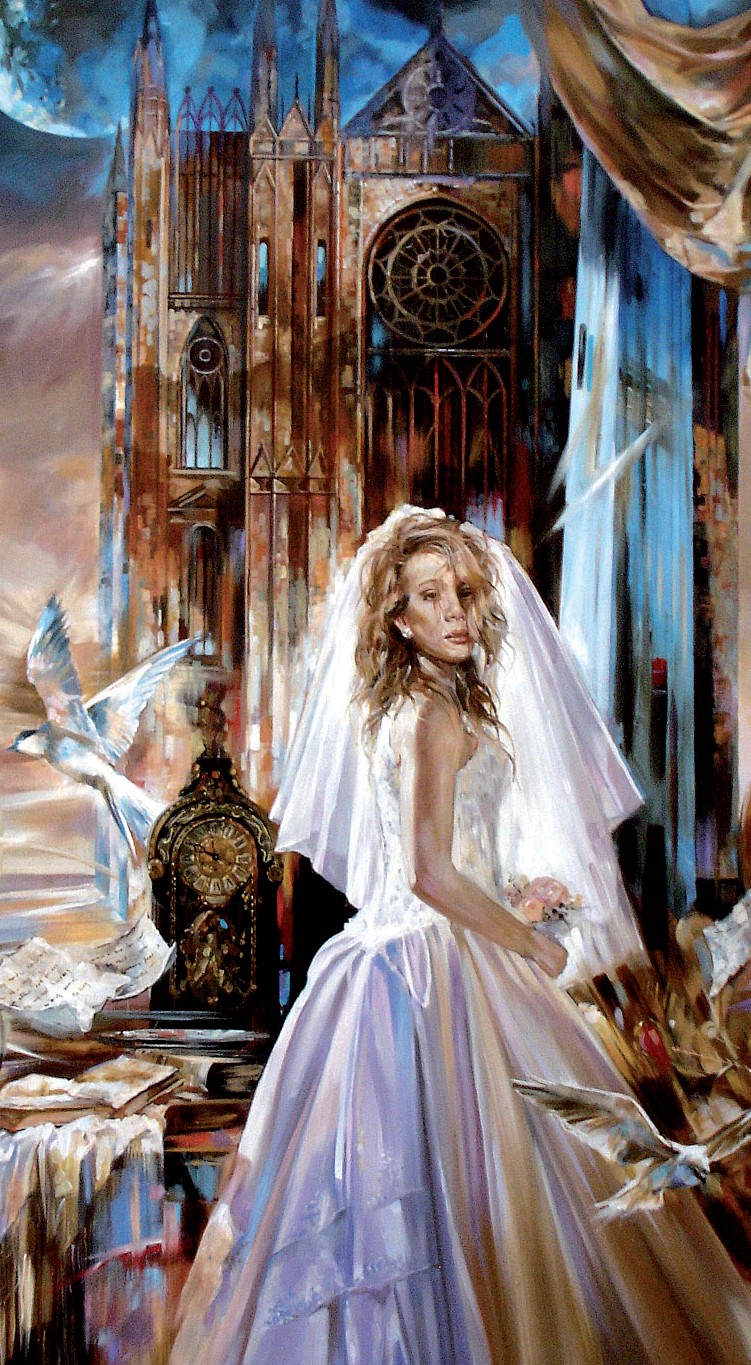
In his astonishing colour-play, the artist arranges accents, transfers moods, and an entire history is born in the imagination - logically inexplicable, but at the same time amazingly bright and attractive.
It is surprising, but it seems that you only now understand (or recall) how much colour there is in the world and how varied are its effects on emotions, feelings, the nuances of sensations and feelings, even on time itself!
But, as the saying goes, it is a mug's game trying to describe the work of a master; so it is in this case, the work must be seen, and more than once. Not only must it be seen, it must be felt. I am confident that it is impossible to remain indifferent to the paintings of Cingiz Abassov.
- Cingiz, My first feeling on seeing your pictures is a certain mysticism.
- You are right. I have been fascinated by mysticism for a long time. I have always been aware that energy tells on people one way or another - whether it be from a place, pictures, buildings. Including energy from other people.
- And have you noticed any mystical ability within yourself? Say, for your future work, a painting - do you 'see' it in advance?
- Perhaps, subconsciously... Originally, any picture carries some associations. Later, it acquires concrete form. In the process of creation, there is a sensation, as if there are some parts of the memory floating and you attempt to mould them together. It is like sleep - rationally, there is no logic to it. But, within this sleep, there is a logic. Here and there: thus far, you paint in a specific state, the subconscious is at work. And when you grasp that, you transfer it to a canvas, and then logic prevails. And this coincides with the subconscious of those who view the paintings.
In the Soviet period, they tried to make us explain artists' work logically, to describe pictures in words - but that is completely incorrect, because the subconscious has its own logic. It is captured by people precisely at the level of energy. So it seems to me that the fascination of paintings by some artists is, precisely, inexplicable.
The very creation of a painting has a certain emotional mysticism. For example, I am frequently asked why I paint pictures of women. Because mysticism and aesthetics are perceived through the subconscious. But what can be more mysterious, more aesthetic and more beautiful than a woman? It seems to me a woman is the most excellent of God's creations. Tell me you do not agree!
- I will not.
- It is true! Therefore, I try to present my paintings so that viewers perceive that mysticism itself via aesthetics. You noted that colours play an enormous role in my pictures.
If you like, I express myself precisely through colours. I said before "I want to report", and then realised that I had made a mistake. For the simple reason that the artist works not because he wants to deliver a message. He paints because there is no other way of life for him. When he touches a canvas with a brush, he experiences genuine ecstasy. Hence that energy appears by itself. And so it is no longer important how he paints: in a suit with a bow-tie, or in the stereotype beret surrounded by cigarette-butts.
- Do you work every day?
- Yes. Many people ask: what about inspiration? I do not know what that is: when 'suddenly the muse touches with its wing'... This is my profession. Or, I am constantly in a state of inspiration.
- In that case, who is the Artist, in your opinion?
- Artists are people who have a constant need to create their own worlds. I cannot say they are more fulfilled than other people. But artists have the constant need to express what they feel.
- From what age did you sense this need?
- Approximately from the age of six. I painted horses constantly. These animals enraptured me with their beauty, expression, grace of movement and, at the same time, with their obstinacy, which was also manifest in their movements, of course they cannot speak. I am explaining it now, but then it was, apparently, a subconscious desire to understand this, feeling through painting. Indeed, it is no secret that an artist who, say, paints someone's portrait, penetrates their nature...
At the age of 12, I had already firmly decided to become an artist. After 8 classes, I entered the Azimzada vocational school; after finishing there I entered the V. I. Mukhina Leningrad Higher Industrial Arts School. In 1994 it was renamed the A. L. Shtiglitz St. Petersburg State Art-Industrial Academy.
Then I served in the army, where I was also involved in art - I was a painter.
- What happened then?
- I returned to Baku for a year or two, and then I was invited to an exhibition in Finland, which was completely unexpected. My paintings, as well as those of many of my colleagues were exhibited in some galleries in Leningrad, and they had been noticed by representatives of a gallery in the Finnish city of Hameenlinna.
That was my first solo exhibition in Finland. After that, I became known there and they began to invite me to other galleries.
At that time there was something that seemed strange to me: everyone was fascinated by abstractionism and I was no exception. It seemed interesting. Probably because the proposal was unexpected, I did not treat it very seriously and I took abstracts to Finland. And it was received with enthusiasm! This astonishes me as I think that abstraction is ridiculously easy.
- But abstractionists themselves say the exact opposite...
- Let them say so, that is their right. The point is that the basis of classical art is also abstract. It is simply that forms intelligible to people are superimposed on this 'abstraction'. We do indeed perceive any picture as abstract at first: we look at it from a distance and see one thing; we approach and begin to distinguish other forms. The way the artist presents it acts on man's subconscious and it is converted into a certain impression, a view.
- Listening to you, I understand that an artist is also a psychologist.
- Certainly! Every time an artist draws someone's portrait, he is immersed in that person! Even the expression on the creator's face becomes identical to that of his model. This is mimicry.
- Is it possible for someone to change opinions about him by accentuating a feature that pleases the artist?
- Certainly, but this also occurs at a subconscious level, because the artist sees such things almost immediately.
But to arrange such features does not mean embellishment. I will explain it with an example. Repin painted the famous portrait of Mussorgsky when the composer was ill. No matter how hard the famous artist tried to paint Mussorgsky as more 'blooming', he could not, because he could not lie.
- If he could? Could, say, a sick person, whom they 'saw' healthy, actually recover?
- This is about vibrations... That is to say, it is necessary that both the artist and his model are, as the saying goes, on the same wavelength.
- What is your attitude towards this relationship: 'art - money'? Do you paint to order?
- In the Soviet school, we were inculcated with the essentially absurd dogma that the artist must not paint for money. This is complete absurdity. Indeed, this is our profession, which must, a priori, bring in money. And then - take the history of the fine arts: all the great masters painted to order: Michelangelo, Rembrandt. What an artist adds to his work in doing so is another question.
- That is to say, to paint something that does not bring you personal satisfaction for big money - is not your way?
- I simply cannot do it, as I try to paint each of my paintings sincerely. Otherwise, it would be doing violence to myself. That is no way to create a masterpiece.
- Have you created one?
- I do not think I have. In general, a true master creates a maximum 10 masterpieces in a lifetime... It is not the case that every painting is genius.
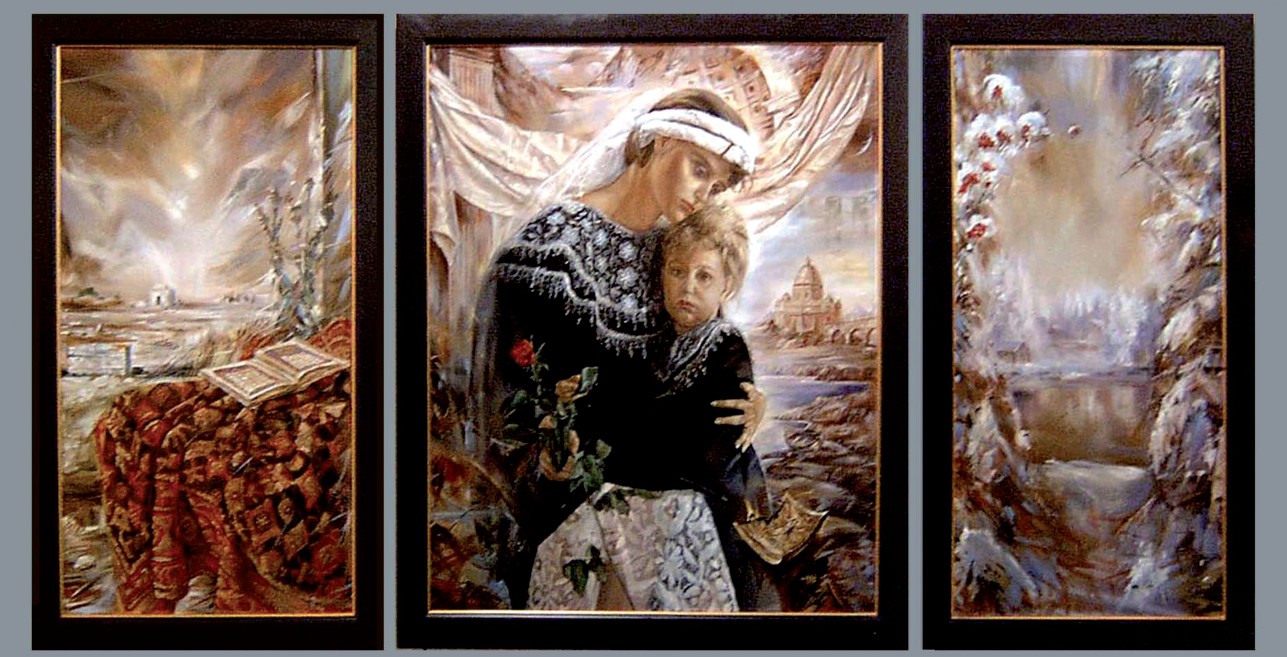
Although many people like my paintings - of course, it cannot but make me happy - I myself constantly experience a feeling of dissatisfaction. Take my painting 'Madonna of the XXI Century', which is a triptych.
It is admired by many people, and the famous Reinhold W?rth - billionaire, businessman, head of the Interdisciplinary Institute of Entrepreneurship at the University of Karlsruhe and chairman of the Supervisory Board of the Adolf W?rth GmbH - purchased it without a moment's hesitation.
It is, of course, a great compliment to me that my painting is among his collection of paintings by Emil Nolde, Ernst, Leger and Pablo Picasso. But I was not 100 percent satisfied with it and I did not consider it a masterpiece. I am not saying that out of false modesty.
- Have you ever had the sensation: "Yes, I am a genius!?"
- Like Pushkin after Eugene Onegin? Honestly speaking, it happens that I feel I am, if not genius, then something close to it, if I succeed in some part of a painting. But thus far, I cannot acknowledge to myself that I have created a masterpiece.
I was content with myself when, say, in Finland, instead of a long explanation to students, I showed visually how to paint a portrait. And I was very glad that they grasped what I wanted to transmit to them with the help of a brush.
- We finally come to the question about how it came about that you live and work in Finland and America.
- The fact is that during that first trip to Finland I met a girl who subsequently became my wife. She is a Finn, but at that time she was working on a contract in the USA, and I had to go with her. My status in that country then did not allow me to find a normal job, but I was lucky. I found a Russian gallery where they took paintings of artists if they thought that they would find a market. It came out that they had my paintings. And they signed a contract with me. Then I obtained a work visa and turned it into a green card, but soon after that I moved to Finland, as my family was already there.
There I had to start from scratch as a private exhibition is one thing, but permanent work is something else entirely. But gradually everything got underway: first, one gallery got interested in my paintings, then another, and today my paintings are in all the galleries there and the artist Cingiz Abassov is known.
Moreover, I was pleasantly surprised when the Finnish presidential administration invited me to a dinner party in honour of the arrival of Azerbaijan's President Ilham Aliyev in Finland in May 2008. I realised that they actually know me in this country; that the name of this Azerbaijani artist is known there.
- In October last year you came to Baku. What did you manage to do during your stay at your father's house?
- To create a series of paintings dedicated to Baku - how I feel it. Its colour, its vibration, its energy. Our city is multicoloured and many-sided. It is different. This is something at the level of sensation, intuition and perception as I feel and see the city.
Baku is a city of surprising energy. It sometimes seems to me that the city fathers who built it placed an enormous, strong magnet under it. Because it is impossible to leave Baku for a long time - it draws you back. During my next visit, I plan to complete a series of paintings about my native city.
- Do you have a certain programme for the near future?
- I want to create an Azerbaijani gallery in California. I am confident that this idea can be achieved successfully as our artists are highly professional.
Another question we need to consider is precisely how to introduce our art there. Unlike, say, in Finland, where demand is quite specific, in America the viewing public is less defined.
It is important to find that edge which would enable us to get a focus on our national art, and also to make it accessible to that public.
At the same time, in no circumstances should one lie to oneself in assessing the situation in their market.
But I am confident that this is possible. Moreover, my idea has been enthusiastically supported by Elin Suleymanov, Azerbaijani consul to Los Angeles.
- I noted that chance has played an important role in your life. Moreover, chance has been benevolent. How would you comment on that?
- Yes, I have also noticed that. But the main thing is to understand what chance wants to show you. There is always a choice to be made. God, whom I firmly believe in, gives us freedom of choice. And only we can do it, by ourselves.
- Well, thank you for the interesting conversation. And more happy chances to you!
RECOMMEND:
 618
618

