
KARABAKH CLAN IN TIME TROUBLE
Yerevan caught in the cross fire of foreign pressure and the threat of social unrest


Author: Oqtay ALIYEV, Head of the International Relations Department at Baku State University Sahil ISGANDAROV, political scientist Baku
The domestic political situation in Armenia is once more at boiling point. And if, on the one hand, this is due to the approaching parliamentary and presidential elections, on the other, it is the effect of the rapidly deteriorating socioeconomic situation. Armenia, sidelined from regional economic cooperation because of its aggressive policy towards its neighbours, is on the verge of a social explosion.
In 2010, poverty levels in Armenia rose considerably, according to official figures already reaching 34.1 per cent, or 1.1 million people. According to independent deputies, this figure greatly understates the reality. In search of their daily bread, whole villages are leaving Armenia. Even members of the Dashnaktsutyun Party (in particular L. Galstyan), which is part of the ruling coalition, accuse the government of promoting social unrest.
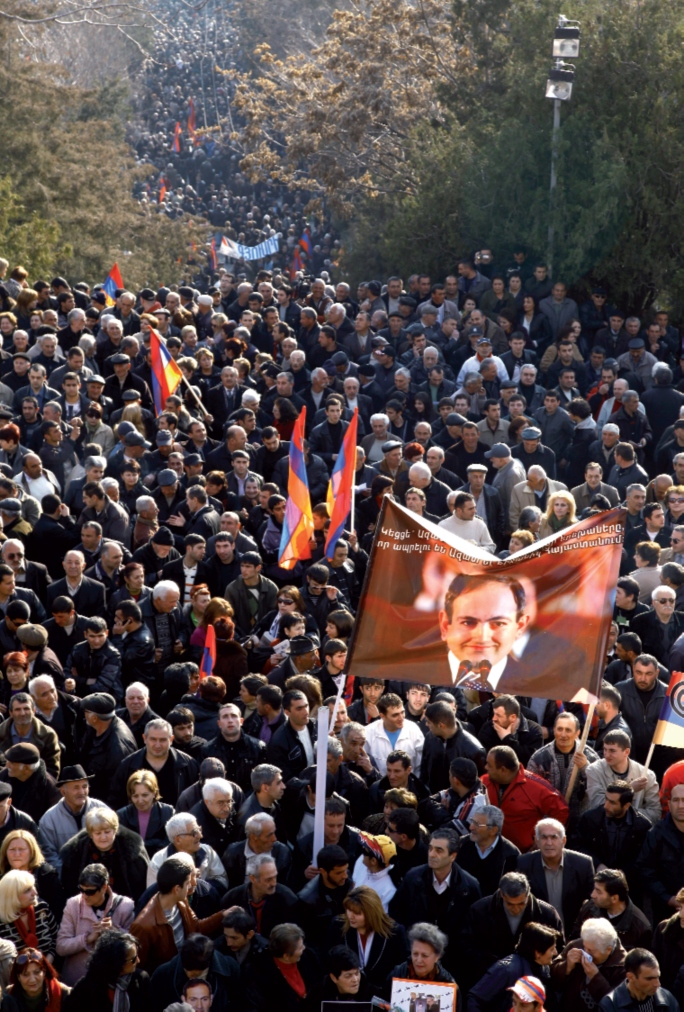
Protests growing in Armenian society with each passing day are fed by the ongoing criminal and mafia-like policies of the ruling Karabakh clan. It was no accident that this year's traditional opposition rally in Yerevan on 1 March was attended by over 50 thousand people. Several days later, a large protest was held by the parliamentary Heritage party.
March rallies in Yerevan became traditional following the presidential election of 2008 when the then Armenian President Robert Kocharyan managed to install as his successor, Serzh Sargsyan, via massive vote rigging. Protests by disaffected masses, led by ex-president Levon Ter-Petrosyan, were brutally suppressed by security forces using military hardware and firearms. Ten people were killed in the clashes, and more than 200 were arrested. Although the majority of those arrested were later released under pressure from the OSCE and PACE, more than 100 political figures and ordinary protesters were sentenced to long prison terms without any justification. Many lost their jobs and businesses. These egregious examples of lawlessness were mentioned in a recent open letter to the PACE co-rapporteur on Armenia, Axel Fischer, by the human rights activist, chairman of the Centre of Law and Freedom NGO and coordinator of the Committee for the Protection of Political Prisoners and the Oppressed, V. Arutyunyan, who urged PACE to abandon its double standards. It was this kind of approach that prompted Armenia's Parliamentary Speaker Hovik Abrahamyan to say, ahead of a meeting with PACE co-rapporteurs on Armenia: "I do not have to give anyone explanations on any issue, including on the issue of political prisoners. With regard to Armenia's commitments to the Council of Europe, they are not imposed on the Armenian authorities, but suggested. They have no right to demand anything from us."
But despite this show of bravado, the Armenian authorities plunged into panic. In this situation, even the ruling coalition's new memorandum, signed on the initiative of Serzh Sargsyan in February this year, cannot serve as a reliable tool for the Republican Party. In particular, the Dashnaktsutyun parliamentary faction expressed its outrage at the incident on the morning of 3 March this year in front of the Armenian government office, wondering who ordered the crackdown on protesters. A member of the ARF Dashnaktsutyun bureau, Hovhannisyan, advised the police not to pose as missionaries. Another pro-government party, the National Democratic Union of Armenia, also strongly condemned the police action against members of the Heritage faction, as well as other peaceful protesters. A member of the ruling Republican Party, Arutyunyan, although he stressed the unacceptability of ultimatums in any dialogue with the authorities, nevertheless acknowledged that the opposition has many just demands, and the Armenian authorities must first respond to issues raised by the opposition.
The focus is on a 15-point ultimatum presented to the Armenian authorities by Levon Ter-Petrosyan's Armenian National Congress (ANC). If most of the demands made in the ultimatum are met, the ANC expressed its readiness to open a practical dialogue with the authorities; on the agenda just one issue - the holding of early parliamentary and presidential elections in the coming months. At another ANC rally attended by 10,000 people on 17 March, the ex-president exchanged his tough rhetoric for a softer one, eliciting some sympathy from the authorities. The latter, for their part, did not interfere with the rally at Matenadaran on that day, and stated that this time Levon Ter-Petrosyan's speech was correct and that some of the ANC's demands had already been met. But there is no talk of parliamentary and presidential elections or the prime minister's resignation, while the ANC is bracing itself for another election. The government does not exclude the possibility that in the next parliamentary elections, the ANC might get a certain number of seats in the National Assembly of Armenia.
Levon Ter-Petrosyan's departure from categorical rhetoric at the last rally has been seen by some Armenian analysts as a step by a man with a public conscience. In their view, public sentiment is so radical and the socioeconomic atmosphere so tense today that the ANC is trying to take advantage of this and establish cooperation between society and the authorities while trying to hold back social unrest.
It should be noted that the response of international organizations and analysts to the political situation in Armenia was immediate. The head of the OSCE Office for Democratic Institutions and Human Rights (ODIHR), Ambassador Janez Lenarcic, said in a meeting in Yerevan that the OSCE/ODIHR had been following the events in Armenia closely. He expressed hope that the Armenian authorities would continue efforts towards reform.
According to Jacqueline Hale, representative of the Open Society Institute-Brussels, Armenia should seek to become a country meeting European Union criteria. She said the ongoing political reforms in Armenia were incomplete: "In Armenia, there is an unfavourable political situation, there are political prisoners and freedom of speech is restricted. In many cases, promises are made, but we do not see their implementation."
In addition, there were other warnings to the Armenian authorities. According to an EBRD report on the economic development of Armenia, submitted on 9 March in Yerevan by the bank's chief economist, Erik Berglof, "Armenia's economy has been recovering since the world economic crisis, but reforms are progressing slowly", and one of the reasons is the unstable domestic political situation. The right conclusions were not drawn from the crisis, which could become the basis for economic reforms, and in the days of crisis, "Armenia's economy finally burst like a bubble". Armenia is noted for the fact that the development of its economy was boosted by financial remittances and capital imports. "But during the crisis we saw that this model of development is very sensitive, which is why the crisis dealt the severest blow to Armenia," said the European Bank representative. According to him, political steps should be taken to implement and deepen reforms to give Armenia the opportunity to register a higher, more stable, economic growth. The bank encourages the Armenian authorities to pay special attention to combating corruption and to reform tax and customs administration. In addition to these problems, according to a survey conducted among Armenian businessmen and economists, improvements in the business environment are also hindered by the unstable political situation and the informal economy.
One of the most authoritative British analytical centres - Foreign Policy - also notes in its report that despite the progress registered (more often on paper rather than in reality) in some areas, reforms in Armenia are moving very slowly and this undermines people's hopes and aspirations. By studying developments in Armenian's domestic and foreign policies, from the struggle against corruption and the recent coalition memorandum to Turkish-Armenian reconciliation and settlement of the Nagornyy Karabakh problem, experts say in the report: "Despite the recent very important statements on reforms by Serzh Sargsyan, the policies of the ruling party do not inspire confidence in terms of their implementation. There is concern that the changes will be mostly cosmetic in nature in order to strengthen the positions of the government before the elections. To regain the trust of the people and the international community, Yerevan should primarily make significant changes to three key areas - the system of justice, freedom of speech and development of democracy."
Dissatisfaction with the actions of the Armenian authorities was also expressed by representatives of the Armenian diaspora. In particular, the Armenian Civil Society, a Los-Angeles-based association for the protection of human rights, spoke out against repression by the Armenian authorities, demanding an end to every kind of political persecution against members of the ANC and the Armenian citizens supporting it. And the Assembly of Armenians of Europe called on the Armenian authorities, the presidium of the National Assembly, the parliamentary and extra-parliamentary political parties and independent MPs to sober up by accepting the responsibility established on them by law, so that an attack on the position of a deputy of the National Assembly does not become a precedent. In analyzing political events in Armenia, we should not lose sight of the geopolitical interests of the world's major powers in the South Caucasus, including in Armenia.
Developments in Armenia are watched closely by the two opposite poles on the world's geopolitical map - Moscow and Washington. On 28 February, US Ambassador to Armenia Marie Jovanovich stressed the need for "deep and radical reform" to deepen democracy and enhance political dialogue in Armenia. The diplomat noted that representatives of civil society should work very actively and tackle the problems that exist in the country. And the government and other agencies should give consistent attention to solving existing problems. The economy cannot prosper when a monopoly on new ideas is in the hands of government officials, and the country will stagnate if "all power is in the hands of the government". The Armenian authorities did not like this rhetoric from Jovanovich.
Moscow, for its part, is putting pressure of another sort on Yerevan. According to the Armenian media, the Kremlin does not like Armenian Prime Minister Tigran Sarkisyan and requires Sargsyan to replace the head of government. The leadership of Gazprom said in early March that negotiations on the price of gas supplied to Armenia have not yet been completed. This is despite earlier statements that the price of gas to Armenia would remain unchanged.
Analysis shows that Yerevan's policy of "sucking two mares", which brings certain dividends, now boomerangs against Armenia. While in military and economic terms, Armenia is increasingly dependent on Russia, for the inflow of large financial aid, it depends on the West and the international Armenian diaspora successfully operating there. But the rival powers, who have long been ably played along by Armenia, are now pressing Yerevan to make a final choice. The Armenian authorities, running out of time and under cross pressure, are increasingly losing the ability to conduct an independent domestic and foreign policy.
This is why positive trends in Azerbaijani-Russian and Turkish-Russian relations plunge the Armenian political establishment into a state of prostration. Thus on 16 March, a protest was staged in Yerevan in front of the Russian embassy about the forthcoming visit of Turkish Prime Minister Recep Tayyip Erdogan to mark the 90th anniversary of the Treaty of Moscow.
Participants in the rally, who called the Treaty of Moscow a shame that has lasted 90 years, advised Russia "to fraternize with anyone they like, but not at the expense of the Armenians". They put their statement in a coffin which was placed in front of the diplomatic mission with the inscription "The mailbox of the embassy of the Russian Federation for the Russian-Turkish treaty".
Analyzing information about the Russian company Rosvertol selling 24 M-35M military helicopters to Azerbaijan, the Armenian military expert Ruben Mehrabyan said: "The sale of the helicopters is another indication of the fact that Armenia is not a strategic partner of Russia. Russia's allies are only its army and navy, as was the case under Alexander III and, in the 21st century, another is its own pocket. The disclosure of information about the transaction with the helicopters before the Medvedev-Sargsyan meeting in St Petersburg and the 5 March trilateral meeting in Sochi is a message sent by Russia to both countries of the region and the international community to show who is master of the situation in the region".
But a probably more serious and dangerous warning to Yerevan came from Leonid Reshetnikov, director of the Russian Institute for Strategic Studies (RISS), at a press conference in Rostov-on-Don ahead of the Sochi meeting between the presidents of Azerbaijan, Armenia and Russia: "We cannot assert with confidence that Armenia today is an immutable partner and ally of Russia in the South Caucasus. The economic, social and political situation has worsened in Armenia over the last few years. More than half the population, including many of the pro-Russian intelligentsia, have left the South Caucasus republic for Russia. And if ordinary people in Armenia are concerned about Russia's departure from the Caucasus, intellectuals and representatives of the state leadership living in the republic have a different reaction. The United States has become more active in Armenia. And it is no accident that the Americans have built 'the world's largest' embassy in Yerevan. This means that the CIA has established its regional residency there, and that is clear to everyone. Therefore, 300-400 officers, disguised as US diplomats and administrative and technical staff, are working there. The Americans' purpose is to knock out the only link undermining their efforts to establish a zone free of Russian influence in the Caucasus. US efforts to 'pacify' Armenia and Turkey also have this aim. Several years ago, I happened to talk to the people who head Armenia today. Even then, talking one to one, they said: the US is a powerful country, why are we focusing on Russia? We should side with the US ... I told one high-ranking figure: the US will not give you money to develop your country, they will give you a loan, for example, to develop the sewage system in Yerevan, which will be used by the senior leadership for personal enrichment. The Americans have never given anything, except for these targeted loans to buy off the leadership. I understood from my interlocutor's face that he agreed with the United States' line - he liked the idea that the Americans would give money to the leadership. The weakening of Russian positions in Armenia will become noticeable in the next one or two years". It is unlikely that Reshetnikov, a retired lieutenant-general of Russia's foreign intelligence service, was referring to unverified data, especially as he used an example from his own conversations with representatives of the Armenian authorities. Therefore, statements by the Armenian political scientist Aleksandr Arzumanyan that a kind of shuffling of political forces in the run-up to the parliamentary elections is now taking place in Armenia's domestic political arena and that Russia is indirectly involved in domestic political processes in Armenia and will work with any government there, are half true. But the whole truth is that all Armenia's problems - the difficult economic situation, political instability, population decline etc. - are mainly the product of its aggressive foreign policy towards its neighbours. And as long as this policy is not replaced by good-neighbourly relations, Armenia will be hostage to foreign injections and domestic political battles.
RECOMMEND:
 696
696