
JOY FOR TRUE THEATRE LOVERS
The "Silk Road Chekhov Festival" project made Baku a true theatre capital
Author: Narmina VALIYEVA Baku
The "Silk Road Chekhov Festival" project by the Chekhov International Theatre Festival, held in Baku from 12 to 30 November, transformed our city into a true capital of theatre. Over three weeks, the Samad Vurgun Russian Drama Theatre and the Youth Theatre showed "Aurelia's Oratorio" by Victoria Thierree-Chaplin, "Wedding" by Vladimir Pankov and "Rain" by the Canadian Cirque Eloize. All three plays were the fruit of hard work by different directors with different views of the world, creative manners and styles, who have one quality in common: talent and perfectionism. The Ministry of Culture and Tourism, the Theatre Union of Azerbaijan and Pro-Cent Productions brought this gift to theatre lovers. Let us note that this year the festival was dedicated to an exact date, the 150th anniversary of the birth of the great Russian writer and playwright, Anton Pavlovich Chekhov. Plays were staged in St Petersburg, Yekaterinburg, Chelyabinsk, Kazan, Yalta, Paris, Berlin, Madrid, Stockholm, Vienna, Chicago, Montreal, Sao Paolo, Rio de Janeiro and Minsk. And for every city, the International Confederation of Theatre Unions prepared a special programme of the best plays of past Chekhov Festivals. The festival was founded in 1992 and its main aim was to familiarise audiences with revolutionary ideas in the theatrical world. It is one of the world's most prestigious festivals. It is a member of so-called Great Club, together with the festivals in Avignon, Edinburgh, Berlin and Salzburg.
Aurelia's wonderland
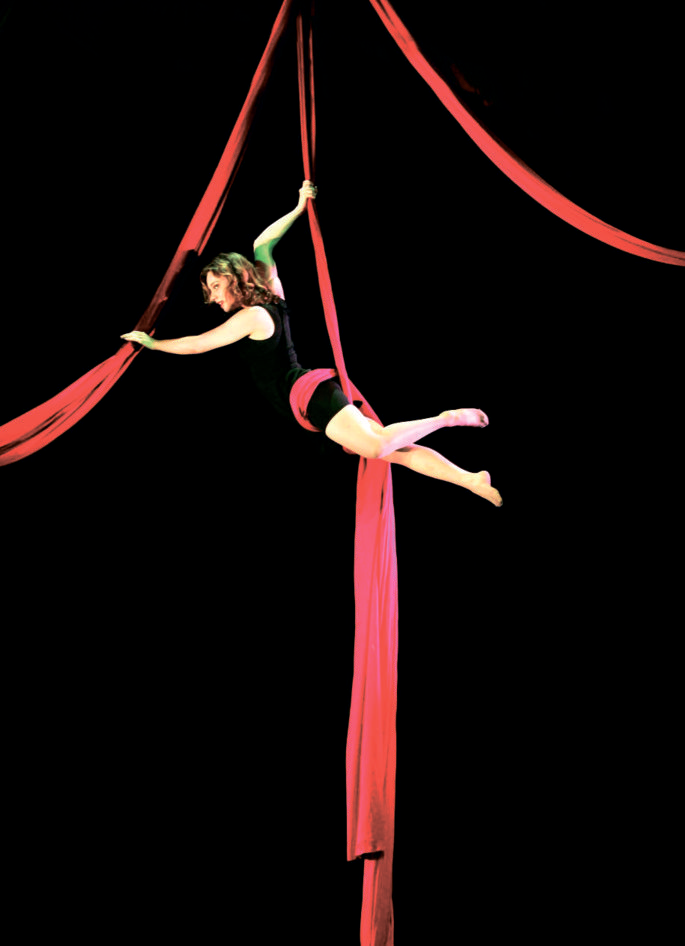
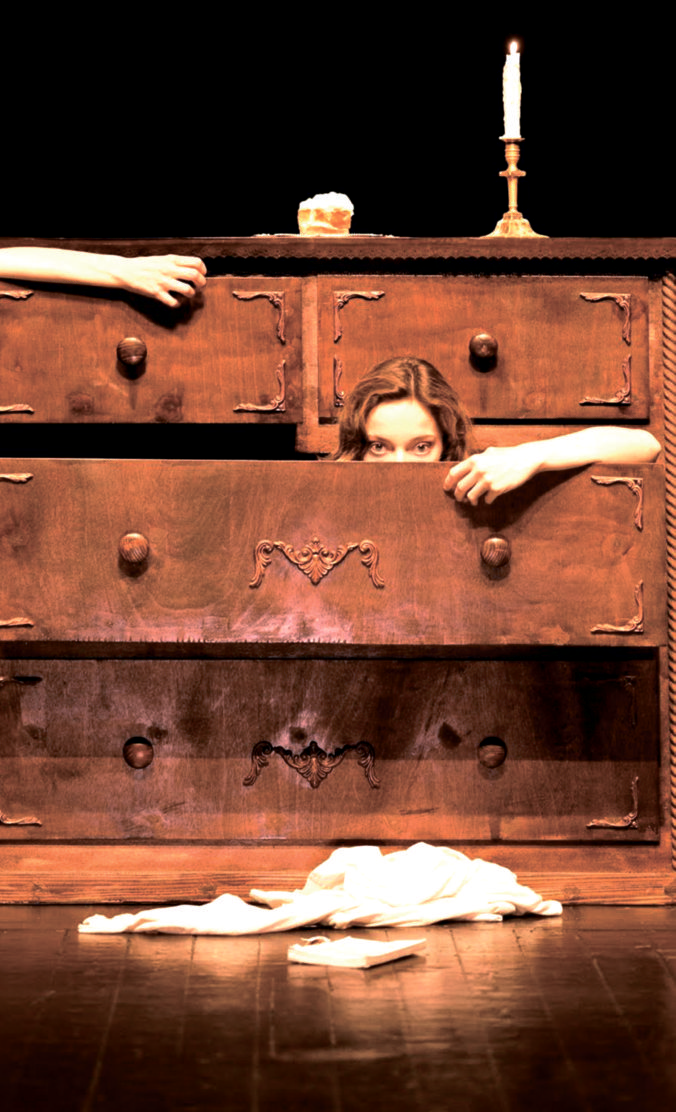
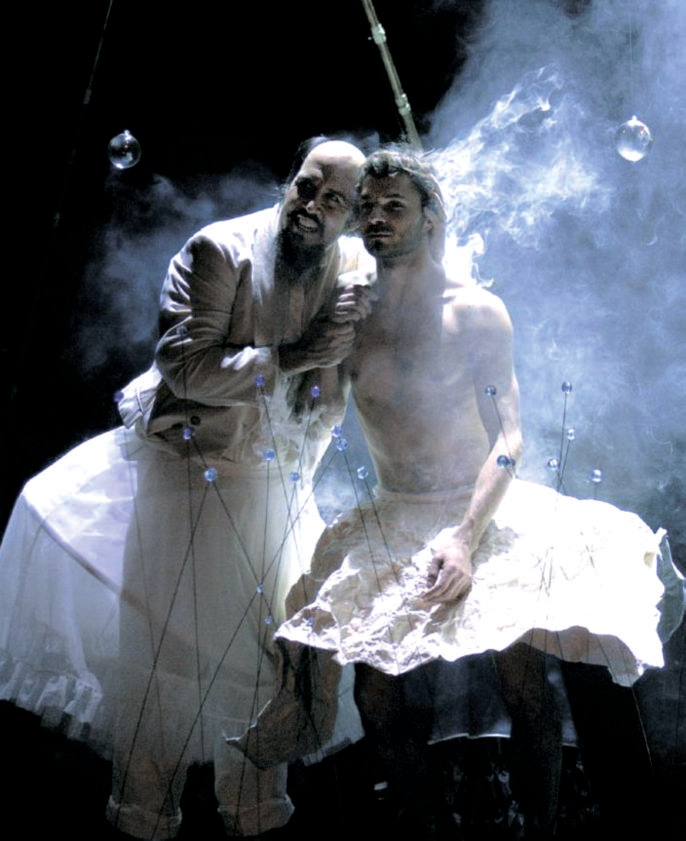
The festival opened with an unusual production, "Aurelia's Oratorio", staged by Victoria Thierree-Chaplin, the great actor's daughter, who wrote the play specifically for her daughter Aurelia. "Aurelia's Oratorio" is a fairy-tale story about the life of a wonderful girl who, in an attempt to learn about the world becomes its hostage. The title of the play is no accident: the play is both lyrical and dramatic. And at its centre, there is Aurelia, confused and always in search of something... Her speedy movements, agility and ability to disappear impressed all who watched the play. The scenery changed constantly. There were three colours: Scarlet, black and white. The red curtains become a huge see-saw. There was a particularly spectacular scene when Aurelia hung onto a red ribbon high above the stage and swung as if in a hammock. On the stage, the heroine rode upside down in a taxi and played a tune on large alarm clocks. This strange world of dreams in which Aurelia lives, is somewhat like Lewis Carroll's Alice in Wonderland. During the play, the protagonist runs away and her partner Jaime Martinez looks for her. And at the end, the audience saw a toy train pass through the heroine. A final whistle of the engine, followed by utter darkness...
Victoria and her husband Jean-Baptiste Thierree, promote the idea of individual circus. This "new circus" sparked debate after one of the Avignon festivals and, in the early 1970s, it was huge in France. Now both Jaime Martinez and Aurelia Thierree are widely known in the world of theatre. Jaime continues the circus style developed by his parents with his La Compagnie du Hanneton, working as both actor and director and Aurelia has become an inspiration for her own mother. Today, the new French circus makes use of all the traditional skills, from acrobatics to choreography and also of all the latest developments, like video, computer graphics and modern equipment. This is why Aurelia's Oratorio, which was brought to the International Chekhov Festival in 2009, was very well received by the Moscow audience. Bakuvians, too, gave this unusual and dynamic production its due.
Ah, this wedding...
The next play onstage in the festival received prolonged applause at the Youth Theatre. This time, the Baku audience saw "The Wedding" (based on the play of the same name by A.P. Chekhov) produced in the Soundrama genre by one of the most progressive Russian directors, Vladimir Pankov. This was a special project by the Yanka Kupala National Academic Theatre of Belarus and the International Confederation of Theatrical Unions.
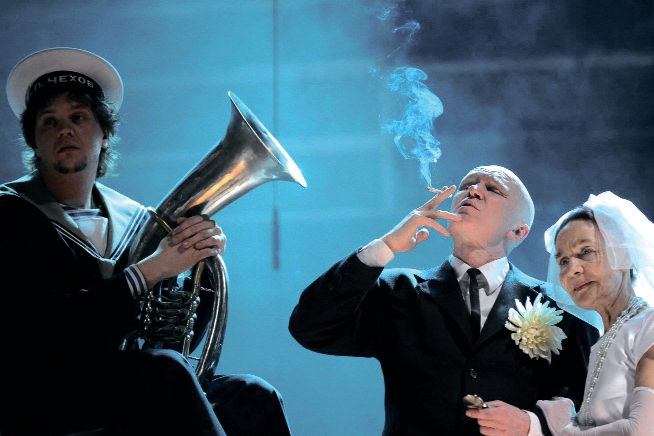
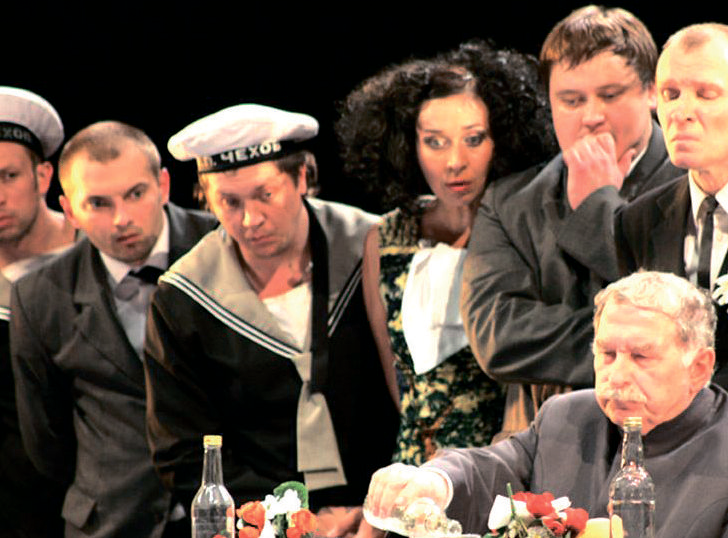
"The Wedding" is an attempt, or rather a novel method proposed by the director, to "discuss" serious issues with the audience, issues concerning personal morality, in the language of music, words and dance. What is Soundrama? It is a synthetic genre which combines word and sound. The "sound" here is not merely a clip of music. It includes song, words, shouts, knocks, noise, rustling - anything that can break silence. Soundrama is not a musical, rock opera or operetta. Sound is the dominant component, the most important part of the play, giving rise to the main idea and giving plays of this genre their unique hue. The text, on the other hand, becomes a musical instrument muting the musical accompaniment. Incidentally, the protagonists in "The Wedding" speak Russian and Belarusian. Pankov has combined the national and theatrical traditions of the two countries. In this production, the protagonist is a groom from the capital and his bride and her family are Belarusians. Hence the clash of mores, views and characters. By directorial decision, a different context is elaborated and reinforced in the well-known work by Chekhov, and vaudeville becomes a satirical depiction of modern customs. For about two hours, the audience watches dynamic scenes from an ordinary wedding, but presented using unusual, unorthodox theatrical methods. Vladimir Pankov said that after seeing the old Soviet screen adaptation of the play, filmed 50 years ago, he was so impressed that he decided to produce the play at all cost. But now a group of musicians in sailors' uniforms performs on the stage. The band features balalaika, accordion, fiddle and percussion. To the fore is a girl in a dress with full-length side vent playing cello. Stravinsky is suddenly followed by a pop song, Olesya, the funky tune is interrupted by cacophonic noise, and a terrible din reigns on the stage. Girls in war paint, also dressed in vented skirts, try to sing, dance or speak French. Then there is a protracted episode imitating slow motion. Everyone takes part in a pillow fight and feathers fly all over the stage. Theatrical convention reaches its peak when all the characters continuously pour vodka from empty bottles and drink it up, making loud swallowing sounds, and the general who is invited to the wedding part eats from his empty plate for a long time. The bride in white veils looks na?ve and innocent, and is somehow a perfect match for the retired general. Their departure during the finale is indeed a good solution. Otherwise it is inconceivable how the tension created by Pankov's talent could be defused.
Circus under the rain
The performance by the Canadian Cirque Eloize on the stage of the Samad Vurgun Russian Drama Theatre was the final chord of the A.P. Chekhov International Theatrical Festival. The unusual and magical performance, "Rain", was staged by the internationally acclaimed director, playwright, choreographer and clown, Daniele Finzi Pasca.
This performance has earned its creator numerous prestigious theatrical prizes and awards. Daniele Finzi Pasca, who is Swiss, created Teatro Sunil in 1986 and staged about 10 plays there, mixing the arts of theatre and circus, dance and music, tricks and clowning; he achieved success and international recognition. In the early 2000s, he was one of the most sought-after directors in the circus and theatre worlds, and the invitation from Cirque du Soleil to stage Corteo testifies to this.
All of Pasca's work is distinguished by an inimitable theatrical style, which organically combines circus and theatre, dance and music. The director says that in the traditional circus, the audience is offered a series of performances and a bit of choreography to connect performances. "Rain" is different. The circus actors work as theatre actors. They act and create dramatic tension. "Rain" has been played very successfully in New York, San Francisco, Paris, Rome, Milan and many other cities.
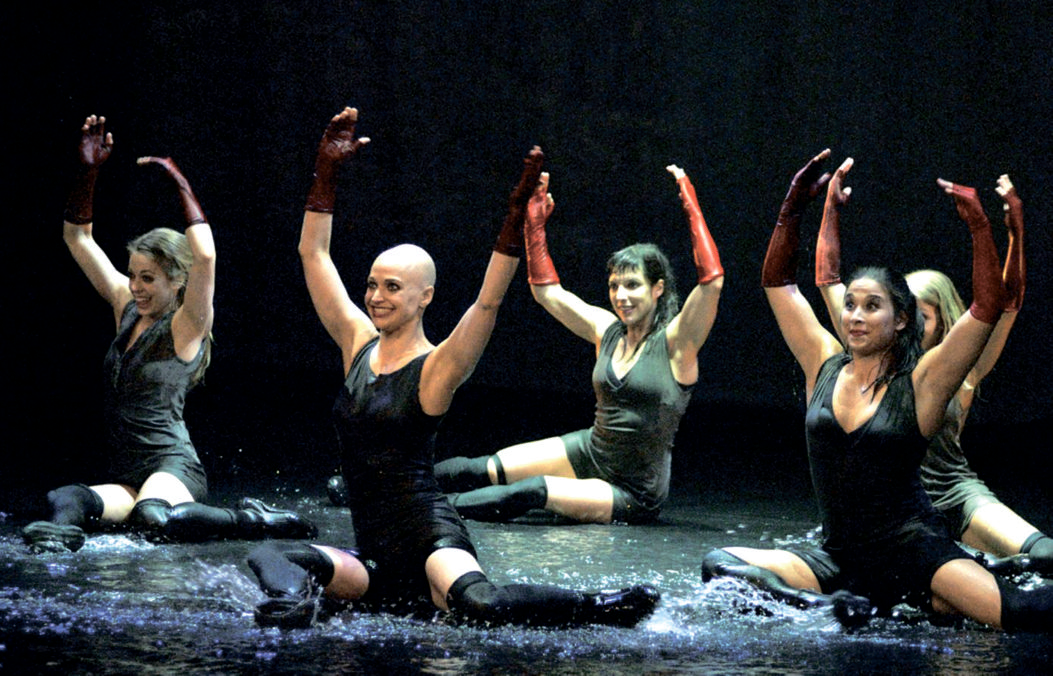
The acrobatic feats are not the most difficult (this was not the aim) but, in combination with music and voiceovers, which fit into the general picture (this is the theatrical part) create lasting impressions. All the components combine to create a specific mood and the director uses different tools, clipped phrases, real water, rain.
In "Rain," everything centres on the rain, its stream, like beads of childhood memories, adventures, allusions and associations. In the finale, a real shower descends on the actors, and they are happy. The production has all the qualities of top-quality circus - sophisticated acrobatics and high-class clowning. But it is also rich in fun and childish mischief. These actors do onstage what clowns usually do in the circus arena, where they awkwardly copy professional acrobatic feats. Trying to describe the plot of "Rain," which rests on childhood memories and associations, is impossible. There probably is no clear-cut plot. Every member of the audience "recollects" his own memories and moments of their past. But every memory is probably associated with warm summer rain, which washes away everything negative and dark in our life...
RECOMMEND:
 534
534