

AGAINST A BACKDROP OF GAUDY EMBELLISHMENT...
The diplomatic games around Tehran's nuclear programme - full speed ahead

Author: Eldar PASHAYEV Baku
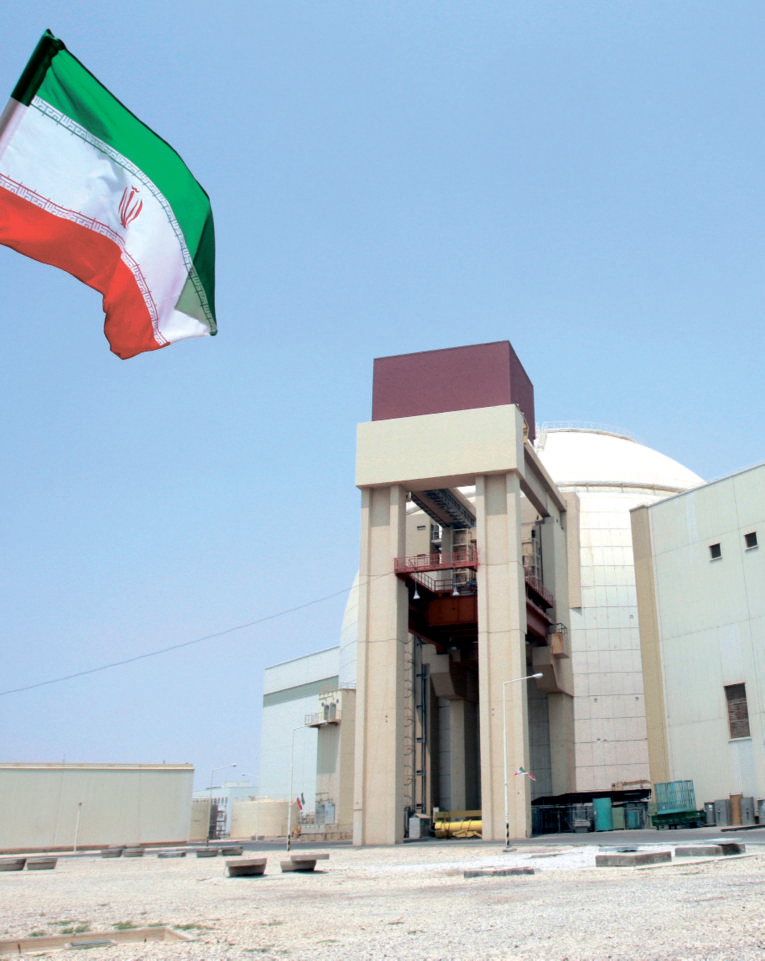
The launch of the nuclear power plant in Bushehr has made it possible to re-examine the roles played by Russia, Israel, the USA, Europe and Turkey in attempting to resolve the crisis over the Iranian nuclear programme.At the current stage, the Bushehr power plant is a litmus test of sorts which shows, in outline, how the situation with Tehran might unfold and how the "players" involved could interact.
On 21 August, the ceremony to inaugurate the reactor at the Bushehr nuclear power plant took place. The construction of the power plant was begun back in 1974 by the German concern Kraftwerk Union AG but, in 1980, the contract was cancelled because the German Government joined the US embargo on equipment supplies to Iran. A decade later, in the 1990s, Russian specialists resumed the construction project; a Russian-Iranian joint venture was created for this purpose.
Ali Akbar Salehi, Iranian vice president and head of Iran's Atomic Energy Organization, said that the launch of the power plant was a symbol of Iran's resolve to continue its "peaceful nuclear programme, despite all the pressure, difficulties and sanctions imposed by Western countries." Salehi also said that Tehran was not going to enrich uranium by more than 20%.
However, the problem is that no one has believed statements from Iranian officials for a long time now: the international community still believes that the Islamic republic wants to create a nuclear bomb.
And the Bushehr plant only worsens these suspicions. For example, The Christian Science Monitor cited assessments of a number of experts who believe that when the reactor reaches its full capacity, Iran will be able to accumulate sufficient spent fuel within a year or a year and a half to create a nuclear weapon.
It is thought that "poor monitoring of nuclear materials in Russia" might assist here. It is also noted that even if this does not happen, "the process of operating the reactor will give Iran additional know-how which it could use later for military purposes."
Other specialists, however, say that reactors of the type used in Bushehr cannot be used for practical production of weapon-grade fissile materials.
So, different experts voice such diametrically opposed opinions in their assessments of the Bushehr plant's potential to develop weapons of mass destruction as if it was not a facility designed by scientists, but a novel or a film about which there can be a great many points of view. Which, of course, makes one think about who benefits from all this talk and how.
It is not surprising that the most critical response to the launch of the Bushehr plant came from Israel , which said it was "absolutely unacceptable" and at the same time urged the international community to put pressure on Tehran. "It is absolutely unacceptable that countries which so grossly violate a resolution of the UN Security Council, IAEA recommendations and their own obligations under the non-proliferation treaty can enjoy the benefits of using nuclear energy," said Israeli Foreign Ministry spokesman Yossi Levi.
A number of Western politicians also voiced their concerns about the Bushehr nuclear power plant. Former US envoy to the UN John Bolton was particularly blunt and said in an interview with the Fox Business Network that Israel had to bomb the station before it was launched and before the fuel was loaded because, after that, bombing would be impossible, as an explosion in a working reactor would inevitably result in radioactive contamination. Bolton said that Iran would have "what no other enemy of Israel and the United States has in the Near East - an operational nuclear reactor," and that Ahmadinejad "has almost achieved what Saddam Hussein in Iraq and Bashar Asad in Syria never managed to accomplish, and is on his way to creating a nuclear weapon."
At the same time, the West is suspicious about the position of Moscow which, as the mass media there write, "supports sanctions against Tehran" on the one hand, and on the other "is building a nuclear power plant for Iran". In particular, Bolton said that Russia, guided by its desire to put a spoke in America's wheel, continues to play a destructive role, acting against both sides to the conflict. And Le Monde writes that for Moscow, the launch of the Bushehr plant is an opportunity to demonstrate to Tehran that Russia remains its faithful ally. So, Russia has managed to both vote for international sanctions against Iran and maintain good relations with it and has won for itself a better position than the other members of the six negotiators, effectively acting as key player.
Furthermore, Russia is sure that it has thus clearly consolidated its position in the international arena by demonstrating that it has great influence on Iran and in the Near East in general.
Criticism of Moscow was also stoked by the fact that the Iranian authorities expressed their profound gratitude to Russia for the plant. Iranian Foreign Ministry press secretary Ramin Mehmanparast said that the word Russia is now written in golden letters in the history of Iran. At the same time, chairman of the National Security and Foreign Policy Commission of the Iranian Parliament, Hosein Ebrahimi, noted that the Russia's release of nuclear fuel for the Bushehr power plant testifies that Russia is essentially opposed to the UN Security Council's sanctions against Iran. Russia's move annuls all the anti-Iran resolutions and sanctions, Ebrahimi said.
In the mean time, the Russian Foreign Ministry has reassured the international community that the Bushehr plant will not be a violation of the non-proliferation regime. Russian Nuclear Agency Head Sergey Kiriyenko said that there is no possibility whatsoever of using the Iranian power plant for non-peaceful purposes. "No professional in the world has any question about the potential for non-peaceful use of the Bushehr power plant. It is absolutely clear that there has never been such potential, and there is none at present," said Kiriyenko, adding that the Bushehr nuclear power plant has never been subject to any restrictions and that the UN Security Council excluded it from all international sanctions. Moscow says that the plant was built in conformity with all the requirements of international law and under the control of IAEA inspectors. Russia specifically stresses the fact that it offered a guarantee to supply nuclear fuel to the power plant and remove the spent nuclear fuel from Iran.
In addition, the Russian Foreign Ministry insists that the Bushehr project shows how Tehran could benefit from cooperation with the international community if it proves that its nuclear programme is of a civilian nature.
It is notable that the United States issued quite calm and reserved statements on the launch of the Bushehr plant. The German periodical Handelsblatt writes that "US State Secretary Hillary Clinton was trying until the last moment to dissuade Moscow from supplying uranium to Iran," but in the end the US State Department's official position was that the "launch of the Bushehr plant does not mean that the threat of proliferation of nuclear weapons by Iran has increased." Furthermore, State Department spokesman Mark Toner stressed that "Russia's support for Bushehr indicates once again that Iran does not seek to develop its own enrichment facility, if its intentions are entirely peaceful." Toner also noted that the Russian-Iranian agreement on the Bushehr power plant is in tune with the West's efforts to supply Tehran with nuclear fuel in return for Iran's suspension of its uranium enrichment programme. A number of German politicians, the periodical adds, also believe that Russian nuclear fuel supplies are the best way out because it is dangerous to leave Iran under no control whatsoever on this issue and the Russian supplies will leave no argument for those forces in Iran which strive to achieve domestic enrichment of uranium.
Literally on the eve of the launch of the Bushehr plant, The New York Times wrote that the Obama administration managed to persuade Israel that Iran would be able to create a nuclear weapon only in a year's time, although Israeli intelligence believes that Tehran only needs a few months to achieve this. US estimates are said to be based on the last year's intelligence and reports from international inspectors. US Administration representatives say that the new information from Washington made a preventive strike against Iran by Israel less likely in the near future. Americans are presumably sure that the international inspectors will be able to detect when Iran is close to a final breakthrough a few weeks in advance and thereby give the USA and Israel enough time to consider military action.
However, it is alarming that discussions on a possible strong-arm solution to the crisis over the Iranian nuclear programme do not subside. And many experts argue that the likelihood of a strike is increasing. In August, US Joint Chiefs of Staff Chairman Michael Mullen said that the US Administration has never abandoned the option of using US military forces against Iran.
In this situation, Iran rushed to demonstrate its military might, as is its custom: It "successfully tested" a new unmanned aerial bomber, surface-to-sea and surface-to-surface missiles, submarines capable of operating in the shallow Persian Gulf and so on. Rumours about a mysterious Iranian military space programme have also started to circulate more intensively: some experts seem certain that it might help Iran develop missiles with nuclear warheads. Things went so far that Ahmadinejad even began to speak about the country needing to be ready to deliver "preventive strikes" against those who pose a threat to it.
However, many military experts believe that Iran is engaging successfully in military PR and mystification. In reality, the Iranian military-industrial complex does not have the capability of creating anything fundamentally new, and all these innovations are simply different modifications of the old Shahab-2 missile.
In the mean time, Iranian officials say that any attempt to attack Iran would be suicidal for the attacker. There is a grain of truth in this, not because Iran is so strong militarily, but because an attack might result in unpredictable consequences. The current tense situation in the Near East could explode like a powder keg from any stray spark.
That is why the Iranian problem cannot be viewed in isolation; instead, it has to be considered in the context of regional developments. For example, the current state of the Arab-Israeli conflict is important.
Turkey's ambitions in the Near East, its recent strained relations with Israel and US displeasure with Ankara's policy on Iran on the one hand and Israel on the other, should also not be ignored. At the same time, the Americans have withdrawn their combat units from Iraq, and Iran is quite capable of putting pressure on Iraqi Shiites to promote its own interests. In this light, the incident on the Israel-Lebanon border, which demonstrated that Hezbollah is clearly growing stronger and that the positions of Iran, Syria and Lebanon are closer than before, also seems important. In the event of a military strike against Iran, Tehran is likely to retaliate, and various extremist and radical organizations in the region, such as Hezbollah and Hamas, would probably support it.
At the same time, it has to be remembered, when analyzing Iran's military potential, that the relatively recent presidential election in Iran escalated into major disorders and that Ahmadinejad has many opponents inside the country. It is also obvious that relations between Ahmadinejad, who spoke about his interest in talks with the West (and personally with Barack Obama) last autumn, and supreme leader Ali Khamenei, who rejected the idea of the talks until sanctions are lifted, are not that smooth.
Further, the UN Security Council's sanctions and the sanctions by the USA and a number of European countries are bound to affect the country's economy and Iranian standards of living, no matter how hard Tehran tries to pretend that it is unaffected. That is why Ahmadinejad and his supporters badly need a foreign enemy in the form of the West to distract people's attention from their problems.
So, it is obvious that on Iran, the tactic of the US-led West is currently to increase pressure on Tehran in all areas. And, most probably, the rumours that the USA dissuaded Israel from bombing Iran just one day before "H hour" is also part of this strategy. After all, it is downright ridiculous to think that Israel would carry out a large-scale operation without US assent. The White House is keeping its eye on the domestic situation in Iran too. Naturally, the weaker Ahmadinejad's position and the less confident he is, the more Tehran will demonstrate "successful" missiles and bombers to the world. This is a proven and widely known tactic.
And of course, the West is irked that, by helping to launch the nuclear power plant, Russia has effectively demonstrated that Iran is not alone. On the other hand, Washington's calm reaction makes it possible to suggest that Russia and the USA reached agreement on this issue in advance. And therefore, the diplomatic game around the Iranian nuclear programme proceeds at full speed, and the talk of a military scenario can be considered, at least for now, as nothing more than a gaudy embellishment of the game.
RECOMMEND:
 593
593