

DIFFERENCE BETWEEN THE VASSAL AND THE PARTNER
Yerevan cannot prevent the regional balance of forces changing in Azerbaijan’s favour

Author: Rasim MUSABAYOV, political expert Baku
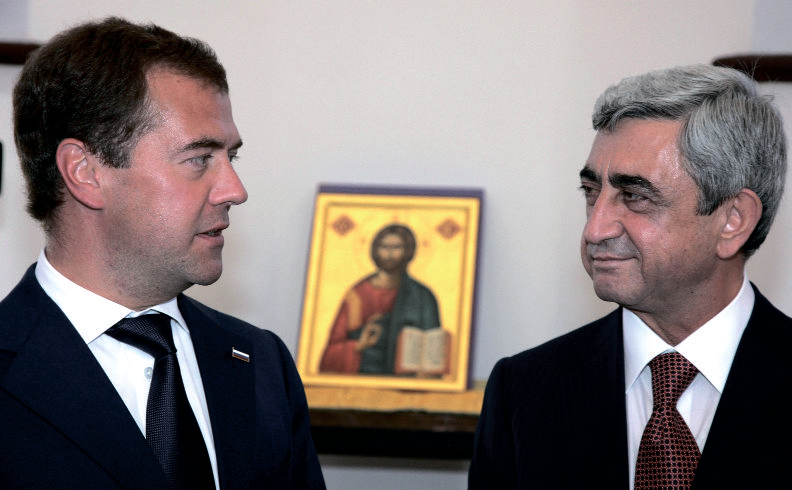
In the second half of August, the attention of local and foreign analysts was attracted by the visits of Turkish President Abdullah Gul to Azerbaijan and the President of Russia, Dmitriy Medvedev, to Armenia. One should not think that they were deliberately synchronized, but it turned out that antagonistic Armenia and Azerbaijan almost simultaneously conducted a "synchronization of watches" with influential players of the region's geopolitical arena.
The visit of Dmitriy Medvedev, although it was planned to coincide with an informal summit of the Collective Security Treaty Organization, CSTO, in Yerevan, was treated as the highest level state visit; with a special festive reception and hospitality events. This was probably to disguise the absence of any valid potential for the development and deepening of Russian-Armenian relations. After all, Armenia, owing to its policy of territorial claims and enmity against Azerbaijan and Turkey, has driven itself into a geopolitical and transport dead-end. Its economy is insignificant. It is enough to say that on income to the budget, all this country's exports amount to approximately 1bn dollars. For comparison, it is thus between 1/15th and 1/30th of the figure for Azerbaijan.
Everything that had some value in the Armenian economy was handed over to Russia to meet debts a long time ago. The political and the military spheres in Armenia are also closely supervised by Moscow. Although the agreements signed in Yerevan looked impressive, the benefit to Armenia is rather doubtful. So the visit of President Dmitriy Medvedev, which has been acclaimed as a demonstration of Russian support, was more likely necessary to strengthen Serzh Sargsyan's shaky hold on power.
Even from the television pictures, it was possible to see a distinct difference between the mutual relations of the two partnerships: Azerbaijan-Turkey and Armenia-Russia. The servile behaviour of Serzh Sargsyan was traced in his every gesture and word. Contrary to the diplomatic protocol accepted all over the world, he personally went to the airport to meet Dmitriy Medvedev. During his speeches, Serzh Sargsyan was profuse in his expressions of gratitude, his voice vibrated with excitement, and the fawning smile never slipped. There was the impression that it was not a visit by the head of one sovereign state to another sovereign state, but that the true vassal and "outpost" was receiving his overlord, defender and supporter.
Against such a background, the visit of Turkish President Abdullah Gul to Baku was quite a contrast. In the behaviour between him and Azerbaijani leader Ilham Aliyev there wasn't the slightest hint of "patron-subordinate" relations; even claims to seniority by either of the fraternal states were not apparent. Relations between Azerbaijan and Turkey have long since acquired the nature of an equal partnership based on ethnic, religious and cultural common ground, bearing in mind also the political and economic interests of each. Military, political and energy issues comprised the main content of both visits and agreements signed, but the difference in positions and potential of Armenia and Azerbaijan were clearly visible here.
At first sight, the contract signed in Yerevan to prolong the deployment of the 102nd Russian military base in Gyumri, is important. But it doesn't actually increase the Russian military presence in the region and doesn't change the existing balance of forces.
The new agreement only fixes and prolongs Armenia's vassal dependence on Moscow until 2044. The positions registered in it: on protection of interests, of both the Russian Federation and Armenia; on Russian security guarantees, with regard to possible threats on all sides of Armenia's borders and on supplying the Armenian army with weapons and special equipment, will change nothing in reality. After all, this agreement neither increases the number of soldiers, nor quantity of military hardware at the 102nd military base.
It is simply difficult to do this under existing conditions as, after the war in 2008, Georgia has closed its borders with Russia and Azerbaijan and Turkey have not let anything cross their territories to Armenia. For Russian-Armenian military transit, there remains one, rather long and unreliable way across the Caspian Sea and then through Iran, under the sanctions regime.
Let us note the fact that, contrary to Armenian verbiage about joint development with the Russian Federation of its own military-industrial complex, that is out of the question and it is only mentioned to create repair centres for military hardware.
One more detail is of interest. Earlier the Armenians had only asked for protection from Turkey; supposing they would cope with Azerbaijan themselves. Armenian military figures and politicians bragged from TV screens and the pages of newspapers that in the event of a renewal of hostilities, they would seize Barda, Ganca and reach Baku with a victorious march. However, they now begin to realize that they are not strong enough alone to resist Azerbaijan. This became apparent at a press conference of the presidents in Yerevan when journalists tried to squeeze a promise from Dmitriy Medvedev to support Armenia if military hostilities resume in Karabakh.
To a direct question on how Russia would behave in such a case, Dmitriy Medvedev said diplomatically that he would try not to allow a new war. On support for Armenia, he spoke only hypothetically, and then only as an ally in the Collective Security Treaty Organization. That is to say, Medvedev didn't guarantee support in the context of the contract on the military base in Gyumri and bilateral allied obligations of Russia to Yerevan. However, in view of the unwillingness of most of the members of the Collective Treaty Security Organization to become involved in ethnic conflicts, it is not realistic to rely on that organization. As for this case, it is a question of aggression by Armenia - a member of the CSTO - against neighbouring Azerbaijan; and not only Central Asian members of the CSTO, even Belarus doesn't agree with Armenia's territorial claims.
I should recall that, the year before last, when the General Assembly of the United Nations considered the resolution "On the situation in the occupied territories of Azerbaijan", no-one except Russia voted in favour of Armenia, and even Uzbekistan supported us. Incidentally, the president of that country, Islam Karimov, ignored the informal summit of the CSTO and did not arrive in Yerevan.
It is not surprising that the agreement itself on prolonging the term of the Russian military base in Armenia is viewed negatively by many. Many Armenian politicians and analysts, especially opposition-minded forces, condemned or recognized it as unprofitable, untimely, unequal and "colonial".
To recap, one can quote a statement by the director of the Armenian Centre for National and International Research, Richard Kirakosyan: "…Yerevan couldn't achieve respect from Moscow, which treats it as a vassal, not as an equal partner."
In an interview with the Zhamanak newspaper, he said: "Eventually, it is the only military base the Russian Federation has outside its borders for which all expenses are borne by the receiving party. For example, even Kyrgyzstan receives millions of dollars from Moscow for the presence of the Russian military base on its territory. To gratify Armenia's desire for military security, Russia offers Armenia a colonizer's approach: in contrast to the presence of its military bases on Armenian territory, it makes some dim and vague promises of help and assistance."
The worldwide reaction to the signing of the agreement on prolonging the term and expanding the functions of the 102nd base in Gyumri can be described as indifferent and negative. Taking into account its tense relations with Moscow, Tbilisi saw in it a threat to itself, said Georgian expert on security issues, Irakliy Sesiashvili. As he added, "prolonging the location in Armenia of the Russian base until 2044 further strengthens a new geopolitical reality in the region which contains certain threats for Georgia".
Washington and Brussels officially ignored the event, but well-known American expert on post-Soviet countries, Ariel Cohen, reacted sharply and critically in the influential Washington Times, commenting on Moscow's action as an exclusion of the USA from the Southern Caucasus. An interactive poll on popular Russian-speaking TV channel RTVI, which broadcasts mainly to an audience outside Russia, showed that 70 per cent of those polled see a threat to the interests of the USA in the military bases stationed by Moscow on the territories of the former Soviet republics.
Azerbaijan's reaction was restrained. "During the withdrawal of the Russian military bases from Akhalkalaki and Batumi (Georgia), Russia has assumed an obligation that weapons transferred to the 102nd Russian military base in Gyumri won't be used against Azerbaijan under any circumstances. We hope that the Russian side will further adhere to the obligations assumed on non-use of the resources and weapons of the Russian 102nd military base located in Armenia against Azerbaijan," Elxan Poluxov, spokesman for the Azerbaijani Foreign Ministry, told the Trend news agency.
However, the agreement has obviously emboldened Serzh Sargsyan who, under the pretext of gratitude to the Russian president has, in essence, publicly rejected the Madrid Principles in the form that they were officially offered a year ago at the Council of the Foreign Ministers of the OSCE in Athens and which have been sabotaged by Yerevan since then. He said literally the following: "I would like to once again express gratitude to Russia, and personally to Dmitriy Anatolyevich Medvedev, for that weighty contribution and positive role which he plays in the resolution of this (Karabakh) problem. Thanks to your efforts, a number of important tripartite meetings of the heads of Russia, Armenia and Azerbaijan have taken place. I want to confirm once again that we are ready to search constructively for a solution to the problem on the basis of your offers made during the tripartite meeting in St Petersburg".
Some words about the agreement according to which Russian atomic scientists undertake to construct a new block at the nuclear power station in Armenia. Actually, it is rather more a protocol on the parties' intentions than a contract. After all, in spite of the fact that Moscow is ready to incur 20 percent of the funding of the project, one cannot talk about starting to build the new block unless the question of where to raise the rest of the funds is resolved. It is known that the project cost is estimated at 5bn dollars. This is almost equal to the total volume of foreign investment in Armenia for the whole period of its independence.
It is doubtful that Russian banks, which do not undertake the funding of similar projects even within their own country, will give money for a nuclear power station in Armenia. Considering that Rosatom, the Russian nuclear agency, will build it, and also due to Armenia's extremely low credit rating, one cannot count on western financial institutions for this project. The possibility of attracting Georgia to share a holding in the project (which was raised earlier) is also ruled out because of the tension between Moscow and Tbilisi. We should also add that the delivery of large-sized equipment for the nuclear power station to Armenia across the closed Russian-Georgian border still remains an unresolved problem. Thus, as well as with the prolonging of the deployment of the military base in Gyumri, Moscow has simply staked out behind the building of the nuclear power station in Armenia and has blocked the possibility of Yerevan turning its eyes towards French or German atomic scientists.
Unlike the Armenian-Russian agreements, the documents signed during the visit by Turkish President Abdullah Gul to Baku, aren't presented to the general public. This indirectly implies that the Azerbaijan-Turkish agreements contain concrete obligations, calculated on practical results rather than their propaganda effect.
"The contract on strategic partnership and mutual assistance" also assumes a military component, including deliveries of arms, the training of officers and joint development of a modern military-industrial complex. The volume of military expenses, solid investment by Baku over recent years in its own military-industrial complex, makes Azerbaijan-Turkish cooperation in the military-technical sphere not only topical, but also mutually advantageous.
Noting that Turkey is a parliamentary republic and questions of an economic nature are the prerogative of the government, the parties restricted themselves to just an exchange of opinions on these questions. Moreover, during the recent visit of President Ilham Aliyev to Turkey, agreements on delivery volumes of Azerbaijani gas, its price and transit tariffs were reached on the transportation of hydrocarbons on to European markets. As President Abdullah Gul said at the reception in his honour: "We have together realized large-scale projects. Those who called them a myth at the time and said that they were impracticable, today view with admiration how these projects connect two countries. The oil and gas pipelines in the energy section, the railway in the transport sphere - we are already connecting Naxcivan to Igdir - all these are large-scale projects. The Baku-Tbilisi-Kars railway will not only connect three countries, but also Central Asia and China to England".
The uncertain response by the Turkish president in Baku to a journalist's question about the possible opening of the Armenian-Turkish border for a short period in connection with NATO drills in Armenia, caused anxiety. But the particulars would create more nervousness in Armenia - an outpost of Russia - than in Azerbaijan. After all, it is a question about NATO, under whose flag there are western troops, including Turkish. There is no basis to assume that even if the Armenian-Turkish border is opened for some days, it will remain so in the future in violation of pledges by Turkish leaders. As the head of the public and political department of the Presidential Administration of Azerbaijan, Ali Hasanov, said in a comment on the situation, "opening Turkey's border with occupying Armenia meets neither the interests of Turkey, nor Azerbaijan - it will only untie the hands of the occupying regime."
"We have brought this position to Turkish officials' notice, and both Prime Minister Recep Tayyip Erdogan and President Abdullah Gul have repeatedly said that unless Armenia comes to a constructive position on the resolution of the Nagornyy Karabakh problem, the border between the two countries won't be opened. We trust Turkey's officials and consider that until all the conditions put forward are secured, the border between Armenia and Turkey won't be opened," Ali Hasanov said.
In conclusion, we should say that Yerevan's flirting with the power centre of the region and even of the world, no matter how high and mighty the Armenians acted, is unable to prevent the regional balance of forces steadily changing in Azerbaijan's favour. Although the roles played by Russia and Turkey in the region are certainly significant, the sides in the Armenian-Azerbaijani conflict should solve the conflict themselves, without relying especially on their strategic allies.
RECOMMEND:
 624
624

