

CONVERTING FANTASIES INTO REALITY
Modern architectural solutions are not only extraordinarily beautiful but economically profitable...
Author: Natali ALEKSANDROVA Baku
The construction boom we have witnessed for more than 10 years caused the most controversial evaluations from its first steps. Rosy forecasts in analytical articles were replaced by quite depressing ones. For the sake of fairness, we should note that all these reports reflected the mood of not only people-in-the-street, but also specialists who were really concerned about the problem of total change in the appearance of Baku. Interestingly, among architects, builders and designers there are still diametrically opposed views: someone criticizes everyone and everything, someone else supports innovations in the architectural appearance of the capital, drawing attention to "some errors", while others are just working on positive changes.
Our interviewee, an architect and member of the Union of Designers, Nizami Qasimzada, has repeatedly said that criticism of the current development of the capital is unfounded. The man with a creative view and approach to life in general and architecture in particular has acted wisely since the very beginning of his work in this area: he just works, focusing his attention not on the negative perception of reality, but on creativity which he initially perceived through the prism of love for his homeland and loyalty to national traditions, respecting the experience of modern architecture. Apparently, this approach to work enabled Nizami Qasimzada to draft a bridge over the Baku bay and, for example, install a logo for AF-holding, visible only from space, at the dawn of the construction boom 15 years ago.
- Judging by projects, you have plenty of experience in construction and architecture...
- My own experience in life confirmed the well-known truth that there are no accidents: in any event you can always see a chance. I graduated from the Azimzada art school and entered the Art Academy, where I unexpectedly started taking an interest in design. There was no such profession in Baku at the time, although there was already demand for designers. I turned out to be in the right place at the right time.
Starting with interior design projects, I was surprised to find out that this job was to my liking, and most importantly, customers liked my work. Thus, in parallel with practice, studying the theory of design and architecture, I realized that I found myself and worked in this direction. However, time set its own priorities: the early 1990s were not the easiest period for our country, and in order to survive, I had to do business in an entirely different field for five years. But I did not leave my favourite job: in my free time, I continued to develop projects my imagination painted, because I could not do without it. As a result, when the construction boom began to gain momentum in 1998, I had something to offer construction companies. For the sake of fairness, I must admit that it was easier for me because there was no serious competition at that time. Time was working for me, but I also tried not to stand still, constantly working on myself and improving my professionalism. During all this time, I had joint projects with several companies. But I have been working much longer with AF-holding, which, as we know, has carried out nearly 20 major construction projects so far.
- It turns out that before the construction boom, you also developed the draft of the bridge over the Baku bay, which provoked such a mixed reaction?
- The idea of the bridge was proposed by me in 1993, but then my project was not taken seriously, and many considered it an outright fantasy devoid of meaning. Today they acknowledge that the bridge is a cost-effective facility that will divert more than 50 per cent of car traffic from Neftcilar Avenue and will actually close the Baku ring road. This will certainly contribute to the development of tourism in Azerbaijan. In addition, the bridge will connect both ends of the National Park-Boulevard, which, as you know, will be expanded along the entire length of the coastal zone.
Of course, the project implemented by the Korean company is slightly different from the original - time has made its own corrections, but in general, my idea has been embodied. And it is very good.
- And what exactly would you change in the project?
- The total length of the highway is about 13 kilometres. However, the length of the structure itself - the bridge - will be 5 km. The original project did not have artificial granite embankments, an idea which I developed recently. First, this project is of benefit from a purely visual point of view: the embankments mimic the "image" of the Baku bay, creating similar mini-backwaters on the ends of the bridge. Second, the length of the embankments (about 2 km) will make it possible to build hotels, yacht clubs and other facilities important for the development of tourism on both sides of the bridge.
In addition, my project proposes installing water purifying filters along the entire length of the bridge, which will make it possible to completely clean the water in the Baku bay in a certain period of time. In my opinion, the expansion of the National Park should start with the clearance of the bay.
- But there was a suggestion that the bridge should pass through the Isle of Nargin?
- There were such suggestions, but I have repeatedly said that they were illogical and short-sighted. After all, Nargin is a mystery island which will attract tourists with its inaccessibility, mystery, fresh air and beauty. There should not be a single car there! Agree that in this context, the idea of a road across the island would destroy the idea of a mysterious island in the Caspian Sea.
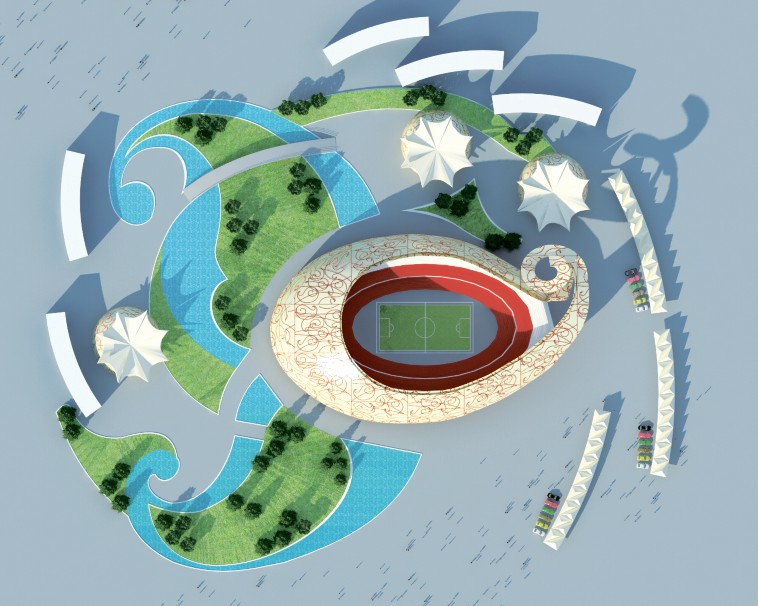
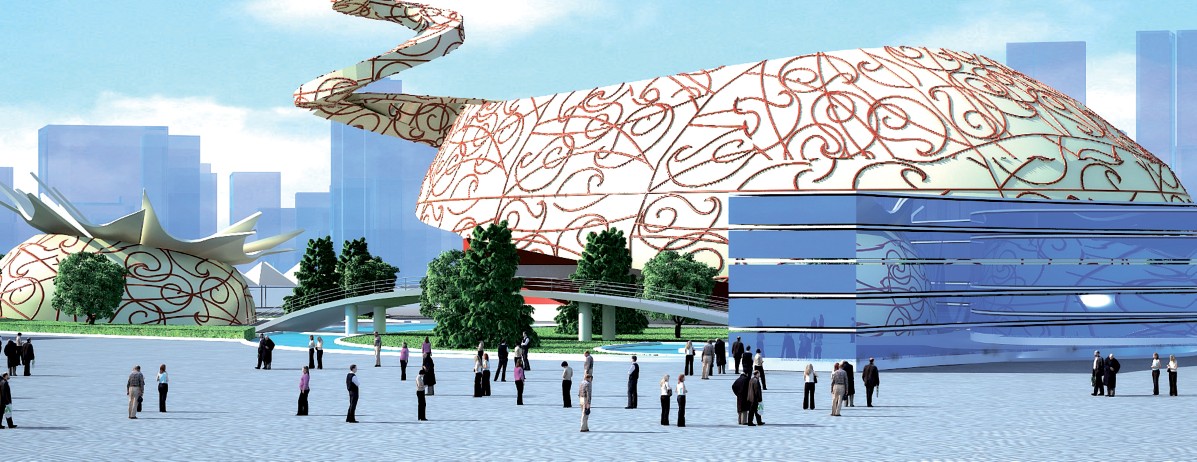
- We agree. So, you are a romantic, and this is proven by one of your projects: a stadium in the form of the national ornament Buta. As far as we know, the history of our architecture has not seen anything like this?
- The history of our architecture has not seen such unusual projects, but they do exist in the world. A creative person always finds it difficult to tell how he gets his ideas. Sometimes it happens very suddenly. There are some associations and fantasies that you convert into reality, at times altering them in the process of working on the project.
I got the idea of the Buta stadium when my son Fikrat and I went to a football match at the Tofiq Bahramov stadium. Everyone knows that this facility was built during the Soviet period and from a bird's eye view it resembles the letter "C" because it was the time of Stalin's personality cult. When I got home, I started to draw a draft of the new stadium, which was supposed, according to my idea, to combine all the modern features of a sports facility and have our own national flavour. Unexpectedly for myself, I realized that I was drawing our national pattern Buta on paper... I developed an idea of creating an entire sports complex, which includes a stadium in the shape of the national pattern, and several infrastructure facilities. It turned out to be interesting. In addition, from a technological point of view, the project is a novelty: an open stadium requires the protection of spectators at the stadium from the wind, rain and sunlight.
- When can we expect the project to be implemented and where do you see its construction?
- The project is currently in the process of approval. It can be implemented in several places - near the airport, where there are still a number of unused areas near the sea, in the 20th section or in the new White City which is under construction at the moment. The special feature of the project is that the pattern can be seen only from above, the building itself looks fairly modern, so the complex should fit into surrounding architecture. Most likely it will look advantageously in the new modern town which is envisaged by the general plan of Baku. I am convinced that such a stadium fits into the plans of the country's leadership to develop both construction and tourism in Azerbaijan, because it will definitely attract the attention of tourists.
- This is not the first time that you have proposed something that can only be seen from above in your projects. How come you were so far-sighted a few years ago, when few people used the "search engine", a programme which is so popular today?
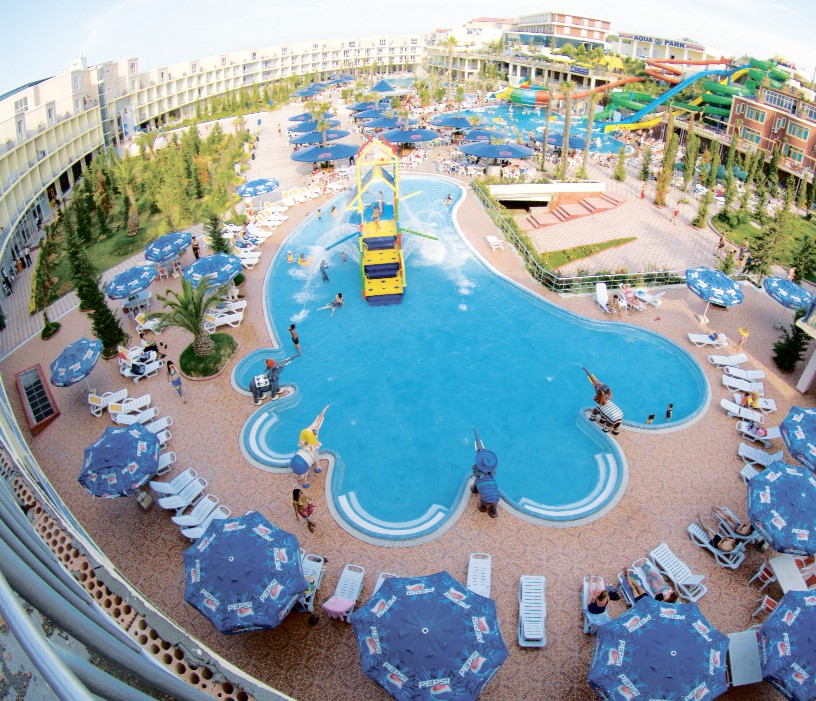
- I have already said that the experience of an architect and designer also evolves from what he can see. I have travelled a lot and from each trip, I tried to bring not only experience but also ideas. A few years ago, AF-holding implemented its first major project - "Water Park" in Novxani. Our common goal was to revive the traditions of family vacations in the country. I am proud that as a result of collaborative work, we managed to implement a project that so many of our fellow citizens needed. I wanted the whole world to know about us, and so I made a logo for AF-holding which everyone can see from space via the Internet. A few years ago, it seemed strange to many, but today my idea has been recognized as quite reasonable. It is the same with the Buta complex - it would be wonderful if our national pattern could be seen from space!
RECOMMEND:
 790
790

