

COURT AS JUDGE
UN fails to end the dispute over Kosovo
Author: Eldar PASAYEV Baku
The UN's highest court has confirmed that Kosovo's unilateral declaration of independence on 17 February 2008 did not break international law, international treaties or Security Council resolutions, including Resolution No 1244. On the contrary, the court has indicated that the Security Council resolutions were documents envisaging the need to determine Kosovo's final status and they created the conditions for the declaration. The decision to apply to the highest court was made by the UN General Assembly, following a Serbian initiative on 8 October 2008. Had the decision gone in its favour, Belgrade intended to re-table the issue of Kosovo's status at the UN General Assembly and, possibly, resume talks. Now, however, it is less likely to do so. At the same time, although the United Nations' highest court is the main UN judicial body, its decisions are not binding and are only of a consultative nature. Thus the Kosovo dispute is far from over.
Kosovo's statehood has been recognized by 69 of the 192 UN member-states. Serbia proper, as well as Russia, China, India, Azerbaijan, Spain, Brazil, Belarus and a number of other countries, believe that Kosovo's declaration of independence runs counter to international law, saying that Kosovo has no right to self-determination because it had always been part of Serbia, not a separate republic or colony.
Kosovo had been under the administration of the UN and the KFOR NATO-led international peacekeeping force from summer 1999, in line with UN Security Council Resolution No 1244, which confirms the territorial integrity of Yugoslavia (currently Serbia) and stipulates the need for a final decision on Kosovo's status. However, Albanian authorities in Kosovo unilaterally declared independence from Serbia; they were supported by the USA and a number of EU countries,.
Meanwhile, according to certain politicians and experts, the court's decision on Kosovo is remarkable because this is the first time that the separation of a province from a UN member-state has been legitimized. The issue of separatism is relevant to many parts of the world, including Europe proper… According to Serbian Foreign Minister Vuk Yeremic, "if the UN court supports Kosovo, no border in the region or the world" will be secure because "the most important principle for any democratic government in the world is the protection of its sovereignty and territorial integrity."
As expected, the court's decision has caused noticeable excitement in Armenia. For example, Deputy Foreign Minister Shavarsh Kocharyan described it as an "unprecedented event". The minister told Armenian Public Television that "when there is self-determination, territorial integrity is of secondary importance, and this what the Hague court decision says."
Of course, if Armenian politicians are so inspired by the Kosovo example that they refer to it in the talks over Upper Qarabag, this may seriously complicate the already complex negotiating process. Thus much will depend on the OSCE Minsk Group co-chairmen, who will now have to thwart Yerevan's attempts to liken Qarabag to Kosovo. In fact, this holds true not only for Upper Qarabag but also for Catalonia and the Basque Country, whose separatist parties have also acclaimed the Hague tribunal's verdict.
Baku has issued a reserved and constructive response to the jubilation of Armenian separatists. "The consultative opinion of the UN court applies only to the Kosovo issue. The Kosovo conflict, as with any other conflict, is unique and there is no common way to resolve them all," said Azerbaijani Foreign Ministry spokesman Elxan Poluxov.
According to Poluxov, settlement of the Armenian-Azerbaijani conflict over Upper Qarabag is ongoing within the framework of the OSCE Minsk Group, and Azerbaijan is continuing talks in this format.
At the same time, the Foreign Ministry spokesman stressed that Azerbaijan continues to recognize Serbia's territorial integrity and intends to adhere to this position in the future.
The fact that the Kosovo issue is "unique" and that "its settlement does not set a precedent for other regions or states" was confirmed by the US Assistant Secretary of State for Europe and Eurasia, Philip Gordon. We recall that during the NATO PA workshop Rose Rote in Yerevan, the French co-chairman of the OSCE Minsk Group, Bernard Fassier, also said that "there are no parallels between Upper Qarabag and Kosovo" and that "unlike Kosovo, not a single country has recognized Upper Qarabag, therefore, Kosovo cannot serve as a precedent."
Fassier also explained other differences between the Kosovo and the Upper Qarabag conflicts. "The Kosovo conflict is a domestic one, while Upper Qarabag is a conflict between two states - Armenia and Azerbaijan. There was an international force in Kosovo for many years, while in Upper Qarabag there wasn't."
It is worth noting, according to lragir.am, that rallies in support of the UN court's decision have been cancelled in the break-away Upper Qarabag region of Azerbaijan. This is first of all linked to possible differences between the "prime minister" and "president" of Qarabag and, secondly, fears that the rallies could produce a negative attitude towards the Madrid principles on which Yerevan has to continue the talks…
Meanwhile, Russia's position on the Kosovo issue is quite interesting. "It is important that the court provided an assessment only of the declaration proper and made a proviso that it had not considered Kosovo's right to unilaterally secede from Serbia in a broader sense. Neither did the court comment on the implications of this document, namely whether Kosovo is an independent state and whether its recognition by a number of countries is legitimate. Our position not to recognise Kosovo's independence remains unchanged," says the official statement from the Russian Foreign Ministry.
Moscow is convinced that the Kosovo problem should be resolved only by continuation of talks based on UN Security Council Resolution No 1244, which, as the court has emphasized, continues to represent the universally recognized international legal framework for resolving the problem. Speaking about the fact that international law does not regulate declarations of independence, a Russian Foreign Ministry official indicated that the UN Security Council had described the declarations by Northern Cyprus and Rhodesia as illegitimate, because only former colonies and people under foreign occupation have the right to self-determination.
The vice-speaker of Russia's Federation Council, Aleksandr Torshin, believes that the UN court's decision to legitimize the unilateral declaration of independence by Kosovo sets a dangerous precedent and that "the UN court has no moral right to deal with such issues". Torshin also pointed to the "legal cynicism" of the court which, according to him, consists mainly of states which have already recognized Kosovo.
At the same time, Russia says that the Hague tribunal's decision on Kosovo will enable the international community to have another look at the sovereignty of South Ossetia and Abkhazia. For instance, the chairman of the Federation Council's committee for defence and security, Viktor Ozerov, has said that "the court decision is further evidence in favour of the sovereignty of South Ossetia and Abkhazia" because "they have no less grounds for separation from Georgia than Kosovo did from Serbia".
"If Kosovo is full of foreign troops, why point a finger at Russia which has stationed its bases in Abkhazia and South Ossetia?" Torshin asked.
As for the world media's reaction to the Hague tribunal decision, El Pais writes that Madrid was awaiting a "more balanced verdict, which would describe secession as illegitimate from a formal standpoint but, de-facto, open up the road to independence".
"The independence Pristina declared two years ago is not illegitimate because it does not contradict Resolution No 1244 of the UN Security Council, which, however, recognizes Serbia's sovereignty over the southern province. This is tantamount to saying that if you capture a part of my house, you can keep it because it 'doesn't contradict the rules of a condominium'," La Stampa writes.
"The UN court's decision does not touch upon the main point - the recognition of Kosovo by other countries. A legal method has been tried, but a durable political decision is required to resolve the problem," The Independent writes. "Might is right. If a part of your state wants to secede from you and is supported by America or Russia, its independence will be recognized," writes The Guardian.
So what next? The answer to this question is quite simple: everything will stay the way it was. Countries supporting the independence of the Serbian province and those who view it as a breach of international law are unlikely to change their minds. Therefore, as mentioned earlier, the Kosovo dispute is far from over and the Balkans are still a potentially unstable region.
Serbian President Boris Tadic said, even before the verdict, that his country was ready for any turn of developments and that Belgrade "will never, directly or indirectly, recognize Kosovo". And so Serbian politicians and public figures will now have to think about what to do next. Many of them are sure that the most important task is to prevent a division of opinion on Kosovo.
Against this backdrop, some observers say that pressure on Serbia may now increase, especially as far as its desire to join the EU is concerned. US Vice-President Jo Biden has called Boris Tadic to advise that he embark on "constructive work towards resolving practical issues with Kosovo, raising living standards in the region".
EU representatives are also saying that Brussels is ready to help Serbia and Kosovo strengthen their positions on the question of joining the bloc. The authorities of Kosovo are unlikely to receive anything more than moral satisfaction from what they call a "major victory". At the same time, there is still quite a strong possibility of violence flaring up in Mitrovica and other regions in the north of Kosovo populated largely by Serbs and not subordinate to Pristina. It wasn't by chance that UN Secretary General Ban Ki-moon warned the parties involved against provocations. The "prime minister" of Kosovo, Hashim Thaci, said for his part that the "Kosovo authorities will remain open to a resumption of good-neighbourly relations with all countries in the region, including Serbia", but that Pristina "will not tolerate the questioning of constitutional order or the territorial integrity of Kosovo". Of course, the reference is to the northern parts of the province, with authorities elected in line with Serbian legislation and financed by Belgrade. The "government" of Kosovo has tried, with the help of western specialists, to develop a special programme to integrate these regions, but it has not had any effect.
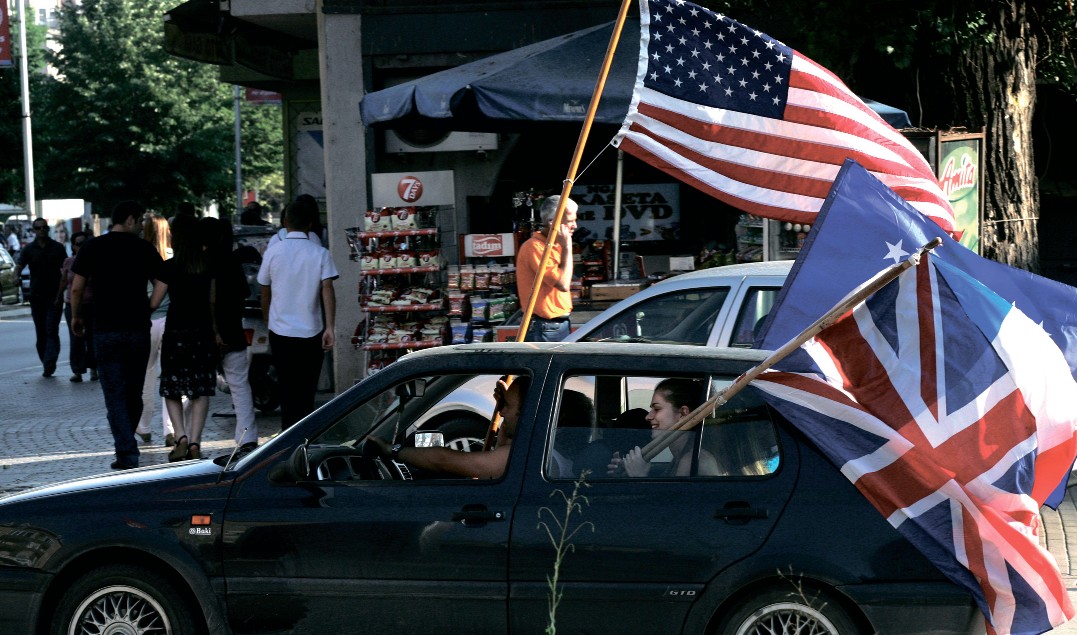
However, Kosovo enjoys serious US support. Hashim Thaci has recently visited the United States, obtaining assurances of the "irreversibility of Kosovo's independence" and promises of support for Pristina's application to the EU and NATO. The Kosovo authorities are so confident that they intend to apply for UN membership next year. According to Kosovo "foreign minister", Sk?nder Hyseni, Pristina will send appeals to 121 countries seeking recognition of its independence…
RECOMMEND:
 770
770

