
THE "EQUIDISTANCE" STRATEGY
The US policy on Nagorno-Karabakh issue must be more decisive

Author: Rasim MUSABAYOV, political analyst Baku
The main political event in June was US Secretary of State Hillary Clinton's tour to Poland and four post-Soviet countries: Ukraine, Azerbaijan, Armenia and Georgia. In 1992, James Baker, then head of the US foreign political department, was on a similar tour to define the US position on the dissolution of the USSR and independence of the former Soviet republics. Although the current situation is entirely different, Hillary Clinton's visit nonetheless attracted close attention, both in the region and internationally.
The point is that, after the change of White House administration, the process of reassessing US foreign political priorities has been dragged out excessively. It is clear that the situation in Iraq and Afghanistan and the problem with the Iranian nuclear programme has riveted the attention of President Barack Obama's administration and presidential advisors. This is why, when Washington talked of "resetting" relations with Moscow, the Eastern European and South Caucasus countries felt "forgotten" and began to voice their disappointment. Secretary of State Hillary Clinton's visit was intended to demonstrate the US's unswerving interest in and attention to these countries. Ariel Cohen, prominent US analyst, said that "after a year and a half of criticism that the Obama administration is forgetful of the US's friends in the post-Soviet area, the White house has finally deployed first Defense Secretary Gates to Azerbaijan and then Hillary Clinton to Ukraine and the Caucasus."
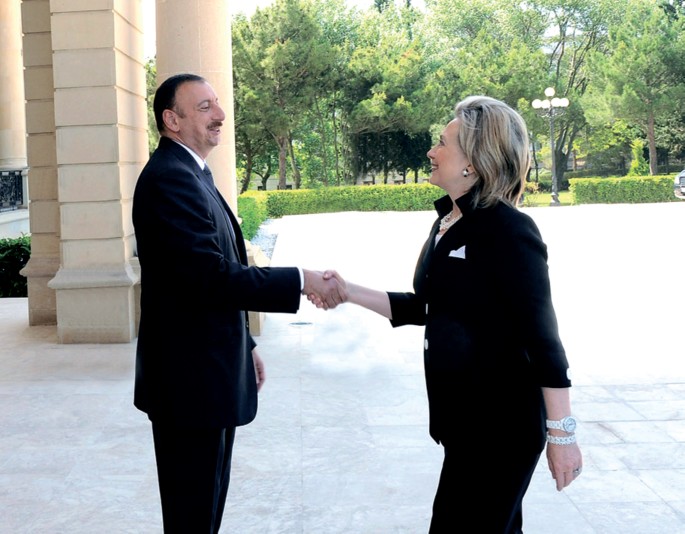
The US Secretary of State's visit to Azerbaijan, like, incidentally, her visits to all other countries during her diplomatic tour, turned out to be fast-paced but busy. Hillary Clinton was received by President Ilham Aliyev, held talks with her opposite number Elmar Mammadyarov, visited the Martyrs' Alley memorial complex, met with youth leaders and held a short press conference.
It is obvious that the most important aspects of Clinton's visit remain hidden by the veil drawn over talks held behind closed doors. Publicly, however, the sides expressed their satisfaction with the resumption of a US-Azerbaijani dialogue and shared their expectations.
"We attach great importance to your visit. I am certain that it will further strengthen our partnership. The scope of our bilateral relations is very broad. Our successful cooperation in different spheres has a great history. I would like to note once again that your visit will further strengthen our partnership, and this is very important for the region. Relations between the United States and Azerbaijan developed very successfully after we regained independence. We cooperate closely in the economic sphere, take part in peacekeeping operations and work together on combating terrorism. Energy security is permanently on our agenda. Naturally, the USA is one of the co-chairs of the OSCE Minsk Group and cooperates closely with us and other states on the regulation of the Nagorno-Karabakh conflict. This conflict is the greatest problem for us and the main threat to regional security. As you know, our land has been under occupation for a long time. The UN Security Council, OSCE, European Parliament, Council of Europe, Islamic Conference Organization - all these organizations have adopted different resolutions describing the situation and demanding that the Armenian forces be withdrawn from territories which are internationally recognized as Azerbaijani. We want to regulate the conflict within the framework of international law and want to get it resolved as soon as possible because our people are suffering from this," Ilham Aliyev said in welcoming the high-level guest.
"I am leaving Baku with great impressions from what I have seen. This is a dynamic city at the crossroads of Eurasia. And the ties between the USA and Azerbaijan are profound, important and strong," Hillary Clinton said. She particularly stressed that US and Azerbaijani soldiers stood shoulder-to-shoulder in Kosovo, Iraq and Afghanistan: "We value highly the commitment and sacrifice of the Azerbaijani people and government in implementing these pressing tasks. Today, the president and I discussed how we can deepen this partnership. We share a profound interest in the sovereignty of nations, security and prosperity in the region and, at the same time, work on global problems, such as the struggle against violent extremism and the provision of sufficient energy resources without damaging the environment."
Speaking about the most painful and important issue for Azerbaijan, the Nagorno-Karabakh conflict, the US Secretary of State said that the "Minsk group is working on its settlement."
"The United States continues its support for a peaceful settlement on the basis of the Helsinki principle of the non-employment of force or threats of use of force, territorial integrity and equality and self-determination for peoples. President Obama confirmed this in a joint statement with the presidents of Russia and France at a recent G8 summit. And I stressed this in our discussion today. We are ready to provide assistance to both Armenia and Azerbaijan in the achievement and implementation of a sustainable peaceful solution," said the US Secretary of State, adding that the final steps toward peace are the most difficult.
"We believe that peace is possible and vital. And it is the prerequisite for creating a safe and prosperous future for both countries. The people of Azerbaijan and the entire region deserve to live in peace and security to realize their God-given potential. The USA cannot resolve the conflicts in the region, but we can be a partner and support and defend a settlement," Clinton stressed.
At the concluding press-conference, the head of the US foreign policy department said that in the process of regulating the Karabakh conflict, great activity had been noted last year and progress was achieved. Clinton also noted that the time had come to address the problem.
Answering journalists' questions, the Secretary of State also said that questions of democracy are always on the agenda. However, democracy is tradition and history. In the USA, the democratic tradition is more than 230 years old and Azerbaijan is a young state. "Nonetheless, the country has made great progress in the field of democracy, created good conditions for business and the country has achieved good economic indicators," she said.
As for the notorious amendment 907 by Congress, she said the following: "As you know, presidents have constantly ignored its limitations and attempted to revoke it. Personally, I would like to cancel that amendment, but this lies within Congress's competence. And until Congress revokes it fully, we will keep suspending it for Azerbaijan as we move ahead."
The agenda of the Secretary of State's visit to Baku was not limited solely to the problems of Karabakh regulation. It is quite evident that Afghanistan and Iran-related issues occupied an important part of the talks. As for Azerbaijan itself, Hillary Clinton highlighted three priorities during her meeting with representatives of youth organizations. Ceyhun Osmanli, chairman of the Irali youth movement, talked to 1news.az about this. In addition to the Karabakh conflict, Secretary Clinton drew attention to Azerbaijan's security, which has economic, energy and political aspects. "There are states in the world which still cannot reconcile themselves to the fact that Azerbaijan is independent, which is why we must support Azerbaijan in terms of security," said the Secretary of State. The third priority, in Clinton's opinion, is the need to develop human capital: "We can see the development of human potential as a matter of evolution. People must develop to adopt democratic values."
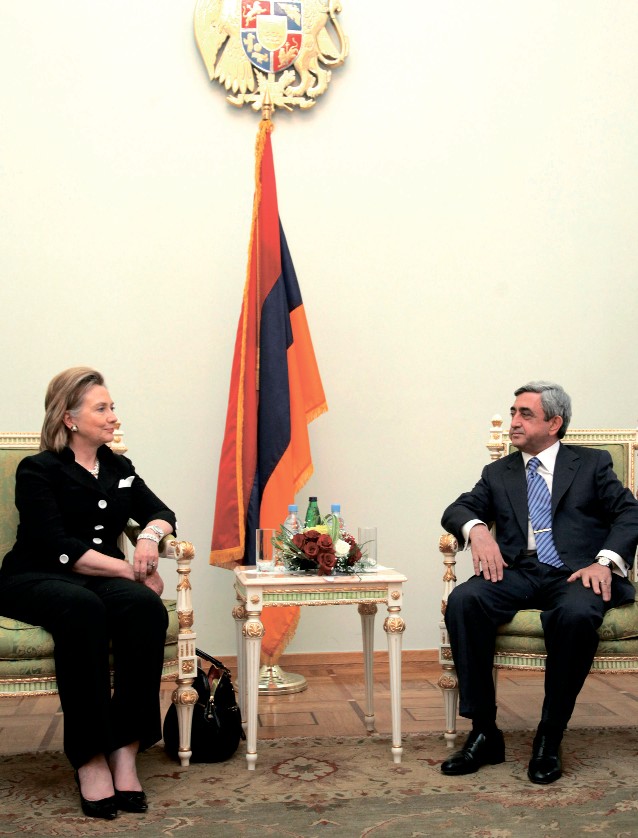
So, it can be said that the United States intends to strengthen its role in the region and intensify work on Karabakh regulation, although Hillary Clinton's visit and her words left an impression of excessive diplomacy. This is particularly noticeable when considering the US Secretary of State's statements in Baku, Yerevan, and Tbilisi. For example, when in Tbilisi, she said that Washington's position on South Ossetia and Abkhazia is diametrically opposite to Moscow's while, with regard to the Karabakh conflict, all the countries -the co-chairs of the Minsk group - are ready to cooperate constructively. Clinton delighted Tbilisi by saying that Russia had occupied Georgian territories and that this was unacceptable to the United States. A question arises: what hindered the Secretary of State from saying that Azerbaijani territories had been occupied by Armenian forces and that there was a need to put an end to this? After all, in the recent statement by Presidents Obama, Sarkozy and Medvedev in Toronto, the liberation of the occupied Azerbaijani territories outside Nagorno-Karabakh was mentioned directly. We can only hope that US policy on this issue will turn out to be more decisive than the words and statements uttered. As for Hillary Clinton's speeches in Armenia, the adjustment in the US position on the normalization of Armenian-Turkish relations merits mention. In the recent past, Washington insisted that these should not be linked to regulation of the Karabakh conflict, but Americans now admit that both processes must develop in parallel and complement each other. Accordingly, there is greater realization that precisely the absence of progress in regulating the Nagorno-Karabakh conflict constitutes the main threat to security and stability in the South Caucasus.
In conclusion, it should be noted that the US expert community, which is not restrained by diplomatic reserve, recommends a change in the policy of equidistance which the United States has pursued in the Armenian-Azerbaijani conflict. The Stratfor think tank, known for its close ties with the CIA and influential Jewish circles, noted in an extensive article by its director George Friedman, "The Caucasus Cauldron," "considering the fact that the United States is not interested in who governs Nagorno-Karabakh and that there is a UN resolution in support of Azerbaijan, it is difficult to understand why Washington essentially remains neutral on this issue." The final passage of the article reads as follows: "It is not clear to us that Clinton was simply making a courtesy call or had strategy on her mind. But the logic of the American position is that it should think strategically about the Caucasus and, in doing so, logic and regional dynamics point to a strong relationship with Azerbaijan."
Other influential think tanks in the USA express similar ideas. And again we can only hope that real US interests will make it possible to release that country from the fetters of Armenian lobbyists, and that the occupation of the territories by Armenia, which continues with the connivance - and sometimes indirect support - of the great powers against the norms of international law, will end. Precisely this, not the neat and tidy words of US visitors, will serve as the test of US interest in the development and strengthening of partnership with our country.
RECOMMEND:
 635
635