

GUNS CHATTER WHILE THE DIPLOMATS SPEAK...
After the talks in St. Petersburg, Armenia attempted to disrupt the cease-fire
Author: NURANI Baku
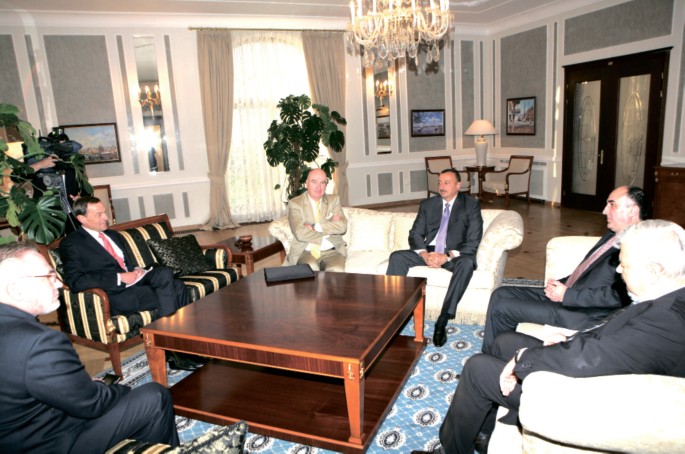
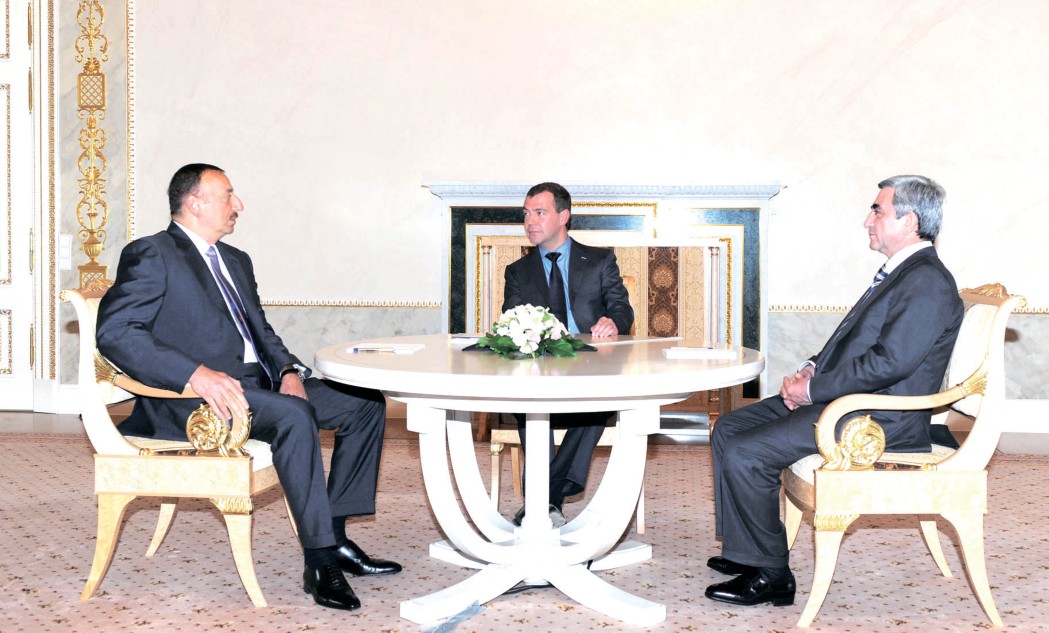
Baku and Yerevan are reviewing the results of another round of Karabakh settlement talks, after which gunshots were heard again on the contact line between the troops (one person was killed on the Azerbaijani side and four on the Armenian side). This happened just hours after the meeting between the presidents of Azerbaijan, Armenia and Russia, on which so many hopes were pinned. Calls for peace can be heard from all the parties involved: the OSCE Minsk Group through its co-chairmen, the European Union and NATO.
Moscow had hosted a meeting in the Moscow Region marked by the signing of the Mayndorf declaration and then talks in Sochi. It is clear that for Russia this also served to demonstrate that it has a "reservoir of influence" in the post-Soviet area. Finally, the Kremlin began its mediation mission at a time when the media in the South Caucasus were full of the comments of political scientists, who said that the United States had reduced its attention to the region since the Democrats led by Barack Obama came to power, while Europe has yet to form a coherent "policy on the Caucasus" etc.
Moscow's rapprochement with Ankara and Baku also provided much food for thought and, what's more, Turkish officials had raised the "Karabakh issue" even at meetings and negotiations at which Russia was clearly planning to concentrate on the subject of "gas".
Finally, a breakthrough in the Karabakh settlement would have been especially pertinent against the backdrop of unexpected developments in Osh, Kyrgyzstan. While Bishkek, Washington and Brussels expected Russia to take decisive action to "unblock" the situation, Moscow confined itself to shipping canned food and blankets as humanitarian aid and decided to opt out of military-political intervention. This led to a flurry of caustic comments in many newspapers around the globe. Time even asked: have we overestimated Russia's influence in the post-Soviet area?
Nevertheless, it was not clear until the last minute whether the meeting would take place at all, and Baku made it clear that it would not "negotiate for the sake of negotiating". In Sochi, informed sources explained, Armenia was asked specific questions which required specific answers within specific deadlines.
And when the Armenian president's press service issued an official report, quoted by many of the media on the morning of 17 June, that "on 17 June, Armenian President Serzh Sargsyan would travel to St. Petersburg on a three-day working visit, at the invitation of Russian President Dmitriy Medvedev, to attend the annual international economic forum, during which it was planned to hold a trilateral meeting between the presidents of Armenia, Azerbaijan and Russia", many viewed it as a harbinger of the long-awaited breakthrough.
Optimistic expectations were expressed, even by the Turkish ambassador to Azerbaijan, Hulusi Kilic. The diplomat expressed Ankara's hope that the meeting between the presidents of the three countries in St. Petersburg would create the necessary preconditions for an intensification of negotiations on a peaceful settlement of the Armenian-Azerbaijani Nagornyy Karabakh conflict.
"Turkey supports the peace talks between Azerbaijan and Armenia. We will monitor very closely the meeting to be held in St. Petersburg between the presidents of Azerbaijan, Armenia and Russia. We hope that Armenia will take a constructive path and withdraw from the occupied territories of Azerbaijan, because it is of benefit primarily to Armenia itself to restore peace and stability in the region, so that Armenia can benefit from economic development in the region and economic ties between countries," Hulusi Kilic stressed.
However, when the Russian presidential press secretary, Natalya Timakova, said after the meeting, "there is progress" and the parties intend to continue the dialogue, it became clear that there was no breakthrough. However, it is unlikely that such a turn of events was a big surprise.
Also, just before the St. Petersburg forum, where the presidents held a meeting, the Regnum news agency filed an "analytical report" (without specifying its authors) on the political situation in the CSTO countries. Armenia was given particular attention because it might become an "asymmetric point of destabilization" for Russia and the CSTO. Armenia was also recognized as "the most vulnerable point of the Collective Security Treaty Organization, not counting Kyrgyzstan, where the situation has already exploded". According to the report's authors, "the US mission in Yerevan is currently led by Marie Jovanovic - a former US ambassador to Kyrgyzstan who had a hand in the overthrow of Askar Akayev, and now "the US embassy is deliberately encouraging various public organizations, including the so-called Helsinki Committee of Armenia". The head of this organization, Avetik Ishkhanyan, was seen during incidents in Liberty Square in Yerevan in late May 2010, when the radical opposition decided to declare itself after quite a long break. As a result, "the probability of a negative scenario in Armenia in the current environment may be regarded as low, but it is possible", and the main domestic policy "detonator" here is Karabakh and relations with Turkey.
"The main feature of Armenian domestic politics is its complete subordination to external challenges and threats. The Karabakh problem and relations with Turkey, as foreign policy issues, are also the most pressing domestic political factors. It is largely for this reason that the settlement of the Nagornyy Karabakh problem is kept totally secret and only a few Armenian politicians are informed about the real essence of the negotiations and, most importantly, about possible future steps by the Armenian side based on agreements with Azerbaijan," says the report. Then they give advice:
"In this regard, during the destabilization of the situation in Kyrgyzstan, Russia should slow down the negotiation process between Yerevan and Baku as much as possible. Decisions that urge Armenia to proactively disrupt the status quo in the Karabakh conflict zone will rebound on Russia and, in particular, will create new operational challenges for the Collective Security Treaty Organization. At the same time, the radical opposition in Armenia will get a long-awaited excuse to accuse the country's leadership of losing the diplomatic war with Azerbaijan, with all the ensuing consequences."
The fact that Russia is facing serious problems in Armenia, which is known as Russia's "outpost", is beyond question. Observers point to a noticeable increase in anti-Russian sentiment here. Today Armenia is even closing Russian schools within Russian military bases. The campaign against the so-called "foreign language speakers", above all, Russian schools, is also significant. In addition, Armenia has renewed accusations against Russia of "betraying" Armenians in the 1920s and modern times.
Notably, as the media published "leaks" from the Russian Foreign Ministry about a possible presidential meeting in St. Petersburg, the notorious Igor Muradyan, one of the initiators of the Karabakh adventure, reported resentfully in the Golos Armenii newspaper: "The Russians believe that it is time for the Karabakh problem to be played out and that Karabakh itself should disappear, together with the problem. As before, many in Russia believe that Armenia has enough land, even without Karabakh. That's the whole logic and political meaning of the Russian position." Moreover, in an interview with the Russian newspaper Nezavisimaya Gazeta, Armenian Foreign Minister Edward Nalbandyan, in fact, disavowed the talks between the presidents, saying that it was not possible to decide anything at all without Nagornyy Karabakh being present.
But, apparently, simply disrupting a meeting was not enough for the Yerevan politicians and they decided to provoke a serious incident on the frontline and then use it as evidence of Azerbaijan's "aggressive behaviour" or, to be more precise, to "weep" and achieve an "exemplary punishment" for Baku.
But events are not developing the way Yerevan expected. It is not just that the Defence Ministry of Azerbaijan explicitly warned that the response to such provocations will be tough. It is not even that, for some strange reason, all the "image makers" of Armenian Defence Minister Seyran Ohanyan, who has recently flaunted himself in the media even more than the president, suddenly fell silent in Yerevan. The stunning failure of Armenian diplomacy is much more important: Yerevan did not manage to convince the world to blame Azerbaijan for the incident. Either way, when Edward Nalbandyan said at a meeting with EU Special Representative Peter Semneby that the recent Azerbaijani attack was a provocation, Semneby said "in order to create the necessary conditions for negotiations, it would clearly be useful to choose words carefully."
RECOMMEND:
 568
568

