

THERE IS NO ALTERNATIVE...
The New York forum must renew the struggle for Non-Proliferation
Author: Irina KHALTURINA Baku
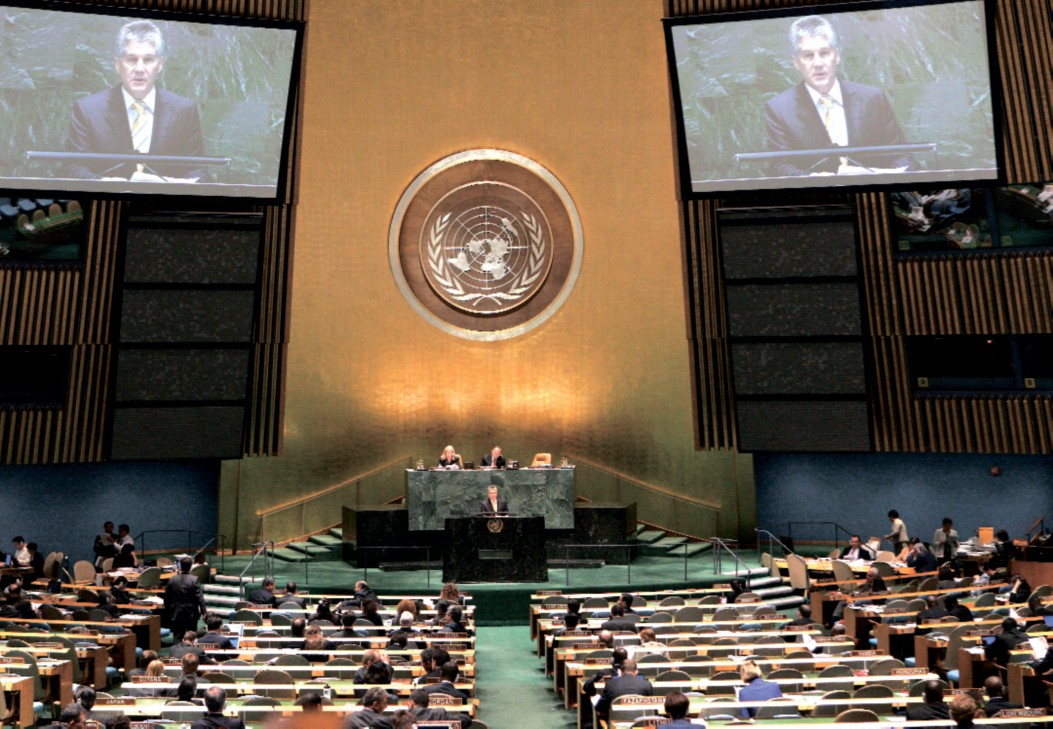
The latest, 8th International Review Conference on the Treaty on the Non-Proliferation of Nuclear Weapons (NPT) is under way in New York. Representatives of about 200 countries arrived at UN headquarters to participate in the forum, and they are to produce a unanimous declaration. If a document is not adopted, as happened in 2005 because of differences among the delegations, the conference will be considered a failure.
However, this time around there are greater chances of success because the latest conference takes place against the background of a number of promising developments. First, in early April Russia and the United States signed a new Strategic Arms Reduction Treaty (START III) to replace the earlier treaty of 1991. According to the new document, the two states are to reduce their operationally deployed nuclear warheads from 2,200 to 1,550, and the number of delivery vehicles from 1,600 to 800. Second, a new US nuclear doctrine was adopted recently and a nuclear summit was held in Washington.
In addition, the White House intends to resume cooperation with Moscow in civilian nuclear energy; it was suspended by George W. Bush after Russia's war with Georgia in August 2008. This implies lifting Cold War era limitations on trade in nuclear fuel. The agreement on civilian nuclear energy is to remain in effect for 30 years, and it will enable the transfer of "technologies, materials, equipment (including reactors) and components for nuclear research and the generation of nuclear energy." The New York Times and BBC confirm, citing Vann Van Diepen, Principal Deputy Assistant Secretary of State for International Security and Nonproliferation, that the Barack Obama administration is sure that the treaty will be approved by Congress because it meets the national interests of both sides. In the opinion of US experts, this news is further proof of the White House's striving to "reset" relations with Russia and of Washington's desire not to speak the language of the Cold War any longer.
So the New York forum might open a new page in the struggle against the proliferation of nuclear weapons. At any rate, many of the world's politicians do not merely support non-proliferation, but also come up with initiatives which, in their opinion, will help bring about a non-nuclear world.
In the mean time, the USA has taken the initiative here and, incidentally, it unexpectedly published official data on the strength of its nuclear arsenal. So, it emerged that Washington has 5,113 nuclear weapons and an additional "several thousand" which are to be dismantled soon (compared to late 1989, this is 75% fewer). This information was classified for a long time and the Obama administration's openness shows its desire to improve Washington's standing in the field of nuclear security.
Incidentally, the Western media now wonder if Russia is going to be as open. The same question is asked about China. However, the Americans themselves answer this question, pointing out that for Moscow, its nuclear arsenal is much more important for its national security than the US nuclear arsenal is for the USA; which is certain that it can handle any eventuality with its conventional weapons.
And going back to the non-proliferation regime, it is worth noting that the Americans are going to increase financial and technical support to countries which are developing civilian nuclear energy and point out the need to expand the powers of the IAEA. Washington maintains that the International Atomic Energy Agency should have not only inspection rights, but also the right to search for secret nuclear facilities. In this way, the USA signals that it wants to create a new climate of transparency and trust. But is this possible?
This issue is particularly significant against the backdrop of resumed discussions on the creation of a non-nuclear zone in the Near East. This initiative was raised 15 years ago and was first approved at the NPT conference in 1995, and now five permanent members of the UN Security Council - the USA, Russia, France, Britain and China - support it.
In the mean time, many Arab states in the region, including Egypt, said that it would not be possible to limit Iran's nuclear ambitions if Israel does not also disclose its nuclear secrets. Furthermore, IAEA General Director Yukiya Amano urged Israel to join the NPT and allow IAEA to inspect its nuclear facilities. Things went so far that the IAEA Board intends to discuss Israel's nuclear programme.
However, Israel has never admitted that it is a nuclear power and, incidentally, has never signed the NPT. At the same time, many experts say that Tel Aviv has about 200 nuclear warheads and aircraft and submarines capable of delivering them to a target. La Repubblica notes that during recent talks in Sharm El Sheikh, Israeli Prime Minister Benjamin Netanyahu tried to dissuade Egyptian President Hosni Mubarak from making comments on the Israeli nuclear arsenal during the NPT conference. But Cairo decided not to remain silent: the Egyptian representative urged Israel to sign the agreement, get rid of its nuclear weapons and open the door to UN inspectors. It was reported that Egypt circulated a document at UN headquarters, in which clause 31 included a demand that "information on Israel's nuclear potential be disclosed," and this is clearly a dig at the USA and also France which, presumably, provided assistance to Israel in the past in the nuclear sphere.
As a result, observers handed down their verdict long before the end of the NPT conference: the USA will not be able to achieve its goals, including the main one, to impose sanctions on Tehran. Until attention was drawn to Israel in a big way, Iran was seen as the main violator of the non-proliferation regime in the Near East.
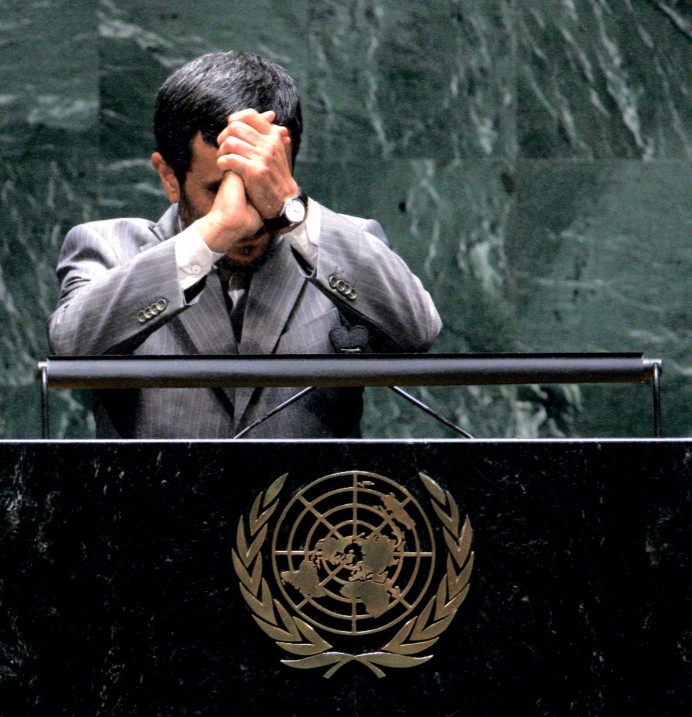
The arrival of Iranian President Mahmoud Ahmadinejad to take part in the conference was another "fly in the ointment" - he criticized the USA as usual, accusing it of double standards and of creating an "international system which does not allow developing countries to use 'civilian nuclear energy' but allows US allies to maintain nuclear arsenals." Ahmadinejad does not believe US statements that Washington will not use nuclear weapons against non-nuclear countries. As a result, during the speech by the Iranian president, the US, French and British delegations left the room in protest.
The White House associates the creation of a nuclear-free zone in the Near East with the achievement of a comprehensive peace in the region; this implies, first and foremost, a resolution of the Arab-Israeli conflict. It is obvious that in conditions when Near Eastern countries are effectively at war and even issue threats that they will wipe each other off the face of the Earth, never mind trusting each other and when combat operations are actually under way in the region, it is premature to discuss the creation of a nuclear-free zone.
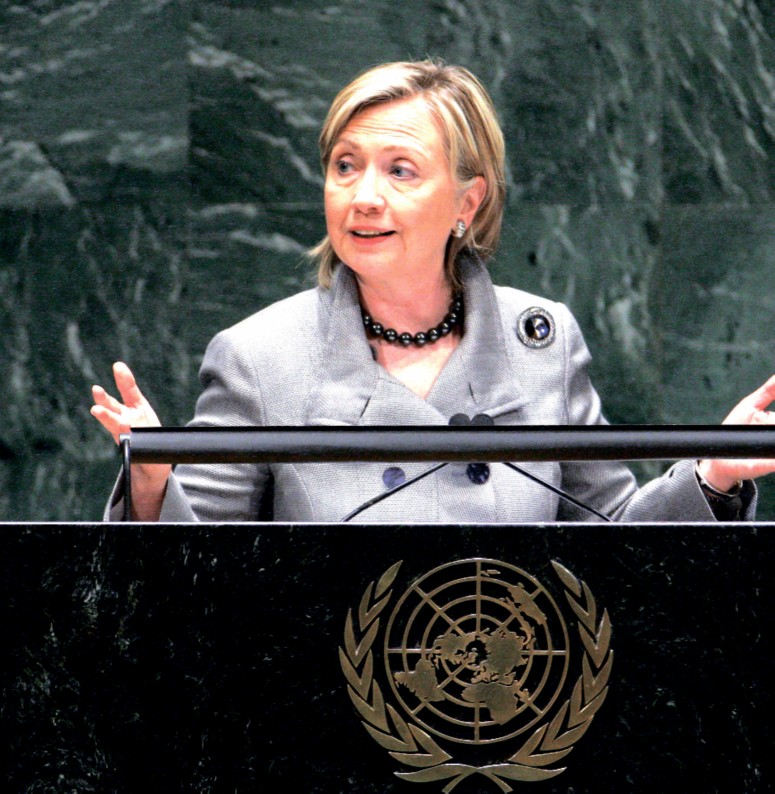
But this is precisely why the Near East is the "greatest threat in terms of the dissemination of nuclear weapons in the world," as US State Secretary Hillary Clinton stressed. And it is precisely Iran that can provoke an arms race in the region at present. As Secretary Hillary Clinton said, "the overwhelming majority of states today honour their non-proliferation obligations, but several outcasts have demonstrated their resolve to break the rules and challenge the international community."
The Iranian accusations against the USA were described by Clinton as "hackneyed, false and preposterous." The head of the US foreign policy department is certain that "Tehran will do its best to avoid responsibility." "Iran has challenged the UN Security Council and the IAEA and brought the future of non-proliferation into question. That is why it finds itself in increasingly profound isolation and comes under pressure from the international community," the secretary of state stressed.
However, while the West is considering what sanctions will have the greatest effect on Iran, Iranian President Mahmoud Ahmadinejad said that Tehran does not fear new UN sanctions, which will at the same time mean a refusal by the US to continue attempts to start a dialogue with Tehran at diplomatic level. "We think that these sanctions will do more harm to the US Administration than to us," Ahmadinejad concluded. The Iranian president also reiterated that Tehran is ready to discuss an exchange of low-enriched uranium for foreign-produced nuclear fuel, but the details of this proposal remain unclear.
In short, as before, Tehran is taking advantage of disunity within the international community and continues to procrastinate. The facts are that Russia and China, which have the right of veto at the UN Security Council, are still saying neither "yes" nor "no" to sanctions, and that the issue of Israel's nuclear weapons was raised again. In addition, the conference on NPT has once again demonstrated the displeasure of developing countries, which are trying to get free access to nuclear technologies; so they raise objections to tightening controls on national nuclear energy programmes.
However, the biggest doubts are raised by the ambiguous, if one might put it that way, implementation of the documents which regulate non-proliferation of nuclear weapons on the planet by those countries which already have weapons of mass destruction but are not signatories to the NPT, like India and Pakistan, for example.
But the worst fact is that the risk of terrorists obtaining nuclear weapons remains high. For example, the USA itself is in no hurry to demonstrate its approximately 200 B-61 bombs, which are kept at six air bases in several European countries and, some experts say, are not properly guarded. Not to mention the nuclear arsenal in Pakistan, where Al-Qaida and Taliban gunmen recently carried out an attack on Islamabad...
"Those countries which possess nuclear weapons will move towards disarmament; countries which do not possess nuclear weapons will not be acquiring them; all countries can have access to peaceful nuclear energy" - these words, uttered by Barack Obama last year, seem utopian at present. IAEA experts say that about 30 more states could join the nuclear club if they really tried...
However, true regional and global security is certainly a worthy enough goal for the NPT to continue "cementing" efforts to prevent the proliferation of nuclear weapons. New ways of renewing and strengthening the treaty need to found, because there is no alternative to it and it is unlikely that there will be an alternative in the foreseeable future. There are many obstacles along this road, and clearing those obstacles might require huge expense and great sacrifice. But first and foremost, all states need to be at least a little bit more honest... If not with their neighbours, then at least with themselves...
RECOMMEND:
 649
649

