

KYRGYZ SYNDROME
Trying to play off geopolitical centres, Bakiyev is finally overthrown
Author: Natiq MAMMADZADE Baku
To all appearances, the second Kyrgyz revolution has changed power once and for all in the poorest state of Central Asia. Kurmanbek Bakiyev was overthrown 9 months after his re-election to a second term. But more time will be needed to assess the Kyrgyz situation. There is, however, no doubt that these events are part of the geopolitical rivalry between the major players in the post-Soviet region.
Revolution without tulips
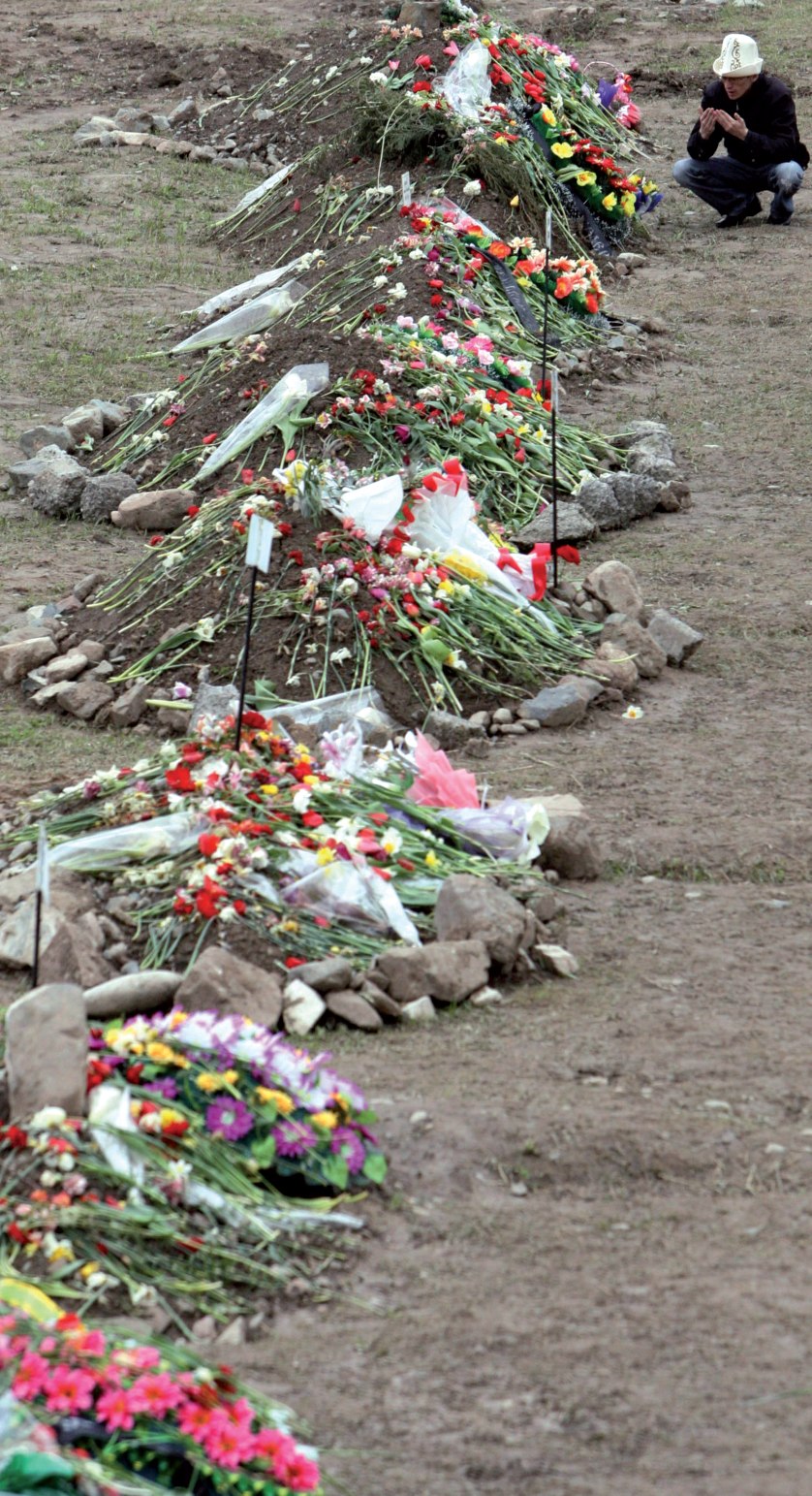
The opposition which seized power in Bishkek following the 6-7 April riots has formed a provisional government in Kyrgyzstan. The new government dissolved parliament and assumed the duties of the president and the cabinet. Those events resembled the situation that resulted in the overthrow of the then president, Askar Akayev, five years ago. The difference is that during the Tulip Revolution it was Bakiyev overthrowing Akayev, whereas this time it was Bakiyev being overthrown. But the main point is that the current revolution claimed many lives. According to different reports, 70 to 100 people were killed and about 500 wounded in the riots which led to Bakiyev's flight from Bishkek. The new Kyrgyz revolution was claiming lives even after the president's flight. Five people were killed and 28 wounded during spontaneous seizures of plots of land that mainly targeted Meskhetian Turks and Russians. Although the provisional government led by Roza Otunbayeva pledged to rein in Kyrgyz chauvinism, new outbreaks of violence showed that Kyrgyzstan is on the verge of anarchy and stabilization is still a long way off. This explosion of discontent happened due to the failure of Bakiyev's economic and social policy. During the five years of his presidency he managed to arouse great discontent. It seems that corruption and nepotism reached unprecedented scales. The ex-president and his family had made enemies even in their home region of Jalalabad where, as it turned out, his brother Akhmat held sway. The provisional government immediately annulled certain decisions made by the toppled authorities, such as increased prices for electricity, housing and utilities. Some linked the increases to the transfer of large shares in state companies to businesses owned by his son Maksim.
However, external factors had an important impact on the situation in the country. Kyrgyzstan has an important role in Russian and US policy in the region, not to mention the growing influence of China, which wants to have a loyal state neighbouring the rebellious Xinjiang Uyghur region. The US and Russia have military bases in Kyrgyzstan. Everything indicates that the balanced policy which Bakiyev was trying to maintain turned out to be beyond him. He promised to close the US base in Manas, then suddenly changed his mind and agreed to the transformation of the base into a US transit centre. The Wall Street Journal said that over 500,000 US and allied soldiers passed through the base in Manas on their way to Afghanistan in March 2010 alone. Kyrgyzstan simultaneously maintained an allied relationship with Russia within the CIS and CSTO (Collective Security Treaty Organization). But Moscow was annoyed with Bakiyev's inconsistency, which manifested itself particularly in the Kyrgyz authorities' decision to open another US military facility, namely the anti-terror training centre in the Batken region. The Kremlin remembered that having promised to close down the Manas base, Bakiyev had managed to wheedle a 150m-dollar grant and 300m-dollar easy terms credit from Russia. But the base was not closed down.
Knowing this, the Russian leaders' remarks following Bakiyev's overthrow were no surprise. President Dmitriy Medvedev said that the protests testified to the Kyrgyz nation's extreme indignation with the authorities. Russian Prime Minister Vladimir Putin said: "When Mr. Bakiyev was bidding for power, he criticized the ousted President Akayev severely for nepotism, because his relatives and close friends had positions in the economic and political sectors. I have the impression that Mr. Bakiyev made the same mistake."
This reaction resembles that of the pro-US orange revolutions, one of which resulted in Kurmanbek Bakiyev's accession to power in Kyrgyzstan 5 years ago.
Deposed Bakiyev
Stabilization became possible after Kurmanbek Bakiyev resigned from his post. He faxed a letter of resignation to the provisional government from Kazakhstan, where he had arrived from Jalalabad. Prior to this he had attempted to retake power with help from supporters in southern Kyrgyzstan. The attempt failed and Bakiyev had to flee to Kazakhstan. The flight was arranged by the Russian military, under instructions from President Dmitriy Medvedev. Assistant Secretary of State Robert O. Blake said in Bishkek that Bakiyev's departure from the country was mediated by Russia, Kazakhstan and the United States.
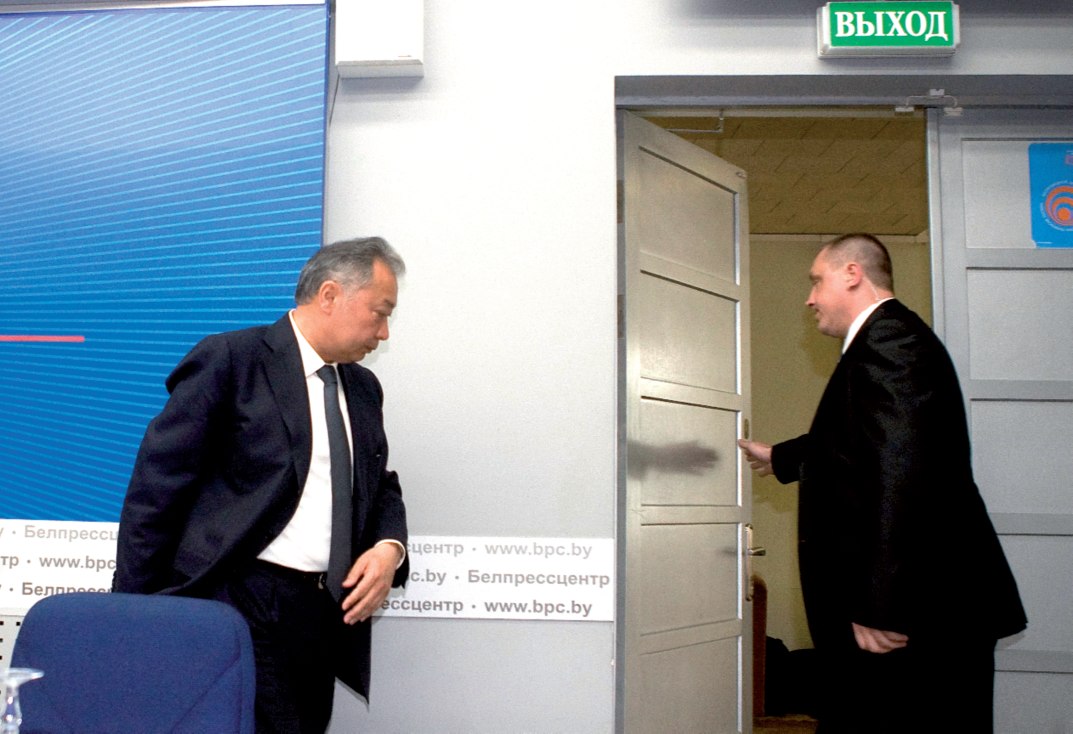
Bakiyev and his family then left Kazakhstan for Minsk, where Belarus President Alexander Lukashenko gave him sanctuary. In Minsk Bakiyev made a number of statements, expressing his view of the situation. He officially denied that he had resigned, saying that he remained Kyrgyz president and that he had taken the decision to resign at Vladimir Putin's recommendation. "I said clearly that I was ready to resign on condition that the persecution of my companions-in-arms and relatives ceased. But so far the situation has been the opposite. My supporters are being severely persecuted. Have they kept their promises?" Bakiyev said.
He added that he was not "clinging to the presidency", did "not intend to go back to Kyrgyzstan as president" and was even ready to accept the provisional government's candidacy "to appoint a temporary legitimate authority, whose decisions will gain legal force and no one will be able to dispute them in the future". Thus, he offered his services as "legitimate president" and offered to use his power "to normalize the situation and make it possible for Kyrgyzstan to enter legality". He did not explain, however, how his services could be considered legal after the letter of resignation that he had signed.
He made it clear that Russia was not interested in having him as president in Kyrgyzstan. "I will not pretend that the Russian leadership was not pleased that the Americans were leasing our base in Manas. But a military base in Kent, which is nearby, was leased for Russian fighter jets. The USA was only using the Manas base to transport cargo to Afghanistan," said Bakiyev. He added that he had had conversations with Medvedev and Putin and he had been told openly that the situation did not suit Moscow. He complained that after he had made the decision to dissolve the leasing agreement with the USA and financial aid came from Russia, the latter, as well as Kazakhstan, Tajikistan and Uzbekistan, "said that they were ready to allow their bases to be used to transport US cargo to Afghanistan. It turns out that only Kyrgyzstan was against it, whereas the others supported it. That was, in fact, a slap in the face from the Russian leadership."
Russia's decision to impose customs duty on fuel and lubricants for Kyrgyzstan, which caused a price hike in the country, had made Bakiyev even more indignant. "That was a shock for the Kyrgyz economy. Especially as the country is a WTO member state. And I said repeatedly that Kyrgyzstan was ready to join the Customs Union of Russia, Kazakhstan and Belarus. Our experts were already working on it. I was indignant and told the Russian leadership that we were members of the EAEC (Eurasian Economic Community) and all sanctions against each other must be coordinated in advance. I mean, in fact that was a Russian blow to our economy."
Thus Bakiyev was a pawn in the great geopolitical game that was set in motion around his country according to super power rules. He tried to play off their interests, but finally became unsuitable for both Russia and the USA. The latter was disappointed in his unreliability as an ally (not to mention the authoritarian and corrupt nature of the Bakiyev regime, which was exasperating Washington). The Americans denied him as they understood that he had no prospects as a politician. Initially, the USA condemned the actions of the Kyrgyz opposition, but later preferred to halt their critical rhetoric and laid down a foundation for the establishment of contact with the new Kyrgyz leadership.
The new Kyrgyz authorities do not need Bakiyev at all. They said that Bakiyev would not return to the country, adding that if he did so, he would be detained and questioned in connection with criminal proceedings launched into the killing of dozens of civilians during mass protests in Bishkek.
The provisional government intends to draw up a new constitution and make Kyrgyzstan a parliamentary republic. A referendum on constitutional reform is planned for 27 June. A decision concerning the presence of the US military base in Kyrgyzstan - an issue of great importance for the country's geopolitical future - will be taken after new state agencies, first of all a parliament, are formed.
Almazbek Atambayev, the deputy prime minister in the interim government, said Bishkek would consider soon the expediency of the US base in Manas. However, the US military will stay in the country for at least one year, as only a new parliament, to be elected on 10 October 2010, will be able to make a decision about the base.
In any case, the new Kyrgyz authorities still have to prove their ability to follow a policy different from that of the toppled government and, what is no less important, to make Kyrgyzstan a country whose development does not depend on the whims of superpowers.
RECOMMEND:
 659
659

