

ARMENIAN-STYLE "DEVELOPMENT"
The number of Armenian citizens wishing to leave the country increases by 43 per cent
Author: Ceyhun NACAFOV Baku
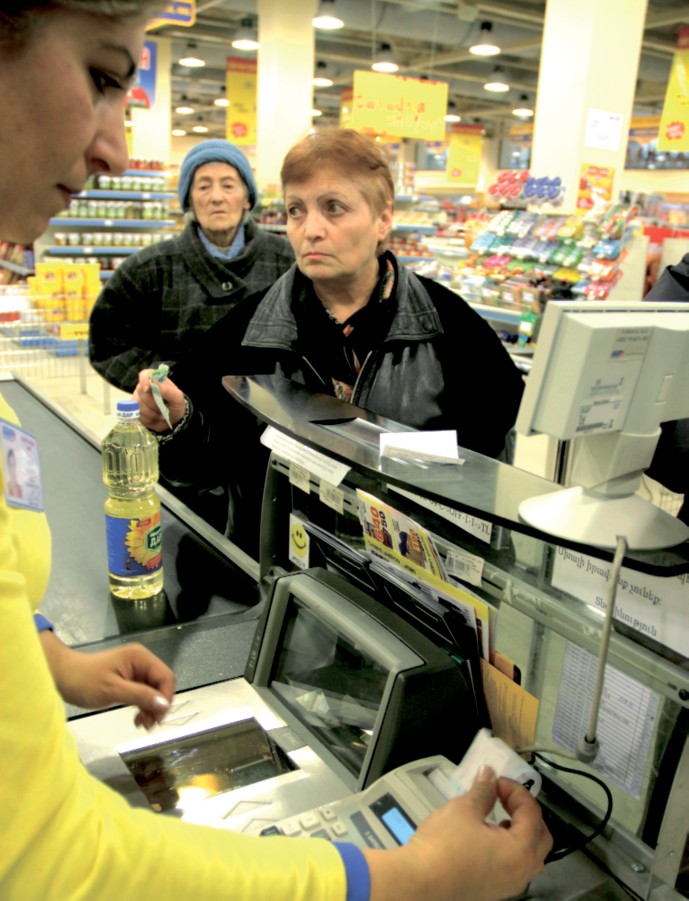
On International Fool's Day - 1 April, the government of Armenia gave its citizens a surprise by increasing the price of gas by 37.5 per cent and justifying its decision by a rise in the price of Russian gas supplies. And this is while the Russians increased the price of gas by only 17 per cent. Thus the population of Armenia was not expecting a sharp increase in tariffs to consumers for the "blue fuel". At the same time, the Armenian government promised to make every effort to mitigate the impact of higher gas prices on the poor. To this end, from 1 May, social benefits in the country will increase by 3,500 drams ($8.7) and from 1 November pensions will rise by 2,650 drams ($6.6).
Chain reaction
Almost simultaneously with the rise in cost of gas, one of Armenia's largest enterprises - the Nairit chemical plant - ceased operations. Presumably, it stopped due to unpaid electricity bills of $2.5 million.
Last year, the Electricity Networks of Armenia (ENA) sued the factory for failing to pay its debts during the year. The ENA won the case and Nairit had to pay up.
The ENA has not yet gone to court over the new debt, but is providing the plant with the minimum amount of power. Nairit is one of the world's five companies producing chloroprene rubber. Over 80 per cent of the plant's output is exported. Its designed capacity is over 700 tonnes of rubber per month. By the way, Armenia owns only 10 per cent of the plant, as the remaining shares belong to Britain's Rhinoville Property Limited.
The cost of gas in Armenia was expected to increase as early as in 2008, but then Yerevan managed to persuade Gazprom to delay changes in the cost of natural gas. The Armenian authorities made it clear that increasing prices against the background of political battles with the opposition threatened unpredictable consequences for Yerevan.
Rising prices for "blue fuel" are the last wake-up call for the collapsing economy of Armenia. The 12-year rule of the Kocharyan-Sargsyan clan has taken Armenia to the brink of bankruptcy.
According to the Armenian press, since 2008 the number of Armenian citizens wishing to leave the country has risen by 43 per cent. Even the State Statistics Committee of Armenia makes it clear in its summaries that the state of affairs in the country is far from satisfactory.
According to statistics, even before the April increase in gas prices, the cost of living in Armenia increased by 8.8 per cent. Prices for gasoline and diesel oil rose in March of this year by 37.6 per cent and 28.3 per cent respectively, compared to the same period last year. Food prices increased by 6.3 per cent, non-food goods - by 14.3 per cent and tariffs for services - by 10.6 per cent. Tariffs for drinking water, drainage and wastewater treatment are also expected to rise.
In search of salvation
Yerevan is mainly looking to Russia for salvation for the choking economy, which is quite natural. The chairman of the Russian State Duma, Boris Gryzlov, said that Armenia is a Russian outpost in the South Caucasus. Therefore, the chairman of the Central Bank of Armenia, Artur Javadyan, spent all last year visiting the Russian Ministry of Finance and Central Bank to get a stabilization loan of $500 million. Incidentally, the Armenian authorities conceal from their own public the fact that they intended to use the Russian money to avoid the collapse of the economy. The information about Armenia's request was disclosed by Russia's Deputy Prime Minister Aleksey Kudrin.
As they say, friendship is friendship, but one good turn deserves another. Moreover, Armenia already owes much to Moscow. Robert Kocharyan, who came to power in Armenia in the late 1990's, handed Armenian enterprises over to Moscow one after the other as part of of the "equity for debts" programme. Thus, Russia took over almost all energy facilities in Armenia, including the Metsamor nuclear and Hrazdan hydroelectric power plants, the transport system, the Mars plant and the Institute of Automated Control Systems. Russia's ownership of the Iran-Armenia gas pipeline deprived Yerevan of its transit prospects.
As it turned out, most of these enterprises are not profitable and require considerable investment. Due to its absurd claims, Armenia has poor or hostile relations with its neighbours, except for Iran. Russian companies simply have no buyers for electricity or for the products made by businesses acquired in Armenia.
Apparently for this reason, the Russian Railways company, which owns Armenian Railways, is not interested in upgrading its infrastructure in Armenia, where the average speed of trains is only 20 km/h due to old rails and the poor condition of the track.
Yerevan's hopes that Russia would accept proposals for financial assistance to Armenian enterprises fully owned by Russia also failed. Moscow did not accept it, believing the companies it received in exchange for debt to be hopeless. Russia itself is full of such enterprises anyway.
In late March, it became known that negotiations between Armenia and Russia for a Russian loan of $100 million for the purchase and processing of rough diamonds had been suspended. An official of the Armenian Ministry of Economy, Gagik Kocharyan, said that "the negotiations were suspended because of the crisis, which made adjustments to plans to conclude an agreement".
Thus, Russian investments in Armenia are falling. In 2009, compared with 2008, the volume of Russian investments into the Armenian economy decreased by 42.9 per cent, while direct investment from Russia slumped by 46.1 per cent.
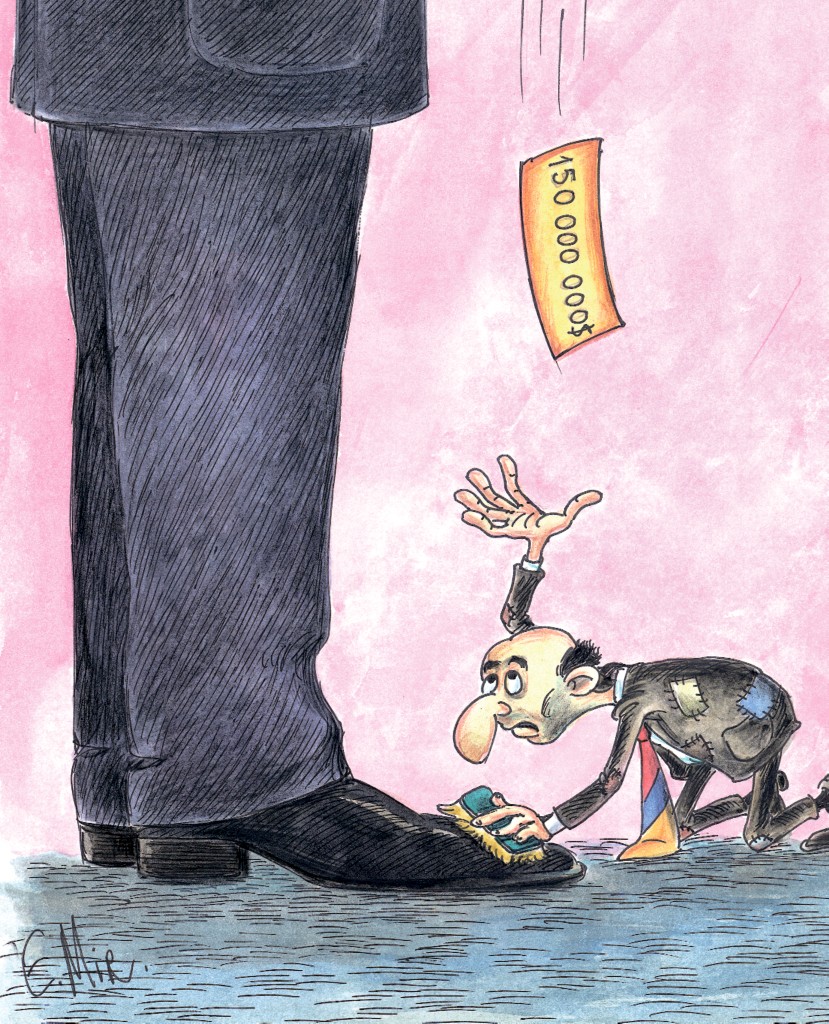
Meanwhile, it has become known that Armenia's external debt this year will be supplemented by another loan from the International Monetary Fund (IMF). How happy the Armenian government was when the IMF approved a report on their collaboration. Prime Minister Tigran Sarkisyan said at a cabinet meeting that it would stimulate the delivery of planned financial assistance from the IMF. "This year the issue is about 150 million dollars, which we will get from the IMF alone. In addition, it will give a green light to all our international programmes," Sarkisyan said.
As we see, forecasts that Armenia's foreign debt would almost reach the risk threshold this year are being justified. According to Armenia's Minister of Finance Tigran Davtyan, the country's external public debt as of 1 January 2010 amounted to 38 per cent of the gross domestic product (GDP). This year the Armenian government expects the external debt to increase, amounting to 45-46 per cent of GDP. The threshold of risk is 50 per cent of GDP. The prime minister acknowledged that loans from the IMF - 823 million dollars, the World Bank - 545 million dollars and Russia - 500 million dollars, had the greatest impact on the volume of external debt. This is despite the fact that the Central Bank of Armenia's reserves on 1 April only slightly exceeded 375 million dollars.
In this situation, even Armenian analysts do not share the government's optimism that the new loans will help to carry out reforms and thus create the basis for strengthening the economy and for subsequent debt repayment.
Too much theft...
In their view, the root of the problem lies in the criminal nature of the current government, which urges people to tolerate the growing social pressure. This, they say, is the cost of Karabakh.
From the lobbies of the Armenian political establishment, the Russian press has received information about substantial, by the standards of a small country, embezzlement of public funds by the Kocharyan-Sargsyan group of oligarchs. The Karabakh clan has developed a huge underground economy, whose turnover is many times higher than the state budget of Armenia. They have set up a multi-stage system of financial flows to pro-Kocharyan forces in Russia; one prominent representative is the well-known member of the Federation Council, Levon Chakhmachan, who was caught red-handed while taking a bribe of $300,000.
Smbat Karakhanyan, head of the Armenian National Club Miabanutyun in Moscow, revealed to the Russian media some details of the criminal nature of the Armenian government and state apparatus, entirely formed of oligarchs, criminals and shady businesses. He suggested that top officials own about 85 per cent of all assets and companies in the country and control almost 90 per cent of financial flows. That is the destination, according to Karakhanyan, of loans issued to Armenia by other states, international financial institutions and the Armenian diaspora.
A special feature of oligarchic structures and corruption schemes in Armenia is the strong and almost public presence of criminality. On top of this pyramid is a clan originating from Nagornyy Karabakh - Kocharyan-Sargsyan - which used to sell the corpses of Azerbaijani soldiers and hostages, said Karakhanyan.
The founder of the oligarchic pyramid is Robert Kocharyan, the former president of Armenia, who still controls taxation, telecommunications, construction, gas supplies, transportation, mining, processing and the sale of precious stones. Karakhanyan said that according to approximate estimates the assets of the Kocharyan family exceed $4 billion.
His prot?g? Serge Sargsyan controls customs duties, imports of petroleum products, gasoline and diesel fuel, exports of metals and scrap metal, imports and sales of gold, air transport and airlines.
A special source of income for the Kocharyan-Sargsyan group is drug trafficking, which originates near the southern borders of Armenia, transits through to Georgia, then on to Ukraine and Russia by air.
According to Karakhanyan, ex-President Robert Kocharyan owns, including through intermediaries and family members: Armeximbank, Armenian Unibank, ABB Bank, Renko Construction, the Zangezur Copper and Molybdenum Combine, Ardshininvestbank, Converse Bank, the Nairi Medical Centre, the BiShin construction company, Downtown Yerevan (via his eldest son Sedrak Kocharyan) the H2 TV company, the SAS and Star chains of shops, the Noah winery and Zvartnots airport. He controls 80 per cent of mobile phone imports, has a large shopping complex and a casino in Moscow, owns the Toyota representation in Armenia, K-Telecom (VivaCell brand), the Golden Palace Hotel in Yerevan, AraratCement etc.
President Serzh Sargsyan owns (also through intermediaries, his brother Aleksandr and son-in law Mikael Minasyan) the assets of the Flash company, a chain of fuel stations, three wineries in Nagornyy Karabakh, a distillery in the town of Karmir Shuka (with a capacity of 2.3 million litres), Bank Ararat, the Ararat restaurant chain (30 sites), the assets of the companies Mika, Armavia, Mika-Cement, the construction company Mika House, a hotel-restaurant complex in Moscow and the Jazve chain of cafes. As defence minister, he was a mediator in small arms supplies to Third World countries by private producers in Bulgaria.
If we also mention the aggressive policy that has driven Armenia into economic isolation, then it is not hard to understand people wanting to leave Armenia.
The worsening of socio-economic realities has inflamed the already tense political situation in Armenia. Thus, on 6 April the opposition staged a large rally in Yerevan, demanding the resignation of the Serzh Sargsyan government. A wave of protests also swept through the regions of Armenia. In the eyes of Armenians, the authorities' promises of all sorts of compensation look like mockery, as meagre compensation simply dissolves in the fluctuations in the rate of the dram. Apparently, the large protest rally in the streets of Yerevan is just the beginning...
RECOMMEND:
 651
651

