

"BLOODY" MONDAY IN MOSCOW
Terrorist attacks in the Russian capital: a one-off act of revenge or the beginning of a new wave?

Author: Ramin ABDULLAYEV Baku
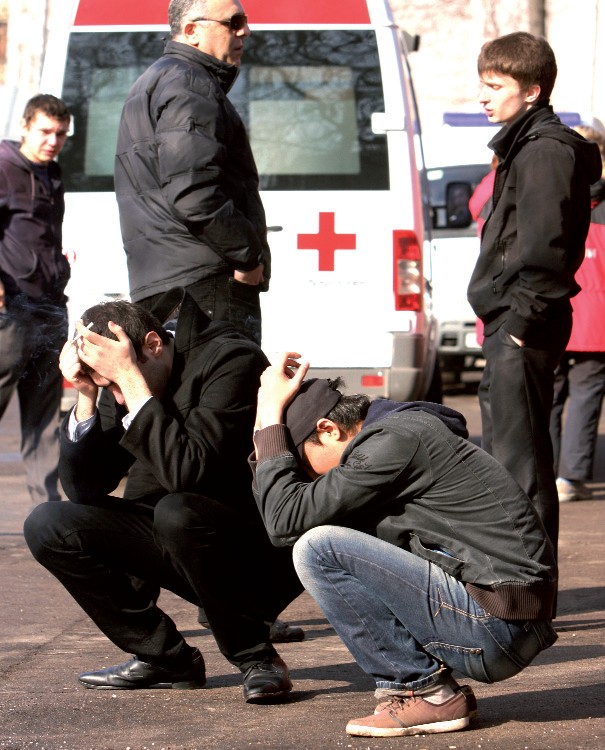
On 29 March, female suicide bombers carried out two explosions on Moscow metro trains travelling on the Sokolnicheskaya line.
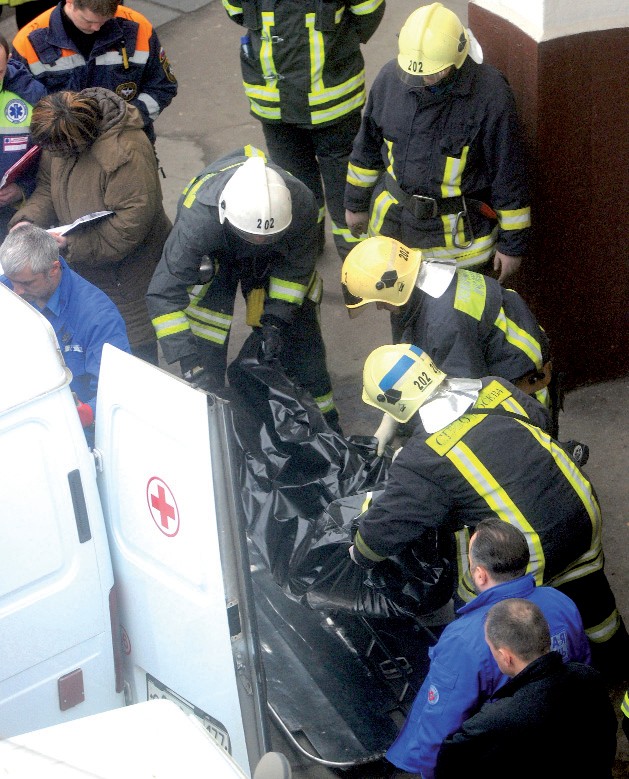
At least 39 people were killed, while more than 70 received injuries of various degrees of severity. The law enforcement agencies, according to the Russian media, had information about possible terrorist attacks on transport. Citing eyewitnesses, they reported that shortly before the explosions in the metro, the police carried out mass identity checks. However, the bombers, defiantly dressed in black, still managed to easily get onto Lubyanka station near the central office of the Russian Federal Security Service and, according to one version, to exact "revenge" for a raid conducted by the service.
The first explosion occurred at 0756 on a Red Arrow train. When the train driver stopped at Lubyanka station and opened the door, a woman standing near the second carriage blew herself up. Two dozen people in the carriage near the bomber and those who had stepped out onto the platform were killed immediately. The power of the blast was so strong that those sitting or standing next to the terrorist had their heads blown off. The others were struck by debris.
The investigation established that at the time of the first attack, the second bomber was already travelling in the same direction, lagging behind the first one by only a few lengths.
Immediately after the explosion, the movement of all trains on the line was stopped "for technical reasons", as it was announced. And then the trains carrying passengers were moved slowly up to the nearest station to drop them off and evacuate. At 0839 when one of the trains arrived at Park Kultury station and the driver asked passengers to leave the train while opening the doors, the second "live bomb" went off. The bomb contained explosive equivalent to about 1.5 kg of TNT.
The security forces are confident that the terrorist attacks were carried out by suicide bombers, based on the fact that at the scene they found fragments of bodies with the characteristic damage caused by the explosion of a bomb strapped around the body. According to participants in the investigation, they had to piece fragments of the suicide bombers' bodies together like a mosaic.
The theory of a "Caucasian Connection" appeared earlier than any circumstantial evidence pointing to the perpetrators or organizers of the attacks. On the one hand, it is understandable when one considers that, recently, the leader of the so-called Caucasus Emirate, Dokku Umarov, had warned several times of impending terrorist attacks outside the North Caucasus region. "The Russians think that the war is far away in the Caucasus and would not affect them, but we are going to prove that this is not so when the war comes to their homes," claimed Umarov.
However, this theory, as expected, immediately provoked an angry response against people of Caucasian nationality and Muslims. The first signs appeared a few hours after the explosions in the same metro, when unknown assailants beat up two Muslim women.
On the other hand, according to Western and some Russian experts, it is very likely that the fear of terrorists will once again be used to demonstrate that it is impossible to govern Russia without sharp practices, harsh laws or with any "excess" of democracy.
Russian opposition newspapers do not rule out the Moscow explosions being used as a pretext to introduce new measures to increase control over society, such as collecting all sorts of data on citizens from fingerprints to genetic material, especially as recent months have seen growing public protests directed by opposition parties.
Supporters of this view point out that the terrorist threat has repeatedly been used by the Kremlin as an excuse to curtail democratic reform and to consolidate power. "For example, it was for this reason that Vladimir Putin overturned the law on the election of governors in his time," says The Washington Post.
The Western press also christened the explosions "a direct challenge to Medvedev", who will now come under pressure to ensure that he "mimics his predecessor, Vladimir Putin, who began a ruthless war against separatists in Chechnya in 1999."
For example, The Times wrote that the former President Vladimir Putin's tactics of "Chechenizing" the conflict, in which the fight against terrorists was entrusted to the republic's President Ramzan Kadyrov, although it brought some success, also led to the transfer of some rebels into neighbouring Dagestan and Ingushetia. Additional impetus was given to separatist activity by Dmitriy Medvedev's decision to recognize the independence of Abkhazia and South Ossetia.
The New York Times is confident that Vladimir Putin will be tempted to respond to these attacks in the old manner. The newspaper says that after a wave of bloody terrorist attacks in Russian cities in 2004, Putin carried out a dramatic reorganization of government structures, explaining this by the need for unity in the fight against terror.
Meanwhile, a barrage of criticism hit the Russian law enforcement agencies which, according to Moskovskiy Komsomolets, "failed to learn anything from life". The newspaper stressed that, despite all the communiqu?s and loud assurances by generals, the security forces are unable to protect Russian society from terrorists. It is no accident that one of the explosions occurred exactly at the station with the well-known name of Lubyanka and during a large-scale reform of the Interior Ministry. "People in uniform are so mired in corruption and intrigue that they do not have time to do their main job," says the publication.
Some experts also see the Moscow bombings as a threat to the Olympics in Sochi and other large-scale international projects of the Russian leadership. "The explosions in Moscow question the megaprojects planned by the Russian leadership; first of all, the Olympic Games in Sochi," Vadim Mukhanov, a senior fellow of the Centre for Caucasian Studies at the Russian Foreign Ministry's Moscow State University of International Relations, told Rosbalt.
It is also interesting that the vast majority of analysts and publications, both in Russia and abroad, refused to support the claim by Foreign Minister Sergey Lavrov linking the bombings in Moscow to machinations by foreign forces. For example, Yezhednevnyy Zhurnal wrote that this type of attack was not imported into Russia by al-Qaeda or other international organizations, and the first female suicide bombing in history happened not in Palestine but in Chechnya, when two Chechen women blew up a military base in Alkhan-Yurt in June 2000. This phenomenon has local roots and the security services should have realized that sooner or later the bombers would return to the capital.
Nevertheless, in the opinion of most Russian journalists and politicians, the tragedy in Moscow is unlikely to cause a change in the approach to combating terrorism. In their view, terrorist attacks in the capital's metro affect mass consciousness, cause panic within the population and generate a phobia in society, not in the government.
In connection with the recent attacks, Russian President Dmitriy Medvedev did not rule out the possibility that articles of the Russian Criminal Code on terrorism would be toughened. "There is reason to return again to issues of justice under the articles on terrorism and adjacent crimes and to talk about the improvement of such practices," he said at a meeting on improving the judicial system.
RECOMMEND:
 623
623

