
"THE NEMTSOV AFFAIR"
The shots outside the Kremlin will echo for some time yet
Author: Fuad HILALOV Baku
He was one of the originators of the "New Russia", one of its symbols and, by his own admission, one of the authors of the Constitution of the Russian Federation. Among the "bright young things" at the helm of power of the young state, Nemtsov was the favourite of the then president, Boris Yeltsin. He entered the Russian Federation Security Council in 1997-98. By the time he was governor of Nizhniy Novgorod Region and Deputy Russian Prime Minister, Nemtsov was the youngest politician ever to have held these posts.
Many people believed that Nemtsov would be the successor of Russia's first president. But people were very soon disillusioned with the reforms and the young reformers, of which Nemtsov was one. This disillusionment and mixed feelings about his work were to prevent Boris Yefimovich from becoming Boris Nikolayevich's successor. And so the choice of the oligarch-reformers' team fell on Putin. Back in 1999, in an interview for the "Ekho Moskvy" opposition radio station, Nemtsov himself said this of Putin: "I am convinced that Vladimir Putin should be the next president. Unless, of course some people succeed in tying him up and pinning him down, I am convinced he has every chance of being elected; I, in any case, will support him in every way I can."
That was in 1999. So what happened next and why did Nemtsov not just refuse to support Putin in every way but, on the contrary, become one of his most vociferous opponents? Experts are of the opinion that a group of young reformers and oligarchs placed their reliance on Putin's "management qualities" and the fact that, as in President Yeltsin's time, the real reigns of power would be in their hands. However, Putin had other plans in that regard and the "young people in the Kremlin" were gradually to be replaced by people from the special services and who supported tougher methods of management. That was the start of the process of turning Nemtsov from a supporter of the incumbent power into a member of the liberal opposition.
However, the liberal opposition did not go down well with Russian society. After switching to the opposition camp Nemtsov's only political success was his election as people's deputy of the Yaroslavl Regional Duma.
It was difficult to see Nemtsov as a politician: he was more of a socio-political figure. His opponents accused him of very often openly supporting anti-Russian forces rather than anti-Putin forces when opposing the Russian government.
While still occupying important posts Nemtsov maintained close relations with the western establishment and when he left government these ties only strengthened. He met President Bill Clinton on a number of occasions. He also had meetings with State Department head Condoleezza Rice and Vice-President Dick Cheney. He was received by US governors and congressmen. Addressing the Senate Committee on Foreign Relations, he proposed that President Barack Obama should meet more often with Russian opposition leaders. During a meeting with the odious Congressman John McCain in March 2010, Nemtsov hinted at what position the US leadership should best adopt at the presidential elections in Russia in 2012. In November that same year Nemtsov addressed the US Congress and urged it to adopt a law "On support for democracy in Russia", and also spoke at a forum which discussed "the restoration of the US' leading role in the world". He was also one of the Ukrainian government's closest allies after the Euromaidan. On a number of occasions Nemtsov condemned Russia's actions in Crimea and the Donbass and criticized the Russian authorities even more than Ukrainian politicians did. Despite this, unlike other Russian opposition leaders - [Aleksey] Navalnyy, who openly supported the neo-Nazi line and the marginal political figure and chess-player [Garry] Kasparov who has been recently living in the US, passing himself off as a political immigrant - Nemtsov called for a democratic change of power, i.e. through the ballot box. Bearing in mind the opposition's low standing among the people, this idea seemed from the sidelines to be rather unrealistic.
And now he has been murdered… The ground-breaking individual of the 1990s has been shot in keeping with time-honoured traditions: openly, brazenly and symptomatically. But death came to him not in some dark doorway, as is usually the case in contract killings of politicians, journalists and so on in Russia. Fate prepared for him - if one may put it like that - a "glamorous" death: in the centre of Moscow, near the Kremlin walls, where he had fought strenuously with its occupants in recent years, by the side of a young girl from Kiev, on an historic bridge during a stroll in the evening rain. A bit like a Hollywood movie…
After his tragic departure, Boris Nemtsov left behind a number of questions, the most important being who needed his death and what impact would it have on Russia's future?
Experts believe that Nemtsov's killers acted in an extremely unprofessional manner. Six bullets were fired at him from very short range, two of which missed the target. The bullets were of different manufacture, which may have meant that one failed to fire at the crucial moment. There was no finishing shot to the head. And most interesting of all, the killers left alive an important witness, Nemtsov's female companion, which points to a lack of professionalism in very interesting circumstances.
On 10 February "Sobesednik" ["Companion"] magazine published an interview with Nemtsov in which he told his mother he was worried that Putin wanted to kill him because of remarks he had made. By these remarks, one could say that he signed his own death warrant, giving his killers a ready-made motive. Immediately after Nemtsov's death, all eyes were on Putin. After all, Nemtsov had criticized him and in some of his interviews he even used offensive words in his abuse of him. Who else, on the face of it, would want to punish Nemtsov more than Putin?! Immediately after the murder, articles began to appear on the Internet stressing "Nemtsov's suspicions about Putin's intentions to do away with him". US Senator McCain expressed his innermost feelings about Nemtsov's safety back in 2013: "I am rather worried about Boris Nemtsov's personal safety. I, of course, told him something was bound to happen."
Just as a defective watch tells the correct time twice a day, so McCain's prediction, which was full of apocalyptic prophecies about Russia, alas came true. Even US President Barack Obama accused Putin in an indirect way. He said that "he has no idea at this point exactly what happened", but this did not stop him saying that "the murder of Boris Nemtsov is a symptom of the deterioration of the situation with civil rights in Russia".
However, before accusing anyone directly or indirectly of Nemtsov's murder, we should stop and think as to who benefits from this. After all, the first thing to look for in any crime, even the most ordinary, domestic crime, is motive. Yes, Nemtsov criticized Putin, and at times his criticism stretched to personal abuse. But would Putin embark on such a foolish step at such a tense time when the West is perpetually looking for a convenient opportunity to toughen sanctions? Currently, Nemtsov presented no danger to the Russian authorities. His numerous reports and statements about corruption in Russia and Moscow's involvement in the events in Donbass surprised and shocked no-one. But Nemtsov's murder has become a major problem for the Russian authorities. If the law-enforcement agencies are unable to solve the murder soon it will turn into a big headache for them. Clearly, the Russian authorities will hardly curry favour with the wishes and whims of the opposition, even if they provide the materials of the investigation for their examination. The reason is quite simple: the only thing the opposition is really interested in is accusing the security structures and President Putin personally of everything. Objective information, whatever they may say, won't bother many people.
If the murder is solved, then, first of all, the transparency of the investigation must still be proved, which could cause another wave of criticism: OK, why were the authorities unable to protect Nemtsov? Although it is hard to imagine that Boris Yefimovich would have agreed, say, to a stroll around Moscow at night accompanied by two bodyguards assigned to him by the Russian FSB.
Was Nemtsov's death of benefit to the Russian opposition? Probably even less than to the authorities. In the first place, the already weak Russian opposition has lost at the very least one of its bright leaders. Who is left among the elite in the Russian opposition now that Nemtsov has departed? We have already talked about Kasparov, who was unable even to attend his colleague's funeral because, as he put it, "Mummy wouldn't let him", and about Navalnyy. Perhaps the glamorous socialite Kseniya Sobchak could take Nemtsov's place? Here, as they say, comment is superfluous. Second, having links up to now in any Russian ministry, Nemtsov could have solved any problem with one phone call and the loss of such a person is tantamount to the loss of a contact between the opposition and the leadership.
So, who could be behind Boris Nemtsov's murder? Again one can't help recalling what Vladimir Putin said in the run-up to the 2012 presidential elections: "I know these techniques very well. Attempts to implement them have been made for 10 years and first of all abroad. They are even looking for a so-called sacrificial victim from among prominent persons. They may - I beg your pardon - waste someone, and then blame the authorities." One also recalls the motto of the infamous oligarch, the "godfather of the Kremlin" in the 1990s, Boris Berezovskiy: "Let's take out Vasya so they can think about Kolya."
So, someone needed to make a "sacrificial victim" out of the departed Nemtsov. Why and who? First one should remember that many revolutions and similar political processes have begun after such "sacrificial offerings". The self-immolation of Mohammed Bouazizi in Tunis heralded the beginning of the "Arab Spring" and the murder of the Armenian Sergei Nigoyan - an open supporter of the ASALA terrorist group in Kiev - became the point after which the Euromaidan succeeded in overthrowing [Ukrainian] President Yanukovych. One could cite many other similar examples.
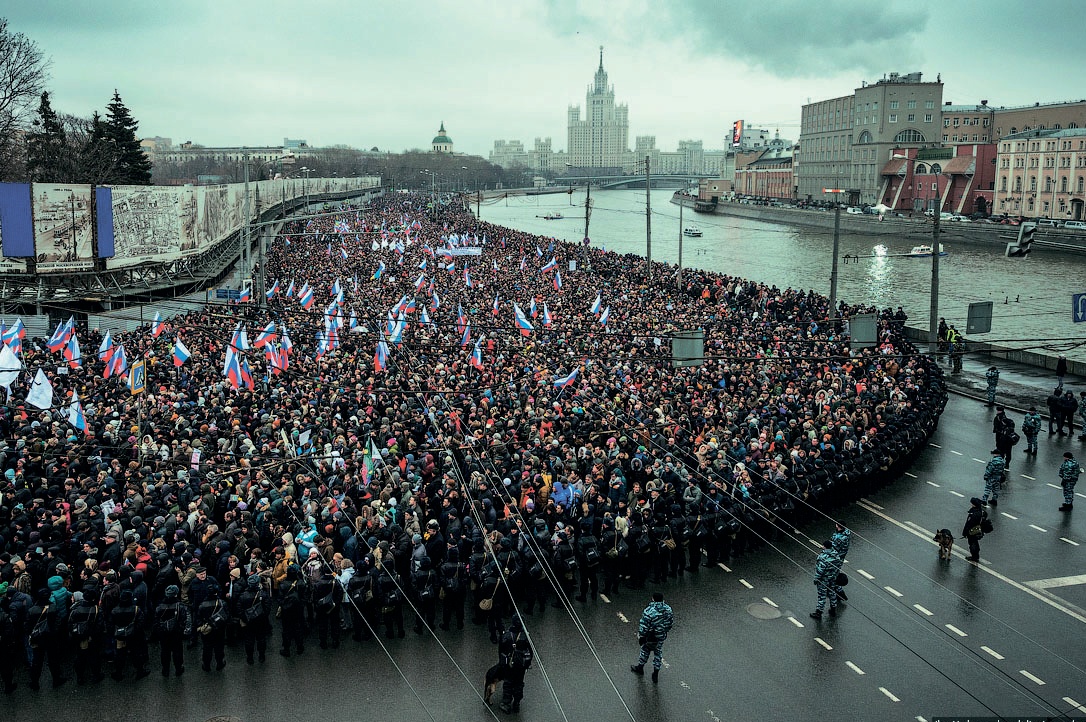
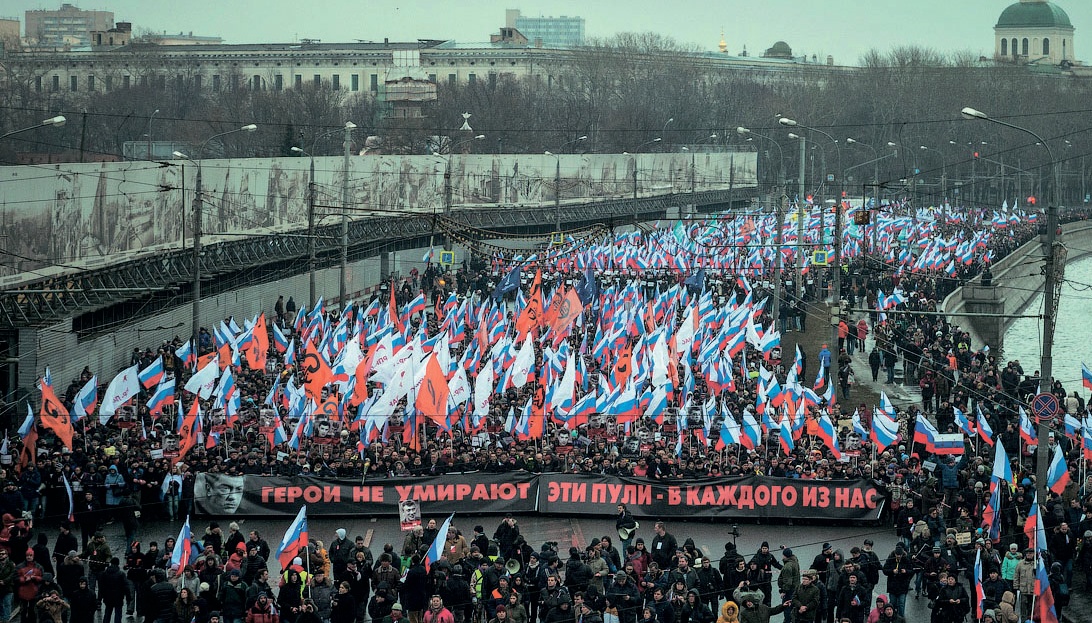
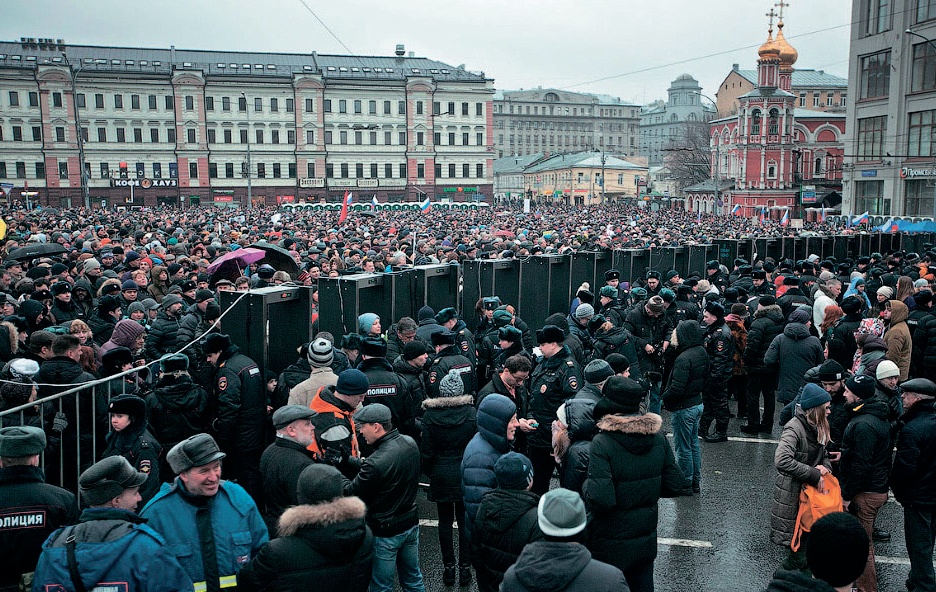
Nemtsov's murder took place in the run-up to an opposition protest planned for 1 March. Bearing in mind the current state of the opposition, it is safe to say that no more than about 20,000 people attended this rally. However, after the incident the rally was given an extra boost and instead of a protest demonstration a decision was made to arrange a funeral march in the centre of Moscow. A great many experts, both in Russia and abroad, waited with bated breath expecting the funeral march to turn into a kind of "local Maidan" which would ultimately destabilize the socio-political situation in the country. However, the worst expectations did not transpire. Either commonsense prevailed among the opposition or the Russian special services reacted promptly to the challenge… Incidentally, there was a report that a number of provocative groups appeared, and before the march itself the Moscow police managed to arrest a Ukrainian MP and an active participant in the tragic events in Odessa in May 2014, Aleksiy Goncharenko. He was found to be in possession of a huge amount of US dollars and he admitted that the money was his. Rumours had been going around the Russian Internet about the involvement of Ukrainian nationalist groups in Nemtsov's murder as a catalyst of the "Maidan" organization. However, none of this has yet been proved and it is too early to confirm anything.
One thing is clear. Nemtsov's murder did not lead to widespread protests and a "Maidan" in Russia. In our opinion, one of the reasons for this could be the fact that in Russia, unlike in Ukraine, there are no hostile and powerful oligarchic regional clans and groups. Yes, Russia has a whole host of problems. But unlike all the countries that experienced "orange revolutions", in Russia there is no disgruntled region like, for example, West Ukraine under Yanukovych or oligarchic groups openly funding protests.
How will Nemtsov's murder impact on Russia's future? Most likely, it will remain a kind of Sword of Damocles which will hang over the head of this country's leaders for some time. Suffice to recall the murder of [Georgiy] Gongadze, who opposed former Ukrainian president [Leonid] Kuchma, the murder of the Argentine prosecutor Alberto Nisman who exposed President Cristina de Kirchner's "shenanigans", or the [Russian lawyer Sergey] Magnitskiy affair in Russia. Incidentally, it was the Magnitskiy affair which became the reason sanctions were imposed on Russia, and not the Ukrainian question as some people mistakenly think. Nemtsov's murder could lead to new sanctions, even greater isolation, intensified diplomatic pressure in the context of the negotiations on Ukraine, and so on.
So, it could be said that after Nemtsov's murder the opponents of the Russian authorities have a fairly strong lever in their hands and we shall wait and see how they use it.
RECOMMEND:
 936
936