

100 PER CENT QUALITY
The AZNAR enterprise plans to become the world’s leading producer of pomegranate juice

Author: Rasmiya QAMBAROVA Goycay
Azerbaijan has entered a phase of economic development in which, along with the restoration of various branches of agriculture, the country is able to supply domestic products to demanding Western consumers.
Our fruit and vegetables, as well as the products of processing, are key to this story. Indeed, Azerbaijan does not possess just one plant distinguished for its taste and healing properties. The pomegranate can rightly be called the "king" of our fruit - some kinds of pomegranate grown in our country are unique. The products of this fruit, especially 100 per cent natural pomegranate juice, are of special interest to the foreign consumer. It is no surprise that the products of Goycay's AZNAR plant, which produces the GRANTE brand of pomegranate juice, are widely popular abroad and have won numerous awards, competitions and exhibitions. Among them was overall victory in the Best Product of 2009 category at the 16th PRODEXPO-2009 international exhibition in Moscow, attended by 37 countries.
According to the deputy director of the plant, N. Asgarov, the history of the plant dates back to 1967. It functioned as a buyer within the Central Union. The high productivity of this region led to the creation of industrial plants for processing pomegranates, apples, cherries etc. In 1970 it was renamed a juice plant. In 1981, the Council of Ministers and Heydar Aliyev issued a decree to open a new pomegranate processing plant. Two state farms were set up to provide the raw material, and yield reached 25,000 tonnes. Two years later, it was a pomegranate processing plant, with three lines able to handle up to 15 tonnes of material per hour.
In the early 90s, the plant almost collapsed but, in 2005, after the plant was bought by businessman Farhad Ahmadov in memory of his father, who was its first director, the company was given a second life. An investment programme was designed to revive the industry.
"We can be proud of producing an environmentally clean and very useful health product - natural pomegranate juice," noted AZNAR CEO Aleksandr Kryuchkov. Thus we began our interview with the manager of the pride of Azerbaijan's food industry.
- Export-oriented industries must comply with international standards. What work has AZNAR carried out towards this?
- In the nature of my work i have to visit similar plants in different post-Soviet and other countries. Everything becomes clear by comparison - without false modesty I would say that the principles of production in our enterprise are in no way inferior to those of our foreign counterparts.
Today several standards apply to the world's food products - ISO and HAASP. And preferences are different: for example, France, Germany and Britain work mainly to ISO standards. The quality of a product is made up of different components - raw materials, equipment, technology, personnel and acceptable conditions of work. We have prepared carefully to obtain the ISO. We plan to complete work within the next month. The problem is that there is only one auditing company to certify the ISO in the entire post-Soviet area. We are looking forward to its visit to our company in early September. I must say that the requirements are quite strict, although, after contact with Japanese colleagues, we have changed our opinion slightly on this matter. The thing is that the Japanese are quite picky and demanding, especially when it comes to health, and we had to endure such tests that we did not even dream of the ISO... The commission comprised Japanese chemists, biologists and experts on standardization. They took samples of soil, both dry and wet, samples of water at a certain depth, they studied the composition of glass bottles, as well as the possible impact of the cover on the product, and tested the temperature at different stages of production. In short, it remained only to take samples of the air. But the result of this scrutiny was a contract, and now AZNAR is preparing to supply the first shipment of our products to distant Japan.
- To which countries are you already supplying pomegranate juice?
- Today, natural pomegranate juice under the brand name GRANTE presents Azerbaijan as a country manufacturing environmentally friendly products of high quality. Let us start from afar - New Zealand, Canada, Japan, Germany and France; former Soviet republics - Kazakhstan, Russia, Belarus, Ukraine and Georgia. The geography of our exports will expand. The ultimate goal is to make the plant a world manufacturer and supplier of natural pomegranate juice.
- There is, however, tough competition on the market now. How can a consumer be sure that your product is the best?
- Juices are divided into two categories: home juice, whose technology of preparation is simple and well known. There are also commercial juices, which are also divided into two categories: 100 per cent juices of direct extraction, and recovered juices. Today, many countries, the European Union, Russia and Belarus are trying to avoid using the word juice in the manufacture of recovered juice, because these products can only be called juice by stretching the definition. For an analogy, many countries previously produced milk and milk beverages, and all this was called milk. But, legally, some countries now differentiate between milk and milk beverages.
In the near future, the legislature will come to the same opinion regarding juice. The consumer should know what kind of product he is buying and why the same name attracts a different price. The point is that the vast majority of juices are recovered from concentrates and purees. I will not say that it is bad, but it is not actually juice. Juice is a fruit or vegetable squeezed directly, treated with a special technological method, filtered and heat-treated. Natural juice does not contain a single drop of water, dye, sweetener or sugar.
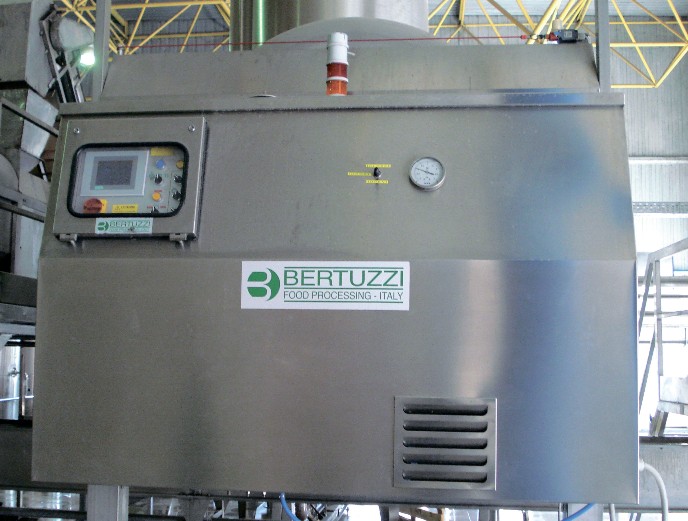
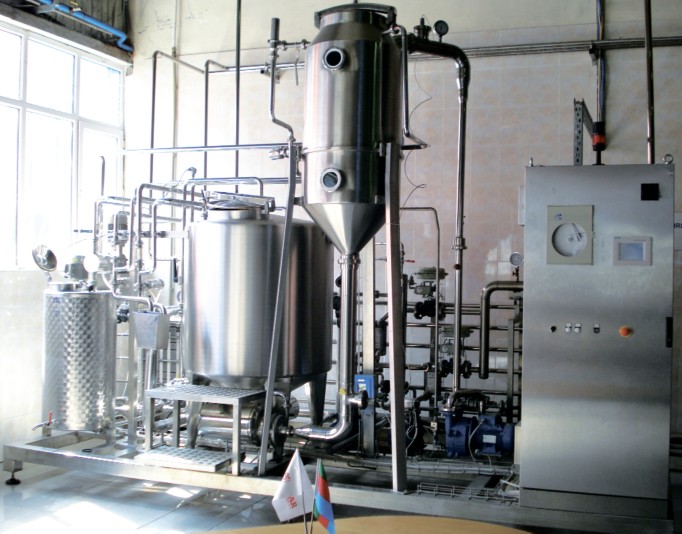
To sum up, I should note that AZNAR juices are 100 per cent natural juices of direct extraction. The raw material goes through several stages of processing: the reception line receives the product itself and then it undergoes visual inspection, i.e. sorting. The whole technological process of juice production is then carried out; it is a particular process in that during squeezing only the grain goes under the press. We purchased special equipment to peel the pomegranates. This is done for several reasons. First, the peel is used to produce tannin, which is used in the pharmaceutical industry - we strive for a clean product which is welcome around the world. The second positive aspect is that this affects the quality of juice, because the peel adds bitterness. The prepared juice is stored in special tanks which satisfy all requirements for the storage of such products - under a regime to regulate pressure and temperature. This makes it possible to keep the product in its original form for up to two years. We produce concentrate independently to sell to companies that produce so-called recovered juice.
By the way, the water for industrial purposes comes from two artesian wells, one of which is located at a depth of 120 metres and the other at160 metres. There are two buildings with water tanks with capacities of 250,000 litres each and they are treated with products of European manufacture which are used in food production.
- What is the complete range of AZNAR products?
- We focus mainly on the production of pomegranate juice: we produce 100 per cent pomegranate juice of direct extraction, pomegranate juice of 100 per cent unfiltered direct extraction, nar sarab, i.e. pomegranate sauce, (we are currently working on a design for the packaging; it will be a small bottle in the form of a jug) and tannins for pharmaceuticals. Soon we will obtain equipment for the production of pomegranate oil from the seeds. We want to ensure a full-cycle and production without waste. But that is not all. In addition, we produce quince juice of direct extraction - a product which is quite specific and unfamiliar as yet to foreign consumers. In autumn, we will make apple juice of direct extraction and will begin to produce 5 or 6 other types of juice. We also produce jams from various fruit.
We plan to expand the range of products; we have already purchased the equipment. For example, we recently acquired the latest water treatment equipment using reverse osmosis, which is capable of clearing any water - important in the technological process. I must say that the whole production process is automated, as we are trying to avoid using unskilled manual labour. This equipment is connected to the Internet so that its producer will be aware of any emerging problems or failures.
- The Goycay District is the home of the pomegranate. How do you solve the problem of acquiring the raw material, because the plant has a large capacity and the company plans to become a global manufacturer...
- To get juice of high quality, the raw materials, as source material, must also be of the highest quality. We try to use products which are intact. To do this, we purchased 700 hectares of land and planted 400 hectares of pomegranate trees of about 10-12 varieties over 2 years. We work with farmers and cooperate closely with the Ministry of Agriculture base, where we cultivate various varieties of pomegranate on nearly 80 hectares of land under the supervision of specialists. Work is under way to revive a number of very well-known varieties of this unique healing fruit. I would note that today the technological capacity of the plant makes it possible to handle up to 10,000 tonnes of raw materials seasonally.
- What is the pricing policy of the company's management?
- It is flexible. We deal with every country and every client on an individual basis. For comparison, in Japan, a 0.75 litre bottle of pomegranate juice we sell for 3 euros, in Azerbaijan it is 2 manats. We meet our customers halfway.
RECOMMEND:
 806
806

