

A PATIENT MORE DEAD THAN ALIVE
Plans to reintegrate the ex-Soviet region around Russia are doomed to failure
Author: Rasim MUSABAYOV, political analyst Baku
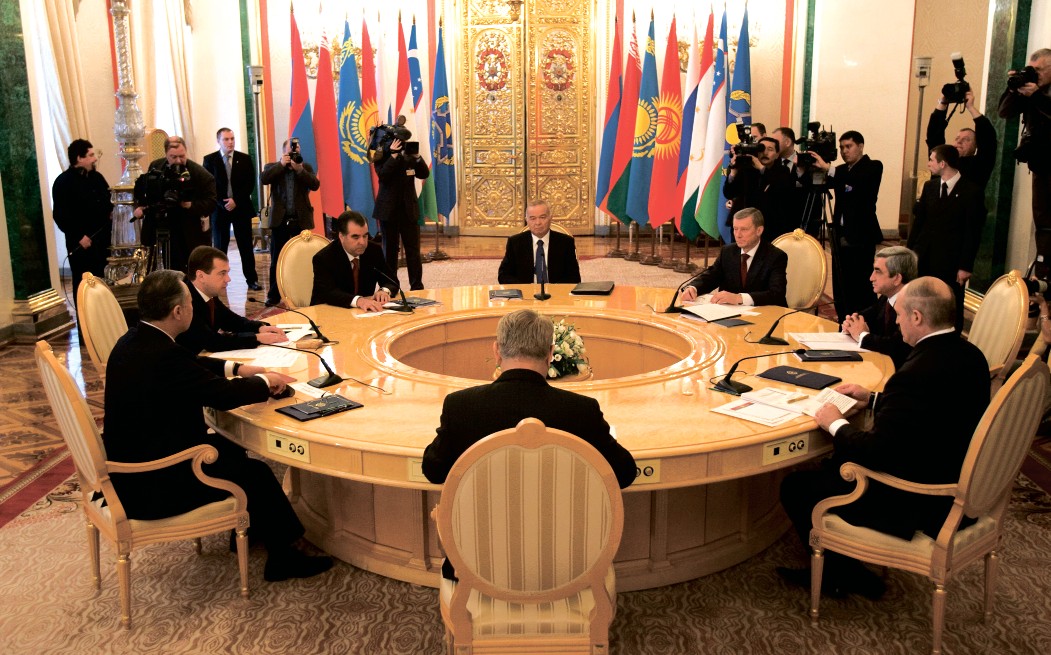
Two quite significant events took place in the ex-Soviet region in recent months. One was the failure of the informal CIS summit in Kazakhstan, which many heads of states, including Azerbaijani President Ilham Aliyev, ignored. The second was the summit of the Collective Security Treaty Organization (CSTO) and the Eurasian Economic Commonwealth (EvrAzES), which was held a few days ago in Moscow and had been promoted as an important step towards a true integration of member countries.
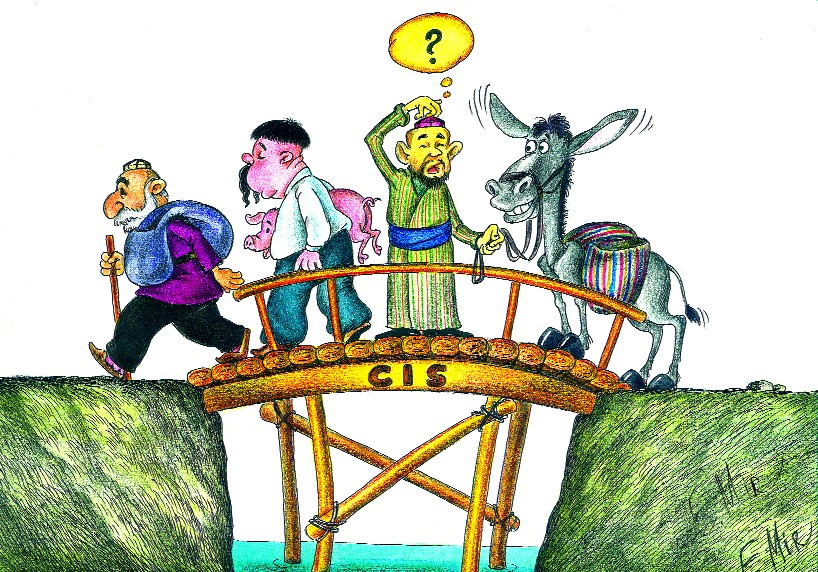
That the CIS, as a project of integration, has exhausted its potential is evident. Interest in the organization is declining rapidly despite the routine official optimism. Attempts to move forward the concept of developing the commonwealth and injecting some life into it have yielded no results. Following the Russian-Georgian military confrontation in August and Moscow's illegal recognition of the separatist regimes in Abkhazia and South Ossetia, Georgia, the last country to join the CIS, left its ranks. Ukraine has never found time to ratify the CIS Charter in the last 18 years and, given the tensions in Ukraine's relations with Moscow and the country's NATO aspirations, the Ukrainian leadership is not particularly keen to take part in the Commonwealth's work. Turkmenistan chose to keep its distance from the CIS back in Niyazov's time, citing its adoption of "permanent neutrality" as the reason. New Turkmen President Berdimuhamedov's participation in CIS summits of heads of states has not been transformed into a desire to rejoin the commonwealth. Ashgabat talks about associate membership (the CIS has no such status) and nothing further. As for Azerbaijan, it takes part in CIS work, but refuses to sign, or has important reservations about, decisions reached within the CIS framework as conflicting with the sovereignty and interests of our state.
If we look at the name of the organization, the CIS's mission for a "Commonwealth of Independent States" implies strengthening the independence of member countries. The CIS was created and functions to ensure a "civilized divorce" of the former Soviet republics. In this respect, the commonwealth addres-sed a whole range of problems - from military to economic and from foreign policy to humanitarian. It was within this framework that independent states came into being and matured. The CIS provided safety nets for all member countries during their economic transformation and the establishment of new market mechanisms and democracy. Customs, foreign politics and military organizations were developed within its framework.
However, this mission is now largely complete. The civilized divorce of the new independent states and the division of the Soviet inheritance was mostly accomplished by the late 1990s. And Moscow's efforts to transform the CIS into an integrated union under its aegis remain fruitless. In this sense, the interests of Russia and many ex-Soviet nations, especially those oriented towards Europe, proved to be directly opposed. This resulted in a slow but sure weakening of the CIS.
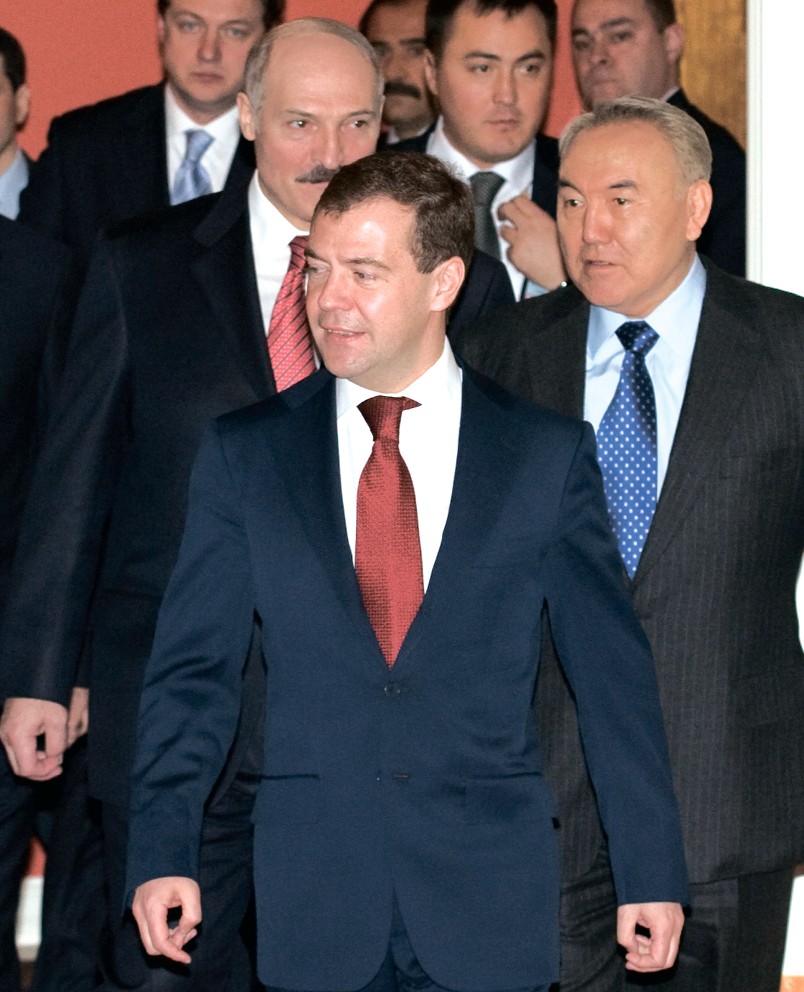
Apparently having realized the futility of its plans for the CIS, Moscow decided to shift the emphasis of its integrationist policy towards the CSTO and EvrAzES. At first sight, the Russian leadership's efforts during the recent joint summit of these organizations in Moscow were successful. On 4 February, Russia's staunchest allies, Armenian President Serzh Sargsyan, Kyrgyzstani President Kurmanbek Bakiyev, Kazakhstani President Nursultan Nazarbayev, and Belarusian President Aleks-andr Lukashenko, met in the Kremlin. At the last moment, the Russian Federation's leadership managed to persuade Tajikistani President Emomali Rakhmon, who, shortly before, had voiced his displeasure at the fact that, despite earlier agreements, Medvedev announced during a visit to Uzbekistan that Moscow would finish the construction of a dam and a chain of power plants in the mountains, without Tashkent's consent. Uzbekistani President Islam Karimov arrived in Moscow too, although Tashkent announced its withdrawal from EvrAzES just recently.
A special session of the CSTO Council decided to deploy combined permanent-readiness forces. These forces would number 10,000. Apparently, the majority of these troops will be Russian (an airborne division and an assault brigade) and Kazakhstani (an assault brigade). The other participants in the agreement will each add one battalion. In peace time, these military contingents will remain at their permanent stations under the command of their national military bodies. The CSTO joint staff will only coordinate operations.
Russian and Armenian propaganda flaunted this decision as something extraordinary. Russian President Dmitriy Medvedev even compared this force, which is yet to be created, with corresponding NATO formations, which have existed for a long time. "Well-trained and strong formations are currently being created, they are well equipped with the latest military hardware, and their potential will be no less than that of the formations of the North Atlantic bloc," the Russian leader said. For his part, Armenian military analyst Major General Katandzhan rushed to speculate on the sobering effect of this decision about CSTO mobile forces on Azerbaijan and its plans for a military solution to the Karabakh conflict.
It is hard to understand what motivated the statement by the Armenian analyst - bragging or self-delusion. Apparently, no matter what is created within the framework of the CSTO, no member state beside Russia will send its troops to support Armenia in a war with Azerbaijan under any circumstances. It is also unlikely that Moscow can count on this type of aid in a conflict with Georgia, especially as some CSTO members commented immediately about the combined security forces to be created. Uzbekistan, for example, will not participate on a permanent basis, but selectively, depending on the operation. Belarus said, via Foreign Ministry Press Secretary Andrey Popov, that its law bans its citizens from taking part in military operations outside the country. In other words, Minsk, like Tashkent, will not allocate troops to the new combined operational reaction force. During the CSTO February summit, however, Russia and Belarus signed a long-awaited treaty on the creation of a unified air defence system, and this is more important for the Kremlin.
As for the Eurasian Economic Commonwealth summit, which took place in parallel with the CSTO session, it too brought poor results. An anti-crisis fund of $10 billion will be created by the EvrAzES, from which member nations can draw money if need be. Russia and Belarus will finally lift all transit limitations within the framework of their bilateral customs union this year - customs offices will be moved to the borders of the union.
The investment fund will be organized specifically to simplify the process for the reception of stabilization credits by commonwealth nations to support their economies during the crisis, as President Medvedev said during a press-conference, and Russia will hold a controlling share in the fund. It will make the largest contribution, $7.5 billion, and Kazakhstan will allocate another $1 billion. Only countries making financial contributions to the fund will be able to receive credits.
"If there is anything binding the ex-Soviet nations to Russia, it is the preferential terms and loans which we issue to these republics," Mikhail Delyagin, head of research at the Institute of Problems of Globalization, maintains. In his opinion, Russia made concessions first and foremost because of the economic crisis, and the threat of regional destabilization is real in the Central Asian nations. "Central Asia fears that Americans will cause chaos in Pakistan and Afghanistan, and then the Taleban's military and political pressure on the ex-Soviet Asian nations will increase. In addition to the increasing social tensions, this is very dangerous for those republics. This is why they want to enlist Russia's support," Delyagin said.
The EvrAzES and CSTO aroused a squall of ironic and biting comments in the Russian and foreign mass media, boiling down to the observation that Moscow buys its "friends." For example, Belarusian President Aleksandr Lukashenko received the second tranche of a $2 billion anti-crisis credit which had been promised earlier (the first billion was transferred back in November), along with assurances to consider an additional credit of $100 million. Kyrgyzstan received a preferential credit of $2 billion from Moscow. Bishkek's debt was entirely written off, and Kyrgyzstan received $150 million in grant aid, essentially in return for the withdrawal of the US military base from Manas. Armenia was promised $500 million rather than the $1 billion which Sargsyan asked for. However, it might well turn out that the financial crisis will reduce Russia's financial resources, and grants to their allies do not guarantee their long-term loyalty.
For example, the Kremlin has spent much time and money persuading Kyrgyzstani President Bakiyev to close down the US military base at Manas near Bishkek. But it emerged that despite loud statements, Bishkek is in no hurry to put the decision into practice. At any rate, the country's parliament has not made a final decision, and it may be reasonably assumed that Kyrgyzstan awaits counterproposals from NATO and the United States. At the same time, another Russian ally in CSTO, Tajikistan, immediately stated its readiness to offer not only its ground infrastructure, but also its air space to NATO for the transportation of non-military cargo to Afghanistan.
Russia rallies the CSTO and EvrAzES to its banners, signs an air defence agreement with Belarus and strives to close the base in Manas to consolidate its position in anticipation of "bargaining" with the new US Administration. However, this does not seem to have impressed Washington. Speeches by the US Vice-President and the NATO Secretary General during the Munich security conference proved that the US missile system deployment programme in Europe has not been cancelled. NATO's doors have not been shut on Georgia and Ukraine. The negative response to Moscow's recognition of South Ossetia and Abkhazia as independent states has not changed, and the inadmissibility of deployment by the Russian Federation of its military bases in those regions was reaffirmed.
Russia poised itself for a struggle for spheres of influence with the United States, as is its habit, whereas the geopolitical situation near Russia's borders is changing dramatically. In mid-February, the Czech Parliament will discuss, and is expected to pass, the Lisbon Treaty. Ireland, the only EU country to reject the treaty, will be called upon to revise its decision in a new referendum. So, the expected reorganization of the EU into a federation will enable it to increase its role in international policy and security matters. Obviously, Brussels' efforts will focus mainly on areas adjacent to the borders of a united Europe. Moscow's ambitions to secure an exclusive position for Russia in the ex-Soviet region will soon encounter opposition, not only from the United State, but also from the EU. In short, given falling energy prices and financial and economic crises, Moscow, in confronting a united Europe, will find it very difficult to realize its plans to restore its hegemony in the ex-Soviet region. Russia has been trying to do this for many years, using numerous economic levers - cheap natural gas, preferences, credits and many others. But Moscow has failed. And today, when it faces serious economic problems itself, the restoration of its previous hegemony does not seem plausible. This is why Russia has decided to use military levers - forming collective forces to be deployed in the former Soviet republics. This will be nominally "collective" but, essentially, a Russian army.
RECOMMEND:
 610
610

