
MUGAM FOR THE CELLO
Eldar Iskandarov: "My dream is to revive the cello in Azerbaijan to such extent that cello festivals will be held in Baku"

Author: Elya ANVARLI Baku
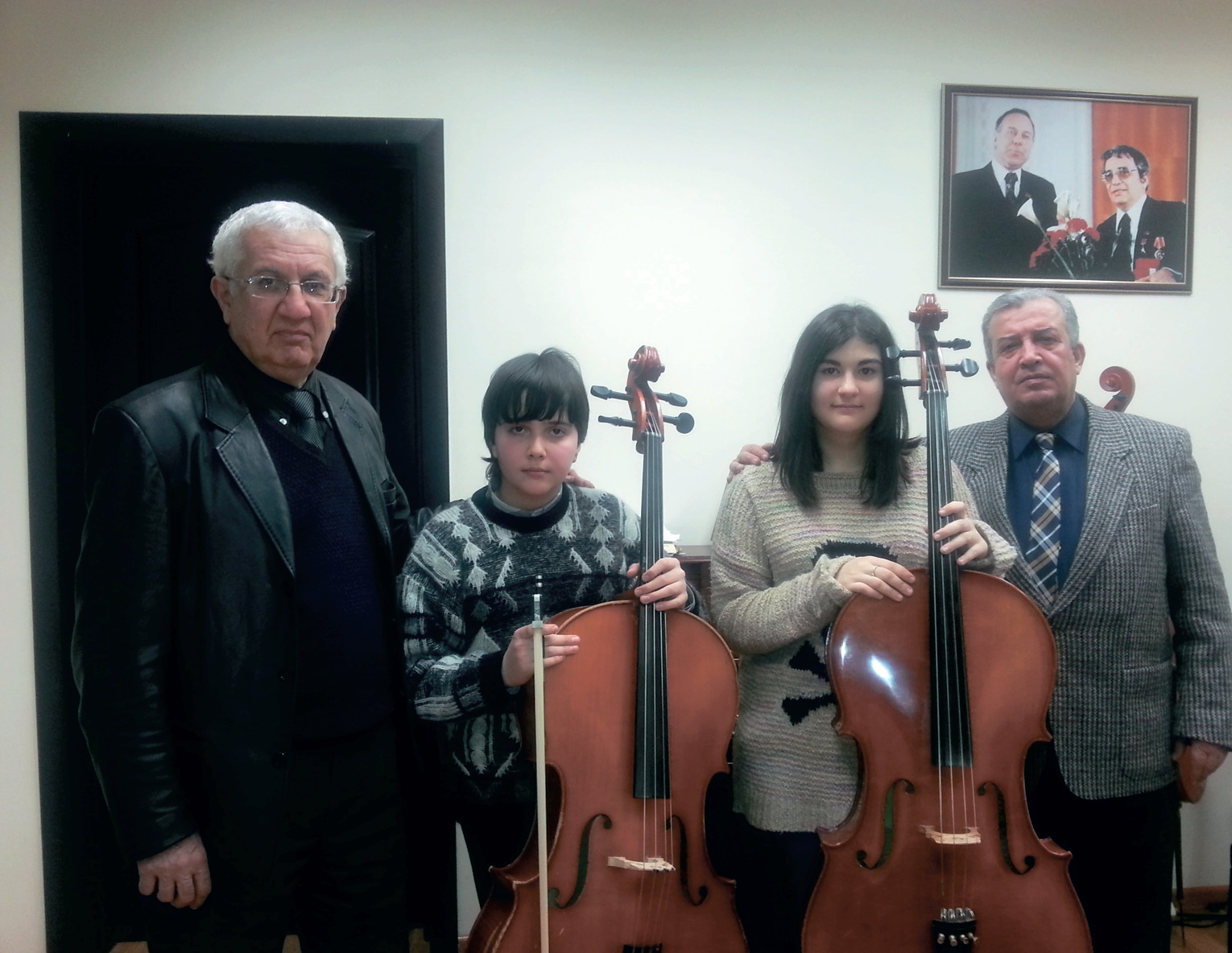
There are people who spend their lives producing creative works without stopping, not even thinking about whether they will be rewarded for their effort. These people love and value creativity to such an extent that they have devoted their lives to it and literally become absorbed by it. People's Artiste of Azerbaijan, cellist Eldar Iskandarov can quite justly be counted among those fanatics who are dedicated to their cause. At the present time, he is a professor at the Istanbul State Conservatory and is living in Turkey.
Iskandarov is the author of the book "Seven Classical Azerbaijani Mugams", the main content of which is the sheet music for the instrumental arrangement for the cello of a dastgah mugam, based on the version by the mugam expert and kamanca player Arif Asadullayev. Generally, the Azerbaijani cello school is highly esteemed in the world. It can confidently be asserted that this came about not just thanks to the Rostropovich father and son and the Azerbaijani cello teachers Isaak Turich, Vladimir Anshelevich, as well as Sabir Aliyev, but also thanks to Eldar Iskandarov. In an interview with Regionplus he spoke about his life, his career plans and so forth.
- Please tell us something about yourself, about your family and your teachers. Were you born into a musical family?
- No, my father, Huseyn Iskandarov, was the minister of transport, then the secretary of the Central Committee and the head of Gosplan [State Planning Organisation] of the Soviet Socialist Republic of Azerbaijan. My mother, Sugra Qaibova, was one of Azerbaijan's first women deputies and a Stakhanovite [super hard-working] oil worker. In short, my parents were extremely far removed from art in their professions, but they were quite culturally minded. At home, classical music, ballet and art works were always held in high esteem.
As far as my teachers were concerned, during the 10-year course at the music school I received my cello lessons from Vladimir Tsezarevich Anshelevich, and perfected my mastery of the cello. For two years my master was Isaak Turich, a pupil of the famous Semyon Kosolupov, who had been invited to our conservatory by Uzeyir Hacibayov in the 1940s.
It was precisely from Turich that I learned many of the secrets of producing the right sound and learnt to go about performing each musical work in a well thought-out manner; tutored by him, I managed to play heaps of cello pieces in a short time. Finally, Sabir Aliyev, under whom I studied for seven years and then at the conservatory, an outstanding cellist and person of incomparable spirit, to whom I shall remain grateful and love to the end of my days… The life of a teacher is always an unfinished sonata, which his pupils are obliged to finish. I have assiduously tried to match up to this commitment over all these years that have passed since the untimely death of Sabir muallim [term of respect in Azerbaijan]…
I would like to set up an ensemble of cellists, drawing on the example of my favourite teacher.
It was precisely in this period when I was studying in his class that I became a laureate of the Transcaucasian Music Performers' Competition, and was also awarded the Certificate of Honour at the All-Union Cellists' Competition. Then, after graduating from the Baku Conservatory, I completed post-graduate studies at the in Moscow Tchaikovsky Conservatory under the splendid professional Tatiana Primenko. I have to admit that I always struck lucky with my teachers.
- Besides performing and doing teaching work, you also publish collections of arrangements of Azerbaijani musical works for the cello. To what extent are Western instruments suitable for the full-bodied rendering of specifically oriental music?
- Yes, in my collection "Seven Azerbaijani Classical Azerbaijani Mugams" for cello solos I have tried to demonstrate the technical possibilities of the instrument that is closest to me as far as possible. Pizzicato, glissando, flagioletto, double notes…
Uzeyir Hacibayov spoke about the possibilities and needs of arranging mugam for European instruments. I can say that these instruments are unusually rich, both in their technical possibilities and in their timbre. So, Hacibayov thought that the most suitable instruments were primarily the trumpet and the trombone with their bright, fanfare-like sounds and that they were good for performing the "Rast" mode mugam.
At the same time, the soft sound of the French horn and deep low timbre of the bassoon splendidly convey the sounds and character of the "Sur" mode mugam. The closest instrument to the kamancheh is the violin. Owing not only to the violin's rich, clear sound and its special timbre of every string, when the "Segah" mode mugam is played on it, it sounds very impressive. The viola is splendidly suited to playing the "Cahargah" mode mugam, making it sound more sorrowful, with a slightly muffled, dulled sound.
The cello with its unique, captivating, magical sound and its amazing timbre has literally been created for performing "Sustar", "Bayati-Siraz" and "Humayan" mode mugams… Professor Mammad Saleh Ismayilov, a researcher into Azerbaijani folk music, has vividly described the dastgah mugam as a monumental musical temple. Putting together dastgah "sections" and "guse", he compared them with the columns in a church, and the various types of melismas [melodies] as a kind of "architectural" decor. But, so that any church retains its feeling of being majestic, sooner or later it has to undergo reconstruction. In this sense, mugam is no exception.
As far as books are concerned, then the first to be published were "The Works of Azerbaijani Composers for Cello and Piano" in two volumes, as well as "Duets for two Cellos for Beginners" and "The First Steps on the Cello". The presentation of the collections, which took place at the Museum of Azerbaijani Musical Culture, attracted great interest. Young cello players played there.
- You have had the good fortune to have contact with the musicians Niyazi and Mstislav Rostropovich. What do you recall about that?
- I was playing in the symphony orchestra conducted by Niyazi. I remember his magical hands, which you focused on all the time, forgetful of all else. As regards my idol Rostropovich, at the request of the Ministry of Culture [and Sport], I even lent my instrument to him once during his stay in Baku. I shall never forget how he helped me cope with a technically difficult episode in a concerto, when he advised me to sing along without interrupting the part played by the flute. So, everything was resolved technically. What a genius he was in everything. Although he had a lot to do, he managed to rehearse with the orchestra, to give master-classes and play 10 legendary concerts in five evenings, in which he did not play a single work twice. Simply phenomenal!
- You are known to play in the so-called orchestra of the three seas. Please can you tell us about that in more detail…
- The best musicians from 23 countries are gathered together in the Tekfen Philharmonic "united orchestra of friendship". Each individual soloist in it can play as a soloist or with the accompaniment of the orchestra. Well-known composers write music for the soloist, including for folk instruments. You come into contact with different musicians and exchange impressions and sheet music. There is real friendship among musicians. The sheet music is sent out to us beforehand so we can become familiar with the repertoire, then we usually meet up in Istanbul, rehearse together and then go off on a guest tour.
- You were the first to perform the compositions of Fikrat Amirov, Asraf Abbasov, Sevda Ibrahimova, Azar Rzayev, Farhang Huseynov and other Azerbaijani composers as well. You have made records, CDs, and been on endless guest tours around different countries… Your repertoire includes Telemann, Vivaldi, Haydn, Tchaikovsky, Shostakovich… Compositions by many of the greatest composers like Mozart, Paganini, Qara Qarayev have been arranged for you for the cello. How do you manage to find time for all of that?
-You can add my teaching activity to that too. All that I spend my time doing forms the main sense of my life. Once you have really fallen in love with something, it does not seem burdensome to serve the object of your love… it is even really enjoyable. In Turkey, for example, there is great interest in the art of music, and in the cello in particular. Perhaps, in order to boost the cello repertoire of Azerbaijani compositions, I will also compile my own collections which I shall often publish at my own expense. I do that for all the musicians, in order to demonstrate the beauty and perfection of this splendid instrument and of Azerbaijani music.
- You have played in prestigious venues on guest tours around Belgium and Holland, France and England, Germany and Spain, Japan and the USA. There were probably some curious incidents of the type that musicians like to tell.
- When we go on a guest tour abroad with the string quartet, we always buy five tickets, not four, with one being for the cello. In the Soviet times, we were given a discount, which for some reason did not apply to the cello's ticket. When we asked why, they quite reasonably replied: it is not a citizen of the USSR. Then on the return journey, at London's Heathrow airport, they asked where my lady friend was. I pointed to the cello case. But they did not want to let the instrument on the plane, explaining that this was not Mrs Violoncello, but simply a cello (as they call the violoncello there).
- But joking apart, if we are serious, what are your plans and pro-jects?
- Concerts are scheduled in Poland, I am completing the arrangement of Paganini sonatas for two guitars and cello, with which my students and I will take part in a guitar festival in Turkey.
- You are fanatical about what you are doing. Do you consider yourself to be a happy person?
- It is hard for me to achieve everything, but I always try to finish what I have started. But I do have a dream, and that is to revive the cello in Azerbaijan and bring it up to such a high level that it will be possible to hold international cello competitions and festivals in Baku. I am working to this end, helping Baku musicians, holding master-classes, publishing original arrangements for the cello and editing new works by Azerbaijani authors.
- Besides your highly professional occupation with music, you are no less professionally engaged in playing draughts (a candidate master of the sport), mountain trekking, stamp collecting and writing current affairs items.
- In my view, any creative personality has to periodically diversify his activities, so he retains a fresh perception of the world.
- Which composer do you like to play most?
- Bach. His music is regular, but at the same time elevated. For me the most important thing about Bach is that his music is evergreen. His music is contemporary in that there is no place in it for the accidental and the transient. Bach's feeling is directed towards the future and therefore his music knows no horizons.
- And what do you think is most important in a performer?
- Sincerity.
- What are your parting words to young musicians…
- Value your teachers and arrange your practice sessions at home in a clever manner. For diligence is also a talent. Work at it and keep on working at it.
RECOMMEND:
 271
271