

IN SEARCH OF A PARTNERSHIP
EU proposes new ways to enhance co-operation with Central Asia
Author: Samir VELIYEV
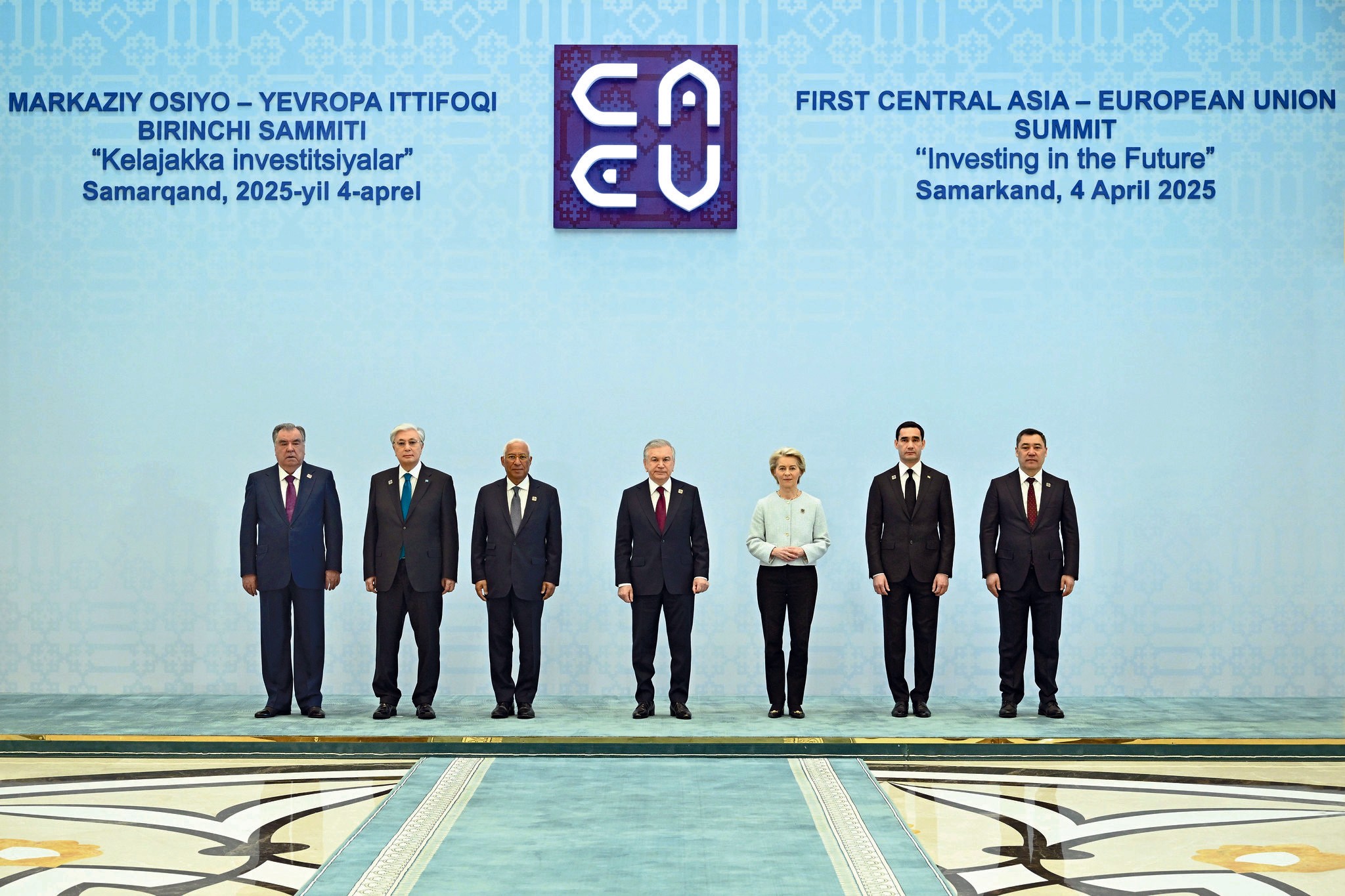
The inaugural official Central Asia-European Union summit, held in Samarkand on April 3-4, clearly highlighted the growing significance of Central Asia on the global political stage over recent years. Although similar meetings have been held before, the decision to label this gathering as the First Summit of its kind signals an effort to institutionalise and regularise future dialogues.
This summit unfolded amid a particularly complex phase in international relations, marked by rising unpredictability, weakening respect for international law, ongoing trade disputes, and escalating climate challenges. Therefore, the declarations and resolutions emerging from this event carry importance not just for those present but for a far broader group of nations.
Rare earth metals as a focus for co-operation
Uzbek President Shavkat Mirziyoyev reported that trade turnover between the EU and Central Asian countries now exceeds 54 billion euros—close to $60 billion. Kazakhstan accounts for 50 billion euros (83 per cent), Uzbekistan 6.4 billion (11 per cent), Kyrgyzstan 2.2 billion (3 per cent), Turkmenistan 1 billion (2 per cent), and Tajikistan roughly $0.5 billion (1 per cent). The quadrupling of trade volume over the past seven years reflects a deepening mutual interest in cooperation.
Strategically positioned at the crossroads between China and Europe, and between Russia and South and South-East Asia, Central Asia boasts abundant energy and mineral resources vital to Europe.
The region holds a significant share of global reserves: manganese ore makes up 38.6%, chromium 30.07%, lead 20%, zinc 2.6%, and titanium 8.7%. It also has considerable potential for rare earth elements such as scandium, yttrium, and lanthanides. In Kazakhstan alone, the US Geological Survey has identified 160 deposits rich in rare and rare-earth metals. Kyrgyzstan possesses nine strategic minerals listed by the US Department of Defence essential for high-tech manufacturing, with 75 such deposits recorded across the country. Uzbekistan has located 87 such deposits and Tajikistan 60.
Kazakhstan’s President Kasym-Jomart Tokayev devoted significant attention to rare earth metals at the summit. He has previously described these resources as “the oil of the 21st century,” underlining their economic importance. Kazakhstan holds 19 of the 34 raw material types necessary for the EU economy, including uranium, titanium, copper, lithium, cobalt, tungsten, among others. “Through our agreement with the EBRD, we are engaged in joint geological exploration projects and implementing best sustainable practices in mining. Kazakhstan plays a crucial role in clean energy production by supplying approximately 40 per cent of the world’s nuclear fuel,” he stated.
Uzbekistan also intends to expand uranium mining and exports considerably, planning to double production to 7,100 tonnes between 2022 and 2030.
The Presidents of Kyrgyzstan and Tajikistan also addressed prospects for developing rare earth metals. Shortly before the summit, they signed a historic agreement resolving border disputes, signalling a commitment to peaceful conflict resolution. This move sends a reassuring message to European investors that Central Asian economies offer stable environments where investments can flourish without fear of renewed conflicts undermining projects.
At the same time, European Commission President Ursula von der Leyen expressed the EU’s desire to partner with Central Asian nations not only in extracting but also processing critical raw materials locally.
Presenting new approaches
With serious competition from China—already active in developing rare earth metals across the region—von der Leyen introduced a fresh co-operation model. She pointed out that unlike other participants who focus solely on resource extraction, the EU aims to be a partner in building local industries. “Some focus exclusively on exploiting critical raw materials. Europe offers something different: partnership in developing local industry,” she explained.
Von der Leyen also highlighted that European companies have invested 1.6 billion euros in developing a copper deposit in Uzbekistan’s Tashkent region.
Today, Central Asia is viewed as one of the EU’s most dependable and promising partners, especially given their decades-long economic dialogue.
All parties recognise that effective economic cooperation depends on reliable transport infrastructure. This is particularly crucial for landlocked Central Asia, which lacks access to open seas and relies on neighbouring countries’ transit routes.
Prioritising the Trans-Caspian route and trade growth
Following the outbreak of the Russian-Ukrainian war and sanctions affecting Russia’s transport sector, the Trans-Caspian International Transport Route (TITR) has emerged as an indispensable corridor facilitating rising trade volumes between involved parties.
The EU proposes expanding this initiative into a broader Trans-Caspian Corridor, potentially including countries outside the current TITR membership. In Central Asia, this would mean all states except Kazakhstan; in the South Caucasus, Armenia.
Von der Leyen emphasised that normalising relations between Armenia and Azerbaijan and opening Armenia’s border with Türkiye are essential steps. She believes this would create genuine opportunities to establish a Trans-Caspian transport corridor for exporting resources via the Caspian Sea through Azerbaijan, Armenia, and Türkiye to Europe.
Armenia’s participation in regional transport projects depends on conditions set by Azerbaijan—namely opening the Zangezur transport corridor to connect Azerbaijan’s western regions with its autonomous region Nakhchivan smoothly. This arrangement offers new opportunities both for Armenia and the EU by diversifying routes and optimising transport networks. As Yerevan currently opposes opening Zangezur corridor, it remains excluded from Trans-Caspian corridor access.
In total, the EU pledged €12 billion for economic development and for boosting bilateral cooperation with regional states through a newly launched partnership programme. The European Commission President announced this just before her visit to Uzbekistan. In Samarkand she stated that strengthening ties with Central Asia forms part of the EU’s strategy to diversify foreign trade in response to tariff disputes instigated by former US President Donald Trump.
Von der Leyen added that Europe already has trade agreements with 76 countries; Central Asia is now next on this list.
Investing in tomorrow
Investment cooperation constitutes a vital pillar of this partnership. The EU is Central Asia’s largest investor, accounting for over 40 per cent of total investment—with Kazakhstan receiving most of it. Both sides are exploring ways to balance trade relations while aligning development with future priorities.
In particular, renewable energy projects are gaining prominence. Whereas earlier collaboration focused primarily on traditional energy sources such as oil and gas, today both parties are keen to advance renewable and environmentally friendly energy initiatives.
Central Asia has enormous untapped potential for renewable energy generation—a fact underscored repeatedly at the summit with regard to producing green energy for export to Europe. For instance, Uzbekistan plans to raise its total green energy capacity to 27 GW by 2030; just in 2024 alone it signed agreements covering development of 18 GW of solar and wind power capacity. Kazakhstan’s goals are more modest: increasing capacity by 5 GW from its current 2.9 GW by 2030. Combined with Azerbaijan’s green energy projects aimed at supplying the EU, these efforts contribute to creating one of the world’s largest green energy corridors stretching from Central Eurasia to Europe.
Historically, Central Asia has been an area where the EU played a secondary role compared with other global powers. However, amid present-day global trade tensions, the EU is determined to leverage its comparative advantages to attract regional states’ interest in co-operation—particularly in digital infrastructure, transport, and green energy sectors. This approach aligns not only with EU strategic priorities but also supports a broader vision for sustainable and progressive development throughout Central Asia.
RECOMMEND:
 266
266

