

TERMINAL BOOM
Baku, Astana, and Tbilisi speeding up expansion capacity of the Middle Corridor
Author: Aghasaf NAJAFOV
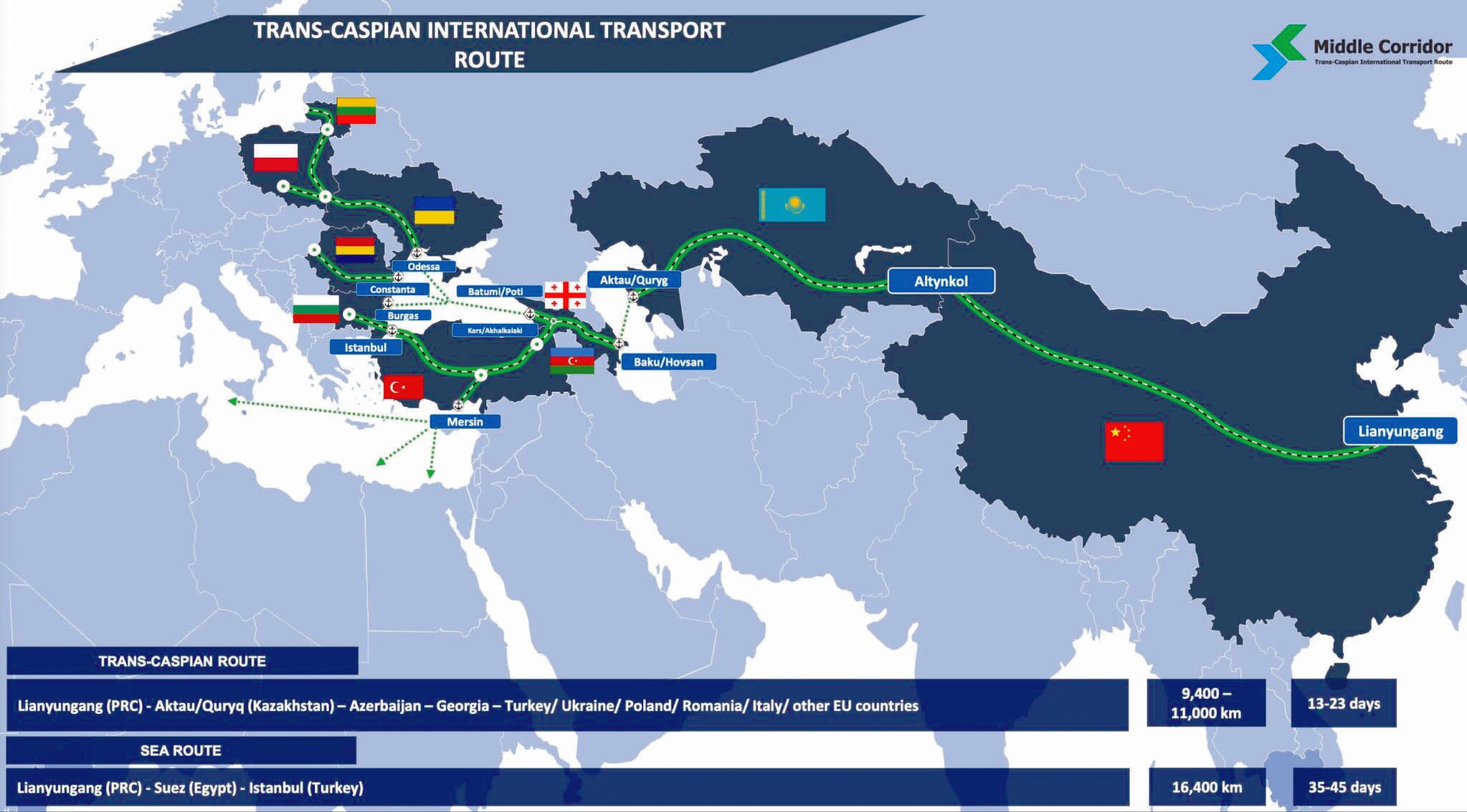
In the context of ongoing military conflicts in the vast Eurasian region, transport and logistics vectors have recently shifted towards the Middle Corridor. The short delivery shoulder, logistics security and established partnerships in the Caspian-Black Sea region have facilitated this. Investments in the development of port terminals and modernisation of the railways of the Trans-Caspian International Transport Route (TITR) have increased significantly. Kazakhstan's PTC Holding group of companies has therefore commissioned a state-of-the-art terminal near the Georgian port of Poti. The terminal was built by Azerbaijan's INNOPRO CJSC. At the end of June, the inaugural goods train from the Chinese province of Zhejiang, transiting through Turkmenistan to Azerbaijan, was launched. This initiative is aimed at expanding the throughput capacity of TITR.
Necessary alternative
The potential impact of Iran's threat to close the Strait of Hormuz on the global economy is significant, given that up to 25 per cent of the world's oil trade passes through this strategic waterway. Furthermore, in the past two years, missile attacks by Yemen's Houthi movement against merchant ships and tankers have already had an impact on maritime transport communications in the Bab-el-Mandeb Strait, the Red Sea region and the Suez Canal.
In light of ongoing regional and international conflicts, the threats pose a significant challenge to well-trodden transport routes.
"Türkiye is developing land and sea logistics routes to mitigate the risks of a potential closure of the Strait of Hormuz. We need reliable alternatives in case the strait is closed, which is why we are implementing the Development Route and Middle Corridor projects," Turkish Transport Minister Abdülkadir Uraloğlu told Hürriyet newspaper. The infrastructure of the Trans-Caspian International Transport Route is also being strengthened, with 2,200 kilometres of the route running through Turkish territory. Once all the work is completed, the time it will take to deliver cargo to Europe via the TITR will be reduced to a record 13 days.
The changes in the global transport system, the sanctions regime and geopolitical tensions, and concerns over energy security that have occurred since the start of the Russian-Ukrainian war have further increased the importance of the Middle Corridor. "This alternative route from China through Central Asia, the South Caucasus and Türkiye to Europe acts as a competitor to both the Northern and Southern Corridors and is causing significant changes in the geo-economic system. The Middle Corridor offers a more efficient and secure route for cargo transportation by combining transshipment of goods via sea, rail and road," says political scientist Azer Garayev, emphasising that the development of this route will undoubtedly contribute to the economic growth of all countries along the corridor.
The key advantages of this route include the absence of military conflicts on its way, which guarantees security for freight forwarders and shippers, as well as the presence of a mild climate, which ensures all-season cargo traffic. The primary benefit is the "short delivery shoulder". Container block trains formed in China typically take approximately 20-25 days to transit. This is half the time taken for transshipment of cargo from China and Southeast Asia by sea via the Suez Canal, which takes an average of 40-50 days.
Regional hub
Azerbaijan's location at the centre of the historical Silk Road has ensured the country's ongoing strategic importance in the evolving geopolitical landscape. Significant investments in transport infrastructure, the modernisation of the Baku-Tbilisi-Kars railway, the Baku International Sea Trade Port (BISTP) in Alat, and the construction and expansion of roads and steel highways have solidified the country's position as a pivotal Middle Corridor regional hub.
"Azerbaijan has invested in the construction of the BTC railway and recently allocated additional funds to increase its cargo handling capacity from 1 million to 5 million tonnes. Concurrently, we are allocating resources to the development of Baku Port, with the aim of increasing its cargo handling capacity from 15 to 25 million tonnes, in anticipation of emerging trade dynamics in the region," stated Hikmet Hajiyev, Assistant to the President of Azerbaijan, at the GLOBSEC-2025 forum in Prague. "We consider our country and the Middle Corridor to be of significant importance as a link between the two most powerful economic centres: the European Union and China, whose annual trade turnover exceeds 700 billion euros."
These endeavours to enhance transport infrastructure are yielding substantial commercial benefits, given the surging interest in Europe and China in transhipment along the Middle Corridor. While the volume of cargo transported through the TITR was around 600,000 tonnes in 2021, last year's volume reached 4.5 million tonnes, indicating a 1.5-fold increase. The most significant demand was recorded for container transport. In 2023, the number of Chinese container block trains travelling along the TITR was between 10 and 12. By 2024, this figure had increased to 390, which is more than 30 times the previous year. By 2025, it is anticipated that cargo traffic along the Middle Corridor will rise to 5.2 million tonnes, and by the end of 2027, this is projected to reach 10 million tonnes per year.
New terminal in Poti
To further increase cargo traffic, participants in the TITR project must expand transport logistics. The necessity for this is paramount, as there is frequently a bottleneck effect at the China-Kazakhstan border, at the port of Aktau, and in Georgian maritime harbours, which hinders the swift handling of cargo.
In order to overcome this negativity, Baku and Astana signed a Roadmap for synchronised debottlenecking and development of TITR for 2022-2027 just under three years ago. This includes the implementation of dredging works in Kazakhstan's Kuryk port, the development of railway infrastructure and the increase in the number of locomotives for loading and unloading wagons, etc. The project will involve the construction of a bypass railway line, the creation of a new railway line (Zhetygen-Kazybek), the construction of a new main line (Bakhty-Ayagoz) and the opening of a third border crossing with China (Bakhty-Chuguchak). The aim of these developments is to redirect cargo traffic to these new infrastructure.
Consequently, there has been a concerted effort in Georgia to expand the capacity of transport infrastructure. Following the completion last year of the reconstruction of the 184-kilometre section of the BTC that runs through the country's territory, a modern railway container and freight terminal was put into operation in Tbilisi. This terminal's infrastructure is designed for multimodal transportation. As part of the development of the TITR route, the container terminal in the seaport of Poti is being modernised and expanded. Two STS Post-Panamax cranes will be installed here, and the new berth will be able to accommodate vessels up to 300 metres long and with a draft of 13.5 metres. Consequently, by 2027, the container berth capacity will be augmented by a further 50,000 TEU (standard 20-foot container), thereby elevating the total annual handling capacity to 400,000 TEU.
A key milestone in TITR's strategic growth in Georgia was the inauguration of the new Poti Transhipment Container Terminal at the end of June. Investments in the project, financed on a parity basis by the Georgian government and the Kazakh group of companies PTC Holding, amounted to $31.5 million. It is anticipated that the terminal, situated in proximity to the Georgian port of Poti, will be constructed within a period of 16 months.
It is noteworthy that the construction contractor is Azerbaijan's INNOPRO CJSC, which has developed design and estimate documentation and directly participated in the implementation of all stages of the project. We are responsible for every stage of the project, from conceptualisation to construction works and commissioning of the terminal, in accordance with modern international standards.
Poti Terminal will be equipped with state-of-the-art logistics infrastructure and video surveillance systems. The complex, which covers an area of 9 hectares, has a capacity of 80 thousand TEU per year, with the possibility of expansion up to 200 thousand TEU. Two powerful cranes will be installed here, as well as a shunting locomotive. This will enable the simultaneous handling of up to 120 wagons or 50 containers per hour, thereby increasing throughput capacity and reducing waiting times. Poti Terminal will therefore play a pivotal role in the development strategy for the TITR route. The new terminal will be able to receive and handle five container trains a day, whereas previously only one container block train a day arrived at the Port of Poti from Azerbaijan.
Accelerating transit
The implementation of port and railway infrastructure modernisation projects in Kazakhstan and Georgia is expected to take approximately two years. Meanwhile, international demand for transshipment of cargo via TITR requires additional capacity today. In this regard, the expansion of transit projects within the framework of China's "One Belt, One Road" initiative and their convergence with other Middle Corridor routes are of particular interest. At the end of June, the first freight block train, loaded with 100 standard containers of clothes, accessories, metal products and other goods, left Jinhua City in Zhejiang Province for the port of Turkmenbashi. The new transport route, which passes through major cities such as Almaty, Tashkent and Ashgabat to BISTP in Alat, will reduce the load on the logistics line between the ports and speed up the transit of Chinese goods to the Turkish and European markets.
The establishment of a new branch of TITR at the port of Turkmenbashi will facilitate the optimal utilisation of the region's robust multimodal infrastructure, enhancing the efficiency of logistical operations in the Caspian Sea region. This includes the Lapis Lazuli route, which aims to link the transport networks of Afghanistan, Turkmenistan, Azerbaijan, Georgia and Türkiye. This combined route (rail, road, sea) is primarily focused on transshipment of non-oil cargoes, including minerals, construction materials, nitrogen fertilisers, textiles, dried fruits and other agricultural products. An important component of cargo traffic between Turkmen and Azerbaijani ports has been the increase of containerised cargo transported by multimodal means, as well as that handled by heavy trucks.
It is worth noting that the port and railway infrastructure of Azerbaijan and Turkmenistan has recently been incorporated into the international multimodal transport route "Asia-Pacific Countries-China-Kyrgyzstan-Kyrgyzstan-Uzbekistan-Turkmenistan-Azerbaijan-Georgia-Türkiye-Europe" (CASCA+). The geographical coverage of the project encompasses three distinct zones: Central Asia, the South Caucasus and the Anatolia region in Türkiye.
As a key hub between Europe and Asia, the EU has prioritised the port of Turkmenbashi, which reduces the time it takes to deliver goods to Europe to about 15 days. The European Commission is also providing financial and technical support for the digitalisation of all segments of the Middle Corridor, the introduction of green technologies and the creation of platforms for high-speed logistics.
This demonstrates the global interest in the successful implementation of these transport and logistics projects, which indicates that their economic impact on participating countries will steadily increase annually.
RECOMMEND:
 237
237

