

SUPPORT WITHOUT COLLATERAL
Mortgage and Loan Guarantee Fund expands entrepreneurs' access to financing and reduces loan costs
Author: Nurlana BÖYÜKAĞAQIZI
When evaluating the creditworthiness of a potential borrower, banks generally aim to mitigate risk by requesting collateral, typically in the form of a pledge. However, it should be noted that not all entrepreneurs will be able to fulfil this condition, and there are sometimes objective reasons for this.
In 2017, the state introduced a loan guarantee mechanism through Azerbaijan's Mortgage and Loan Guarantee Fund (MLGF) with a view to facilitating entrepreneurs' access to loan resources and reducing their costs.
This system is intended for representatives of the non-oil sector who are planning to implement projects in the country and who wish to apply for a loan from one of the 17 banks authorised by the fund. Thanks to guarantees from the fund, entrepreneurs can obtain financing even if they do not have sufficient collateral, which previously made lending impossible. Furthermore, the reduction in the interest rate will ease the financial burden on businesses of debt servicing.
This is also beneficial for banks, as it enables them to share risks with the fund, thereby making loan products more affordable and profitable for both banks and borrowers from the real sector.
Justified hopes
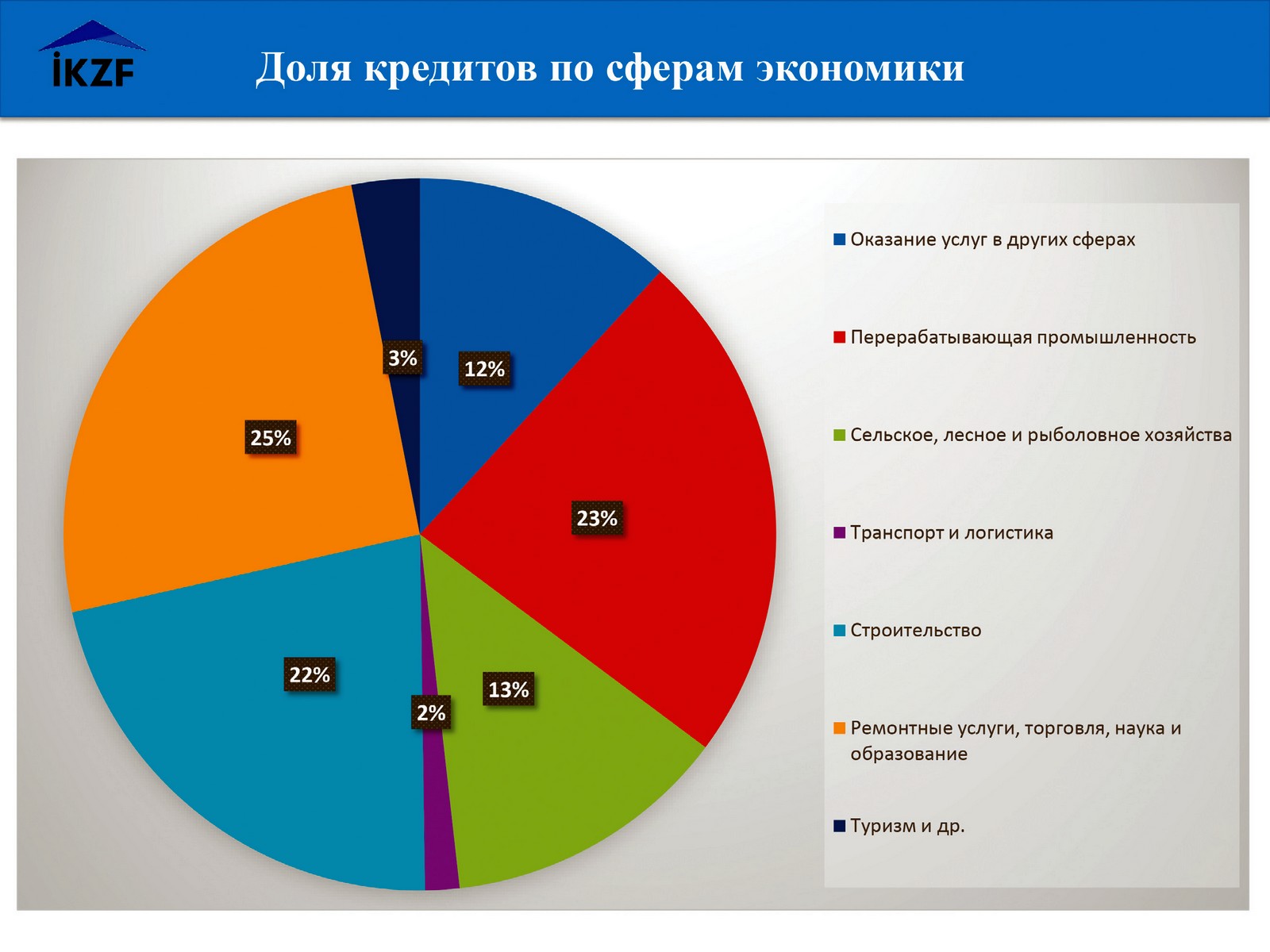
The effectiveness of this mechanism is best illustrated by the statistics: as of 1 July this year, the MLGF had provided guarantees for loans to entrepreneurs totalling ₼299.9 million. In terms of sector, 25 per cent of these loans were issued for repair services, wholesale and retail trade, science and education. 23 per cent were for the manufacturing industry, 22 per cent for construction, 13 per cent for agriculture, forestry and fishery, 3 per cent for tourism and catering, 2 per cent for transport and warehousing, and 12 per cent for the provision of services in other spheres.
Elshan Kerimov, director of the fund's loan guarantee department, has stated that, at the same time, only four defaults on guaranteed business loans have been recorded so far. This indicates that the method used is effective and justifiable. "Regarding the aforementioned four cases, each one is supported by solid reasoning. For instance, a fire occurred, resulting in the complete destruction of the business. If we consider this particular case, it is clear that other cases can be handled in the same way. For these cases, we have fully ensured payments," he said.
MLGF has highlighted that the fund employs a comprehensive process of underwriter analysis and utilises a loan rating model. "That is, in contrast to bank analyses, there is a more streamlined (average) valuation process. Consequently, the portfolios in the fund's cases are quite stable," Kerimov added.
Please note that, according to the rules, MLGF is able to provide guarantees for business loans of ₼30,000 and over. The total amount of guaranteed loans provided by authorised banks to one borrower should not exceed ₼5 million, and to a group of borrowers, ₼10 million. It is imperative to note that the term of the loan should not exceed seven years, and the credit line should be set at 12 months.
The entire process is conducted online. The Fund makes a decision on the application of the authorised bank in electronic form for issuing the guarantee and publishes it in the electronic system no later than 10 working days in advance. In summary, the application has been streamlined and automated to such an extent that any businessman should be able to use it independently, without the need for additional consultants.
At the same time, the MLGF and the public association Association of Banks of Azerbaijan (ABA) are in regular dialogue regarding options to further improve the system. The agenda included several key issues, namely risk mitigation in ensuring mutual settlements between entrepreneurs, safeguarding the continuity of the "value chain", promoting non-cash settlements and exploring new guarantee methods to bolster entrepreneurial activity in both domestic and international markets. The experts of both structures considered the possibilities of providing guarantees for such financial instruments as letters of credit, factoring and bank guarantees.
It should be noted that as of 1 June this year, the volume of loan portfolio of banks in Azerbaijan amounted to ₼28.4 billion, of which ₼15.1 billion was business loans.
Guaranteed subsidies
In addition to challenges in securing loans, entrepreneurs frequently express concerns about the high cost of loans, which at times renders them unprofitable.
As reported by the Central Bank of Azerbaijan, the average annual interest rate on new loans in national currency was 18.9% as of 1 June 2025. Concurrently, the average interest rates increased by 3.79 percentage points compared to the same period last year. The average interest rate on loans issued in foreign currency was 6.59 per cent, which is an increase of 0.84 percentage points compared to last year.
Should these interest rates prove unaffordable for businessmen, they have the option of taking advantage of another MLGF facility: the interest subsidy. Therefore, the fund has the capacity to assume responsibility for a proportion of the interest on a loan. For instance, a businessman might be granted a loan at a rate of 12% per annum, of which 8% can be subsidised by the fund (if there is an investment promotion document, the subsidy will be 10%). It is important to note that the interest rate on the loan will be a very low 4% or even 2% per year.
The subsidy is issued for a period of three years, and the annual rate should not exceed 20%. In any event, the situation is highly advantageous for entrepreneurs, and not only for them.
New tools
In addition, MLGF has introduced a number of advances in new instruments. These include the provision of guarantees for securities issued by domestic companies and portfolio guarantees to agent banks.
Within the framework of this innovation, the Fund's guarantee is provided for loans ranging from ₼5,000 to ₼50,000. Concurrently, the annual interest rate on the loan should not exceed 20%, the term should be a minimum of 3 months and a maximum of 3 years, and the total amount of loans of one borrower for all authorised banks should not exceed ₼250,000.
The mechanism also provides for more streamlined document verification and financial analysis, allowing micro and small entrepreneurs to have more flexible access to loans for smaller amounts.
"The analysis has shown that micro and small enterprises are the ones who stand to benefit most from this instrument. The reality is that, due to the absence of banking and credit history, applicants are confronted with unachievable collateral requirements when seeking funding from financial institutions. In a number of cases, quite promising projects remain unrealised only because of the lack of liquid collateral," Kerimov said.
He noted that to date the requests of 173 entrepreneurs have already been financed, the total amount of loans is about ₼2.4 million and the amount of guarantees is ₼1.8 million.
The method of providing guarantees for issued securities is aimed at business entities willing to issue bonds. "We established this mechanism as a supplementary borrowing option. Following a thorough analysis of the market, we have concluded that business entities lacking collateral can issue bonds," Kerimov stated.
According to the initiators of the new instrument, it will contribute to the development of the market and, at the same time, increase the attractiveness of bonds. "At present, we have active cases that we are working on. It is anticipated that the process will be concluded next month, at which point guarantees will be issued for a number of bonds. In order to proceed with the investment process, business entities are required to demonstrate both financial history and accountability. These are quite large corporate clients," Kerimov stated.
The Loan Guarantee Mechanism also supports the Government's efforts to mobilise all resources, including in the private sector, for the rehabilitation of lands liberated from occupation. Entrepreneurs engaged in these activities in the de-occupied territories of Azerbaijan can obtain working capital loans from authorised banks for more than 2 years. In such cases, the MLGF is entitled to provide a subsidy of 10% to the authorised bank on behalf of the business entity.
It is evident from both international experience and Azerbaijani practice that the loan-guarantee mechanism is the most reliable tool for improving business access to loan resources. This is a significant step towards ensuring the growth of the private sector and its active involvement in strengthening the country's economy as a whole.
RECOMMEND:
 247
247

