

STATEMENT FROM THE PAST
A revanchist attempt, or the diplomatic illusion about the Minsk Group
Author: Namig ALIYEV
Amidst the Washington summit on April 8, 2025, and the joint appeal by Azerbaijan and Armenia to OSCE states to dissolve the Minsk Group and its structures, rhetoric from the past has resurfaced in the public domain. In this context, the appeal by Ashot Danielyan — the "representative" of the so-called "parliament" of the separatist regime that once existed in the occupied territories of Azerbaijan in Khankendi — to OSCE leadership raises understandable questions.
Danielyan's appeal and attempts to revive the Minsk Group
Danielyan's appeal for the preservation of the OSCE Minsk Group is anchored in the principles of the "right of return", "security guarantees" and the imperative for inclusive negotiations. However, his statement is a diplomatic illusion that does not reflect the current reality of the South Caucasus. Danielyan's letter to the OSCE leadership is an attempt to revive a format that is no longer in use and lacks international support. The appeal contains assertions regarding the "forcible displacement of the Armenian population", the "right of return", and the "necessity to preserve" the Minsk Group as the allegedly sole legitimate instrument for resolving the Nagorno-Karabakh conflict.
The seemingly elaborate justifications are, in fact, a reiteration of the occupation of 20% of Azerbaijan's territory, which was successfully reversed through Baku's military and diplomatic efforts in 2020–2023.
The collapse of separatism and the attempt to rewrite history
Following the 44-day war of 2020 and the counter-terrorist operations in September 2023, the Armenian side has effectively lost any influence in Garabagh. The Armenian population that resided in those territories during the occupation period left the region in an organised manner, following orders from the separatist regime, despite calls and guarantees offered by official Baku.
Ashot Danielyan's assertions regarding the nature of the displacement are inaccurate. The displacement was not a result of force; rather, it was a voluntary departure precipitated by panic, disinformation, and interference by Armenian politicians who were not interested in integrating the Armenian population into Azerbaijan's legal framework. It is evident that the current political discourse in the South Caucasus is characterised by revanchist positions, which regrettably impede progress in the peace process and regional integration.
Azerbaijan, by contrast, has repeatedly emphasised its commitment to ensuring the rights and safety of citizens of Armenian origin. However, this commitment is contingent upon their recognition of the sovereignty and Constitution of Azerbaijan, renunciation of foreign allegiances, and acceptance of Azerbaijani citizenship. These proposals were disregarded or rejected, leading to a significant departure — not due to pressure from Baku, but as a result of a strategic defeat by the Armenian side.
The OSCE Minsk Group: an outdated mechanism without prospects
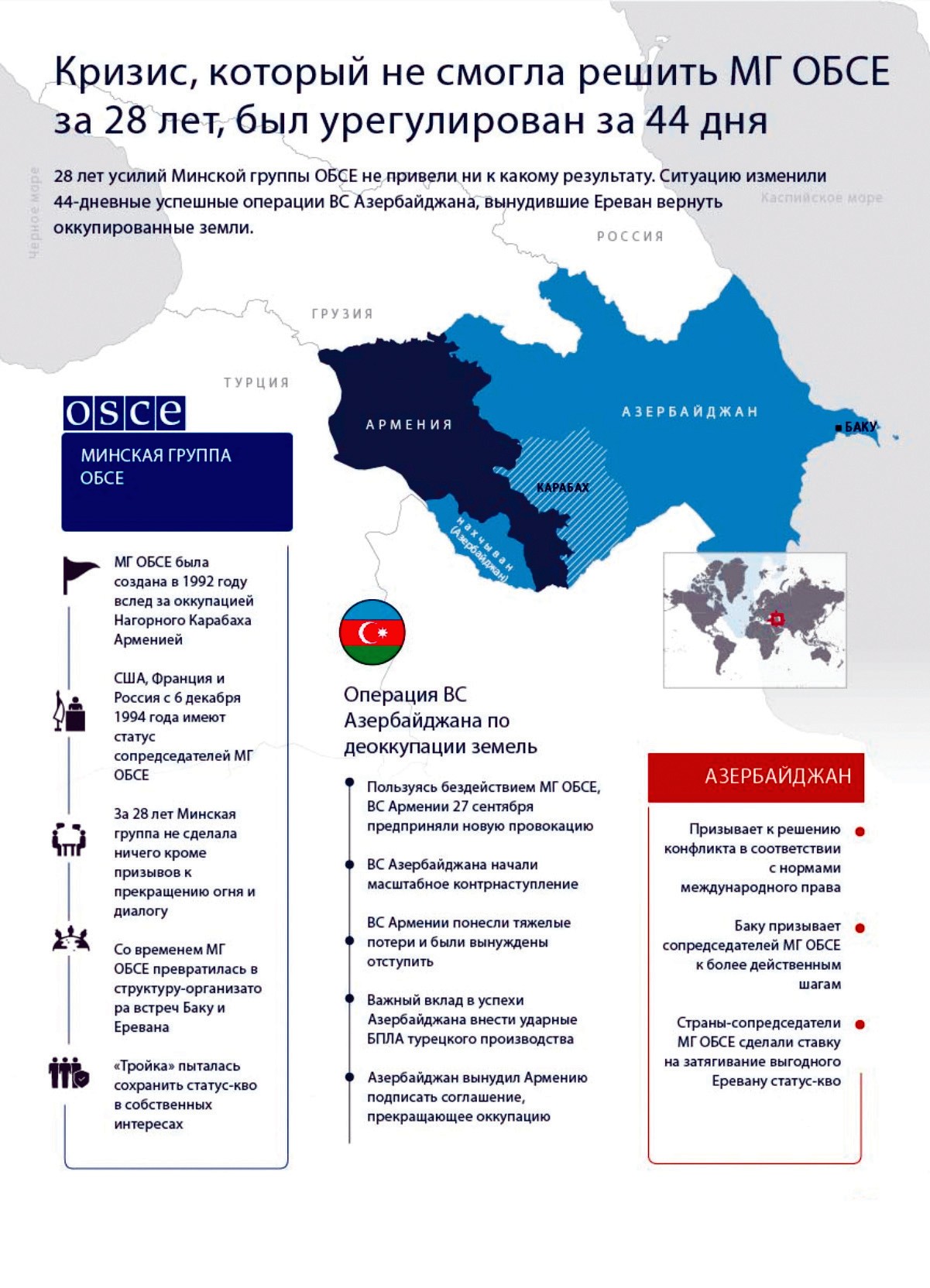
Danielyan has formally appealed to the OSCE Minsk Group, citing it as the sole legitimate negotiation format. Established in 1992 with the objective of resolving the conflict peacefully, it has not yielded any significant outcomes over the past three decades. Since the early 2020s, it has become evident that its influence has been significantly diminished. The fact that it was unable and uninterested in resolving the conflict, the internal fragmentation among the co-chairs, and the absence of concrete results during its existence transformed the mechanism into a symbol of inaction. It is regrettable to note that no significant progress was made during this period towards achieving an agreement on status or the withdrawal of Armenian occupying forces from Azerbaijani territories. In practice, the Minsk Group has been instrumental in the freezing of the conflict rather than its resolution. The ongoing conflict has been protracted by the passivity of international institutions, resulting in significant loss of life, widespread destruction of infrastructure, and the occurrence of humanitarian catastrophes. Approximately 700,000 Azerbaijanis were forcibly displaced from Garabagh during the 1990s and were unable to return to their homes for many years. The international community did not provide any support to these people.
The Minsk Group's activities effectively reached a dead end, and following the events of 2020–2023, the resolution of the conflict, Armenia's renunciation of territorial claims and recognition of Azerbaijan's territorial integrity, the group lost all political influence and relevance. Armenia and Azerbaijan officially declared the end of the Minsk Group's mandate, stating that the organisation had become obsolete in terms of promoting peace and regional stability.
Legal manipulations and false analogies
In an attempt to provide legal weight to his statement, Danielyan cites international law, Article 13(2) of the Universal Declaration of Human Rights (1948): As outlined in Article 12(4) of the International Covenant on Civil and Political Rights (1966), everyone has the right to leave any country, including their own, and to return to their country. As outlined in the UN Declaration of Human Rights, no individual should be subjected to the arbitrary deprivation of their right to enter their own country. He also references the International Court of Justice decision of November 17, 2023, the details of which are not specified in his appeal.
A more detailed review of the reasoning reveals that it is not legally or politically sound. These norms cannot be applied to a situation involving return to a sovereign state, Azerbaijan, under conditions that amount to political separatism. The right of return cannot be used to restore separatist structures or to revive political claims that undermine the territorial integrity of UN member states. In such a case, the concept of "right of return" evolves into a "right of revanche". International law is chiefly concerned with upholding state sovereignty, including that of Azerbaijan, rather than seeking to establish quasi-state entities within its borders.
Armenia did not grant refugee status to Armenians who relocated from the Garabagh region of Azerbaijan, because to obtain such status they had to be citizens of Azerbaijan. The absence of Azerbaijani citizenship (by their own choice) and possession of Armenian, Russian or other citizenships does not entitle them to refugee status. Armenians who relocated from Garabagh are therefore foreigners who voluntarily left Azerbaijan. Following the conclusion of local anti-terrorist operations in the Garabagh region, it was determined that none of the individuals in question were in possession of Azerbaijani passports. All of the individuals in question were Armenian citizens, with a small number holding Russian citizenship. None of the individuals in question held Azerbaijani citizenship or passports.
In terms of residency, foreigners are only recognised as such in the country of their citizenship. Therefore, the duration of their stay outside their country of citizenship is governed by international and national law. It is a legal principle that no state is under any obligation to return foreign nationals who have left their country of citizenship.
Baku does not refuse the Armenian population that lived in Garabagh before the occupation the right to return — on the contrary, it stresses its readiness to guarantee the rights of all its citizens regardless of ethnic origin, provided they respect the Constitution of the Republic of Azerbaijan, just as it does for all other citizens of Azerbaijan.
By conflating concepts, Danielyan also asserts that "an entire people was uprooted from their historic homeland". Garabagh is a region of Azerbaijan where two communities lived before the ethnic cleansing carried out by Armenians: Armenian and Azerbaijani. The two communities form the population of Garabagh, but do not constitute a "people". "People" is a political category, and in this context the "peoples" are "Armenians" and "Azerbaijanis", who have already exercised their rights to self-determination within the Republic of Armenia and the Republic of Azerbaijan respectively. The term "people" is not applicable to the population of Garabagh.
Consequently, none of the conventions or court decisions cited by Danielyan have been breached.
Azerbaijan as an example of effective restoration of territorial integrity
Following the liberation of its occupied territories, Azerbaijan initiated a major programme to restore Garabagh. The return of internally displaced persons — Azerbaijanis expelled in the 1990s — is proceeding in full. Projects are underway in the infrastructure, environmental safety, education and healthcare sectors. In contrast to previous practices, Baku has adopted a consistent approach with international norms by acknowledging the right of Azerbaijani refugees from Armenia to return.
Attempts to use the OSCE or other international platforms to revive the lost status quo only delay integration processes and undermine confidence in international institutions.
It is evident that the appeal articulated by Ashot Danielyan, and analogous statements proffered by certain Armenian pseudo-politicians, are not concerned with the promotion of rights, the facilitation of a peaceful return, or the assurance of security. These proposals are not constructive, but rather represent attempts at revenge and the preservation of political influence for structures that have lost all connection with reality. Neither the OSCE nor other international bodies are in a position to arbitrate on the results of occupation and separatism.
The Garabagh conflict has now been resolved. Azerbaijan is ready for integration, regional reconstruction and the return of its citizens to their historic homeland — and it is doing so today. The "Great Return" programme is being implemented in stages; "smart villages" are being created; infrastructure, schools, roads and hospitals are being restored. The commitment to tangible action is what sets Baku's approach apart from previous declarations.
Those with a genuine interest in the future of Garabagh's Armenian community must understand that the path forward does not lie through attempts to revive the Minsk Group. Instead, it is essential to recognise realities and participate in reconstruction and peaceful life within Azerbaijan.
Armenians wishing to return and live in Azerbaijan are granted this opportunity, on the condition that they respect the country's sovereignty, laws and public order. Please find below the details of the meeting. Any attempts to substitute reality with nostalgia for separatism will be decisively rejected.
RECOMMEND:
 290
290

