
ARMENIA: AN IDEOLOGICAL FRACTURE
Pashinyan's dismantling old symbols and elites, attempts to lead the country out of isolation and post-conflict stagnation
Author: Namig H. ALIYEV
Following its defeat in the 2020 Garabagh War, and especially after Azerbaijan fully restored sovereignty over its territory in 2023, Armenia has been experiencing a profound socio-cultural conflict. This conflict has emerged between advocates for modernisation, pragmatism, and foreign policy reorientation, and those who champion traditionalism, sanctity, historical continuity, and the "inviolability" of Armenian identity.
The government, led by Nikol Pashinyan, is attempting to implement reforms, mend international relations, primarily with its neighbours, and alter symbols and practices perceived as sensitive elements of national identity. This is all occurring against a backdrop of strengthening opposition (comprising disparate forces, from national conservatives to former "Garabagh" elites), discontent within parts of civil society, and resistance from traditional institutions, particularly the church. The West, represented by France, the EU, and the US, for its part, supports the reforms and the government's openness.
The strategy of Nikol Pashinyan and his team is to pull Armenia out of its state of "isolation and defeat" by resetting its foreign policy, which includes normalisation with Türkiye and shifting from an excessive dependence on Russia to a more pragmatic relationship. Domestically, this involves dismantling the old elites, including the church-oligarchic and post-Garabagh structures, and attempting to build a secular, rational state.
Armenia in the mirror of its history: on the ex-presidents
A post on Armenian Prime Minister Nikol Pashinyan's Facebook page, in which he sharply criticised his predecessors—Levon Ter-Petrosyan, Robert Kocharyan, and Serzh Sargsyan—provoked a wide public response. The statements that the "victorious presidents" had in fact "dragged Armenia into an abyss" became a catalyst for re-evaluating not only their political legacies but the entire post-Soviet history of the Armenian-Azerbaijani conflict.
A key element of Pashinyan's speech was the assertion that all three ex-presidents lacked genuine popular support. This applies to the 1996 election (Ter-Petrosyan) as well as the 2003 and 2008 votes (Kocharyan and Sargsyan, respectively), which were accompanied by mass protests and accusations of rigging.
Pashinyan's question is rhetorical yet pointed: if you brought the people victory, why did the people never genuinely vote for you? This argument raises a fundamental question about the legitimacy of power amidst national mobilisation and external conflict. Nikol Pashinyan's statement is not mere political rhetoric; it is an act of historical reassessment. His words pose the question: what was the "victory" of past years—a real achievement or an illusion purchased at too high a price?
When analysing the actions of Armenia's ex-presidents through the prism of the Garabagh conflict, it becomes clear that not one of their administrations proposed a sustainable peace. This means the question of political responsibility for the past remains open. The answer to it is not only a matter of history but also a foundation for the future of Armenia and the entire South Caucasus.
The Fourth Republic, a new constitution, and the renunciation of territorial claims
At the 7th congress of Armenia's ruling "Civil Contract" party, Prime Minister Pashinyan presented a large-scale strategic initiative: the Fourth Republic project. At the centre of his concept is a systemic renewal of political and legal institutions, including the development of a new constitution and the reformulation of the country's foreign policy course.
This project is not limited to the current political cycle; it represents an attempt at a deep institutional transformation affecting key areas of the state's structure.
In the Armenian context, the idea of a Fourth Republic signifies not just a change of elites or a reform of government, but a rethinking of the very model of statehood. This implies a complete reset of the constitutional order: redistributing powers among the branches of government, possibly revising the roles of the parliament and president, creating a more balanced system of checks and balances, and definitively eliminating territorial claims against neighbours—first and foremost, Azerbaijan.
Such an approach is also crucial from the standpoint of building a new architecture of relations with neighbours in a peaceful South Caucasus.
Pashinyan's confrontation with the Church
Pashinyan identifies the church as a conservative institution that interferes in politics. Seeing the need for its depoliticisation, he accuses certain high-ranking church officials, including Catholicos Garegin II, of participating in a conspiracy and attempting a "coup" through an "oligarchic-clerical structure." He has suggested that Garegin II resign and is seeking a replacement. In response, church authorities, trying to preserve their legitimacy, complain of state interference, an attack on ecclesiastical autonomy, and a threat to the national and cultural fabric. Garegin II and other hierarchs criticise Pashinyan for inciting internal conflict and exploiting the issue of the church for political ends.
On June 27, 2025, the authorities attempted to arrest the head of the Shirak Diocese, Mikayel Ajapahyan. The Investigative Committee of Armenia intended to detain the archbishop on charges under Article 422, Part 2 of the Criminal Code of Armenia—for public calls for the seizure of power or the violent overthrow of the constitutional order. Despite a confrontation between security forces and the church with a group of parishioners, the archbishop left the territory of Etchmiadzin himself and went to the investigative committee, accompanied by lawyers. A court in Yerevan ordered Archbishop Ajapahyan to be placed in custody for two months. The defence declared the court's decision illegal.
The confrontation is accompanied by statements from Pashinyan that the Catholicos must resign and that church officials are not fulfilling their obligations and are violating church canons (including the vow of celibacy). Following this, Pashinyan announced the idea of creating a consultative group that will participate in organising "new elections" for the Catholicos, with criteria related to spiritual practice and morality.
Meanwhile, a serious stratification of Armenian society is observable. Urban youth (aged 20-35) tend to support pragmatism and the normalisation of relations; they do not trust the church. The older generation in rural regions is attached to the church and sees Pashinyan as a threat to traditions. The middle class and intelligentsia are divided: one part supports modernisation and the peace process, while another fears a loss of "sovereignty." Emigrants (especially from the diaspora) are critical: many support the opposition, viewing current events as a "capitulation." The military and former participants in the occupation of Garabagh are mostly opposed to Pashinyan, considering that he "surrendered everything." They see Russia as an ally and a guarantor of security with whom integration (up to a union state) is necessary.
All of this carries certain internal risks. The first is the potential for a societal schism along state-church lines, especially in religiously-inclined communities where the church traditionally holds strong moral and identificational weight. The second is resistance from a segment of the elite and the population, who perceive these steps as an attempt to weaken the institution of the church, which certain layers of society regarded as the guardian of national memory. The third is the possibility of escalation if actions by the state are perceived as excessive or a violation of religious freedom.
It should be noted that Russia views Armenia's distancing negatively and fears the loss of a second lever of influence (after Garabagh) through the church. Therefore, Yerevan periodically makes corresponding overtures toward Moscow: through rhetoric and more frequent trips to Russia by Pashinyan and his team. Recently, at the 7th congress of the ruling "Civil Contract" party, the prime minister stated that Armenia would pursue the path of strengthening its relations with Russia, which are currently in a stage of transformation.
Impeachment
Opposition factions in parliament, such as I Have Honour and others, are undertaking initiatives to declare no confidence in Pashinyan and to impeach him. This is a manifestation of self-defence by the clerical, Garabagh, and military elites.
To initiate the procedure, 36 signatures from deputies are required, which remains problematic due to the fragmentation of the opposition and the presence of a strong parliamentary group from the ruling party. Certain independent deputies have left the ruling faction, which has reduced its support base, but this has not yet led to the sufficient number of signatures and votes needed to remove the prime minister.
Impeachment within the legal framework requires either a significant expansion of support in parliament or the creation of a bloc composed of the opposition and dissidents from the ruling party. This entails the risk of infighting and internal shifts, especially ahead of the 2026 parliamentary elections.
Even if an impeachment is initiated, its further course depends on judicial and constitutional precedents and how society perceives such a move—as a legitimate mechanism of accountability or as political pressure.
The initiatives to carry out an impeachment are baseless; they are founded on "lies and manipulations." The obvious motivation here is personal scores with Pashinyan—for his criticism of previous authorities and his rejection of the Garabagh doctrine.
The Mayors of Gyumri and Parakar
In April 2025, in Gyumri, where Russia's 102nd military base is located, Vardan Ghukasyan was elected mayor. He is a candidate associated with opposition forces, who present him as a "symbol of the awakening of patriotic forces." Ghukasyan takes a more conservative, nationalist position and criticises Pashinyan, especially on issues of foreign policy and the idea of a "union state" with Russia. This became a symbolic defeat for the ruling party in a "significant" province—Gyumri is Armenia's second-largest city and has long had strong pro-Russian opposition sentiment.
Armenia's Anti-Corruption Court chose a preventive measure against Gyumri's mayor, Vardan Ghukasyan, in the form of a travel ban and set bail at 5 million drams (over $13,000).
Observations indicate that the situation in Gyumri is having a minimal impact on national processes. The regional defeat of Pashinyan's team is likely temporary.
On the night of September 24, Volodya Grigoryan, the head of the Parakar community in the Armavir region, was shot and killed. In March of this year, he had defeated the candidate from the ruling "Civil Contract" party in local elections. Grigoryan represented the "Country for Life" party, founded in Armenia by Ruben Vardanyan, a Russian oligarch of Armenian origin whose criminal trial is currently underway in Baku. His election as mayor of Parakar was made possible with the support of other pro-Russian opposition parties.
Normalising relations with Türkiye and symbolism
Armenia and Türkiye are conducting negotiations on "full normalisation" without any preconditions. Special representatives from both sides are holding technical meetings to discuss issues such as opening borders, the Gyumri-Kars railway, electricity supply, and more.
In June 2025, Pashinyan visited Istanbul and met with President Erdogan. This visit is regarded as one of the most symbolic steps in the normalisation of relations.
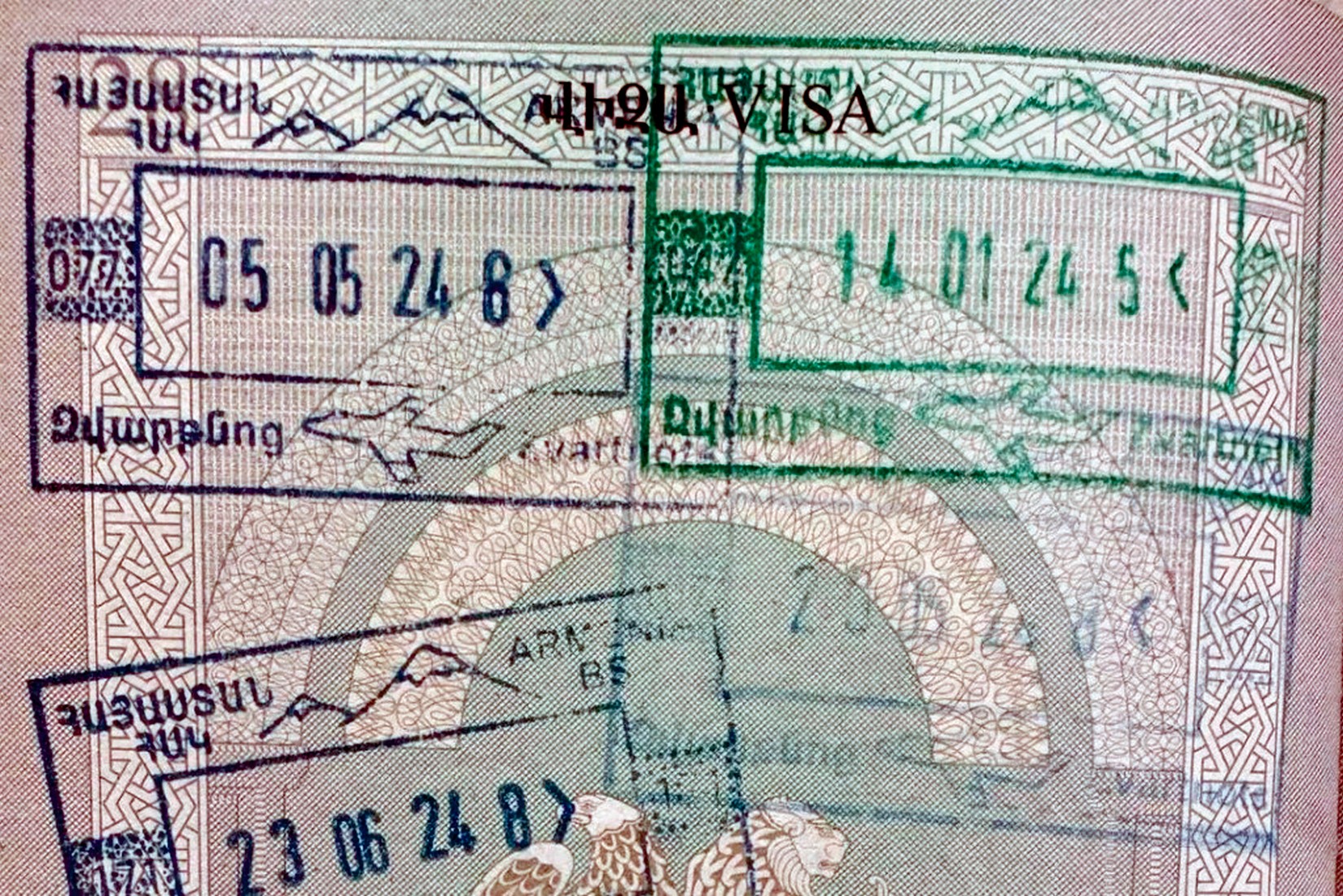
On September 11, 2025, the government signed an order to remove the image of Aghridagh Mount (known in Armenian as "Ararat") from border stamps (for entry/exit), starting on November 1, 2025. This image was not on the stamps before 2004. The reason, according to Pashinyan and the authorities, is the need for symbolism not to provoke ambiguous interpretations in the context of relations with neighbours (Türkiye and Azerbaijan), as well as a desire for "practical" and "neutral" symbols in such documents.
This change is perceived by many as a significant symbolic departure from nationalist rhetoric, as Aghridagh Mount is seen by a part of the population as "one of the key symbols of Armenian identity," although it is geographically located on the territory of Türkiye and has never historically been part of Armenian territory.
Overall, Turkish officials have positively assessed the normalisation process but insist on seeing it through to completion, linking it to the fulfilment of conditions for signing a peace agreement with Azerbaijan.
Armenia today is a country of collapsing consensus, where the political struggle is intensifying not only over power but also over identity, memory, and symbols. The conflict between Pashinyan and the church is not just a political quarrel but an expression of a profound change of an era.
The urban elites who support the rational modernisation and peaceful course of Pashinyan towards a Fourth Republic risk alienating traditionalists and causing destabilisation. The opposition, the church, and the provinces, which adhere to a nationalist-religious course, risk facing isolation, conflict with the West, and economic decline.
If Pashinyan's government can advance technical and infrastructure projects (TRIPP, railways, power grids, opening borders), symbolic concessions like removing Ararat from stamps will be perceived by society as part of the "price" for broader economic and geopolitical benefits.
Further developments will depend on several factors: 1) the government's ability to reduce the level of conflict, for instance, through dialogue; 2) the opposition's capacity to mobilise society without resorting to destructive scenarios; 3) the real effectiveness of reforms, including constitutional reform and the opening of TRIPP (Zangezur Corridor)—if the economy and security improve, symbolic concessions may be forgiven.
RECOMMEND:
 248
248