

A TURN TO THE WEST
From Moscow to Brussels: Armenia's new trajectory
Author: Namig H. ALIYEV
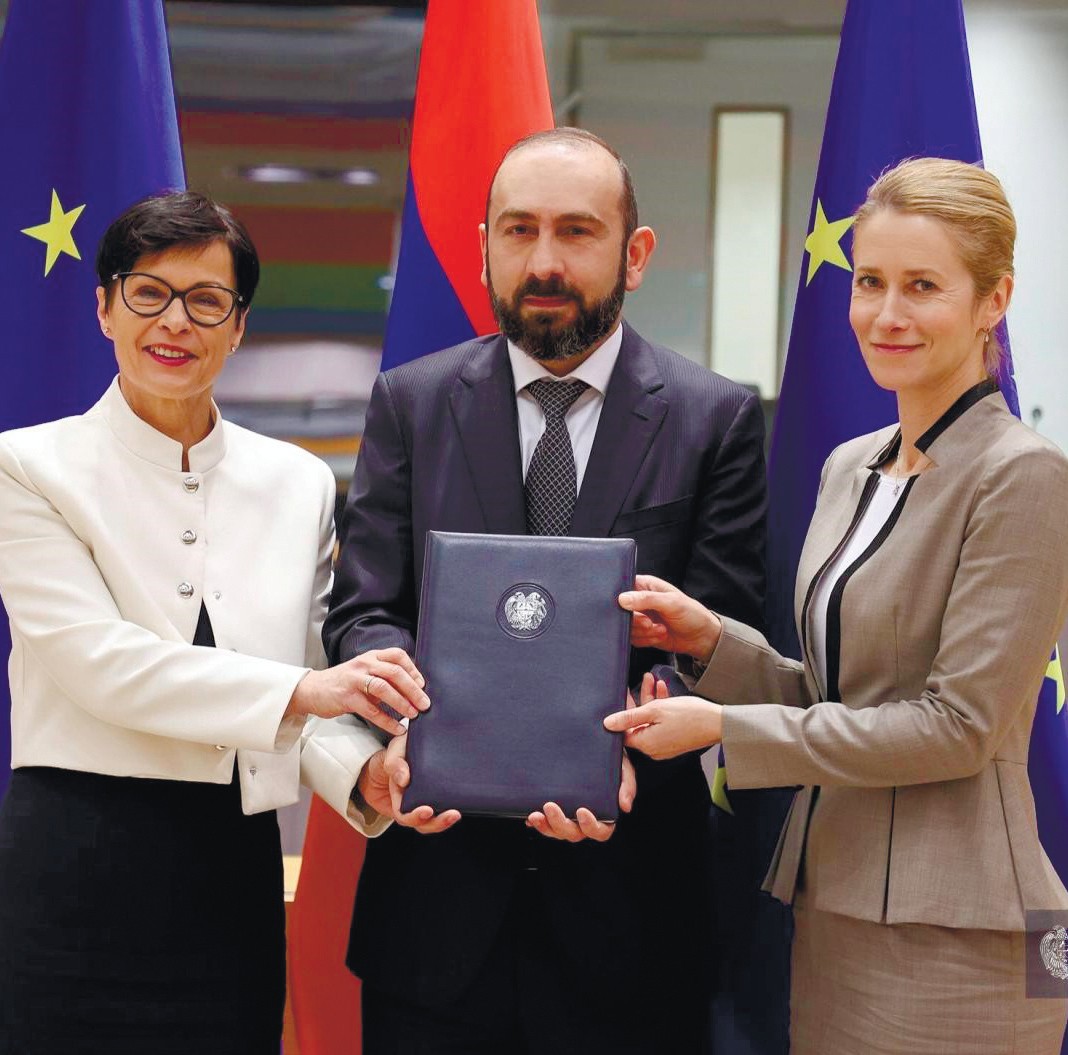
In early December, the 6th meeting of the European Union-Armenia Partnership Council took place in Brussels, during which Yerevan and the EU approved a new "strategic agenda" for cooperation.
Negotiations between Armenian Foreign Minister Ararat Mirzoyan and EU High Representative for Foreign Affairs Kaja Kallas focused on deepening cooperation, including reforms in the legal and judicial systems, democratisation, socio-economic development, energy security, digital transformation, trade diversification, and security collaboration.
Brussels makes no secret of it: against the backdrop of the peace process with Azerbaijan, 2025 should be a turning point for EU-Armenia relations. Europe has already announced it will provide financial and technical assistance, particularly within the so-called "Resilience and Growth Plan." The plan's total budget is around €270 million, the lion's share of which is grants. The EU has also promised, among other things, €15 million "for peacebuilding and enhancing resilience" in Armenia, including, for example, demining and specialist training.
Thus, the current Brussels stage is not merely a diplomatic ritual, but effectively a reboot of relations: from the previous, rather cautious "partnership" scheme to a deeper and more ambitious strategy.
It is an interesting and noteworthy process. Baku initiated the peace process with Armenia, the aggressor expelled from devastated Azerbaijani territories. Meanwhile, the EU, following the initialling of the prepared peace agreement, began active cooperation and investment not with the country that suffered aggression, but with the occupier that exploited Azerbaijani subsoil and lands for 30 years.
Incidentally, the content of the negotiations contained considerable anti-Azerbaijani rhetoric, contradicting the spirit of the agreements from the August 8, 2025 Washington Summit. The Azerbaijani MFA even had to issue a comment on the "Strategic Partnership Agenda between the European Union and Armenia": "It is unacceptable that in this bilateral document, defining the strategic priorities of relations between the EU and Armenia for the next 7 years, attention is paid to issues concerning Azerbaijan, and this, in turn, negatively affects the prospects of relations between Azerbaijan and the European Union." The MFA stated that "taking into account the elimination of these claims in the peace agreement initialled in Washington with the participation of the leaders of Azerbaijan, the US, and Armenia, the mention of this issue in the EU-Armenia document directly contradicts the peace process and raises serious questions regarding the declared intentions of the Armenian side."
What can the 'European umbrella' offer Armenia instead of the Russian one?
If Armenia indeed begins to move in the direction outlined by the new strategy, and reforms progress steadily, a number of opportunities could open up for it. First and foremost, the EU will aim to support reforms in the judicial system, human rights, and the rule of law. Such pressure and the democratisation of institutions could change the republic's image: help reduce the influence of old elites, strengthen legal protections for citizens, and increase trust in the state. European investments, which would stimulate economic development, will be important. Grants, investments in infrastructure, energy, and export diversification are a chance for Armenia to modernise its economy, reduce dependence on traditional markets, and attract foreign investors.
Opportunities for energy and transport diversification will open up. The EU is betting on a programme that could connect Armenian energy grids to European ones and develop transport and logistics infrastructure. This would mean reduced strategic vulnerability, less dependence on a single direction, and more flexible links within the region and with Europe.
Another opportunity is the formation of civilised international ties. Participation in European projects, programmes, partnerships, and access to assistance. This would possibly signal that Armenia wants to be more open to European and regional cooperation in various spheres.
Overall, the "European umbrella" is not just a symbol, but a tool for creating a visible subjectivity for Armenia, reducing its dependence on previous alliances.
Moscow's potential reaction and expected consequences for Russia?
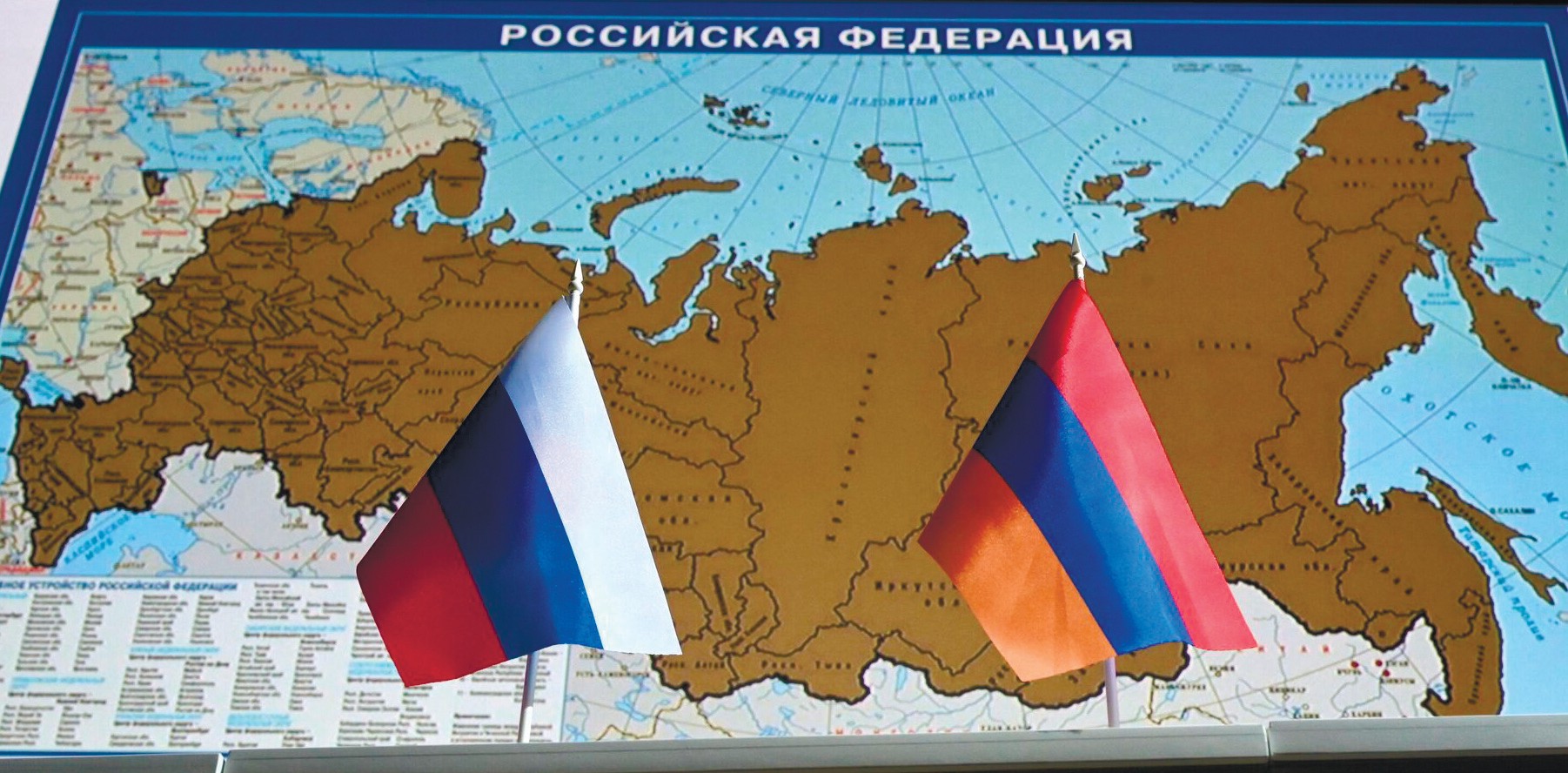
It is obvious that Yerevan's current move has not gone unnoticed by Moscow. Official comments have already emphasised that Armenia's participation in the EU is incompatible with its presence in projects related to Russian economic and military-political integration (EAEU, CSTO, etc.).
What could this trend mean for Russia? Firstly, a loss of influence, which is a key element of Russia's presence in the South Caucasus. If Armenia begins moving more actively towards the West, Russia risks losing its traditional foothold in the region, and simultaneously, it would send a message that the "Russian umbrella" is not a guarantee of eternal security.
Secondly, a reduction in strategic value. Armenia, playing on geopolitical flexibility, could diminish the significance of the so-called "buffer zone" for Russia and thereby transform from an ally into a country that is becoming an EU "outpost."
Thirdly, increased competition. The EU, the US, and other Western partners, having invested effort and resources in Armenia, can count on growing their influence in the South Caucasus, which would unequivocally undermine Russia's traditional dominance in the region.
For Armenia, this is a chance to change its foreign orientation; for Moscow, it is a reason for serious reconsideration of relations with its former ally.
Why is Europe betting on Armenia and not Georgia?
Georgia is closer to Europe than Armenia in many parameters. It possesses more stable democratic institutions, a more noticeable public demand for Euro-integration, and a more pronounced history of a "European path." Nevertheless, the EU, it seems, is making a strategic bet precisely on Armenia. Why?
The first thing that catches the eye is geopolitical calculation. Armenia is an important node between Europe, Russia, Iran, and the Caucasus. The Washington agreements on opening the Zangezur corridor (TRIPP) made Armenia a subject of "East-West" transport communications. Yerevan's reorientation could give Brussels more influence in the region, providing a "bridge" in the complex and turbulent South Caucasus space.
The second reason is Yerevan's flexibility. Unlike Georgia, Armenia, while balancing between East and West and not building anti-Russian rhetoric, is trying to gradually move from under the "Russian umbrella." Such pragmatism may distinguish Yerevan favourably in the eyes of the EU.
The third reason is the possibility of institutional building "from scratch." Armenia is less burdened than Georgia by a complex history of Euro-integration expectations and setbacks. The EU can "cultivate" a compliant ally from a clean slate, helping to build institutions, reform the economy, and legislation–something that is often harder to achieve where reform has been underway for a long time with varying success.
Finally, for over 100 years the Armenian state, and for more than 200 years the Armenian nation, have been instruments in Russia's hands in the South Caucasus. Depriving Russia of this "outpost" is seen by Europe, and the West in general, as a crucial factor in weakening Russia.
At the same time, Europe does not view Armenia's path as a quick march towards EU membership. Rather, it is a medium-term strategy: reforms, cooperation, gradual rapprochement. The EU's bet is on stability, gradual building, not on quick but risky declarations.
Potential risks, difficulties, and 'watersheds'
Armenia's path of rapprochement with the EU will by no means be smooth. Serious internal resistance, fuelled by pro-Russian forces, revanchists, and the opposition, is to be expected. Reforms, especially in the judiciary, the fight against corruption, and the restructuring of elites are painful processes. They will clash with conservatism, resistance from forces of the old regime, and pseudo-patriotic sentiments.
Russia's reaction is easy to foresee. Pressure, diplomatic strikes, attempts at disinformation, hybrid attacks–all of this is probable, and their scale depends on the degree of Armenia's closeness with Europe. Warnings are already coming from Brussels: Russia is active, especially ahead of parliamentary elections in Armenia, and the EU considers its interference in the country's internal affairs unacceptable. At the same time, the European Union is offering Yerevan financial aid and political support in countering Russia.
Potential geopolitical instability can also be counted among the risks. Armenia borders Georgia, which has two conflict zones; periodic Georgian closure of the Lars border crossing for Armenian transit may become more frequent due to fears of losing monopoly and jealousy over the Zangezur corridor. Furthermore, relations with Iran will become more complicated, and all of this could hinder Armenia's stable development. EU support is important but insufficient if long-term sustainability is not worked on. And the path to that lies through developing relations with neighbouring Azerbaijan and Türkiye.
One should also anticipate transformational expectations among the population in the context of reforms. If promised changes (economy, investments, rising living standards) are not felt, disappointment will grow. Then the coalition of "pro-Western" forces could lose support, and the country could plunge into new instability.
Armenia should make a choice
Mirzoyan's visit to Brussels is far more than a routine diplomatic mission. It is a symbol of changing patrons, the beginning of a new stage in foreign and domestic policy. If Yerevan seizes the chance, carefully implements the European agenda, carries out reforms, strengthens institutions, and diversifies its economy and external ties, the country could gradually emerge from the shadow of the "Russian umbrella."
For Europe, this is an attempt to strengthen its influence in the South Caucasus, to gain a partner that will ensure its presence in the region. Incidentally, the first step has already been taken: the EU monitoring mission on the border with Azerbaijan, where all has been calm for a long time. For Russia, this is a signal: the foreign policy it pursued is in deep crisis, former allies are striving to reorient themselves, and the habitual sphere of influence is beginning to unravel.
Armenia's drift towards the EU is not without risks of a new crisis, internal division, distrust, and the exacerbation of external challenges. Contradictions in relations with partners, inconsistency, and slowness in fulfilling obligations raise their level.
In this situation, one thing is clear: Yerevan is required not declarations, but consistent, real steps to implement the agreements and obligations it has undertaken, first and foremost towards Azerbaijan.
RECOMMEND:
 224
224

