

WIKILEAKS, ARMENIAN STYLE
Did Pashinyan pull off a knight’s move?
Author: NURANI
There is a well-worn expression that public politics is always partly a performance, a game played for the audience. When it comes to an election campaign, the performative element increases many times over. Hired political strategists, speechwriters and assorted advisers diligently explain to candidates for parliament, prime ministers and even presidents that voters, the majority of whom are women, “listen with their ears”. That is why, during an election campaign, it is so important to make an impression and to tell voters exactly what they most want to hear. Sensational revelations and loud scandals involving rivals also tend to be especially popular.
Although Armenia’s parliamentary elections are still some distance away and are scheduled only for June 2026, the election campaign has already begun de facto. It promises to be both scandalous and spectacular. Prime Minister Nikol Pashinyan has chosen an offensive strategy and is delivering painful blows to his most dangerous opponents, making active use of administrative resources. How successful this approach will be will become clear only next summer.
A bombshell for former presidents and former mediators
Perhaps the loudest sensation of the current political season was expected to be the Armenian government’s publication of negotiating documents on Garabagh.
After Azerbaijan achieved an unconditional military victory in Garabagh and consolidated its results through political and diplomatic means, all previous projects and proposals from that period are of little more than historical interest. The Azerbaijani army consigned to the dustbin of history not only the occupation junta in Khankendi, but also the entire impressive pile of various Paris and Key West principles, Kazan documents and Madrid proposals. The Garabagh issue has ceased to be a matter of domestic politics. This nationwide task has been successfully resolved by Baku, the page of the conflict has been turned, and it was therefore entirely predictable that the publication of negotiating documents by the Armenian government did not provoke any significant debate in Azerbaijan.
At the same time, a serious blow was dealt to the authority of the former mediators, who had effectively proposed Azerbaijan’s capitulation. It is worth recalling that under earlier proposals Armenia would have withdrawn its forces from five districts surrounding the former Nagorno-Karabakh Autonomous Oblast (NKAO), but not from Garabagh itself. Moreover, the Lachin and Kalbajar districts would have remained under Armenian control. Until the final determination of status, Garabagh would in practice have become a second Armenian state, with the right to form its own self-defence forces, engage in external relations and so forth. Azerbaijan, for its part, would supposedly have been allowed to return refugees to the five districts surrounding the former NKAO, but without the right to deploy troops there, being limited instead to police and lightly armed border guards. It was obvious that the implementation of such proposals would also have opened the door to a new war.
The situation is different in Armenia, where Garabagh remains a highly sensitive issue of domestic politics. For Nikol Pashinyan, the publication of the negotiating documents was meant to resolve several tasks at once. The current prime minister sought to demonstrate that key diplomatic positions had been “surrendered” before he came to power. It was the former presidents, and now his most dangerous political rivals, Robert Kocharyan and Serzh Sargsyan, who bear responsibility for the outbreak of a new war in the region. In this way, Pashinyan clearly hoped to rid himself of the label of “traitor”.
What, then, was the real effect of this “Wikileaks, Armenian style”?
Who ordered the war?
The former presidents themselves are in no hurry to give interviews or justify their actions. Their supporters, however, have already begun to remind Pashinyan of his own record. One Yerevan-based Telegram blogger, Andranik Hovhannisyan, notes: “In August 2019, Pashinyan travels to Stepanakert, where he holds a mass rally and chants, ‘Artsakh is Armenia, period.’ Aliyev uses this to suspend the negotiation process, accusing Armenia of destructive actions. In July 2020, clashes occur on the border between Armenia and Azerbaijan. Pashinyan pompously honours the participants in these clashes, further raising the level of tension. In August 2020, Pashinyan and Armen Sarkissian, then president of Armenia, take part in a conference dedicated to the 100th anniversary of the Treaty of Sèvres. This was, in effect, an open provocation towards Türkiye. Why was this done?”
Similar arguments were voiced in the immediate aftermath of the 44-day war by Armenian-American historian and diplomat Jirair Libaridian in his widely discussed interview with the BBC. In addition, there is another extremely uncomfortable circumstance for all generations of the Armenian political elite. The legal framework of the Garabagh settlement was formed back in the early 1990s and promised nothing good for Armenia. First, the countries of the South Caucasus were recognised within their existing borders, which in Azerbaijan’s case included Garabagh. Second, four UN Security Council resolutions were adopted, demanding the immediate withdrawal of Armenian troops from Azerbaijani territory. These were legally binding documents, unlike various proposals by mediators, which could be accepted or rejected at will.
When Armenia’s first president, Levon Ter-Petrosyan, called in 1997 for reaching an agreement with Azerbaijan, subsequent ruling teams led by Kocharyan, Sargsyan and Pashinyan in his pre-war incarnation did not plan to negotiate or withdraw troops even from a single district, let alone five. In Yerevan, there was an expectation that a little more time would pass and Baku would be forced to recognise the existing line of contact as a new border.
The sudden affection for the Kazan documents, Madrid principles and similar proposals flared up in Yerevan only after the lost war, the very war that had been conceived as a “new war for new territories”. Under such initial conditions, the publication of negotiating documents alone was insufficient to produce any revolutionary shift in Armenian public consciousness. The majority of voters remained unconvinced.
Nikol Pashinyan’s second front
This concerns the current prime minister’s efforts to take control of the Armenian Church. A roadmap has already been published. The government intends to remove the current Catholicos, Garegin II, whom the prime minister’s supporters refer to exclusively by his secular name, Ktrich Nersisyan. An acting Catholicos is then to be appointed, followed by new elections for the head of the Armenian Church. At the same time, the government is demanding financial transparency from the clergy.
In addition, Pashinyan believes that the Armenian national anthem should be performed before the start of the liturgy.
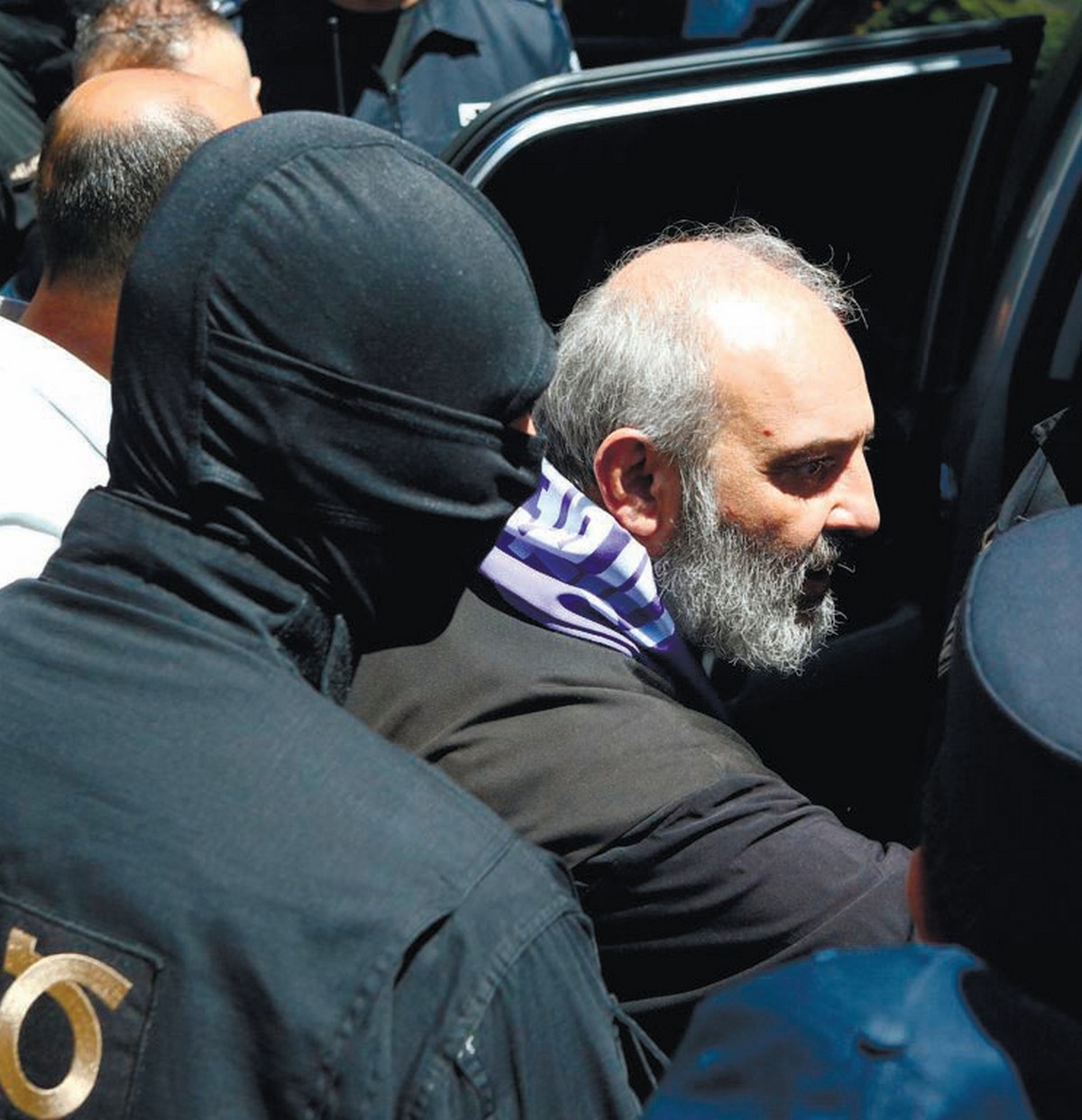
This, however, is only the external side of the process. In reality, several archbishops and even the head of the Etchmiadzin chancery have already been arrested in Armenia. At the same time, Pashinyan is creating an “alternative front” within the Church, holding meetings with archbishops willing to support plans to remove Garegin II.
It is tempting to assume that Pashinyan is thereby attempting to strike at a bastion of revanchists. Yet among those attending the meeting was Archbishop Vrtanes Abramyan, head of the so-called Artsakh Diocese of the Armenian Church. This diocese, as is well known, was created after the occupation of Azerbaijani territories and the launch of the so-called Miatsum project. After the liberation of Garabagh and the collapse of the occupation junta, Etchmiadzin did not dissolve this diocese. It is possible that, in assembling a front of supporters within the Church, the prime minister is not particularly selective about which archbishops he relies on. But such “carelessness” raises serious questions, especially given his intention to bring all major public institutions under control.
Even before the war, Pashinyan successfully subordinated Armenia’s Constitutional Court to the government. The next stage is the Church. And finally, it is clear that the decisive factor will be the success or failure of Civil Contract in the parliamentary elections.
From Etchmiadzin to Gyumri
Until recently, it seemed that Nikol Pashinyan had dealt a crushing blow to the positions of revanchists and, above all, to the clergy. In Vagharshapat, the residence of the Catholicos and the Etchmiadzin Monastery, local elections were held and ended with a victory for the prime minister’s supporters. Although the opposition hastened to claim that constituency boundaries had been altered just before the vote to include settlements where Pashinyan’s supporters held a majority, this did little to dampen the government camp’s satisfaction.
However, a complete victory in public opinion remains distant. This is confirmed by Pashinyan’s trip to Gyumri, the country’s second-largest city, where he was met by protests. Earlier, Pashinyan’s supporters had lost elections in Gyumri, and the post of mayor was won by opposition candidate Vardan Ghukasyan. Today, he and his deputy have been arrested, but this has changed little.
It is no secret that in Gyumri the mood of the electorate is shaped not so much by the Church as by the Russian military base stationed there. In any case, it is clear that the struggle for public opinion in Armenia is only intensifying, and it will be exceptionally fierce.
RECOMMEND:
 203
203

